codewhale
App New
Terminal UI for open-source and open-weight coding models
- Downloads
- 19,483
- Dependents
- Not applicable
- Stars
- 41,158
- Forks
- 3,565
- Contributors
- 218
- Commits
- 14,393
- Latest release
- 0.10.2 ·
About

An open-source coding agent for your terminal that works with any model.
Give Codewhale a task and it reads the repository, edits files, and runs
commands until the task is done or it needs input from you. It works with more
than 40 built-in providers, DeepSeek V4.1 Flash by default, and with models running on
your own machine. /receipts lists the files it changed, the commands it ran,
and the web and MCP calls it made.
Website · Documentation · Changelog · Contributing
简体中文 · 日本語 · Tiếng Việt · Bahasa Indonesia · 한국어 · Español · Português · Русский · Українська · Français · Deutsch · 繁體中文 · हिन्दी · Türkçe · Italiano · Polski · العربية · Català
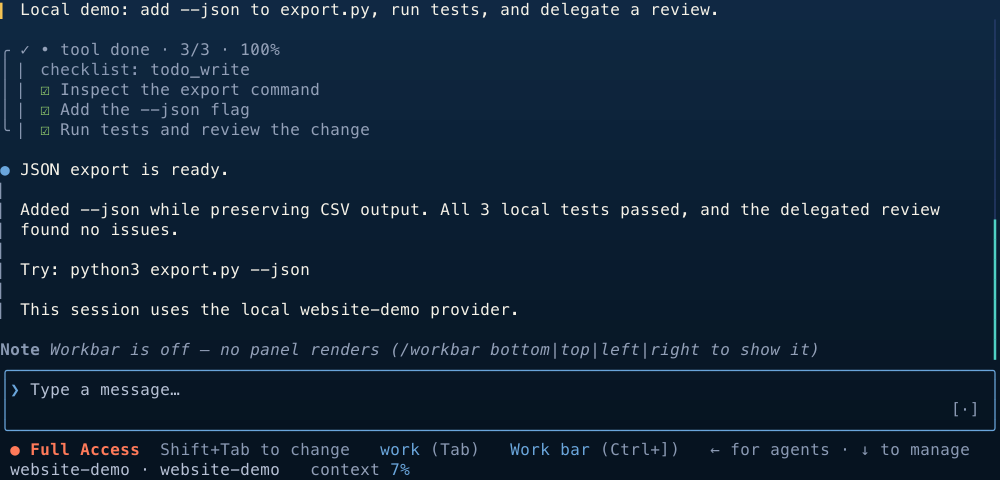
A 0.10.2 development build with a scripted test model, in Full Access inside a throwaway workspace. The edit, three tests and a sub-agent review ran for real.
View the Codewhale × OrcaRouter offer. Codewhale earns a referral fee from OrcaRouter.
Install
macOS and Linux:
curl -fsSL https://codewhale.net/install.sh | sh
Read the full README
The installer puts checksum-verified codewhale and its short alias codew
in ~/.local/bin. If your shell then says command not found, run the PATH
line the installer prints (details).
codewhale update upgrades it. These commands install the latest release.
This page follows main, so a feature marked with a version arrives in that
release; the changelog lists what each release adds.
Windows, npm, Cargo, and other ways to install
winget install HunterBown.CodeWhale  # Windows x64 (or Scoop, or the installer from GitHub Releases)
npm install -g codewhale            # wraps the same release binaries
cargo install codewhale-cli --locked  # crates.io; can trail GitHub Releases
Prebuilt binaries cover Linux, macOS, and Windows on x64 and arm64. Nix,
Homebrew on Linux, Android/Termux (preview), and manual downloads are in the
installation guide, and containers in
Docker. Stick to one install method per machine; otherwise
two copies end up on PATH and whichever comes first wins.
Quickstart
- Commit or stash your work, then run
codewhalefrom the root of a git repository. By default it asks before each file edit and command; pressShift+Tabonce for Accept Edits to let it edit files in the repository without asking. - Run
/provider(or pressF3), pick a provider, paste its API key, and choose a model. DeepSeek is the default provider. With no key, pick a local runtime instead. If no provider is configured and Ollama is already serving a chat model, Codewhale uses it automatically; from 0.10.2 it offers it when you send your first message. - Type a task:
Fix the failing tests and explain what changed.
Read-only commands run straight away. For any other shell command Codewhale
asks first: y runs it once, a allows commands like it for the rest of the
conversation, n refuses. /undo takes back your last request and its file
changes. /help lists commands and keys.
For scripts and CI, codewhale exec runs one task without the interface. By
default, --auto uses Full Access: tools run without asking, shell commands
have no Codewhale sandbox, and trust mode lets file tools write outside the
workspace. Add --sandbox workspace-write to keep the shell sandbox and
file-tool workspace restrictions, with trust mode off:
codewhale exec --auto --sandbox workspace-write "fix the failing tests and explain what changed"
Modes and permissions
A fresh install starts in Work mode with the Ask permission.
| Switch with | Options | |
|---|---|---|
| Mode | Tab (when the input is empty) or /mode | Plan reads and searches but changes nothing. Work edits files and runs commands; start a goal with /goal when a request needs more than one turn. |
| Permission | Shift+Tab | Ask asks before every file edit and every shell command that is not read-only. Accept Edits applies file edits in your git repository without asking and still asks before commands. Auto-Review lets rules and a reviewer model approve routine calls and refuses high-risk ones; switch to Ask to approve those yourself. Full Access never asks and turns off Codewhale's sandbox; repository rules and managed policy still apply. |
See the modes and permissions guide for the details.
What it does
New in 0.10.2
/pet onturns your terminal into an animated whale that shows what the agent is doing, while the message box stays live. Its 980 particles spell the current step in English, Chinese or Japanese./workbar terminalshows the shells the agent is running as they run. Type into one, or pressCtrl+Nfor a shell of your own (macOS and Linux)./undotakes back your whole last request in one step, including every file it changed, and/diffworks in folders without Git.- When a plan is ready, Codewhale asks whether to start Work with Ask or Auto-Review, or keep planning.
/colorgives each chat its own composer color, saved with the session.web_searchcan use DeepSeek's new Search API: set[search] provider = "deepseek"with a DeepSeek key.- Outside Full Access, a
curlorwgetthat would upload a credential never runs without your approval, and a command that hides invisible Unicode is refused.writeno longer replaces a file the agent has not read, or one that changed after it read it.
Models
More than 40 providers are built in, including Anthropic, OpenAI, DeepSeek,
Google, Mistral, Moonshot, OpenRouter, and xAI. Any OpenAI-compatible endpoint
works, and so do local models through Ollama, vLLM, or SGLang. The default is
DeepSeek's deepseek-flash, which DeepSeek moved to DeepSeek-V4.1-Flash-1017
on 2026-10-17; 0.10.1 runs it without an update
(details).
/model switches models between turns, and /model auto picks one for each
turn (/router sets up how). /turn inspect shows which model a turn used,
what it cost and how long it took. codewhale auth chatgpt lets you use a
ChatGPT plan instead of an API key (experimental). See
Providers.
Receipts and undo
/receipts, or codewhale receipts --last after you quit, lists the files
changed, commands run, web and MCP calls, agents started, approvals and who
gave them, and failures. /undo takes back your last request and the files it
changed, in one step and without trust mode. /restore
rolls the whole workspace back to an earlier snapshot; because that overwrites
later edits, it needs /trust on or Full Access. See Receipts.
Exec runs that offer tools are saved in every output format, so
codewhale receipts --last works after exec --auto, including --json.
Answer-only text and --json runs are saved only when resuming or when
conversation compaction starts; use --output-format stream-json to always
save them for receipts or exec --continue.
Longer work
/goal sets an objective that carries across turns. Codewhale can split work
across sub-agents, run a fleet of agents,
or follow a workflow checked into the
repository.
Coming from another agent
Codewhale reads AGENTS.md on its own. Instruction files written for other
tools, such as CLAUDE.md, .cursorrules, or
.github/copilot-instructions.md, load only when you opt in with
project_instruction_imports = ["claude"] (or "cursor", "cline",
"windsurf", "copilot", "all") in your config; see
config.example.toml. Codewhale warns when it finds one
it did not load.
/import-claude prepares an import of your Claude Code settings and MCP
servers for you to review. /plugin install accepts Claude Code plugins
containing skills, commands, agent profiles, and MCP servers, and refuses
plugins that need hooks or LSP servers
(details).
Extensions
Connect MCP servers, add skills and
plugins, and run hooks on session and tool
events. Code mode (experimental, on by default) lets the model write one
execute_tools program that calls several MCP and plugin tools; each call
still meets your approval rules and keeps its receipt. The independently installed Computer
Use plugin (experimental, macOS only) can observe
and operate other apps. It stays off until you review its access and enable it
(guide).
Ways to run it
| Command | What it does |
|---|---|
codewhale | The interactive terminal app |
codewhale exec "…" | One task without the interface. On its own it answers without using tools; --auto enables tools with Full Access by default, --sandbox workspace-write restricts them, and --output-format stream-json streams events as JSON |
codewhale web | A local web UI on 127.0.0.1 (guide) |
codewhale review --pr N | An advisory review of a GitHub pull request. The GitHub bot setup generates a pinned workflow for automatic reviews and @codewhale review, using your own model key and optional App identity |
codewhale app-server --http | The Runtime API, a local HTTP API for threads, events, approvals, and each turn's file changes |
codewhale serve --acp | The Agent Client Protocol over stdio, for editors such as Zed |
The terminal app, exec, web, and the Runtime API share one engine
(architecture). A community-maintained
VS Code extension
connects to it from the sidebar (source).
A native desktop app built on the Runtime API is in development; it has no
public download yet.
Cost and accounts
Codewhale is free and MIT licensed. With your own API key you pay the provider
directly; local models need no key. The footer and /cost show what a session
has cost when the price is known, and an unknown price is shown as unknown,
never as free.
You don't need an account. Keys you add with /provider stay on your machine.
Safety and privacy
In Ask and Auto-Review, commands run in an OS sandbox where the system has
one: Seatbelt on macOS, and bubblewrap on Linux when it is installed.
Windows has no OS sandbox yet, and Full Access turns the sandbox off. Inside
the sandbox, shell commands cannot read credential stores such as ~/.ssh,
~/.aws and .env files; from 0.10.2 the same rule covers terminal sessions
and more file tools. /preview-request shows a redacted preview of the next
request without sending it.
Telemetry is on by default. It sends aggregate counts (version and platform,
session length and outcome, which built-in providers you used, feature and
error counts) with a random install ID that rotates every 90 days, and never
conversations, code, prompts, model names, file or repository names, or
credentials. codewhale config set telemetry false turns
it off. At startup Codewhale also
checks GitHub for a new release; set CODEWHALE_NO_UPDATE_CHECK=1 to skip
that. More in authorization order,
sandboxing, and telemetry.
Documentation
| Start here | Reference |
|---|---|
| Installation | Configuration |
| Providers and local models | Architecture |
| Modes and permissions | Runtime API |
| Keybindings | Plugin authoring |
| GitHub PR review | All documentation |
Community
If a provider is missing or a workflow is awkward, open an issue or send a pull request. Contributors keep credit for the work that lands, and the repository layout shows where things live.
Chat on Discord, or add the maintainer,
Hunter, on WeChat (hunterbown) and ask to join the Whale Brothers group.
History and license
Codewhale started as deepseek-tui and still reads that project's
configuration and sessions. It is independently maintained and not affiliated
with DeepSeek or any other model provider. Thanks to
everyone who has contributed.
MIT. Code adapted from other open-source projects is listed in the third-party notices.
Compatibility
- Runs on
- GPU support unknown
What shows it
- no dependency or feature matches a backend row
- Native code
- Required
- Binds native code: aws-lc-rs, ring, liblzma-sys, libsqlite3-sys, rquickjs-sys and 1 more
- Python bindings
- No Python binding crate found
- License
- MIT
Compare with similar projects
Order: strongest tier first, then most downloads, then name, with unmeasured values last. A library counts downloads over 30 days. An app counts binary downloads per release. An app with none counts its crate downloads over 30 days. ML Rust runs this catalogue, so its closest project always gets a row.
| Project | Downloads | Dependents | Stars | Latest release | Runs on (GPU) | Native code | License |
|---|---|---|---|---|---|---|---|
|
Terminal UI for open-source and open-weight coding models |
19,483 binary downloads per release | Not applicable | 41,158 | 0.10.2 | GPU support unknown | Binds native code: aws-lc-rs, ring, liblzma-sys, libsqlite3-sys, rquickjs-sys and 1 more | MIT |
|
an open source, extensible AI agent that goes beyond code suggestions - install, execute, edit, and test with any LLM |
63,795 binary downloads per release | Not applicable | 56,377 | Not measured | Not measured | Apache-2.0 | |
|
adk-rust Listed
Rust Agent Development Kit - Build AI agents in Rust with modular components for models, tools, memory, and more. |
5,419 downloads over 30 days | 25 | 743 | 2.3.0 | CUDA, Metal | Binds native code: alsa-sys (feature desktop-audio), audiopus_sys (feature openai-webrtc), cxx (feature livekit), espeak-rs-sys (feature kokoro), libsqlite3-sys (feature sqlite) and 4 more | Apache-2.0 |
|
Open-Source Coding Agent in the terminal |
740 binary downloads per release | Not applicable | 853 | 0.1.4 | GPU support unknown | No native code found | MIT |
|
Open-source AI coding agent and agent runtime: one binary, any model, MCP-native. Runs in terminal, CI, or as a daemon — guardrails in scripts, not approval popups. |
110 binary downloads per release | Not applicable | 624 | 0.69.0 | GPU support unknown | Binds native code: zstd-sys | Apache-2.0 |
|
An open protocol that gives AI agents a secure, sandboxed place to run code and use tools — with lean context usage. AXP works alongside MCP |
Not measured | Not applicable | 3 | Not measured | Not measured | Not measured | Apache-2.0 |
|
Scale computer-use 2.0 with open-source drivers, cross-OS sandboxes, and benchmarks for training, evaluation, and data generation. |
528 binary downloads per release | Not applicable | 32,010 | 0.10.1 | GPU support unknown | Binds native code: ring | MIT |
Why NewIts first release on 23 May 2026 is under 180 days old.
The check tests the Featured gates once the first release passes this age limit.
What else the check found
- The last activity is on 9 Nov 2026, 0 days ago. The rules expect an update within 365 days. Dormancy rule
Exact rules: New. The check on applied thresholds version 9.
Every rule outcome, as the check records it
expected-interval: app: E = 365 daysdormancy: last activity 2026-11-09, 0 days ago, E = 365: activenew: new: first release 2026-05-23 is under 180 days old
Crates29 crates
- codewhale-tui Primary
- codewhale-agent
- codewhale-app-server
- codewhale-build-support
- codewhale-cli
- codewhale-cloud-facts
- codewhale-command-contract
- codewhale-commands
- codewhale-config
- codewhale-core
- codewhale-execpolicy
- codewhale-hooks
- codewhale-lane
- codewhale-localization
- codewhale-mcp
- codewhale-memory
- codewhale-models
- codewhale-palette
- codewhale-paths
- codewhale-protocol
- codewhale-release
- codewhale-runtime
- codewhale-sanitize
- codewhale-secrets
- codewhale-state
- codewhale-telemetry
- codewhale-tools
- codewhale-workflow
- codewhale-workflow-js
Measurements and sources
Each signal row shows the raw value, its source and the fetch date. The Sources list gathers every distinct source on this page. Movement needs more history.
Sources6 sources
- Description: the crates.io description
- crates.io database dump, fetched
- GitHub releases, fetched
- GitHub repository, fetched
- crates.io package, fetched
- GitHub contributors, fetched
Adoption19,483 binary downloads per release4 not measured
| Signal | Value | Source | Fetched | Counts |
|---|---|---|---|---|
| Active dependents | Not measured | Yes | ||
| New dependents (365 days) | Not measured | Yes | ||
| Peak active dependents | Not measured | Yes | ||
| Active dependents as a share of the peak | Not measured | Yes | ||
| Binary downloads per release | 19483 | GitHub releases | Yes |
MaintenanceLatest human commit: on the check date4 not measured
| Signal | Value | Source | Fetched | Counts |
|---|---|---|---|---|
| Latest human commit | 2026-11-09 | GitHub repository | Yes | |
| Latest release | 2026-10-24 | GitHub releases | Yes | |
| First release | 2026-05-23 | crates.io database dump | Yes | |
| Latest version | 0.10.2 | crates.io database dump | No | |
| Days the oldest outside issue waits for a reply | 9 | GitHub repository | Yes | |
| Maintainer replies over 365 days | 86 | GitHub repository | Yes | |
| Repository archived | false | GitHub repository | Yes | |
| Repository gone | false | GitHub repository | Yes | |
| Release commit or manifest in the repo | true | crates.io package | No | |
| Published docs | Not measured | Yes | ||
| Latest release fails cargo check | Not measured | Yes | ||
| Build check date | Not measured | Yes | ||
| Build check toolchain | Not measured | Yes |
SecurityNot measured
| Signal | Value | Source | Fetched | Counts |
|---|---|---|---|---|
| Unpatched vulnerabilities past the grace window | Not measured | Yes | ||
| RustSec unmaintained advisory | Not measured | Yes | ||
| Deprecation notice | Not measured | Yes | ||
| Deprecated requirement | Not measured | Yes |
Distribution41 releases, 306 downloads over 30 days6 not measured
| Signal | Value | Source | Fetched | Counts |
|---|---|---|---|---|
| Releases | 41 | crates.io database dump | No | |
| Downloads over 30 days | 306 | crates.io database dump | No | |
| Binary downloads over the last 3 releases | 58450 | GitHub releases | Yes | |
| Homebrew installs on request over 365 days | Not measured | Yes | ||
| Repology repository families | Not measured | Yes | ||
| Docker pull growth over 90 days | Not measured | Yes | ||
| Docker pulls at the growth baseline | Not measured | Yes | ||
| Every version a prerelease | false | crates.io database dump | Yes | |
| Every version 0.0.x | false | crates.io database dump | Yes | |
| Every version yanked | Not measured | Yes | ||
| Crate deleted from crates.io | Not measured | Yes |
Repository41,158 stars, 3,565 forks, 218 contributors, 14,393 commits. Stars alone never qualify a project.
| Signal | Value | Source | Fetched | Counts |
|---|---|---|---|---|
| GitHub stars | 41158 | GitHub repository | Yes — one part of the repository route | |
| GitHub forks | 3565 | GitHub repository | Yes — one part of the repository route | |
| Contributors with a GitHub account | 218 | GitHub contributors | Yes — one part of the repository route | |
| Commits on the default branch | 14393 | GitHub repository | No | |
| Repository's main crate left out of the entry | none | crates.io database dump | Yes |
Facts that never count
| Signal | Value | Source | Fetched | Counts |
|---|---|---|---|---|
| License | MIT | crates.io database dump | No | |
| Runs on, from listed crates and their direct dependencies | GPU support unknown | crates.io database dump | No | |
| What shows each backend | no dependency or feature matches a backend row | crates.io database dump | No | |
| Native code, from listed crates and their dependencies | Binds native code: aws-lc-rs, ring, liblzma-sys, libsqlite3-sys, rquickjs-sys and 1 more | crates.io database dump | No | |
| Python bindings, from direct dependencies of listed crates | No Python binding crate found | crates.io database dump | No | |
| Crates that depend on a listed crate directly | Not measured | No |
Corrections and review history
No correction applies to this entry.
Judgments
A judgment enters only through an approved issue and a merged pull request.
No judgment applies to this entry.