octomind
App Listed
Open-source AI coding agent and agent runtime: one binary, any model, MCP-native. Runs in terminal, CI, or as a daemon — guardrails in scripts, not approval popups.
- Downloads
- 110
- Dependents
- Not applicable
- Stars
- 624
- Forks
- 77
- Contributors
- 25
- Commits
- 2,806
- Latest release
- 0.69.0 ·
About
Open-source coding agent harness. One Rust binary, any model, every surface.
Interactive, stdin, daemon, WebSocket, or ACP — one binary, one config.
A supervising model plans and checks the work.
Policy lives in TOML guardrails, not approval prompts.
Website · Docs · Tap Registry · Benchmarks · Issues
Octomind is an open-source coding agent harness. It gives any LLM the tools to work in a repository — read and edit files, run shells, search code, delegate to sub-agents — through MCP, and runs the result as an interactive CLI, a stdin pipe, a daemon, a WebSocket server, or an ACP agent in your editor. Most agents stop and ask a human before each risky step, which works at a keyboard and blocks everything in CI. Octomind writes that policy down as TOML guardrails and adds a supervising model that plans and checks the work, so the same session can run with nobody watching. On 25 tasks taken from merged pull requests it solved 24; OpenCode solved 19 with the same model at about twice the cost (benchmarks).
How It Works
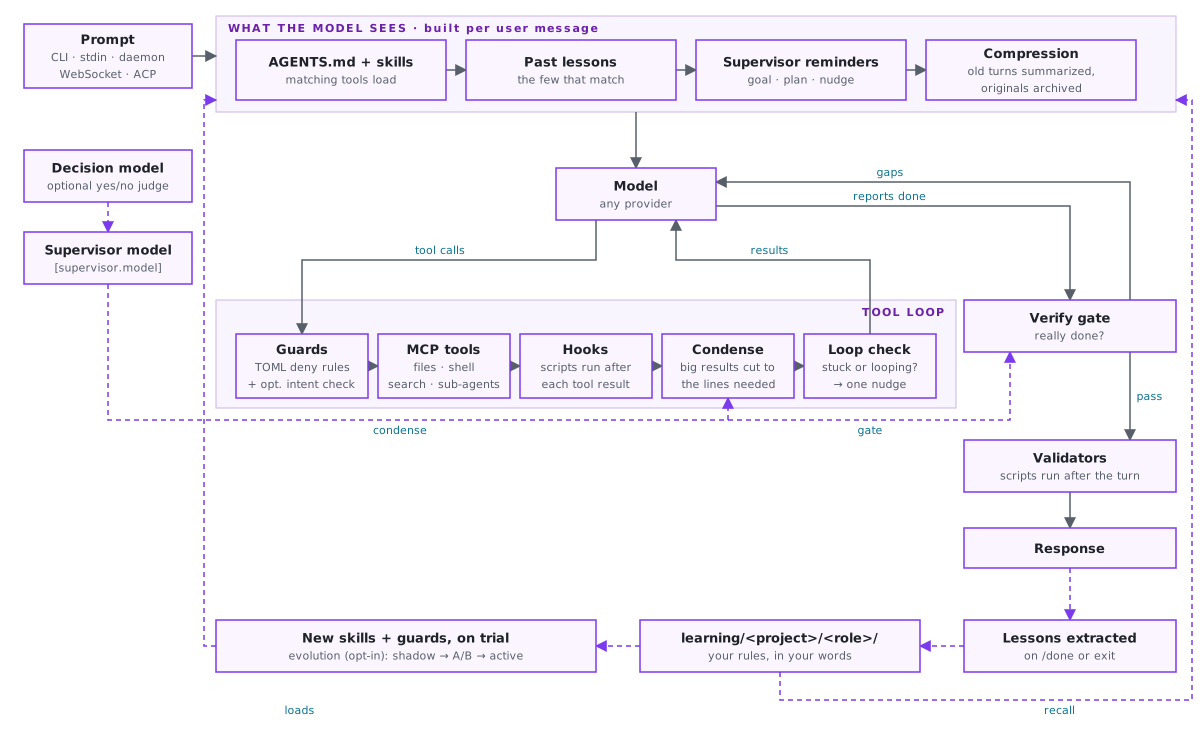
One diagram, the whole turn: what is assembled before the model sees the request, the tool loop, how a turn is allowed to end, and what carries over to the next session.
Read the full README
- What the model sees is built once per user message, not per tool round:
AGENTS.md, the skills whose rules match the prompt (standardSKILL.mdfolders), the tool bundles those skills need (they start their own MCP servers on demand), and the few past lessons that match. Skills · Learning - Compression folds older turns into a summary that cites content-addressed blocks; the raw messages stay in a per-session archive and the
recalltool brings any block back verbatim as a normal tool result, so history is never rewritten and the prompt cache survives. Compression - Guards, hooks, validators are deterministic and live in
.agents/guardrails.tomlplus scripts; they run before any model opinion. The optional intent check ([supervisor.authorizer], off by default) adds one supervisor-model look after the guards and blocks a call only when it independently conflicts with what you asked for. Guardrails - The supervisor is a second model (
[supervisor.model]): it keeps the plan and reminds the model of the goal each turn, cuts oversized tool results down to the lines the task needs (copied, never retyped), and refuses a self-reported "done" until the evidence checks out. The loop check is a fixed heuristic: when the model repeats itself or stalls it gets one nudge, never a takeover. Supervisor - The decision model (
[decision]) is optional: a classifier that answers typed yes/no questions with a probability instead of prose. When set, the supervisor sends its cheap questions there — which lessons to recall, which skill to activate, which lines to keep, whether a completion claim holds — and keeps chat calls for writing. Calibrated decisions - Learning extracts lessons after
/doneor at exit, in your own words, into files underlearning/<project>/<role>/; later sessions recall the ones that match. With[supervisor.learning.evolution]enabled, recurring lessons become skill and guardrail candidates that run in shadow first, then an A/B trial against a control arm, and go active only when they beat it. Learning
Why Octomind?
Built for the work that keeps going after you leave:
- Policy as code, not approval popups. Deterministic guardrails — pre-call guards, post-result hooks, post-turn validators — live in TOML and scripts, so they work in CI, daemons, and scheduled runs.
- Measured, not claimed. All four agents ran stock on the same tasks with the same judge. Per-case table, artifacts, and a reproduction guide are in the benchmarks.
- Ready-made specialists.
octomind run developer:generalpulls a packaged agent (prompt, model, MCP servers, tool permissions) from a tap. Publish your own with one repo. - Sessions that stay sharp. Adaptive compression keeps long tasks moving without forgetting the task or your last few messages.
- Learns the project as you work. Corrections and rules you state become lessons, quoted from your own words and scoped to the project and role, and come back in later sessions. Turn on evolution and recurring lessons compile into skill and guardrail candidates, trialled against a control and kept only when they help.
- Any model, any budget. Use Octomind Cloud or your own key (OpenRouter, Anthropic, OpenAI, DeepSeek, Ollama, and more), pick a model per role, and cap spend per request and per session. Over budget, a terminal session asks y/N; a non-interactive run stops with exit code 75.
- One config. Models, tools, roles, guardrails, budgets: all TOML, no framework code.
# Interactive
octomind run developer:general

# Non-interactive — CI, scripts, automation
echo "Explain the auth module" | octomind run developer:general --format plain

# Daemon — keep it alive, talk to it from another terminal
echo "watch the build" | octomind run --name watcher --daemon --format jsonl
octomind send --name watcher "run the test suite"
Quick Start
1. Install (macOS, Linux):
curl -fsSL https://raw.githubusercontent.com/muvon/octomind/master/install.sh | bash
On Windows, in PowerShell:
irm https://raw.githubusercontent.com/muvon/octomind/master/install.ps1 | iex
On macOS, you can also install with Homebrew:
brew install muvon/tap/octomind
2. Choose where models come from. Start octomind once in a terminal:
octomind
Before it writes a config, the first interactive run asks where to get models:
- Octomind hub (recommended): one browser sign-in,
autopicks a model for each job, paid with credits you buy. - Your own provider: OpenRouter, OpenAI, Anthropic, DeepSeek, Ollama, and every other provider octomind supports. Octomind asks for the key with hidden input, saves it to its own
.env(readable only by you), and lists the provider's models to pick from. One model can serve the main agent, the supervisor, and compression, or you can pick each. - Skip: keep the shipped defaults (
octohub:auto).
Run octomind configure to change this later. Scripts, piped input, and --format runs never see the screen; they use the default config.
3. Run a specialist in your project:
cd ~/your/project
octomind run developer:general
You're now in a session with an agent that can read your code, run commands, and edit files. The interface is a plain line prompt with markdown rendering — no TUI to learn, so it works over SSH, in tmux, and in CI logs. The first time you run a specialist, it may install its tools and ask for credentials.
developer:generalcomes from the default tapmuvon/tap, not your local config. Plainoctomind runstarts the config's default role,assistant:concierge.
Try the recorded bug-fix demo: two failing tests, an agent fix, and an independent test rerun.
Benchmarks
Measured on octobench against 25 tasks harvested from merged pull requests across Python, PHP, Rust, C++, and JavaScript. Each agent works in the pre-fix repo; held-out tests from the merged fix decide pass or fail. These are the published July 30, 2026 results, not a measurement of this checkout.
| solved | judge Σ / 2500 | cost | wall time | |
|---|---|---|---|---|
| octomind + glm-5.2 | 24/25 | 2264 | $63.43 | 3.6h |
| claude code + claude-opus-5 | 23/25 | 2262 | $81.79 | 6.7h |
| codex + gpt-5.6-sol | 21/25 | 2127 | $14.86 | 1.0h |
| opencode + glm-5.2 | 19/25 | 2093 | $129.54 | 3.3h |
- The harness matters. opencode used the same model and endpoint; octomind solved 24 vs 19 at roughly half the cost. All four agents ran stock invocations with no tuning, so this measures the whole harness, not individual features.
- Worst-case pricing, still ahead. glm-5.2 ran without prompt caching while Opus billed ~97% of context re-reads at cache rates — and octomind still led on solves, cost, and wall time.
- Reproducible. Per-case table, artifacts, and reproduction guide: BENCHMARK.md. Background: blog post.
Guardrails: Policy as Code
Drop a .agents/guardrails.toml in your repo. Octomind enforces it deterministically, with no code to compile and no plugin to install.
# Pre-call deny — block a class of calls before they execute
[[guard]]
match   = "shell(command=^rm\\s+-rf?)"
message = "rm -rf blocked."

# Conditional rule — only fires after the agent ran git status this session
[[guard]]
match   = "shell(command=git push)"
when    = ["+shell(command=git status)"]
message = "Review changes before pushing."
| Layer | When it runs | What it does |
|---|---|---|
| Guards | Before a tool call | Deny by capability, argument regex, and session history. A match returns a denial instead of executing the call. |
| Hooks | After a tool result | A non-zero exit injects stdout into the agent's inbox — lint and format failures become automatic corrections without restarting the turn. |
| Validators | After a turn | Scripts the agent reads on its next turn. This replaces "approve this change?" prompts in autonomous loops. |
If you know Claude Code hooks: guards are PreToolUse denies declared in TOML, hooks are PostToolUse, validators are Stop — no scripts required for the common cases.
Hook and validator script examples: Guardrails guide.
One Harness, Five Surfaces
The same harness, exposed wherever your workflow needs it.
| Surface | Use it for | Docs |
|---|---|---|
| Interactive CLI | Daily work, any domain | Sessions |
Non-interactive (--format plain / jsonl) | CI, scripts, scheduled jobs | CLI reference |
Daemon + send | Background agents, continuous monitoring | Daemon & hooks |
WebSocket (octomind server) | IDE plugins, dashboards, integrations | WebSocket server |
ACP (octomind acp) | Agent inside Zed, JetBrains, VS Code, Neovim, or any ACP editor | ACP protocol |
Need machine-readable results? Pass --schema schema.json to constrain the final response to a JSON Schema (requires a model with structured-output support). See Structured output.
Features
| Feature | What you get | Learn more |
|---|---|---|
| Specialists & taps | Packaged agents with model, prompt, MCP servers, and permissions; installs their tool dependencies on first use | Tap system |
| Roles | Per-role model, temperature, system prompt, tools | Roles |
| Workflows | Multi-step pipelines, each step with its own model and toolset | Workflows |
| MCP client | stdio and Streamable HTTP servers, with OAuth; enable/disable servers mid-session | MCP tools |
| Agent Skills | Standard SKILL.md skills from .agents/skills/, ~/.config/agents/skills/, and taps; they activate on demand, so your context stays small | Skills |
| Local project tools | Executable scripts in .agents/tools/ auto-register as tools | Local tools |
Plugins & AGENTS.md | Agent Plugins (plugin.json + skills + mcp.json) from taps, .agents/plugins/, or ~/.config/agents/plugins/; project AGENTS.md loads at session start | Configuration |
| Supervisor & learning | A second model plans, checks completion, and condenses tool output; lessons persist as files per project and role | Supervisor, Learning |
| Sandbox | --sandbox locks writes to the working directory via Landlock (Linux) or Seatbelt (macOS), inherited by every shell, MCP server, and sub-agent | Config reference |
| Token efficiency | Cache-aware cost accounting and adaptive compression | Token efficiency |
Specialists
octomind run developer:general    # general dev, language skills auto-activate
octomind run doctor:blood         # blood-test interpretation specialist
octomind run lawyer:sg            # legal specialist
Running a specialist fetches its manifest from the tap registry, installs any required binaries, resolves credentials, starts the right MCP servers, and then opens the session.
Build and register your own:
octomind tap init yourteam/my-tap   # scaffold, validate, git-init, and register locally
octomind tap yourteam/my-tap        # on another machine, after publishing to GitHub
The octomind- prefix is added automatically: yourteam/my-tap maps to the repository
yourteam/octomind-my-tap.
Installation
| Method | Command |
|---|---|
| Install script (recommended) | curl -fsSL https://raw.githubusercontent.com/muvon/octomind/master/install.sh | bash |
| Install script (Windows PowerShell) | irm https://raw.githubusercontent.com/muvon/octomind/master/install.ps1 | iex |
| Homebrew (macOS) | brew install muvon/tap/octomind |
| Scoop (Windows) | scoop bucket add muvon https://github.com/Muvon/scoop-bucket then scoop install muvon/octomind |
| Cargo (Rust 1.95+) | cargo install octomind |
| Docker | docker run --rm ghcr.io/muvon/octomind --help |
| From source | git clone https://github.com/muvon/octomind.git && cd octomind && cargo build --release |
The install script detects your OS and architecture (Linux and macOS on x86_64/aarch64) and installs to ~/.local/bin/. Pass --install-dir <DIR> or set OCTOMIND_INSTALL_DIR to override. On Windows (x86_64/aarch64), install.ps1 installs to %LOCALAPPDATA%\octomind\bin and adds it to your user PATH; it honors OCTOMIND_INSTALL_DIR and OCTOMIND_VERSION too. install.sh still works from Git Bash or MSYS2.
Command not found? Add the install directory to your PATH:
export PATH="$HOME/.local/bin:$PATH"
Building from source requires protoc; see Building from source for per-OS prerequisites.
Verify:
octomind --version
octomind config      # generate the default config
octomind run         # start your first session
Shell completions: octomind completion <bash|zsh|fish|elvish|powershell>.
Model access
Run octomind configure any time to switch between the hub and your own provider. It changes only the three model names (main, supervisor, compression) and keeps the rest of your config and its comments.
Octomind Cloud — choose the hub in octomind configure, or run octomind login (device-code sign-in, like gh auth login). Either stores a gateway key locally. The default config already uses octohub:auto. Learn more.
Bring your own key — choose your provider in octomind configure. To set it up by hand instead, set the provider's environment variable (OPENROUTER_API_KEY, OPENAI_API_KEY, ANTHROPIC_API_KEY, DEEPSEEK_API_KEY, …) and point the model tables at it. The supervisor and compression profiles also default to octohub:auto, so update all three:
[model]
name = "anthropic:claude-sonnet-5-5"

[supervisor.model]
name = "anthropic:claude-haiku-5-5"

[compression.model]
name = "anthropic:claude-haiku-5-5"
Provider details and per-role overrides: Providers & models.
Configuration
Config lives at ~/.local/share/octomind/config/config.toml on macOS and Linux, and under %LOCALAPPDATA%/octomind/config/ on Windows. Set OCTOMIND_DATA_DIR to override the data root.
octomind config --show       # view current config
octomind config --validate   # validate config
Override any value for a single run with -c:
octomind run -c supervisor.enabled=false
Full reference: Configuration reference · Environment variables.
Session commands
| Command | Description |
|---|---|
/help | Show all commands |
/info | Token usage and costs |
/model anthropic:claude-sonnet-5-5 | Switch model mid-session |
/role developer:general | Switch to a configured role or tap tag |
/new Review auth | Start a fresh session (title optional) |
/done | Force context compression and start background learning extraction when enabled |
/exit | Exit the session |
Full list: Session commands.
Telemetry
Octomind reports anonymous usage: which commands, tools, and models are used, plus timings, token counts, and error kinds. It never sends your code, prompts, file paths, tool arguments, or environment values. Opt out in any of three ways:
export DO_NOT_TRACK=1          # the cross-tool standard, honored first
export OCTOMIND_TELEMETRY=0    # for subsequent commands in this shell
# or set `telemetry = false` in config.toml
Exact field list: Telemetry.
Documentation
Full index: doc/README.md · Hosted: octomind.run/docs.
Contributing
The most impactful contribution isn't code — it's specialist agents. A cardiologist publishing doctor:medications. A tax attorney publishing lawyer:us. A security researcher publishing security:owasp. One TOML file, and everyone with that problem gets an agent that knows the domain.
Code contributions are welcome too. Set up the hooks and run the gate before you push:
pip install pre-commit && pre-commit install
make dev    # fmt + clippy + test
Commits follow Conventional Commits. Full guide, architecture overview, and code conventions: CONTRIBUTING.md · internals: Architecture.
Community participation follows our Code of Conduct. Report vulnerabilities privately using the security policy.
License
Apache License 2.0 — see LICENSE.
Octomind by Muvon · Website · Documentation
Compatibility
- Runs on
- GPU support unknown
What shows it
- no dependency or feature matches a backend row
- Native code
- Required
- Binds native code: zstd-sys
- Python bindings
- No Python binding crate found
- License
- Apache-2.0
Compare with similar projects
Order: strongest tier first, then most downloads, then name, with unmeasured values last. A library counts downloads over 30 days. An app counts binary downloads per release. An app with none counts its crate downloads over 30 days. ML Rust runs this catalogue, so its closest project always gets a row.
| Project | Downloads | Dependents | Stars | Latest release | Runs on (GPU) | Native code | License |
|---|---|---|---|---|---|---|---|
|
Open-source AI coding agent and agent runtime: one binary, any model, MCP-native. Runs in terminal, CI, or as a daemon — guardrails in scripts, not approval popups. |
110 binary downloads per release | Not applicable | 624 | 0.69.0 | GPU support unknown | Binds native code: zstd-sys | Apache-2.0 |
|
an open source, extensible AI agent that goes beyond code suggestions - install, execute, edit, and test with any LLM |
63,795 binary downloads per release | Not applicable | 56,377 | Not measured | Not measured | Apache-2.0 | |
|
Open-Source Coding Agent in the terminal |
740 binary downloads per release | Not applicable | 853 | 0.1.4 | GPU support unknown | No native code found | MIT |
|
Rust-native, library-first coding-agent runtime and terminal CLI inspired by Pi, with composable LLM providers, tools, sessions, and plugin ABI |
16 binary downloads per release | Not applicable | 231 | Not measured | Not measured | MIT | |
|
shodh-memory Listed
Persistent cognitive memory for AI agents and robots — Hebbian learning, knowledge graph, spatial recall. Zenoh/ROS2 native. Single binary, runs offline. Python bindings |
1 downloads over 30 days | 0 | 322 | 0.2.0 | GPU support unknown | Binds native code: libmimalloc-sys, librocksdb-sys, lz4-sys, ort-sys, pnet_sys (feature zenoh) | Apache-2.0 |
|
An open protocol that gives AI agents a secure, sandboxed place to run code and use tools — with lean context usage. AXP works alongside MCP |
Not measured | Not applicable | 3 | Not measured | Not measured | Not measured | Apache-2.0 |
|
Terminal UI for open-source and open-weight coding models |
19,483 binary downloads per release | Not applicable | 41,158 | 0.10.2 | GPU support unknown | Binds native code: aws-lc-rs, ring, liblzma-sys, libsqlite3-sys, rquickjs-sys and 1 more | MIT |
Why ListedNo archive, New or Featured rule places it, so it is Listed.
What it lacks for Featured
- The check holds no value for Homebrew installs on request over 365 days, Repology repository families, Docker pull growth over 90 days. A gate that lacks its signal does not pass.
What else the check found
- The last activity is on 8 Nov 2026, 1 day ago. The rules expect an update within 365 days. Dormancy rule
Not measured: Homebrew installs on request over 365 days, Repology repository families, Docker pull growth over 90 days.
Exact rules: Listed, Featured app. The check on applied thresholds version 9.
Every rule outcome, as the check records it
expected-interval: app: E = 365 daysdormancy: last activity 2026-11-08, 1 days ago, E = 365: activefeatured: not featured: unknown homebrew_on_request_365d, repology_families, docker_pull_growth_90dlisted: listed: no archive, new or featured rule applies
Measurements and sources
Each signal row shows the raw value, its source and the fetch date. The Sources list gathers every distinct source on this page. Movement needs more history.
Sources6 sources
- Description: the crates.io description
- crates.io database dump, fetched
- GitHub releases, fetched
- GitHub repository, fetched
- crates.io package, fetched
- GitHub contributors, fetched
Adoption110 binary downloads per release4 not measured
| Signal | Value | Source | Fetched | Counts |
|---|---|---|---|---|
| Active dependents | Not measured | Yes | ||
| New dependents (365 days) | Not measured | Yes | ||
| Peak active dependents | Not measured | Yes | ||
| Active dependents as a share of the peak | Not measured | Yes | ||
| Binary downloads per release | 110 | GitHub releases | Yes |
MaintenanceLatest human commit: 1 day ago4 not measured
| Signal | Value | Source | Fetched | Counts |
|---|---|---|---|---|
| Latest human commit | 2026-11-08 | GitHub repository | Yes | |
| Latest release | 2026-11-08 | GitHub releases | Yes | |
| First release | 2025-06-26 | crates.io database dump | Yes | |
| Latest version | 0.69.0 | crates.io database dump | No | |
| Days the oldest outside issue waits for a reply | 16 | GitHub repository | Yes | |
| Maintainer replies over 365 days | 33 | GitHub repository | Yes | |
| Repository archived | false | GitHub repository | Yes | |
| Repository gone | false | GitHub repository | Yes | |
| Release commit or manifest in the repo | true | crates.io package | No | |
| Published docs | Not measured | Yes | ||
| Latest release fails cargo check | Not measured | Yes | ||
| Build check date | Not measured | Yes | ||
| Build check toolchain | Not measured | Yes |
SecurityNot measured
| Signal | Value | Source | Fetched | Counts |
|---|---|---|---|---|
| Unpatched vulnerabilities past the grace window | Not measured | Yes | ||
| RustSec unmaintained advisory | Not measured | Yes | ||
| Deprecation notice | Not measured | Yes | ||
| Deprecated requirement | Not measured | Yes |
Distribution120 releases, 487 downloads over 30 days6 not measured
| Signal | Value | Source | Fetched | Counts |
|---|---|---|---|---|
| Releases | 120 | crates.io database dump | No | |
| Downloads over 30 days | 487 | crates.io database dump | No | |
| Binary downloads over the last 3 releases | 332 | GitHub releases | Yes | |
| Homebrew installs on request over 365 days | Not measured | Yes | ||
| Repology repository families | Not measured | Yes | ||
| Docker pull growth over 90 days | Not measured | Yes | ||
| Docker pulls at the growth baseline | Not measured | Yes | ||
| Every version a prerelease | false | crates.io database dump | Yes | |
| Every version 0.0.x | false | crates.io database dump | Yes | |
| Every version yanked | Not measured | Yes | ||
| Crate deleted from crates.io | Not measured | Yes |
Repository624 stars, 77 forks, 25 contributors, 2,806 commits. Stars alone never qualify a project.
| Signal | Value | Source | Fetched | Counts |
|---|---|---|---|---|
| GitHub stars | 624 | GitHub repository | Yes — one part of the repository route | |
| GitHub forks | 77 | GitHub repository | Yes — one part of the repository route | |
| Contributors with a GitHub account | 25 | GitHub contributors | Yes — one part of the repository route | |
| Commits on the default branch | 2806 | GitHub repository | No | |
| Repository's main crate left out of the entry | none | crates.io database dump | Yes |
Facts that never count
| Signal | Value | Source | Fetched | Counts |
|---|---|---|---|---|
| License | Apache-2.0 | crates.io database dump | No | |
| Runs on, from listed crates and their direct dependencies | GPU support unknown | crates.io database dump | No | |
| What shows each backend | no dependency or feature matches a backend row | crates.io database dump | No | |
| Native code, from listed crates and their dependencies | Binds native code: zstd-sys | crates.io database dump | No | |
| Python bindings, from direct dependencies of listed crates | No Python binding crate found | crates.io database dump | No | |
| Crates that depend on a listed crate directly | Not measured | No |
Corrections and review history
No correction applies to this entry.
Judgments
A judgment enters only through an approved issue and a merged pull request.
No judgment applies to this entry.