opendev
App Listed
Open-Source Coding Agent in the terminal
- Downloads
- 740
- Dependents
- Not applicable
- Stars
- 853
- Forks
- 89
- Contributors
- 6
- Commits
- 865
- Latest release
- 0.1.4 ·
About

Open-source AI coding agent that spawns parallel agents, each bound to the LLM of your choice.
Website and documentation coming soon!

Introduction
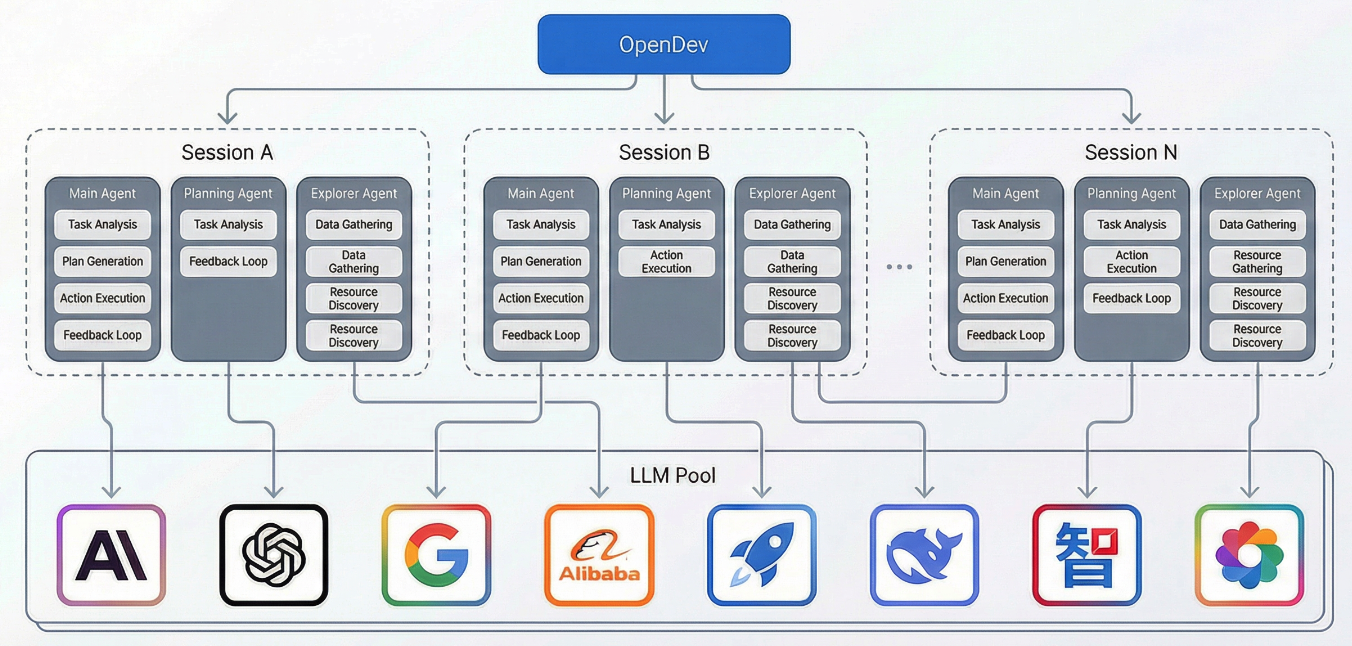
OpenDev is an open-source, terminal-native coding agent built as a compound AI system. Instead of a single monolithic LLM, it uses a structured ensemble of agents and workflows -- each independently bound to a user-configured model.
Work is organized into concurrent sessions composed of specialized sub-agents. Each agent executes typed workflows (Execution, Thinking, Compaction) that independently bind to an LLM, enabling fine-grained cost, latency, and capability trade-offs per workflow.
OpenDev automatically routes each phase of work to the right model. Five workflow slots — Normal (execution), Thinking (reasoning), Compact (context summarization), Self-Critique (output verification), and VLM (vision) — each bind independently to any LLM you configure. For example, Claude Opus handles execution, GPT-o3 handles reasoning, and a lightweight Qwen model handles compaction — all routed automatically. Together, these form a compound AI system where multiple models collaborate, each optimized for its role.
Read the full README
OpenDev is written in Rust — it starts in 4.3 ms, uses just 9.4 MB of memory, and ships as a single 18 MB binary. That makes it the fastest and lightest coding agent available today — up to 128x faster startup and 30x less memory than alternatives.
| Agent | Startup (mean ± σ) | Peak Memory (median) | Install Size |
|---|---|---|---|
| OpenDev 0.1.4 | 4.3 ms ± 0.4 ms | 9.4 MB | 18 MB |
| Codex 0.116.0 | 37.8 ms ± 0.8 ms (9x) | 43.7 MB (4.6x) | 116 MB |
| Claude Code 2.1.87 | 87.3 ms ± 2.0 ms (20x) | 214.6 MB (22.8x) | 188 MB |
| OpenCode 1.2.27 | 557.4 ms ± 31.8 ms (128x) | 285.9 MB (30.4x) | 90 MB |
macOS ARM64 (Apple Silicon) · Startup: hyperfine --shell=none --warmup 10 --runs 100 · Memory: /usr/bin/time -l median of 20 runs · Multipliers relative to OpenDev
Why OpenDev?
- Blazing fast, ultra lightweight. 4.3 ms startup, 9.4 MB RAM, 18 MB on disk. Written in Rust with zero interpreter overhead — it launches before other agents finish loading their runtime.
- Proactive, not reactive. OpenDev can plan, execute, and iterate autonomously. Kick off a refactoring, walk away, and come back to a PR ready for review.
- Multi-provider, multi-model. Assign different models from different providers to every workflow and session, all running in parallel. Your models, your rules.
- TUI + Web UI. A full terminal UI for power users and a Web UI for visual monitoring. The Web UI supports remote sessions, so you can start a task from your phone and let OpenDev work while you sleep.
⚡ Agent Fleet — Parallel Execution at Scale
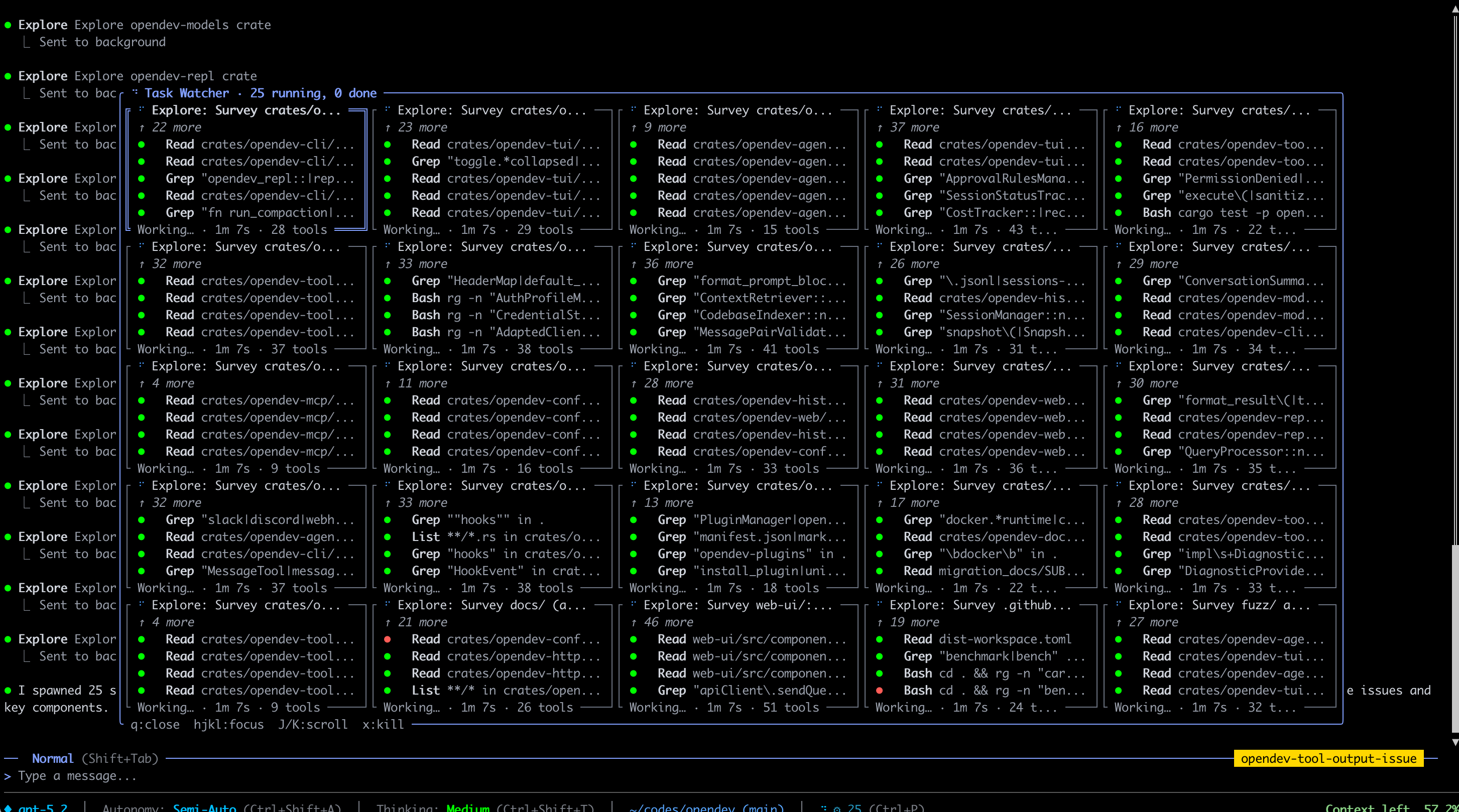
A fleet of agents, each independently exploring a different crate — all running concurrently in a single session.
Need to survey an entire codebase? Refactor across 20 crates? Run a dozen tool calls at once? Spawn a fleet.
OpenDev's agent fleet launches multiple sub-agents in parallel, each with its own LLM binding, context window, and tool access. Because the runtime is written in Rust with fully async I/O, there is zero interpreter overhead — agents fan out across your workspace and converge results back in seconds, not minutes.
You                          OpenDev Fleet
 │                           ┌─ Agent 1 → crate/agents
 │   "survey all crates"     ├─ Agent 2 → crate/http
 │ ─────────────────────►    ├─ Agent 3 → crate/tui
 │                           ├─ Agent 4 → crate/tools
 │                           ├─  ...
 │   ◄── aggregated results  └─ Agent N → crate/config
- Concurrent, not sequential. Every agent runs its own async task — no GIL, no queue, no waiting.
- Rust-native performance. Near-zero overhead per agent. Memory-safe parallelism via Tokio.
- Independent LLM bindings. Each agent in the fleet can target a different model or provider.
Installation
From crates.io (all platforms)
cargo install opendev-cli
macOS
# Homebrew (recommended)
brew install opendev-to/tap/opendev

# Shell installer
curl --proto '=https' --tlsv1.2 -LsSf https://github.com/opendev-to/opendev/releases/latest/download/opendev-cli-installer.sh | sh

# Or download the binary directly from GitHub Releases:
#   opendev-cli-aarch64-apple-darwin.tar.xz  (Apple Silicon)
#   opendev-cli-x86_64-apple-darwin.tar.xz   (Intel)
Linux
# Shell installer (x86_64 and ARM64)
curl --proto '=https' --tlsv1.2 -LsSf https://github.com/opendev-to/opendev/releases/latest/download/opendev-cli-installer.sh | sh

# Or download the binary directly from GitHub Releases:
#   opendev-cli-x86_64-unknown-linux-gnu.tar.xz   (x86_64)
#   opendev-cli-aarch64-unknown-linux-gnu.tar.xz   (ARM64 / Raspberry Pi)
Windows
# PowerShell installer
powershell -ExecutionPolicy ByPass -c "irm https://github.com/opendev-to/opendev/releases/latest/download/opendev-cli-installer.ps1 | iex"

# Or download opendev-cli-x86_64-pc-windows-msvc.zip from GitHub Releases
From source (all platforms)
Requires Rust 1.94+.
git clone https://github.com/opendev-to/opendev.git
cd opendev
cargo build --release -p opendev-cli
# Binary at target/release/opendev (or opendev.exe on Windows)
If you use the repo for development, you may also have a local symlink at ~/.local/bin/opendev pointing at target/release/opendev. That can take precedence over the Homebrew binary in /opt/homebrew/bin/opendev.
To test a Homebrew install from a clean shell state:
rm -f ~/.local/bin/opendev
hash -r
brew uninstall opendev
brew untap opendev-to/tap
brew tap opendev-to/tap
brew install opendev-to/tap/opendev
which opendev
opendev --version
See DEVELOPMENT.md for the full local development and Homebrew testing workflow.
All release binaries, checksums, and installers are available on the GitHub Releases page.
Supported platforms
| Platform | Architecture | Binary |
|---|---|---|
| macOS | Apple Silicon (M1+) | opendev-cli-aarch64-apple-darwin.tar.xz |
| macOS | Intel | opendev-cli-x86_64-apple-darwin.tar.xz |
| Linux | x86_64 | opendev-cli-x86_64-unknown-linux-gnu.tar.xz |
| Linux | ARM64 | opendev-cli-aarch64-unknown-linux-gnu.tar.xz |
| Windows | x86_64 | opendev-cli-x86_64-pc-windows-msvc.zip |
Verify installation
opendev --version
If Homebrew reports Not a valid ref: refs/remotes/origin/main while auto-updating the tap, remove the stale local tap clone and retry:
brew untap opendev-to/tap
brew tap opendev-to/tap
brew install opendev-to/tap/opendev
Quick Start
# Set an API key (OpenAI, Anthropic, or Fireworks -- any one will do)
export OPENAI_API_KEY="sk-..."
# export ANTHROPIC_API_KEY="sk-ant-..."
# export FIREWORKS_API_KEY="fw_..."

# Start the interactive TUI
opendev

# Or start the Web UI
opendev run ui

# Single prompt (non-interactive)
opendev -p "explain this codebase"

# Resume most recent session
opendev --continue
Prefer a guided walkthrough? Run opendev config setup to interactively choose providers, models, and workflow bindings.
See the Provider Setup Guide for all 9 supported providers, authentication details, and advanced configuration.
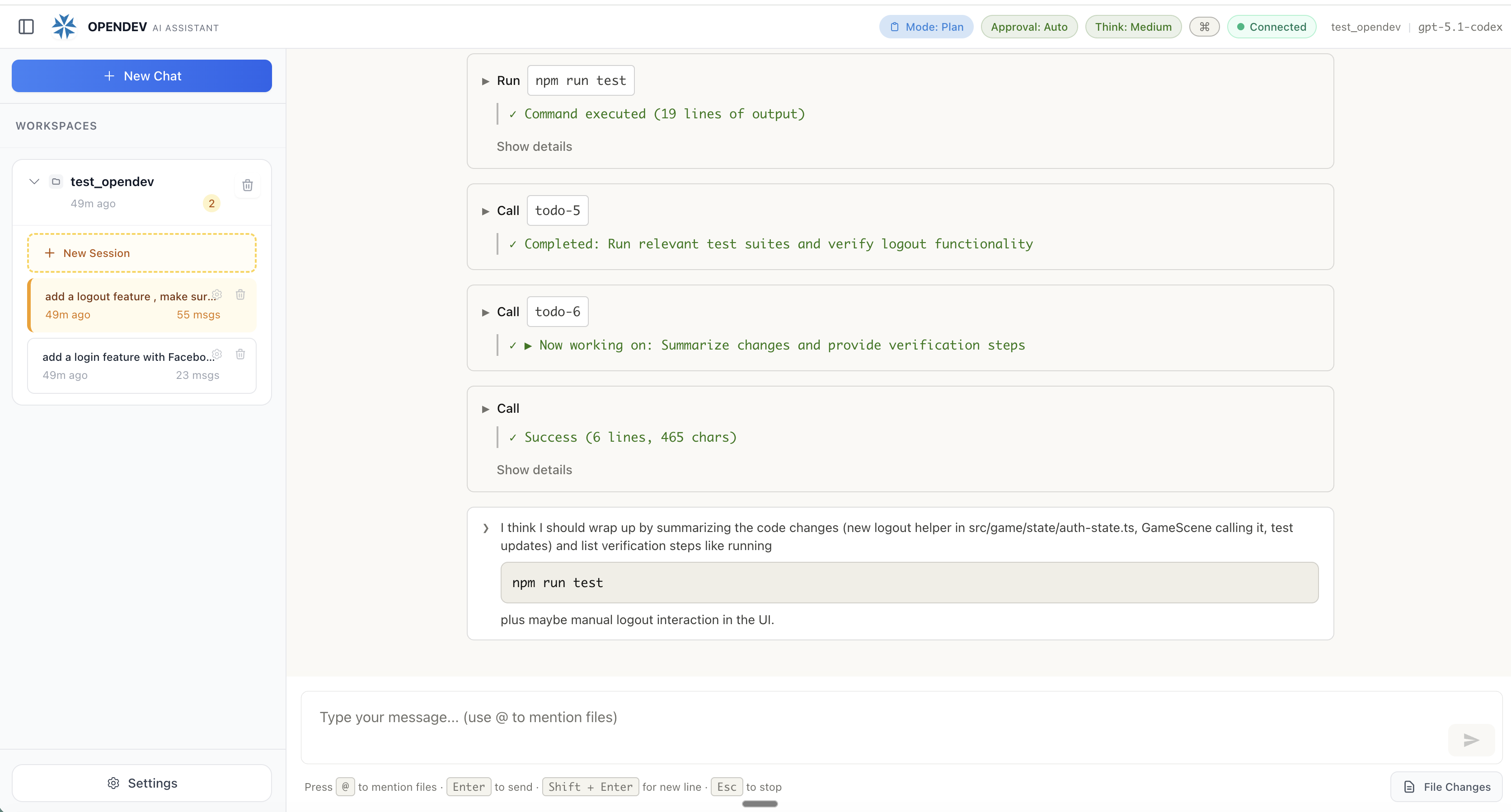
Multi-Provider Support
OpenDev supports 9 LLM providers: OpenAI, Anthropic, Fireworks, Google, Groq, Mistral, DeepInfra, OpenRouter, and Azure OpenAI.
Each provider's models can be independently assigned to 5 workflow slots:
- Normal -- Primary execution model for coding tasks and tool calls
- Thinking -- Complex reasoning and planning (falls back to Normal)
- Compact -- Context summarization when history grows long (falls back to Normal)
- Critique -- Self-critique of agent reasoning (falls back to Thinking)
- VLM -- Vision/image processing (falls back to Normal if it supports vision)
Mix and match providers per slot in ~/.opendev/settings.json:
{
  "model_provider": "anthropic",
  "model": "claude-sonnet-4-20250514",
  "model_thinking_provider": "openai",
  "model_thinking": "o3"
}
See the Provider Setup Guide for the full list of env vars, fallback chains, and configuration options.
OpenDev also works fully offline against local OpenAI-compatible endpoints (Ollama, LM Studio, llama-server): set OPENDEV_DISABLE_REMOTE_MODELS=1 to skip the models.dev catalog fetch and point OPENDEV_API_BASE_URL (or api_base_url in settings) at your local endpoint. See Offline and Air-Gapped Use.
MCP Integration
Dynamic tool discovery via the Model Context Protocol for connecting to external tools and data sources.
opendev mcp list
opendev mcp add myserver uvx mcp-server-sqlite
opendev mcp enable/disable myserver
Development
git clone https://github.com/opendev-to/opendev.git
cd opendev
cargo build --workspace
cargo test --workspace
cargo check --workspace       # Type check
cargo clippy --workspace      # Lint
cargo fmt --all               # Format
cargo test -p opendev-cli     # Test a specific crate
Detailed local-dev, symlink, Homebrew, and release-testing notes are in DEVELOPMENT.md.
Web UI
The frontend is a React/Vite app in web-ui/:
cd web-ui && npm ci && npm run build
Contributing
If you're interested in contributing to OpenDev, please open an issue or submit a pull request.
See the Roadmap for current priorities and areas where community contributions are most welcome.
How OpenDev Compares
- vs. Claude Code / Codex CLI / Gemini CLI: Closed-source tools that lock you into a single provider. OpenDev is fully open source and lets you mix models from any provider, independently bound per workflow (execution, thinking, critique, compaction, vision).
- vs. OpenCode: OpenCode is a great open-source coding agent with TUI, Web UI, and LSP support. However, its architecture is not modular enough to support per-workflow model binding, concurrent multi-agent sessions, or compound AI orchestration.
- vs. OpenClaw: OpenDev and OpenClaw share similar concepts around autonomous AI agents. The key difference is focus: OpenDev is purpose-built for the software development lifecycle, with context engineering, structured agent workflows, and deep code understanding.
Star History
Compatibility
- Runs on
- GPU support unknown
What shows it
- no dependency or feature matches a backend row
- Native code
- None found
- No native code found
- Python bindings
- No Python binding crate found
- License
- MIT
Compare with similar projects
Order: strongest tier first, then most downloads, then name, with unmeasured values last. A library counts downloads over 30 days. An app counts binary downloads per release. An app with none counts its crate downloads over 30 days. ML Rust runs this catalogue, so its closest project always gets a row.
| Project | Downloads | Dependents | Stars | Latest release | Runs on (GPU) | Native code | License |
|---|---|---|---|---|---|---|---|
|
Open-Source Coding Agent in the terminal |
740 binary downloads per release | Not applicable | 853 | 0.1.4 | GPU support unknown | No native code found | MIT |
|
agent-client-protocol Featured
Core protocol types and traits for the Agent Client Protocol |
941,949 downloads over 30 days | 145 | 245 | 5.0.0 | GPU support unknown | No native code found | Apache-2.0 |
|
an open source, extensible AI agent that goes beyond code suggestions - install, execute, edit, and test with any LLM |
63,795 binary downloads per release | Not applicable | 56,377 | Not measured | Not measured | Apache-2.0 | |
|
Open-source AI coding agent and agent runtime: one binary, any model, MCP-native. Runs in terminal, CI, or as a daemon — guardrails in scripts, not approval popups. |
110 binary downloads per release | Not applicable | 624 | 0.69.0 | GPU support unknown | Binds native code: zstd-sys | Apache-2.0 |
|
Rust-native, library-first coding-agent runtime and terminal CLI inspired by Pi, with composable LLM providers, tools, sessions, and plugin ABI |
16 binary downloads per release | Not applicable | 231 | Not measured | Not measured | MIT | |
|
An open protocol that gives AI agents a secure, sandboxed place to run code and use tools — with lean context usage. AXP works alongside MCP |
Not measured | Not applicable | 3 | Not measured | Not measured | Not measured | Apache-2.0 |
|
Terminal UI for open-source and open-weight coding models |
19,483 binary downloads per release | Not applicable | 41,158 | 0.10.2 | GPU support unknown | Binds native code: aws-lc-rs, ring, liblzma-sys, libsqlite3-sys, rquickjs-sys and 1 more | MIT |
Why ListedNo archive, New or Featured rule places it, so it is Listed.
What it lacks for Featured
- The check holds no value for Homebrew installs on request over 365 days, Repology repository families, Docker pull growth over 90 days. A gate that lacks its signal does not pass.
What else the check found
- The last activity is on 8 Aug 2026, 93 days ago. The rules expect an update within 365 days. Dormancy rule
Not measured: Homebrew installs on request over 365 days, Repology repository families, Docker pull growth over 90 days.
Check notes
- the latest release was packaged from a dirty working tree
Exact rules: Listed, Featured app. The check on applied thresholds version 9.
Every rule outcome, as the check records it
expected-interval: app: E = 365 daysdormancy: last activity 2026-08-08, 93 days ago, E = 365: activefeatured: not featured: unknown homebrew_on_request_365d, repology_families, docker_pull_growth_90dlisted: listed: no archive, new or featured rule applies
Measurements and sources
Each signal row shows the raw value, its source and the fetch date. The Sources list gathers every distinct source on this page. Movement needs more history.
Sources6 sources
- Description: the GitHub repository description
- crates.io database dump, fetched
- GitHub releases, fetched
- GitHub repository, fetched
- crates.io package, fetched
- GitHub contributors, fetched
Adoption740 binary downloads per release4 not measured
| Signal | Value | Source | Fetched | Counts |
|---|---|---|---|---|
| Active dependents | Not measured | Yes | ||
| New dependents (365 days) | Not measured | Yes | ||
| Peak active dependents | Not measured | Yes | ||
| Active dependents as a share of the peak | Not measured | Yes | ||
| Binary downloads per release | 740 | GitHub releases | Yes |
MaintenanceLatest human commit: 3 months ago4 not measured
| Signal | Value | Source | Fetched | Counts |
|---|---|---|---|---|
| Latest human commit | 2026-08-08 | GitHub repository | Yes | |
| Latest release | 2026-07-10 | GitHub releases | Yes | |
| First release | 2026-03-29 | crates.io database dump | Yes | |
| Latest version | 0.1.4 | crates.io database dump | No | |
| Days the oldest outside issue waits for a reply | 240 | GitHub repository | Yes | |
| Maintainer replies over 365 days | 0 | GitHub repository | Yes | |
| Repository archived | false | GitHub repository | Yes | |
| Repository gone | false | GitHub repository | Yes | |
| Release commit or manifest in the repo | true | crates.io package | No | |
| Published docs | Not measured | Yes | ||
| Latest release fails cargo check | Not measured | Yes | ||
| Build check date | Not measured | Yes | ||
| Build check toolchain | Not measured | Yes |
SecurityNot measured
| Signal | Value | Source | Fetched | Counts |
|---|---|---|---|---|
| Unpatched vulnerabilities past the grace window | Not measured | Yes | ||
| RustSec unmaintained advisory | Not measured | Yes | ||
| Deprecation notice | Not measured | Yes | ||
| Deprecated requirement | Not measured | Yes |
Distribution1 releases, 1 downloads over 30 days6 not measured
| Signal | Value | Source | Fetched | Counts |
|---|---|---|---|---|
| Releases | 1 | crates.io database dump | No | |
| Downloads over 30 days | 1 | crates.io database dump | No | |
| Binary downloads over the last 3 releases | 2221 | GitHub releases | Yes | |
| Homebrew installs on request over 365 days | Not measured | Yes | ||
| Repology repository families | Not measured | Yes | ||
| Docker pull growth over 90 days | Not measured | Yes | ||
| Docker pulls at the growth baseline | Not measured | Yes | ||
| Every version a prerelease | false | crates.io database dump | Yes | |
| Every version 0.0.x | false | crates.io database dump | Yes | |
| Every version yanked | Not measured | Yes | ||
| Crate deleted from crates.io | Not measured | Yes |
Repository853 stars, 89 forks, 6 contributors, 865 commits. Stars alone never qualify a project.
| Signal | Value | Source | Fetched | Counts |
|---|---|---|---|---|
| GitHub stars | 853 | GitHub repository | Yes — one part of the repository route | |
| GitHub forks | 89 | GitHub repository | Yes — one part of the repository route | |
| Contributors with a GitHub account | 6 | GitHub contributors | Yes — one part of the repository route | |
| Commits on the default branch | 865 | GitHub repository | No | |
| Repository's main crate left out of the entry | none | crates.io database dump | Yes |
Facts that never count
| Signal | Value | Source | Fetched | Counts |
|---|---|---|---|---|
| License | MIT | crates.io database dump | No | |
| Runs on, from listed crates and their direct dependencies | GPU support unknown | crates.io database dump | No | |
| What shows each backend | no dependency or feature matches a backend row | crates.io database dump | No | |
| Native code, from listed crates and their dependencies | No native code found | crates.io database dump | No | |
| Python bindings, from direct dependencies of listed crates | No Python binding crate found | crates.io database dump | No | |
| Crates that depend on a listed crate directly | Not measured | No |
Corrections and review history
No correction applies to this entry.
Judgments
A judgment enters only through an approved issue and a merged pull request.
No judgment applies to this entry.