adk-rust
Library Listed
Rust Agent Development Kit - Build AI agents in Rust with modular components for models, tools, memory, and more.
- Downloads
- 5,419
- Dependents
- 25
- Stars
- 743
- Forks
- 116
- Contributors
- 22
- Commits
- 1,817
- Latest release
- 2.3.0 ·
About
A production-ready Rust framework for building AI agents. Model-agnostic, type-safe and async, across 49 publishable crates for agent orchestration.
v3.0.0 release candidate — unpublished. This major release carries breaking API changes: tool calls run through one governed path, the server binds
127.0.0.1and refuses unlisted hosts and origins by default, and run budgets, durable runs, approvals, and audit records join the runtime. The published release is 2.3.0, with all 43 crates on crates.io.Milestone: ADK-Rust has crossed 500K total crates.io downloads across the workspace crates.
Coming from 2.x: see the 2.x to 3.0 migration guide and the CHANGELOG. Coming from 1.x: start with the 1.0 to 2.0 guide.
🎬 Rust & Beyond Podcast — Episode 3: Agents That Act
ADK-Rust v2.0.0 — Agents That Act. Eight chapters on agents that run on their own and finish what they start: a workflow that resumes exactly where it stopped, a graph that changes course when the problem does, and approvals you can trust down to the digest. 42 crates, 4,300+ tests, sub-millisecond loop overhead.
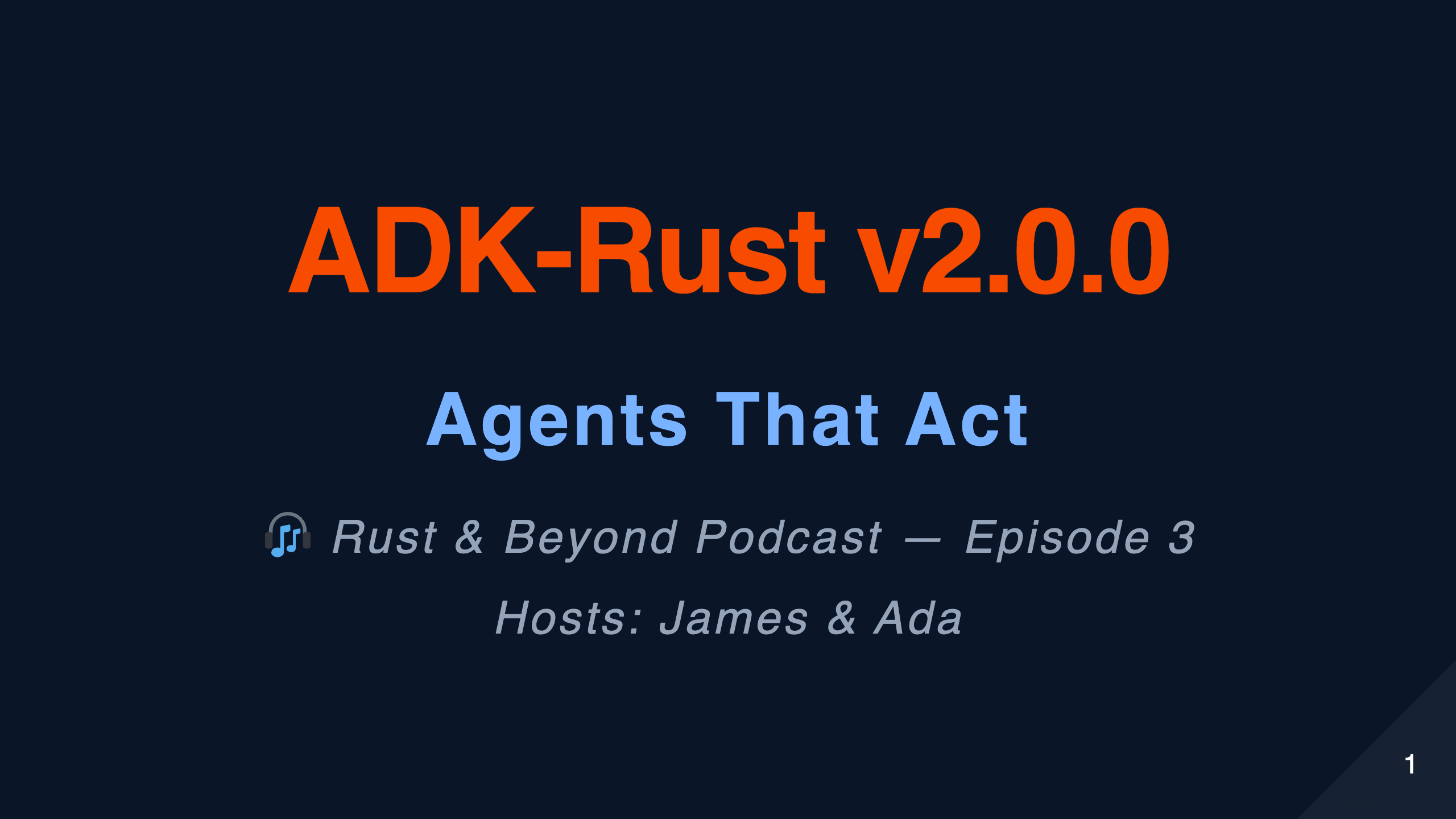
▶️ Watch on YouTube — 40 min 50 sec · Hosts: James (Fenrir) & Ada (Kore) · Video with slides
Read the full README
"Show me." — Ada, thirty seconds in, declining to be told about the visual builder
Episode highlights
- The Numbers — 42 crates, 4,300+ tests, 104 runnable examples, 568 μs agent-loop overhead against LangGraph's 1,228 ms
- Agents That Survive — SQLite checkpointers, delta checkpoints, and a pause that resumes in a fresh process that shares only the database file
- Subgraphs — a graph as a node, nested three deep, with channel mismatches caught when the parent compiles rather than as an absent value at run time
- Deciding At Run Time —
run_node_withfor work whose size comes from state, andwith_gotofor a node that picks its own successor with no edge declared - Built To Run Unattended — retries with capped backoff, concurrency bounds, node timeouts, and checkpoint retention that keeps a week-long thread steady
- Governed Computer Use — approval interrupts bound to a digest, so what you approved is what runs
- What It Costs — no automatic crash recovery, an unbounded child ledger, and why we kept two orchestration APIs when the other ADKs deprecated one
Previous episodes
🎧 Episode 2: v1.0.0 — The Stable Foundation
A deep-dive into what shipped, who built it, and where it was going. 39 crates. 130K downloads. Semver stable.
▶️ Watch on YouTube — 10 min 12 sec · Hosts: James (Fenrir) & Ada (Kore)
"We believe the next generation of software will be built by composing autonomous agents, not by writing every line of logic by hand. And we believe Rust is the right language for the runtime those agents live in." — James
🎧 Episode 1: What is ADK-Rust?
2 min 21 sec · Generated entirely by ADK-Rust using Gemini 3.1 Flash TTS
How are these made?
Episodes are generated using ADK-Rust's own audio capabilities — Chirp3-HD
multi-speaker TTS synthesis via adk-audio. The script, slide deck (Marp), and
synthesized audio segments are concatenated with ffmpeg into a video presentation.
Zero manual voice recording.
# Episode 3 assets
docs/podcast/episode-3-script.md      # Full script, eight chapters
docs/podcast/episode-3-slides.md      # Marp slide deck
docs/podcast/adk-rust-episode-3.mp4   # Final video
docs/podcast/episode-3-narration.mp3  # Audio-only
The episode 3 video and slides are not in the repository: the video alone is about 900 MB, over GitHub's 100 MB per-file limit. The script and the deck source are.
Build and test an agent in five minutes
Scaffold an OpenAI agent with the HTTP runtime:
cargo install cargo-adk
cargo adk new quickstart_agent --template api --provider openai
cd quickstart_agent
cp .env.example .env
# Open .env and replace the OPENAI_API_KEY placeholder, then:
cargo run
The server listens on 127.0.0.1:8080 (set BIND_HOST=0.0.0.0 to listen on every interface).
Confirm it with:
curl -fsS http://127.0.0.1:8080/api/health
For a page where you talk to your agents, decide what they ask to do and review what they
did, adk-rust serve serves the web home at
http://127.0.0.1:8080/ui/: Threads, Today and Memory & rules, in
light and dark.
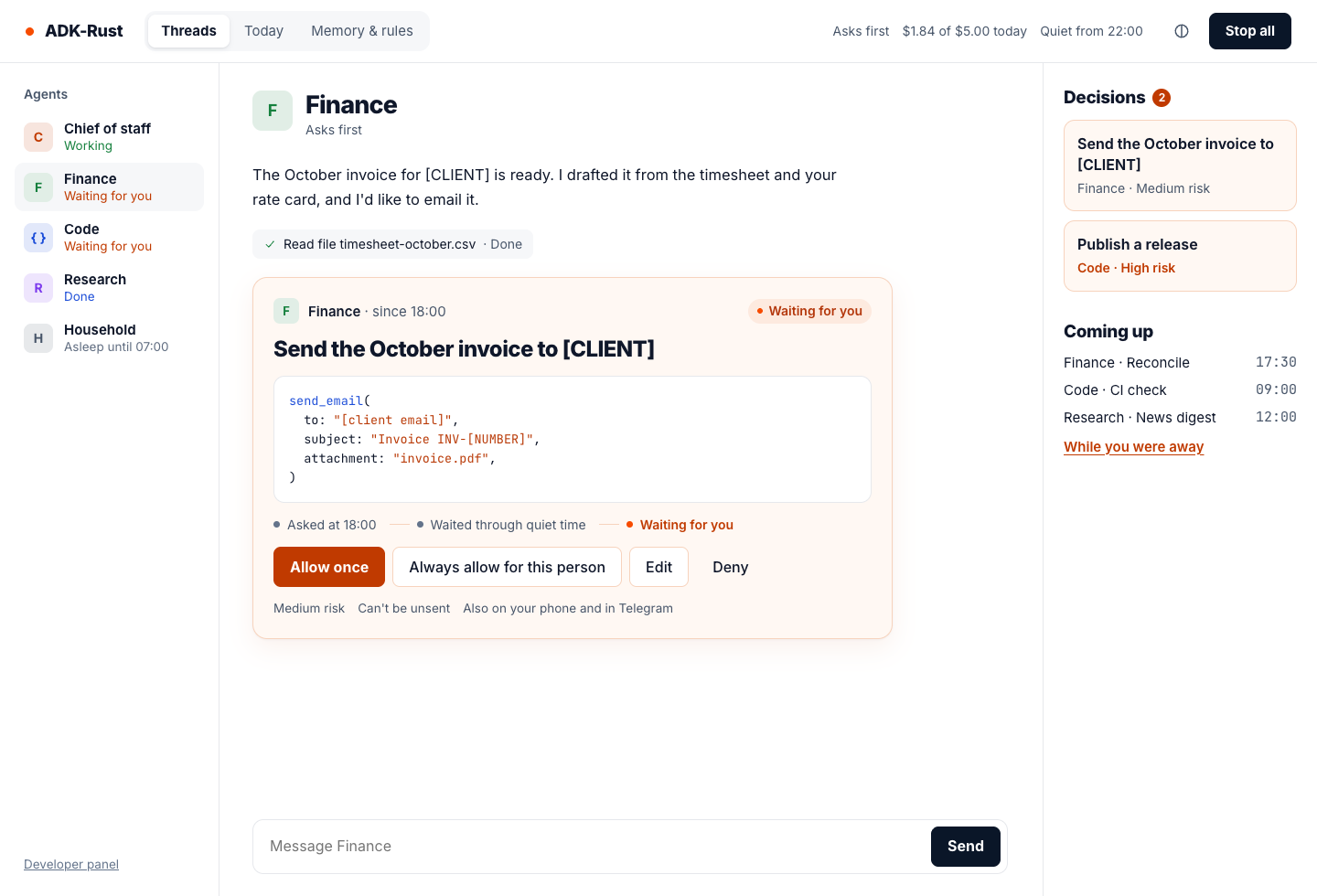
The five-minute quickstart explains the generated files and the console-only alternative.
Add ADK-Rust to an existing project
[dependencies]
adk-rust = "3.0.0"                                        # Gemini, agents, runner, sessions
# adk-rust = { version = "3.0.0", features = ["standard"] }  # + server, auth, graph, eval
| Tier | Includes | Use case |
|---|---|---|
minimal (default) | Gemini provider, agents, runner, sessions | Fast starter agents |
standard | minimal + OpenAI, Anthropic, tools, memory, telemetry, server, auth, graph, eval, guardrail, plugins, artifacts, skills, computer use | Serving an agent over HTTP |
enterprise | standard + realtime, browser, RAG, payments, AWP | Voice, retrieval and payments |
full | enterprise + audio, code execution, sandbox, code tools, the harness and its kernel, the AWP website, and the functional, node-cache, delta, and time-travel graph capabilities | Everything that needs no external infrastructure |
A tier is a starting point, not a ceiling. Add any single capability on top of one
without moving to the next tier, so features = ["minimal", "audio"] gives you the
minimal build plus audio. adk-rust/Cargo.toml lists every feature you
can add this way.
One agent, end to end
use adk_rust::prelude::*;
use adk_rust::Launcher;

#[tokio::main]
async fn main() -> AnyhowResult<()> {
    dotenvy::dotenv().ok();
    let model = GeminiModel::new(&std::env::var("GOOGLE_API_KEY")?, "gemini-3.7-flash")?;

    let agent = LlmAgentBuilder::new("assistant")
        .instruction("You are a helpful assistant. Be concise and accurate.")
        .model(Arc::new(model))
        .build()?;

    Launcher::new(Arc::new(agent)).run().await?;
    Ok(())
}
Swap the provider by swapping the client. The agent, runner and tools are unchanged:
| Provider | Client | Feature | Key |
|---|---|---|---|
| Gemini | GeminiModel::new(key, model) | default | GOOGLE_API_KEY |
| OpenAI | OpenAIClient::new(OpenAIConfig::new(key, model)) | openai | OPENAI_API_KEY |
| OpenAI Responses | OpenAIResponsesClient::new(OpenAIResponsesConfig::new(key, model)) | openai | OPENAI_API_KEY |
| Anthropic | AnthropicClient::new(AnthropicConfig::new(key, model)) | anthropic | ANTHROPIC_API_KEY |
| DeepSeek | DeepSeekClient::chat(key) | deepseek | DEEPSEEK_API_KEY |
| Groq | GroqClient::new(GroqConfig::gpt_oss_120b(key)) | groq | GROQ_API_KEY |
| Ollama | OllamaModel::new(OllamaConfig::new(model)) | ollama | none |
| Bedrock | BedrockClient::new(BedrockConfig::new(region, model_id)).await? | bedrock | AWS credential chain |
| mistral.rs | MistralRsModel::new(config).await? | adk-mistralrs | none, local |
Or let it choose: adk_rust::run(instructions, input) picks a provider from the
environment, among those you compiled in.
Models
| Provider | Model Examples | Feature Flag |
|---|---|---|
| Gemini | gemini-3.7-flash (default), gemini-3.6-flash, gemini-3.5-flash-lite, gemini-3.1-pro-preview | (default) |
| OpenAI | gpt-5.6-terra (default), gpt-5.6-sol, gpt-5.6-luna | openai |
| OpenAI Responses API | gpt-5.6-terra, gpt-5.6-sol, gpt-5.6-luna | openai |
| Anthropic | claude-sonnet-5 (default), claude-opus-5-5, claude-sonnet-5-5, claude-haiku-5-5, claude-fable-5-1 | anthropic |
| DeepSeek | deepseek-flash (default; deepseek-v4-flash is accepted), deepseek-v4-pro | deepseek |
| Groq | openai/gpt-oss-120b, openai/gpt-oss-20b | groq |
| Ollama | qwen3.6:35b-a3b, qwen3.5, llama3.2:3b | ollama |
| Fireworks AI | accounts/fireworks/models/kimi-k2p6 | openai (preset) |
| Together AI | MiniMaxAI/MiniMax-M2.7 | openai (preset) |
| Mistral AI | mistral-medium-latest | openai (preset) |
| Perplexity | sonar-pro | openai (preset) |
| Cerebras | gpt-oss-120b | openai (preset) |
| SambaNova | gpt-oss-120b | openai (preset) |
| xAI (Grok) | grok-4.6 | openai (preset) |
| OrcaRouter | openai/gpt-5.6-terra, anthropic/claude-sonnet-5 | openai (preset) |
| Cheaper Inference | gpt-5.4-mini, claude-sonnet-5 | openai (preset) |
| API Route | (listed by GET /v1/models) | openai (preset) |
| Amazon Bedrock | anthropic.claude-sonnet-4-20250514-v1:0 | bedrock |
| Azure AI Inference | (endpoint-specific) | azure-ai |
| mistral.rs | Gemma 4, Phi-3, Llama, Qwen 3.5, Voxtral, FLUX | adk-mistralrs |
Defaults are curated in adk_model::catalog and were checked on 23 August 2026.
Deployment-scoped providers such as Bedrock and Azure AI still require the model
or deployment identifier available in your own account and region.
Use adk_model::catalog::recommended_model(provider) for ADK's portable default,
MODEL_CATALOG for user-facing pickers, and validate_model_selection when
accepting configuration. Unknown IDs remain valid for private deployments and
new releases; known retired IDs include an actionable replacement.
What you can build
Each row links to its guide and a runnable example.
| Capability | Guide | Example |
|---|---|---|
| The web home — Threads, Today and Memory & rules: decisions with full detail, what happened while you were away, what your agents may do, and Stop all; a developer panel with topology, protocols, state and telemetry | web home | adk-rust serve, adk-rust up |
Tools — #[tool] derives the JSON schema from your argument type | tools | examples/coding_agent |
MCP clients and servers on rmcp 3.1 — tools, resources, prompts, elicitation, tasks | mcp | examples/mcp_protocol_revisions |
| Workflow agents — sequential, parallel, loop | agents | examples/multi_perspective_analysis |
| Portable teams — validated handoff, delegation, policies, receipts and shared state | multi-agent | examples/team_architectures |
| Graph workflows — checkpoints, durable resume, human-in-the-loop, subgraphs | graph-agents | examples/graph_subgraph_claims |
| The harness — a governed coding agent: modes, approvals remembered per user, a sandboxed shell, team members, plan graphs and durable goals | harness | examples/harness_openai, examples/harness_anthropic |
| Coding agents — read, edit and run code in a confined workspace | coding-agent | examples/coding_goal |
| Realtime voice and video — OpenAI Realtime, Gemini Live, Vertex, LiveKit, WebRTC | realtime | examples/realtime_voice |
| Governed computer use — approval interrupts bound to a digest | computer-use | — |
| RAG — chunking, embeddings, vector search, 6 backends | rag | — |
| Memory — semantic search, project isolation, a bi-temporal knowledge graph | memory | examples/skill_memory_improvements |
| Servers — REST with SSE, A2A v1.0.0, durable background runs, cron, webhook wake-ups, approvals | deployment | examples/background_runs |
| Governance — tool policies, a replicated kill switch, run budgets, a spend ledger, an action ledger, and signed audit logs | tool authorization | examples/durable_company |
| Gemini Enterprise Agent Platform — Agent Engine BYOC, managed state, memory, artifacts, telemetry and sandbox | agent-engine | examples/vertex_sandbox |
Agentic Web Protocol 2.0 — signed site contracts and releases, verified agent identity, capabilities over A2A, MCP and HTTP, awp verify | awp | examples/awp_agent (AWP 1.x) |
| AWP websites — a static, signed site with an agent edge, run by a team of agents inside its owner's charter; migration from WordPress | website quickstart | examples/website |
| Agentic commerce — ACP and AP2 with durable journals | payments | examples/payments |
| Editor interop — use an ACP coding agent as a tool, or expose yours | acp | — |
| Browser automation — WebDriver tools for navigation, extraction, forms, and screenshots | browser-tools | — |
| Evaluation — trajectory, rubric, LLM-judge, A/B, CI output | evaluation | examples/eval_showcase |
| Guardrails, RBAC, SSO, audit logging | security | — |
| Observability — OpenTelemetry tracing, structured logging | observability | examples/advanced_agents |
Scaffold a project
cargo install cargo-adk

cargo adk new my-agent                       # basic Gemini agent (alias for --template llm)
cargo adk new my-agent --template tools      # agent with #[tool] custom tools
cargo adk new my-agent --template rag        # RAG with vector search
cargo adk new my-agent --template api        # REST server
cargo adk new my-agent --template graph      # graph workflow with checkpoints
cargo adk new my-agent --template realtime   # realtime voice agent
cargo adk new my-agent --template agent-engine # Gemini Enterprise Agent Engine BYOC
cargo adk new my-agent --template harness    # governed harness: REPL with approvals, AGENTS.md, skills
cargo adk new my-site --template website     # AWP 2.0 website: content, theme, charter, data and its edge

# Compose addons with any template
cargo adk new my-agent --template tools --addon telemetry --addon sessions
cargo adk new my-agent --addon mcp --addon guardrails

cd my-agent
cp .env.example .env    # add your API key
cargo run
Agent types — the core agent structure.
| Template | What you get |
|---|---|
llm (alias basic) | Single LLM agent with tool calling |
tools | LLM agent with #[tool] custom tools |
sequential | Multi-agent pipeline executing in order |
parallel | Parallel execution with result aggregation |
loop | Iterates until a condition is met |
conditional | Routes based on LLM decisions |
graph | Graph workflow with an agent node and per-step checkpoints |
realtime | Gemini Live voice agent with transcripts |
rag | Vector search over a knowledge base |
api | REST server exposing the agent over HTTP |
agent-engine | Gemini Enterprise Agent Engine BYOC container and Terraform deployment |
openai | OpenAI-powered agent |
custom | Manual Agent trait implementation |
Enterprise patterns — pre-composed, several capabilities already wired together.
| Template | What you get |
|---|---|
production | LLM agent with server, auth, sessions and telemetry |
multi-agent | Supervisor over sub-agents, with telemetry |
pipeline | Sequential data processing with session state |
chatbot | Conversational agent with memory and an HTTP interface |
a2a-server (alias a2a) | A2A protocol server with session management |
managed-agents | Anthropic Managed Agents API session with SSE streaming |
Addons — composable with any template, and with each other.
| Addon | Adds |
|---|---|
telemetry | OpenTelemetry tracing |
auth | API key and JWT authentication |
sessions | Session state management |
memory | Semantic memory and RAG |
mcp | MCP tool integration |
guardrails | Input and output validation |
eval | Evaluation framework |
browser | Browser automation |
server | HTTP server with A2A |
cargo adk build compiles the project without deploying, and cargo adk validate
checks an agent definition without building. cargo adk templates and
cargo adk addons print these lists.
Crates
| Crate | Purpose | Key Features |
|---|---|---|
adk-core | Foundational traits and types | Agent, Tool, Llm, Content, Event, AdkError, the governed tool path, agent identity, budgets, and durable runtime contracts |
adk-agent | Agent implementations | LlmAgent, workflow agents, and portable TeamSpec / CompiledTeam composition |
adk-skill | AgentSkills parsing and selection | Skill markdown parser, .skills discovery/indexing, lexical matching, prompt injection helpers |
adk-model | LLM integrations | Gemini, OpenAI, Anthropic, DeepSeek, Groq, Ollama, Bedrock, Azure AI + OpenAI-compatible presets (Fireworks, Together, Mistral, Perplexity, Cerebras, SambaNova, xAI, OrcaRouter, Cheaper Inference, API Route) |
adk-gemini | Gemini client | Google Gemini API client with streaming and multimodal support |
adk-gcp | Shared Google Cloud plumbing | ADC credential caching, bounded REST transport, Vertex resource names, and LRO polling |
adk-anthropic | Anthropic client | Dedicated Anthropic API client with streaming, thinking, caching, citations, vision, PDF, pricing |
adk-mistralrs | Native local inference | mistral.rs v0.8 — Gemma 4, Qwen 3.5, Voxtral, ISQ/MXFP4 quantization, LoRA adapters |
adk-tool | Tool system and extensibility | Typed Rust tools, provider-native tools, MCP clients and server SDK, and Vertex AI Example Store |
adk-devtools | Coding-agent dev tools | read_file/write_file/edit_file/glob/grep/bash as a DevToolset, scoped to a sandboxed Workspace |
adk-session | Session and state management | In-memory, SQLite, PostgreSQL, Redis, MongoDB, Firestore, Neo4j, and Vertex AI backends; encrypted sessions; durable stores (spend, action, approval, audit, lease, run, schedule, governance) on every backend |
adk-artifact | Binary artifacts for agents | In-memory and GCS storage, versioning, MIME types, and image/PDF/video support |
adk-memory | Long-term memory | Semantic stores, Vertex AI Memory Bank, project isolation, and bi-temporal knowledge graphs |
adk-payments | Agentic commerce orchestration | ACP/AP2 adapters, canonical transaction kernel, durable journals, evidence-backed payment flows |
awp-types | AWP protocol types | AWP 2.0 site contract, keys, releases, capabilities, status, events, consent, charter and signals, with JSON Schemas; the AWP 1.x types — zero adk-* deps |
adk-awp | Agentic Web Protocol implementation | AWP 2.0 routes and version negotiation, capabilities as tools, signing and the static bundle, the verifier and conformance kit; the AWP 1.x routes behind awp-v1 |
adk-site | Site pipeline (Experimental) | Content, the built-in and sandboxed external generators, the launch gate, signed releases and the site log, host adapters, migration, constant updates |
adk-drivers | Service drivers (Experimental) | DNS and registrar, email, analytics and search console, social and advertising, as kernel driver manifests with conformance suites |
adk-website | The AWP website product (Experimental) | Site kinds, the team of eight agents, onboarding, capability packs, playbooks, incidents, alarms, the weekly review and deployment shapes |
adk-acp | Agent Client Protocol integration | Official stable v1 client and server, one-shot and persistent sessions, streaming, cancellation, async permissions, client files and terminals, per-session MCP, and editor-facing ADK agents |
adk-rag | RAG pipeline | Document chunking, embeddings, vector search, reranking, 6 backends |
adk-runner | Agent execution runtime | Event streaming, session persistence, transfer enforcement, plugins, run budgets, spend and action ledgers, durable cancellation, Runner::close |
adk-server | Production API servers | REST and SSE, A2A, loopback-first security defaults, durable background runs and cron, webhook wake-ups, approvals, governance endpoints, and Gemini Enterprise Agent Engine runtime dispatch |
adk-harness | Governed harness agent (Beta) | HarnessAgent over LlmAgent: modes, standing approvals, host or OS-sandboxed bash, todos, AGENTS.md, skills, team members, plan graphs, durable goals |
adk-kernel | Agent kernel (Beta) | Resident supervisor with a process table, wake sources (cron, file, webhook, queue, approval), an event bus, freeze across replicas, and a control plane; process stores on SQLite, PostgreSQL, and Redis |
adk-surface | Agent surfaces (Beta) | SurfaceEngine turns sessions, decisions, and activity into plain words for every surface; the web home and its HTTP API (web), agent-drawn forms and tables (genui), and the workflow observer |
adk-cli | Run and inspect agents from a terminal | adk-rust binary: interactive REPL, web server, coding agent (code/goal/ultracode), skills, graph checkpoint inspection, signed audit log verification; embeddable Launcher |
adk-realtime | Real-time voice & multimodal agents | OpenAI Realtime + Gemini Live, bidirectional audio, video frames, VAD, affective dialogue, server-side tools via IntegratedRealtimeRunner |
adk-graph | Graph-based workflows | LangGraph-style orchestration, state reducers, checkpointing (memory, SQLite, delta), durable resume, human-in-the-loop interrupts, subgraphs, with_goto routing, per-node retry and timeouts, time travel |
adk-browser | Browser automation | WebDriver tools for navigation, forms, screenshots, and PDF generation, with private-network and upload confinement |
adk-computer-use | Governed desktop automation | Deterministic graph over computer-use-mcp: parallel observation, digest-bound approval interrupts, single-executor mutation, verification; wire contracts + tamper-evident evaluation receipts |
adk-eval | Agent evaluation | Test definitions, trajectory validation, LLM-judged scoring, rubrics |
adk-guardrail | Runtime validation | Input/output checks, PII redaction, and argument-level tool allow/deny/revision |
adk-auth | Access control | Role-based permissions, declarative scope-based security, SSO/OAuth, audit logging |
adk-sandbox | Sandboxed code execution | Process/WASM backends, OS-level sandbox profiles (Seatbelt on macOS, bubblewrap on Linux, a restricted-token tier on Windows) |
adk-telemetry | Observability | OpenTelemetry tracing, structured logging, and Google Cloud export |
adk-managed | Managed agent runtime (Experimental) | Provider-neutral agent execution, event replay, custom tool calls and confirmations parked on durable runs; sessions survive process loss with durable stores |
adk-enterprise | Enterprise client SDK (Experimental) | HTTP/SSE client for managed agent service, zero runtime deps |
adk-plugin | Lifecycle hooks | EnhancedPlugin trait, tool and model interception, priority pipeline, shared PluginContext |
adk-retry-reflect | Retry and reflect plugin | Intercepts tool failures, injects reflection prompts, exponential backoff, circuit breaker |
adk-action | Action node types | 14 deterministic node types, StandardProperties, variable interpolation — the shared types behind adk-graph's ActionNodeExecutor |
adk-code | Code execution substrate | Process, Docker, embedded runtimes, and Vertex AI Agent Engine managed sandboxes |
adk-codeact-monty | Python runtime for CodeAct (Experimental) | Pydantic Monty interpreter, sandboxed OS access, suspend and resume snapshots |
adk-audio | Audio processing | STT and TTS providers, Deepgram streaming, desktop capture and playback, VAD, ONNX models (Whisper, Moonshine, Kokoro) |
adk-bench | Benchmarking | Framework runtime performance against real LLM APIs, and cross-framework comparison with Python ADK |
adk-deploy | Deployment utilities | Targets, manifests, and Gemini Enterprise Agent Engine BYOC deployment |
adk-rust-macros | Procedural macros | #[tool] with read_only/idempotent/concurrency_safe/long_running/lenient_args, #[entrypoint] and #[task] for the functional API |
cargo-adk | Cargo subcommand | Project templates including the harness and Agent Engine BYOC, composable addons, eval runs, benchmarks, and deployment |
adk-rust | Umbrella crate | Re-exports every crate above behind tiered feature presets — the one dependency most projects need |
Retired and extracted repos: adk-ui is retired in favour of
adk-surface'sgenuifeature (Agent-Drawn UI), and adk-studio is retired in favour of the workflow observer; adk-playground holds more examples.
Performance
Measured with cargo adk bench in June 2026, same model, workload, and prompt for every
framework.
| Framework | Cold Start | Agent Loop Overhead (mean) | Agent Loop Overhead (P95) | Peak RSS |
|---|---|---|---|---|
| ADK-Rust | 109 ms | 568 μs | 615 μs | ~15 MB |
| Gemini Python SDK | 501 ms | 253 μs | 334 μs | 69.7 MB |
| LangGraph | 502 ms | 1,228 ms | 1,228 ms | 92.7 MB |
Cold start is process launch to first API call. Overhead is turn time minus the LLM
round trip. Apple M-series, macOS, June 2026. Run it yourself with
cargo adk bench --dry-run to see the cost estimate first.
Develop
devenv shell            # reproducible toolchain, or ./scripts/setup-dev.sh
make build              # cargo build --workspace
make test               # cargo nextest run --workspace
make clippy             # -D warnings
AGENTS.md documents the conventions CI enforces, including the per-platform tool matrix and the CI cost tiers. CONTRIBUTING.md covers the workflow and the required checks.
Documentation
- Official docs — guides for every capability above
- Wiki — tutorials and quickstarts
- docs.rs — API reference
- Examples — 148 standalone crates, plus more in the playground
Companion projects
| Project | What it is |
|---|---|
| adk-studio | Visual agent builder, retired in favour of the workflow observer (spec 3.3 §13 decision 12) |
| adk-ui | Retired, for ADK-Rust 2 only — agent-drawn UI is adk-surface's genui feature |
| adk-playground | Working examples, and a hosted playground |
Project
- ROADMAP.md — v3.0.0 (release candidate). Longer-term direction and why both orchestration APIs are supported
- CHANGELOG.md — every release
- CONTRIBUTORS.md — the people who built this
- STABILITY.md — crate stability tiers and the deprecation policy
- Discussions — ideas and questions
Related: Google's ADK · MCP · Gemini API
Sponsors
ADK-Rust is Apache 2.0 and developed in the open. Sponsorship pays for the CI minutes, model-provider credits, and benchmark hardware the project runs on.
Thank you to our sponsors:
Become a sponsor — monthly tiers from $5, or a one-off contribution. Sponsors are listed here and on the sponsors page.
Star History
License
Apache 2.0. See LICENSE.
Compatibility
- Runs on
- CUDA, Metal
What shows it
- CUDA: adk-mistralrs feature cuda
- Metal: adk-mistralrs feature metal
- Native code
- Optional
- Binds native code: alsa-sys (feature desktop-audio), audiopus_sys (feature openai-webrtc), cxx (feature livekit), espeak-rs-sys (feature kokoro), libsqlite3-sys (feature sqlite) and 4 more
- Python bindings
- No Python binding crate found
- License
- Apache-2.0
Compare with similar projects
Order: strongest tier first, then most downloads, then name, with unmeasured values last. A library counts downloads over 30 days. An app counts binary downloads per release. An app with none counts its crate downloads over 30 days. ML Rust runs this catalogue, so its closest project always gets a row.
| Project | Downloads | Dependents | Stars | Latest release | Runs on (GPU) | Native code | License |
|---|---|---|---|---|---|---|---|
|
Rust Agent Development Kit - Build AI agents in Rust with modular components for models, tools, memory, and more. |
5,419 downloads over 30 days | 25 | 743 | 2.3.0 | CUDA, Metal | Binds native code: alsa-sys (feature desktop-audio), audiopus_sys (feature openai-webrtc), cxx (feature livekit), espeak-rs-sys (feature kokoro), libsqlite3-sys (feature sqlite) and 4 more | Apache-2.0 |
|
rust-mcp-schema Featured
Type-safe implementation of the Model Context Protocol in Rust, designed to reduce errors and accelerate development with powerful utilities. |
107,187 downloads over 30 days | 19 | 79 | 2.0.0 | GPU support unknown | No native code found | MIT |
|
yoagent Listed
The agent loop for Rust: stream from 7 LLM protocols, run tools, loop until done. Native or wasm32 (Cloudflare Workers). |
2,027 downloads over 30 days | 5 | 369 | 0.27.4 | GPU support unknown | No native code found | MIT |
|
mofa Listed
MoFA - Modular Framework for Agents. Modular, Compositional and Programmable. |
613 downloads over 30 days | 0 | 296 | 0.1.1 | GPU support unknown | Binds native code: ort-sys (feature kokoro), pnet_sys (feature dora) | Apache-2.0 |
|
chidori Listed
The agent framework where every run is durable, replayable, and resumable by default. Plain async TypeScript agents on an embedded pure-Rust JS engine. Python bindings |
257 downloads over 30 days | 0 | 1,372 | 3.8.1 | GPU support unknown | Binds native code: aws-lc-rs, aws-lc-sys, lcms2-sys, libffi-sys, libsqlite3-sys and 4 more | Apache-2.0 |
|
Rust-native, library-first coding-agent runtime and terminal CLI inspired by Pi, with composable LLM providers, tools, sessions, and plugin ABI |
16 binary downloads per release | Not applicable | 231 | Not measured | Not measured | MIT | |
|
An open protocol that gives AI agents a secure, sandboxed place to run code and use tools — with lean context usage. AXP works alongside MCP |
Not measured | Not applicable | 3 | Not measured | Not measured | Not measured | Apache-2.0 |
Why ListedNo archive, New or Featured rule places it, so it is Listed.
What it lacks for Featured
- It has 2 active dependents and 2 new dependents in 365 days. Featured needs 11 active dependents or 9 new dependents in 365 days. The repository route reads 743 stars, 116 forks and 22 contributors. It needs 4,539 stars, 434 forks and 79 contributors together.
What else the check found
- The last activity is on 7 Nov 2026, 2 days ago. The rules expect an update within 365 days. Dormancy rule
Exact rules: Listed, Featured library. The check on applied thresholds version 9.
Every rule outcome, as the check records it
expected-interval: version 2.3.0 base 200, raised to the 365-day floor: E = 365 daysdormancy: last activity 2026-11-07, 2 days ago, E = 365: activefeatured: not featured: active_users 2 < 11 and new_adopters 2 < 9 and repository route stars 743 (needs 4539), forks 116 (needs 434), contributors 22 (needs 79)listed: listed: no archive, new or featured rule applies
Crates35 crates
- adk-rust Primary
- adk-acp
- adk-action
- adk-agent
- adk-anthropic
- adk-artifact
- adk-audio
- adk-auth
- adk-bench
- adk-cli
- adk-code
- adk-codeact-monty
- adk-computer-use
- adk-core
- adk-devtools
- adk-enterprise
- adk-eval
- adk-gcp
- adk-gemini
- adk-graph
- adk-guardrail
- adk-managed
- adk-memory
- adk-mistralrs
- adk-model
- adk-plugin
- adk-rag
- adk-realtime
- adk-runner
- adk-rust-macros
- adk-server
- adk-session
- adk-telemetry
- adk-tool
- cargo-adk
Measurements and sources
Each signal row shows the raw value, its source and the fetch date. The Sources list gathers every distinct source on this page. Movement needs more history.
Sources6 sources
- Description: the crates.io description
- crates.io database dump, fetched
- RustSec advisory database, fetched
- GitHub repository, fetched
- crates.io package, fetched
- GitHub contributors, fetched
Adoption2 active dependents, 2 new dependents in 365 days1 not measured
| Signal | Value | Source | Fetched | Counts |
|---|---|---|---|---|
| Active dependents | 2 | crates.io database dump | Yes | |
| New dependents (365 days) | 2 | crates.io database dump | Yes | |
| Peak active dependents | 3 | crates.io database dump | Yes | |
| Active dependents as a share of the peak | 1 | crates.io database dump | Yes | |
| Binary downloads per release | Not measured | Yes |
MaintenanceLatest human commit: 2 days ago3 not measured
| Signal | Value | Source | Fetched | Counts |
|---|---|---|---|---|
| Latest human commit | 2026-11-07 | GitHub repository | Yes | |
| Latest release | 2026-10-09 | crates.io database dump | Yes | |
| First release | 2025-11-30 | crates.io database dump | Yes | |
| Latest version | 2.3.0 | crates.io database dump | Yes | |
| Days the oldest outside issue waits for a reply | 11 | GitHub repository | Yes | |
| Maintainer replies over 365 days | 27 | GitHub repository | Yes | |
| Repository archived | false | GitHub repository | Yes | |
| Repository gone | false | GitHub repository | Yes | |
| Release commit or manifest in the repo | true | crates.io package | Yes | |
| Published docs | true | crates.io database dump | Yes | |
| Latest release fails cargo check | Not measured | Yes | ||
| Build check date | Not measured | Yes | ||
| Build check toolchain | Not measured | Yes |
SecurityUnpatched vulnerabilities: none
| Signal | Value | Source | Fetched | Counts |
|---|---|---|---|---|
| Unpatched vulnerabilities past the grace window | none | RustSec advisory database | Yes | |
| RustSec unmaintained advisory | none | RustSec advisory database | Yes | |
| Deprecation notice | none | crates.io database dump | Yes | |
| Deprecated requirement | none | crates.io database dump | Yes |
Distribution31 releases, 5,419 downloads over 30 days5 not measured
| Signal | Value | Source | Fetched | Counts |
|---|---|---|---|---|
| Releases | 31 | crates.io database dump | Yes | |
| Downloads over 30 days | 5419 | crates.io database dump | Yes | |
| Binary downloads over the last 3 releases | Not measured | Yes | ||
| Homebrew installs on request over 365 days | Not measured | Yes | ||
| Repology repository families | Not measured | Yes | ||
| Docker pull growth over 90 days | Not measured | Yes | ||
| Docker pulls at the growth baseline | Not measured | Yes | ||
| Every version a prerelease | false | crates.io database dump | Yes | |
| Every version 0.0.x | false | crates.io database dump | Yes | |
| Every version yanked | false | crates.io database dump | Yes | |
| Crate deleted from crates.io | false | crates.io database dump | Yes |
Repository743 stars, 116 forks, 22 contributors, 1,817 commits. Stars alone never qualify a project.
| Signal | Value | Source | Fetched | Counts |
|---|---|---|---|---|
| GitHub stars | 743 | GitHub repository | Yes — one part of the repository route | |
| GitHub forks | 116 | GitHub repository | Yes — one part of the repository route | |
| Contributors with a GitHub account | 22 | GitHub contributors | Yes — one part of the repository route | |
| Commits on the default branch | 1817 | GitHub repository | No | |
| Repository's main crate left out of the entry | none | crates.io database dump | Yes |
Facts that never count
| Signal | Value | Source | Fetched | Counts |
|---|---|---|---|---|
| License | Apache-2.0 | crates.io database dump | No | |
| Runs on, from listed crates and their direct dependencies | CUDA, Metal | crates.io database dump | No | |
| What shows each backend | CUDA: adk-mistralrs feature cuda; Metal: adk-mistralrs feature metal | crates.io database dump | No | |
| Native code, from listed crates and their dependencies | Binds native code: alsa-sys (feature desktop-audio), audiopus_sys (feature openai-webrtc), cxx (feature livekit), espeak-rs-sys (feature kokoro), libsqlite3-sys (feature sqlite) and 4 more | crates.io database dump | No | |
| Python bindings, from direct dependencies of listed crates | No Python binding crate found | crates.io database dump | No | |
| Crates that depend on a listed crate directly | 25 | crates.io database dump | No |
Corrections and review history
No correction applies to this entry.
Judgments
A judgment enters only through an approved issue and a merged pull request.
No judgment applies to this entry.