oxionnx
Library Listed
Pure Rust ONNX inference engine — zero C/C++ dependencies
- Downloads
- 550
- Dependents
- 24
- Stars
- 20
- Forks
- 3
- Contributors
- 1
- Commits
- 8
- Latest release
- 0.1.7 ·
About
Pure Rust ONNX Inference Engine -- Zero C/C++ Dependencies
OxiONNX is a high-performance ONNX inference engine written in pure Rust.
It supports 189 ONNX operators, GPU acceleration via wgpu, SIMD optimization,
and runs in the browser on wasm32-unknown-unknown (CPU inference via
wasm-bindgen; build with -C target-feature=+simd128 to enable
matrixmultiply's SIMD sgemm kernel) as well as every native target -- GPU
acceleration ships for native targets today; an async WebGPU path for
wasm32 now compiles and is exercised by native tests, but is not yet
wired into the browser bindings (see Feature Flags).
159,672 lines of Rust | 3,595 tests | 0 clippy warnings
Live Demo
swap.cooljapan.tech is a face-swap application running on OxiONNX -- every forward pass in the pipeline goes through this crate, with no C/C++ dependency anywhere in the stack.
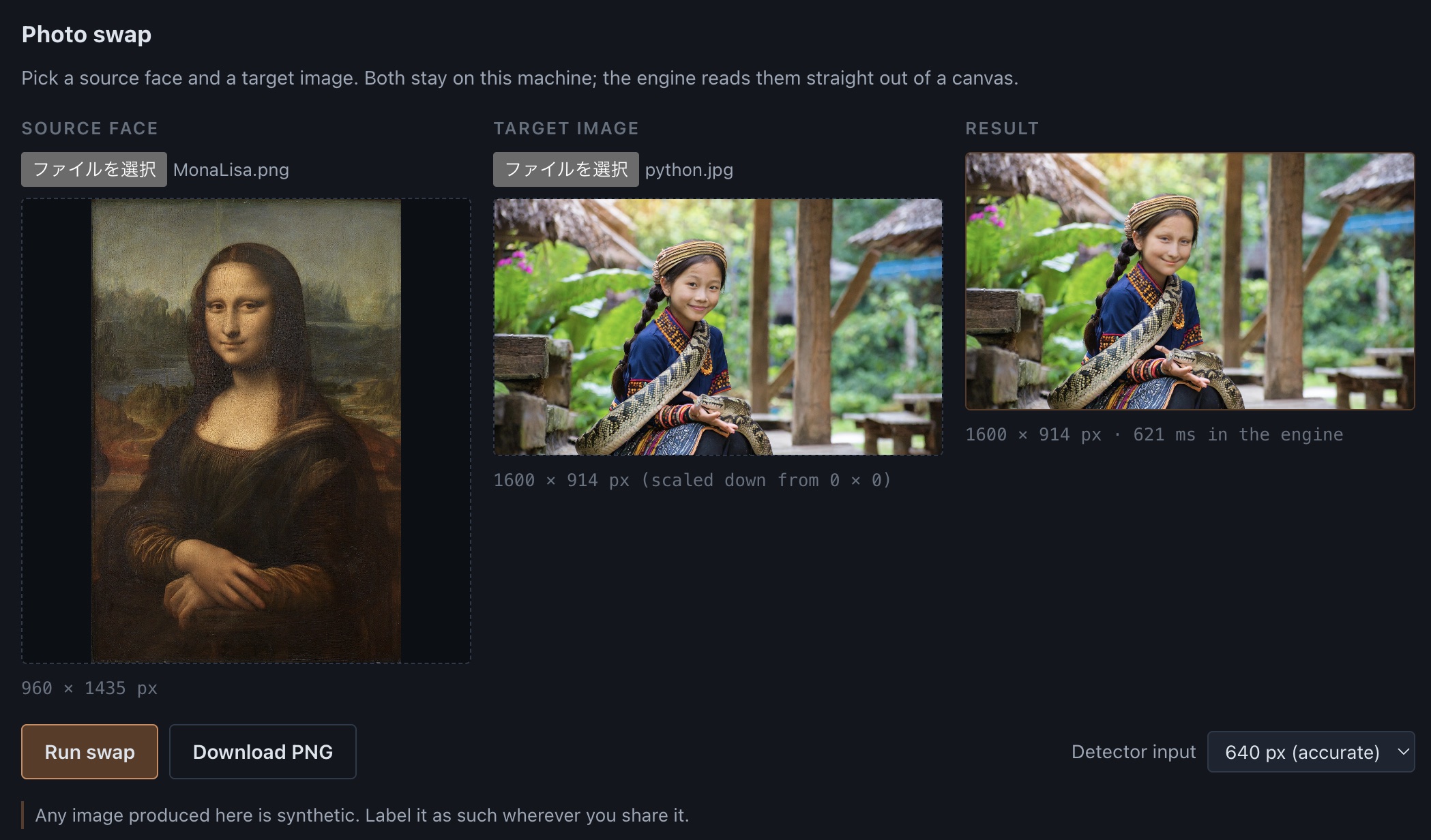
Source face and target image are read straight out of a canvas and stay on the machine running the engine. The result panel reports the wall-clock time OxiONNX spent in the engine -- 621 ms for the 1600 x 914 frame above, at the 640 px detector input setting. Below is that output at full resolution:

Read the full README
Above: synthetic image, generated by the demo. Not a photograph.
Synthetic media notice. Every image this demo produces is synthetic, and the demo labels it as such. Please keep that label attached wherever such output is reshared.
Features
- Pure Rust -- Zero C/C++/Fortran dependencies. Safe, portable, auditable.
- 189 ONNX operators -- Math, NN, Conv, Shape, Indexing, Comparison, RNN, Attention, ML; real-world detection models run, including YOLOv8 and YOLO11 (opset 11+)
- GPU dispatch is device- and shape-aware -- every
oxionnx-gpuentry point decides whether a node is worth dispatching fromGpuTuning, derived once from the adapter's ownwgpu::AdapterInfo, rather than from compile-time constants. Three consequences worth knowing before turning thegpufeature on: a total FLOP count is not sufficient (a skinny[1,25088] x [25088,512]GEMM clears any FLOP floor and measured 1.54x slower than the CPU kernel on an RTX A4000, because it moves a 51.4 MBBto do 25.7 MFLOP -- so the gate also tests arithmetic intensity,2mkn/(mk+kn+mn)); the same shape is 0.43x, a 2.3x win, once thatBis served from the weight-residency cache, so the gate takes residency as an input rather than applying one rule to both; and a software adapter (Mesalavapipe, SwiftShader, Direct3D WARP -- what a headless container gets frommesa-vulkan-drivers) declines every size, because it is the same CPU running one invocation per shader thread without rayon ormatrixmultiply. On Linux, wgpu also needs the Vulkan loader package (libvulkan1/vulkan-loader/vulkan-icd-loader), which GPU driver packages do not pull in;GpuContext::try_new_diagnosed()names it instead of returning a bareNone - GPU acceleration -- wgpu compute shaders for MatMul, Gemm (incl. transposed-B
gemm_nt), Conv2D (direct implicit-GEMM kernel with no im2col materialization, ~692 GFLOP/s at InSwapper-128's 128x128 decoder layer on M3), Softmax, ReLU, PRelu, Resize, broadcast elementwise, etc. Session-lifetime weight residency cachesConv'sW/BandGemm'sB/Cinitializers on the device after their first upload (Session::gpu_resident_bytes(); e.g. InSwapper-128's 502.7 MB/frame of convolution weights now cross the host<->device bus once per session instead of once per dispatch), and run-scoped activation residency lets one GPU node's output stay device-resident for the next GPU consumer to bind in place instead of a read-back plus re-upload at every node boundary (toggle viaSession::activation_residency_enabled()/set_activation_residency()). A measured two-tier size gate (gpu_min_transfer_elements) declines to dispatch memory-bound elementwise ops whose operands must still cross the bus -- several measured strictly slower on the GPU than the rayon CPU kernel by more than an order of magnitude (up to ~36x forRelu) -- so turning on thegpufeature does not by itself guarantee a speedup on every op; residency and this size gate are what keepOpPlacement::Autofrom trading a CPU win for a GPU loss - SIMD optimization -- NEON (aarch64) and AVX2 (x86_64) for element-wise ops
- Multi-dtype -- f32, f16, bf16, i8, i32, i64 with automatic type promotion
- INT8 quantization -- Quantized MatMul with per-channel scale/zero-point
- Mixed precision -- f16 activations with f32 accumulation
- Graph optimization -- Constant folding, operator fusion, CSE, dead code elimination
- Memory efficiency -- Arena allocator, buffer pooling, strided tensor views
- Streaming inference -- Token-by-token generation for autoregressive models:
session.generate(prompt, GenerationConfig)returns aTokenStreamiterator that runs one forward pass pernext(), feeds the model'spresent.*key/value outputs back in as the next step'spast.*inputs, and stops on EOS, on a token cap, or on cancellation. Greedy (argmax) selection only -- temperature / top-k / top-p / beam search are deliberately out of scope; setemit_logitsand sample outside the crate. No tokenizer: token ids in, token ids out - Async execution -- Non-blocking inference via
Arc::clone(&session).run_async(inputs), which starts the model on astd::threadimmediately and returns aRunFuture. Executor-agnostic (no async-runtime dependency at all):.awaitit under tokio/async-std/smol, or drive it with the crate's own dependency-freeblock_on.spawn_run()returns a blockingRunHandlefor callers with no executor. The receiver isArc<Self>because the worker thread outlives the call; thread-per-inference is the right tool for one long inference, not for many small concurrent ones. Native targets only --wasm32-unknown-unknowncannot spawn OS threads, so this whole module is compiled out there (a compile-time error on that target rather than the runtime panic it used to be); callSession::runsynchronously instead - Cancellation --
SessionBuilder::with_session_cancellation(token)makes every operator the model uses check aCancellationTokenbefore it runs, sorun()unwinds withOnnxError::Cancelledat the first node boundary aftertoken.cancel()-- on the sequential path, the rayon parallel path, and insideIf/Loop/Scanbodies. The token is session-scoped: cancelling stops every run in flight on that session. For per-request cancellation of a generation, useGenerationConfig::with_cancellation, which is checked between decode steps. Nodes claimed by a GPU execution provider are dispatched before the registry and are not cancellation points - Control flow -- If/Loop/Scan operators with nested subgraph execution
- ONNX local functions --
FunctionProtobodies are inlined into the graph at load time, in both the eager and streaming parsers, so models built from reusable function definitions execute like any other graph - Rank-generic convolution --
Conv/ConvTransposesupport 1D/2D/3D spatial ranks through a shared N-D im2col path (padsuses the ONNX[begin_0..begin_r-1, end_0..end_r-1]layout, which forr == 2is exactly the classic[top, left, bottom, right]array); the 2D case keeps its dedicated fast path - Rank-0 (scalar) tensor support --
Tensor/TensorViewrepresent a true ONNX scalar (shape: vec![], one element) instead of silently promoting every rank-reducing result to shape[1];Detand the loss ops (NegativeLogLikelihoodLoss/SoftmaxCrossEntropyLosswithreduction=mean|sum) emit it end-to-end today, confirmed through shape resolution and output-slot allocation -- most other rank-reducing ops (e.g. an all-axesReduce*) still promote to[1], a known tracked gap - Opset-aware execution --
Softmax/LogSoftmax/Hardmaxbranch on the model's declaredai.onnxopset (parsed fromopset_import) instead of hardcoding opset-13+ semantics, so a pre-13 model gets the spec's default-axis-1-and-flatten-to-2D contract rather than the post-13 per-axis one - Einsum ellipsis and broadcasting -- the equation parser handles numpy-compatible
...tokens (e.g....ij,...jk->...ikfor broadcast batched matmul) with numpy's right-aligned broadcasting rule, and a label shared across operands broadcasts when one side's extent is1; large contractions lower tomatrixmultiply::sgemmvia greedy pairwise decomposition instead of a scalar loop nest - Model encryption -- AES-GCM encrypted model files, keyed with CSPRNG-derived nonces
- WebAssembly --
wasm32-unknown-unknownCPU inference via wasm-bindgen (wasmfeature); load a model from bytes and run it with no native code path involved.-C target-feature=+simd128routes matrixmultiply's MatMul/Convsgemmkernel through itsv128SIMD path (measured ~3-4.3x over the scalar fallback).Session::run_async/spawn_run(thread-per-inference) are unavailable on this target -- wasm32-unknown-unknown cannot spawn OS threads -- callSession::runsynchronously instead; GPU acceleration (gpufeature) now builds forwasm32too, with a working async execution path --Session::enable_gpu_async/run_gpu_async,GpuContext::try_new_asyncacquiring awgpu::Backends::BROWSER_WEBGPUadapter, kernels awaiting a realmap_asyncread-back -- proven on native targets so far; it is not yet wired into thesewasm-bindgenbindings (WasmSessionstill runs every GPU-eligible node on the CPU) or exercised in an actual browser - no_std -- Core types work without std (alloc only)
- Session caching --
session.save_optimized(path)writes the post-optimization graph (nodes, rewritten weight table, value-info, model metadata, nested subgraphs) in a version-tagged, length-prefixed pure-Rust binary format;Session::load_optimized(path)/SessionBuilder::load_optimized(path)rebuilds it atOptLevel::None, so constant folding, CSE, fusion and dead-node elimination do not run again (the test suite proves this by counting operator executions during load: exactly zero). The encoding is deterministic, so a cache file can be content-hashed; a truncated, foreign or wrong-version file is always a typedOnnxError::Parse. Runtime settings (threads, providers, profiling, memory pool) are not cached -- they come from the builder that loads it - Native dtype dispatch --
run_typed()path executes 40+ operators natively (no f32 round-trip) viaTypedOpContext; MatMul and Gemm natively handle F32/F16/BF16/I8→I32/I32 dtypes, and Conv/ConvTranspose, Attention/MultiHeadAttention, and LSTM/GRU also have dedicated native F32/F16/BF16 typed kernels (cast-compute-cast with an f32 accumulator) beyond the original pilot set - DirectML backend -- Windows D3D12 execution provider (
directmlfeature) with CPU fallback on other platforms; opt-in (OXIONNX_DIRECTML=1/.with_directml(true)), compile- and lint-verified for Windows and proven on Linux against a CPU oracle, but not yet executed on GPU hardware - Zero-copy output reuse -- Operators write into pre-allocated output slots via
execute_into_slots; a large subset of hot operators (elementwise, activations, normalization, reduce, pooling, shape, indexing, attention, conv, RNN) have hand-coded zero-copy slot-write kernels that avoid the intermediate copy and preserve pointer identity across inference runs withIoBinding. Operators without a hand-coded kernel fall back to a correct copy-based default (execute()thencopy_from_slice) - Graph introspection -- Enumerate a model's compute nodes (op type, inputs, outputs, attributes) via
Session::nodes()/NodeInfo
Status
| Crate | Status | Tests (all-features)* |
|---|---|---|
oxionnx (root) | Alpha | 1,113 passing |
oxionnx-core | Stable | 69 passing |
oxionnx-ops | Alpha | 1,325 passing |
oxionnx-proto | Stable | 134 passing |
oxionnx-gpu | Alpha | 272 passing |
oxionnx-cuda | Partial | 397 passing -- MatMul/Gemm (batched, with session-lifetime buffer-pool/weight/PTX-module caching), Conv (direct dispatch to oxicuda-dnn's Conv1x1/DepthwiseConv/ImplicitGemmConv), 16 unary activations, Add/Sub/Mul/Div (incl. channel and scalar broadcast), PRelu, BatchNorm/OxiInstanceNorm, ReduceSum/Max/Mean, Softmax, MaxPool/AveragePool, Resize, Pad, Slice, Concat, and zero-cost Reshape/Squeeze/Unsqueeze/Flatten -- 40 ops total via is_supported_op, plus opt-in CUDA Graph capture for MatMul/Gemm. Most of these tests need no GPU; the on-device gpu-tests suite skips gracefully on a host with no CUDA device, so this row's count is not evidence the device paths ran |
oxionnx-directml | Implemented (opt-in; GPU path not yet hardware-verified) | 242 tests, all Linux-executed or cross-target type-checked. Dual backend — DirectML operators + HLSL/D3D12 compute fallback — routing 15 ops: MatMul, Gemm, Add, Sub, Mul, Div, Relu, Sigmoid, Tanh, Softmax, ReduceSum, ReduceMean, ReduceMax, ReduceMin, Conv; kernels compile/lint-verified for Windows and proven on Linux vs a CPU oracle, but not yet run on GPU hardware |
oxionnx-coreml | Alpha (opt-in; predict path not yet verified against a real model) | 8 passing on non-Apple hosts (compiles to a stub); 43 passing + 8 skipped on macOS/iOS/tvOS/visionOS. The 43 cover the surrounding logic -- tensor/MLMultiArray layout conversion, f16 up-conversion, metadata handling. The 8 that skip are exactly the end-to-end ones (test_load_arcface, test_predict_arcface_returns_512_dim_embedding, the two compute-plan tests, test_model_metadata_returns_ok_map): they need a real .mlpackage, so predict/predict_raw/predict_features, ANE engagement and the compute plan are not exercised by the passing count. Apple frameworks are reached through objc2/objc2-core-ml, behind the off-by-default coreml feature |
* Per-crate figures are all-features passing counts from this release (the oxionnx-coreml row uses its macOS figure, 43, since that is the host this run used) and sum exactly to the workspace total below: 1,113 + 69 + 1,325 + 134 + 272 + 397 + 242 + 43 = 3,595 passing.
Total: 3,595 tests passing with all features (cargo nextest run --workspace --all-features, run on macOS; the exact count drifts between runs as the workspace evolves under active development), 3,289 with default features (19 pre-filtered/ignored tests either way). 0 clippy warnings on the host target (cargo clippy --all-features --all-targets -- -D warnings). Platform-gated suites still run only on their target OS — this run's macOS host exercises oxionnx-coreml's Apple-only paths, included above (8 of its tests still skip, needing a real .mlpackage), but not oxionnx-directml's Windows FFI tests, and oxionnx-cuda's on-device tests skip for want of an NVIDIA device — so no single machine runs the entire cross-platform set, and a green total is not by itself evidence every hardware path ran. 190,392 lines of Rust (159,672 excluding blanks/comments).
Quick Start
use oxionnx::{Session, Tensor};
use std::collections::HashMap;

// Load model
let session = Session::from_file("model.onnx".as_ref())?;

// Prepare input
let mut inputs = HashMap::new();
inputs.insert("input", Tensor::new(vec![1.0, 2.0, 3.0], vec![1, 3]));

// Run inference
let outputs = session.run(&inputs)?;
println!("{:?}", outputs);
Session Builder
use oxionnx::{Session, OptLevel};

let session = Session::builder()
    .with_optimization_level(OptLevel::All)
    .with_memory_pool(true)
    .with_parallel_execution(true)
    .with_profiling()
    .load("model.onnx".as_ref())?;
Supported Operators
OxiONNX implements 189 ONNX operators (plus 15 aliases: short-forms like LayerNorm/RMSNorm/Silu/CeLU, plus the 11-name ai.onnx.ml.* domain) -- 204 op-type strings resolve through the registry in total.
| Category | Count | Examples |
|---|---|---|
| Math | 47 | MatMul, Gemm, Add, Mul, Pow, Sqrt, Reduce* (incl. L1/L2/LogSum/LogSumExp/SumSquare), Trig, ArgMax/Min, CumSum, TopK, BitShift, VariadicMin/Max/Mean/Sum, Det |
| Neural Network | 35 | Relu, Sigmoid, Softmax, LayerNorm, BatchNorm, GELU, SiLU, Mish, GroupNorm, InstanceNorm, RmsNorm, Hardmax, Shrink, NegativeLogLikelihoodLoss, SoftmaxCrossEntropyLoss |
| Convolution / Pool | 15 | Conv, ConvTranspose (rank-generic: 1D/2D/3D), MaxPool, AveragePool, GlobalAvgPool, GlobalMaxPool, Pad, Resize, LRN, LpPool, GlobalLpPool, MaxUnpool, MaxRoiPool, Upsample, Col2Im |
| Shape | 15 | Reshape, Transpose, Concat, Slice, Split, Flatten, Tile, DepthToSpace, SpaceToDepth, ReverseSequence, Size, Expand, Squeeze, Unsqueeze, CenterCropPad |
| Indexing / Quant | 16 | Gather, GatherElements, GatherND, Scatter, ScatterND, Where, OneHot, Compress, Unique, QuantizeLinear, DequantizeLinear, QLinearConv, QLinearMatMul, MatMulInteger, ConvInteger, DynamicQuantizeLinear |
| Comparison / Logic | 26 | Equal, Greater, Less, And, Or, Not, Xor, Bitwise* (And/Or/Xor/Not), IsInf, IsNaN, NonZero, Cast, CastLike, Constant, Einsum, ConstantOfShape, EyeLike, Trilu, Identity, Shape, NonMaxSuppression |
| RNN / Attention | 8 | RNN, LSTM, GRU, Attention, MultiHeadAttention, RotaryEmbedding, GridSample, RoiAlign |
| DSP | 7 | DFT, STFT, HannWindow, HammingWindow, BlackmanWindow, MelWeightMatrix, Bernoulli |
| Control Flow | 3 | If, Loop, Scan |
| ONNX-ML | 11 | LinearClassifier, LinearRegressor, TreeEnsembleClassifier/Regressor, SVMClassifier/Regressor, Normalizer, Scaler, LabelEncoder, TfIdfVectorizer, StringNormalizer |
| Random / Generator | 5 | RandomNormal, RandomUniform, RandomNormalLike, RandomUniformLike, Multinomial |
Feature Flags
| Feature | Description |
|---|---|
gpu | GPU acceleration via wgpu |
simd | SIMD-accelerated element-wise ops |
encryption | AES-GCM model encryption |
cuda | CUDA GPU acceleration via OxiCUDA |
mmap | Memory-mapped weight loading |
wasm | WebAssembly browser bindings -- CPU inference on wasm32-unknown-unknown via wasm-bindgen. Combining this with gpu now builds: Session's Send + Sync requirement is wasm32-exempt and an async WebGPU path exists (enable_gpu_async/run_gpu_async, BROWSER_WEBGPU adapter, map_async read-back), proven on native targets only -- not yet wired into these bindings or run in a browser |
wasm-threads | Re-enables rayon's intra-operator parallelism on wasm32. Needs a nightly -Z build-std browser build with +atomics,+bulk-memory, a cross-origin-isolated page, and a wasm-bindgen-rayon initThreadPool() call before the first operator. Inert on every non-wasm32 target |
ndarray | ndarray interop for Tensor conversion |
directml | DirectML GPU acceleration (Windows, via D3D12) |
coreml | CoreML execution provider (Apple Silicon: macOS/iOS/tvOS/visionOS) |
Architecture
oxionnx (root)           -- Session, optimizer, execution engine
  oxionnx-core           -- Tensor, DType, Graph, Operator trait, OnnxError
  oxionnx-ops            -- 189 operator implementations
  oxionnx-proto          -- Pure Rust ONNX protobuf parser
  oxionnx-gpu            -- wgpu compute backend (optional)
  oxionnx-cuda           -- CUDA dispatch layer via OxiCUDA (optional)
  oxionnx-directml       -- DirectML execution provider for Windows D3D12 (optional)
  oxionnx-coreml         -- CoreML execution provider for macOS/iOS/tvOS/visionOS (optional)
Performance
OxiONNX is a pure Rust implementation with no C/C++ BLAS dependency.
Run cargo bench --bench performance to measure on your hardware.
Operator Microbenchmarks
benches/performance.rs covers MatMul (512², 1024², 2048², via matrixmultiply), Conv2D
(64ch 56×56 3×3, im2col + matmul), Softmax and LayerNorm at [1, 128, 768], GELU over 100K
elements (SIMD-accelerated under --features simd), and broadcast Add. Numbers are
hardware-specific and deliberately not reproduced here -- run the bench to get yours.
End-to-End Model Workloads
| Workload | Description | Notes |
|---|---|---|
| ResNet-50 backbone | Conv(3→64, 7×7) → BN → ReLU → MaxPool → 4 residual blocks | batch=1, 224×224 input |
| BERT attention | Q/K/V projections → scaled dot-product attention → output proj | seq=128, hidden=768 |
| Transformer block | LayerNorm → Attention → FFN(GELU) → Residual | Stacked 4-layer encoder |
| Optimization passes | Session load with/without graph optimization | 20-layer graph with dead code |
Performance Characteristics
- Pure Rust, zero C/BLAS: All computation uses
matrixmultiply(pure Rust BLAS-like) and hand-written kernels - SIMD: Optional NEON (aarch64) and AVX2 (x86_64) acceleration for element-wise ops via
--features simd - Graph optimization: Constant folding, operator fusion, CSE, and dead code elimination reduce runtime overhead
- Memory pooling: Buffer reuse across inference calls reduces allocation pressure
- Parallelism: Rayon-based parallel execution of independent graph branches
Comparison note: OxiONNX prioritizes portability and safety: pure Rust with zero C/C++/Fortran dependencies, built on memory-safe pure-Rust crates. It is not
unsafe-free — the ops crate confinesunsafeto a few documented sites: the call intomatrixmultiply(itself pure Rust) that backs MatMul/Conv in the default build, plus optional SIMD intrinsics compiled only under--features simd. In the default (non-simd) buildoxionnx-opsis#![deny(unsafe_code)], with thosematrixmultiplycall sites the only explicitly-allowed exceptions. For absolute peak throughput, C++ runtimes like onnxruntime (with MKL/cuDNN) will be faster on operations dominated by BLAS. OxiONNX targets use cases where pure Rust, WebAssembly compatibility, and zero native dependencies are more important than raw FLOPS.
License
Apache-2.0
Author
COOLJAPAN OU (Team Kitasan)
Compatibility
- Runs on
- CUDA, WebGPU
What shows it
- CUDA: oxionnx feature cuda
- WebGPU: oxionnx feature gpu (dependency wgpu), oxionnx-gpu dependency wgpu
- Native code
- None found
- No native code found
- Python bindings
- No Python binding crate found
- License
- Apache-2.0
Compare with similar projects
Order: strongest tier first, then most downloads, then name, with unmeasured values last. A library counts downloads over 30 days. An app counts binary downloads per release. An app with none counts its crate downloads over 30 days. ML Rust runs this catalogue, so its closest project always gets a row.
| Project | Downloads | Dependents | Stars | Latest release | Runs on (GPU) | Native code | License |
|---|---|---|---|---|---|---|---|
|
Pure Rust ONNX inference engine — zero C/C++ dependencies |
550 downloads over 30 days | 24 | 20 | 0.1.7 | CUDA, WebGPU | No native code found | Apache-2.0 |
|
ort Featured
A safe Rust wrapper for ONNX Runtime 1.31 - Optimize and accelerate machine learning inference & training |
3,902,768 downloads over 30 days | 694 | 2,611 | 2.0.0-rc.15 | CUDA, WebGPU, ROCm | Binds native code: onnxruntime, ort-sys. Build uses a native toolchain: pkg-config (feature pkg-config) | Apache-2.0 OR MIT |
|
llama-gguf Listed
A high-performance Rust implementation of llama.cpp - LLM inference engine with full GGUF support |
1,787 downloads over 30 days | 3 | 21 | 0.14.0 | CUDA, Metal, Vulkan | Binds native code: hailort-sys (feature hailo), libsqlite3-sys (feature rag-sqlite) | Apache-2.0 OR MIT |
|
Inference server for LLMs, speech and embeddings: OpenAI-compatible routes with streaming, plus speech synthesis (TTS) and transcription (ASR). Serves Llama, Mistral, Qwen, Mamba2, MLA+MoE and hybrid models from SafeTensors, AWQ, GPTQ and GGUF. |
8 binary downloads per release | Not applicable | 7 | 0.7.1 | CUDA, WebGPU | Binds native code: ring (feature distributed) | Apache-2.0 |
|
Pure Rust + CUDA LLM inference engine — no PyTorch, OpenAI-compatible, serves Qwen3 to Kimi-K2 |
6 binary downloads per release | Not applicable | 738 | Not measured | Not measured | Apache-2.0 | |
|
oxibonsai Listed
Pure Rust 1-bit LLM inference engine for PrismML Bonsai models — umbrella crate |
1 downloads over 30 days | 0 | 137 | 0.2.3 | CUDA, Metal | No native code found | Apache-2.0 |
|
furnace New
Fast, unified, Rust-native, Axum-compatible inference endpoints and nervous system for tensor models and LLMs: KServe / Triton and OpenAI APIs from one pure-Rust server |
241 downloads over 30 days | 0 | 66 | 0.16.2 | CUDA, WebGPU, Metal | No native code found | MIT |
Why ListedNo archive, New or Featured rule places it, so it is Listed.
What it lacks for Featured
- It has 2 active dependents and 2 new dependents in 365 days. Featured needs 11 active dependents or 9 new dependents in 365 days. The repository route reads 20 stars, 3 forks and 1 contributor. It needs 4,539 stars, 434 forks and 79 contributors together.
What else the check found
- The last activity is on 13 Aug 2026, 88 days ago. The rules expect an update within 400 days. Dormancy rule
Exact rules: Listed, Featured library. The check on applied thresholds version 9.
Every rule outcome, as the check records it
expected-interval: version 0.1.7 base 450, capped at 8 releases = 400: E = 400 daysdormancy: last activity 2026-08-13, 88 days ago, E = 400: activefeatured: not featured: active_users 2 < 11 and new_adopters 2 < 9 and repository route stars 20 (needs 4539), forks 3 (needs 434), contributors 1 (needs 79)listed: listed: no archive, new or featured rule applies
Crates8 crates
Measurements and sources
Each signal row shows the raw value, its source and the fetch date. The Sources list gathers every distinct source on this page. Movement needs more history.
Sources6 sources
- Description: the crates.io description
- crates.io database dump, fetched
- RustSec advisory database, fetched
- GitHub repository, fetched
- crates.io package, fetched
- GitHub contributors, fetched
Adoption2 active dependents, 2 new dependents in 365 days1 not measured
| Signal | Value | Source | Fetched | Counts |
|---|---|---|---|---|
| Active dependents | 2 | crates.io database dump | Yes | |
| New dependents (365 days) | 2 | crates.io database dump | Yes | |
| Peak active dependents | 3 | crates.io database dump | Yes | |
| Active dependents as a share of the peak | 1 | crates.io database dump | Yes | |
| Binary downloads per release | Not measured | Yes |
MaintenanceLatest human commit: 2 months ago3 not measured
| Signal | Value | Source | Fetched | Counts |
|---|---|---|---|---|
| Latest human commit | 2026-08-13 | GitHub repository | Yes | |
| Latest release | 2026-08-13 | crates.io database dump | Yes | |
| First release | 2026-03-26 | crates.io database dump | Yes | |
| Latest version | 0.1.7 | crates.io database dump | Yes | |
| Days the oldest outside issue waits for a reply | 0 | GitHub repository | Yes | |
| Maintainer replies over 365 days | 7 | GitHub repository | Yes | |
| Repository archived | false | GitHub repository | Yes | |
| Repository gone | false | GitHub repository | Yes | |
| Release commit or manifest in the repo | true | crates.io package | Yes | |
| Published docs | true | crates.io database dump | Yes | |
| Latest release fails cargo check | Not measured | Yes | ||
| Build check date | Not measured | Yes | ||
| Build check toolchain | Not measured | Yes |
SecurityUnpatched vulnerabilities: none
| Signal | Value | Source | Fetched | Counts |
|---|---|---|---|---|
| Unpatched vulnerabilities past the grace window | none | RustSec advisory database | Yes | |
| RustSec unmaintained advisory | none | RustSec advisory database | Yes | |
| Deprecation notice | none | crates.io database dump | Yes | |
| Deprecated requirement | none | crates.io database dump | Yes |
Distribution8 releases, 550 downloads over 30 days5 not measured
| Signal | Value | Source | Fetched | Counts |
|---|---|---|---|---|
| Releases | 8 | crates.io database dump | Yes | |
| Downloads over 30 days | 550 | crates.io database dump | Yes | |
| Binary downloads over the last 3 releases | Not measured | Yes | ||
| Homebrew installs on request over 365 days | Not measured | Yes | ||
| Repology repository families | Not measured | Yes | ||
| Docker pull growth over 90 days | Not measured | Yes | ||
| Docker pulls at the growth baseline | Not measured | Yes | ||
| Every version a prerelease | false | crates.io database dump | Yes | |
| Every version 0.0.x | false | crates.io database dump | Yes | |
| Every version yanked | false | crates.io database dump | Yes | |
| Crate deleted from crates.io | false | crates.io database dump | Yes |
Repository20 stars, 3 forks, 1 contributors, 8 commits. Stars alone never qualify a project.
| Signal | Value | Source | Fetched | Counts |
|---|---|---|---|---|
| GitHub stars | 20 | GitHub repository | Yes — one part of the repository route | |
| GitHub forks | 3 | GitHub repository | Yes — one part of the repository route | |
| Contributors with a GitHub account | 1 | GitHub contributors | Yes — one part of the repository route | |
| Commits on the default branch | 8 | GitHub repository | No | |
| Repository's main crate left out of the entry | none | crates.io database dump | Yes |
Facts that never count
| Signal | Value | Source | Fetched | Counts |
|---|---|---|---|---|
| License | Apache-2.0 | crates.io database dump | No | |
| Runs on, from listed crates and their direct dependencies | CUDA, WebGPU | crates.io database dump | No | |
| What shows each backend | CUDA: oxionnx feature cuda; WebGPU: oxionnx feature gpu (dependency wgpu), oxionnx-gpu dependency wgpu | crates.io database dump | No | |
| Native code, from listed crates and their dependencies | No native code found | crates.io database dump | No | |
| Python bindings, from direct dependencies of listed crates | No Python binding crate found | crates.io database dump | No | |
| Crates that depend on a listed crate directly | 24 | crates.io database dump | No |
Corrections and review history
No correction applies to this entry.
Judgments
A judgment enters only through an approved issue and a merged pull request.
No judgment applies to this entry.