furnace
Library New
Fast, unified, Rust-native, Axum-compatible inference endpoints and nervous system for tensor models and LLMs: KServe / Triton and OpenAI APIs from one pure-Rust server
- Downloads
- 241
- Dependents
- 0
- Stars
- 66
- Forks
- 6
- Contributors
- 4
- Commits
- 363
- Latest release
- 0.16.2 ·
About
Furnace serves Burn models over HTTP and gRPC, as an axum
router you mount in your own Rust service or as a standalone server. The server itself
(furnace-server) runs no model and depends on no ML framework; Burn models come in through
furnace-burn, and any other engine through the TensorModel trait.
Try it in a minute: the nervous system in your terminal, with a mock LLM as the brain, no model file and no port:
cargo install --locked --git https://github.com/Gilfeather/furnace furnace-demo && furnace-demo
Every signal shows where it went, why, and how long until the actuator acted: a reflex in
microseconds, the mock brain in a couple of hundred milliseconds, repeats quiet at the
receptor. Releases after 0.13 also publish it as
docker run --rm -t ghcr.io/gilfeather/furnace-demo. Before you depend on Furnace, read
what it cannot do yet and the FAQ.
Embed it in your Axum app
Your app keeps its own routes for pre- and post-processing, the database and the rest of your API. Furnace adds the inference endpoints, with backpressure, metrics, optional dynamic batching and the KServe / Triton protocol:
Read the full README
use axum::{Json, Router, routing::get};
use burn::module::Module;
use burn::nn::{Linear, LinearConfig};
use burn::tensor::{Device, Tensor};
use furnace::Server;
use furnace_burn::BackendKind;

// One of your own routes: the class names for the 10 logits /predict returns
async fn labels() -> Json<Vec<String>> {
    Json((0..10).map(|digit| digit.to_string()).collect())
}

#[tokio::main]
async fn main() -> Result<(), Box<dyn std::error::Error>> {
    tracing_subscriber::fmt::init(); // Furnace logs through `tracing`; without this it prints nothing
    let device = BackendKind::Cpu.device();
    let mut net = Net::new(&device); // your Burn Module
    furnace_burn::weights::load_burnpack(&mut net, "net.bpk")?;
    let model = furnace_burn::from_fn("digits", BackendKind::Cpu, &[784], &[10],
        move |images: Tensor<2>| net.forward(images))?;

    let app = Router::new()
        .route("/labels", get(labels))
        .merge(Server::new().model(model).router()?);

    let listener = tokio::net::TcpListener::bind("0.0.0.0:3000").await?;
    axum::serve(listener, app).await?;
    Ok(())
}

// Your Burn Module
#[derive(Module, Debug)]
struct Net {
    linear: Linear,
}

impl Net {
    fn new(device: &Device) -> Self {
        Self { linear: LinearConfig::new(784, 10).init(device) }
    }

    fn forward(&self, images: Tensor<2>) -> Tensor<2> {
        self.linear.forward(images)
    }
}
[dependencies]
furnace-server = "0.16"
furnace-burn = "0.16"
burn = "0.22"
axum = "0.8"
tokio = { version = "1", features = ["macros", "rt-multi-thread", "net"] }
tracing-subscriber = "0.3"
The snippets in this README follow main, which is released as 0.16. Until 0.16 is on
crates.io, take both crates from the repository, so they are the same furnace-server:
furnace-server = { git = "https://github.com/Gilfeather/furnace" } and
furnace-burn = { git = "https://github.com/Gilfeather/furnace" }.
The app now answers GET /labels itself and, through Furnace, POST /predict,
POST /v2/models/digits/infer, GET /healthz, GET /readyz and GET /metrics. Furnace's API
keys and rate limits guard only its own routes (for per-IP rate limits, serve
app.into_make_service_with_connect_info::<furnace::api::ClientAddr>()). Models with several
or integer inputs, batching, and every setting are covered below.
Or run it standalone
The furnace command serves the same API on its own, from a release binary,
brew install gilfeather/tap/furnace or Docker
(Install). No Python, no C++ runtime: it starts in milliseconds and uses a fraction
of the memory of a Python stack.
Try it in 30 seconds (ResNet-18 built in):
docker run --rm -p 3000:3000 ghcr.io/gilfeather/furnace
curl -s localhost:3000/v2/models/resnet18     # inputs, outputs, shapes
Then send it tensors with any Triton or KServe client, or JSON to POST /predict
(Quick start below).
Measured as a server, against the minimum a Burn user would write by hand (one axum route
calling forward on a blocking thread) and against FastAPI. Shared runners are noisy: the
absolute numbers move from run to run, the ratios between the servers measured side by side
are what carries over.
On GitHub's ubuntu-latest runner (Intel(R) Xeon(R) Platinum 8370C CPU @ 2.80GHz, 4 cores), 2026-10-21, commit db85c42,
16 concurrent clients, medians of 3 runs (workflow run):
| Furnace | Hand-written axum | FastAPI (uvicorn, 4 workers) | |
|---|---|---|---|
| Model that returns its input: requests/s, median latency | 48,299, 0.29 ms | 60,758, 0.24 ms | 13,487, 1 ms |
| Small CNN digit classifier in Burn: requests/s, p95 | 18,572, 1.6 ms | 22,142, 1.4 ms | |
| ResNet-18 in Burn: requests/s, p95 | 21, 1.1 s | 21, 1 s | |
| Transformer text classifier in Burn: requests/s, p95 | 100, 194 ms | 100, 194 ms | |
| Ready after start, returning its input | 5.8 ms | 5.7 ms | 1.1 s (422 ms with 1 worker) |
| Memory (peak private), returning its input | 2.2 MB | 1.7 MB | 46 MB with 1 worker |
Furnace adds request IDs, metrics, input checks, backpressure and the Triton protocol to the hand-written server: 7.9 µs per request in process, one request at a time (30.0 µs against 22.1 µs). Under load it serves 79% of the hand-written server's requests per second with the model that returns its input and 100% with ResNet-18. The release binary with ResNet-18 built in is ready 46 ms after it starts and has answered its first inference at 79 ms.
For ONNX models, compiled to Burn, ONNX Runtime's kernels are faster on a CPU (the engines compared). Details and how to reproduce: docs/PERFORMANCE.md. Starting in milliseconds makes scaling to zero practical: docs/SERVERLESS.md.
Features
- Mount it in your own axum app with
Server::router(), or serve on its own withServer::new().model(furnace_burn::from_fn(...)?).serve(). - Serve the Burn model you wrote (
furnace-burn): one float tensor in and out through itsforward, or named FP32 / INT64 / INT32 tensors through theBurnModeltrait. Other engines implement furnace'sTensorModeltrait. - Also: compile an ONNX file in at build time: put
foo.onnxinfurnace-burn/models/, rebuild, runfurnace --model-name foo(with burn-onnx). - KServe / Triton Open Inference Protocol over HTTP and gRPC: Triton and KServe clients work unchanged. Tensors are FP32, INT64 or INT32, several in and out, in JSON or binary.
- LLMs too, from the library (feature
llm; thefurnacecommand does not serve them): the OpenAI chat and completions API with streaming, next to your other models in the same server. GGUF files run on the CPU through candle (furnace-candle), and your own Burn LLM plugs in with prefill and decode. See docs/LLM.md. - A nervous system: receptors, reflex arcs, a brain and effectors, with habituation, thresholds, refractory periods and pathway selection by timing, so that most signals never reach the LLM and the ones that must act do so in microseconds. Between the brain and the body sit a spine and a nerve per body part: the brain names an action ("get dressed"), and motor neurons break it down, retry and adjust locally, and report back up. The server's own routes run on it: every model is a neuron. See docs/NERVE.md.
- Several models per process, each swappable for new weights without downtime.
- Dynamic batching of concurrent requests, for models where it pays (off by default).
- Pure Rust, CPU or GPU:
--backend cpu|wgpu|metal|cuda. - Weights stay outside the binary in a memory-mapped
.bpkfile (or embed them with--features embed-weights). - Plain
/predictwith JSON or rawfloat32, and optionally JPEG/PNG with ImageNet preprocessing (--features image). - Production basics: request size limits, input validation, backpressure (
503), timeouts (504), Prometheus metrics, readiness after a warm-up, graceful shutdown. - Security: HTTPS and mutual TLS with certificate reload, in pure Rust (
--features tls); API keys; per-client rate limits.
Your own Burn models
Add furnace-server and furnace-burn next to Burn; furnace-burn's ONNX import (feature onnx)
is not needed for this (until 0.16 is on crates.io, use the git lines
above):
[dependencies]
furnace-server = "0.16"
furnace-burn = "0.16"
burn = "0.22"
tokio = { version = "1", features = ["macros", "rt-multi-thread"] }
tracing-subscriber = "0.3"
A model that takes one float tensor and returns one is served by its forward as it is:
use burn::module::Module;
use burn::nn::{Linear, LinearConfig};
use burn::tensor::{Device, Tensor};
use furnace::Server;
use furnace_burn::BackendKind;

#[tokio::main]
async fn main() -> furnace::Result<()> {
    tracing_subscriber::fmt::init(); // Furnace's startup and request logs
    let device = BackendKind::Cpu.device();
    let mut net = DigitNet::new(&device); // your Burn Module
    furnace_burn::weights::load_burnpack(&mut net, "digits.bpk")?;

    let model = furnace_burn::from_fn("digits", BackendKind::Cpu, &[1, 28, 28], &[10],
        move |images: Tensor<4>| net.forward(images))?;
    Server::new().port(3000).model(model).serve().await
}

// Your Burn Module: [batch, 1, 28, 28] images in, [batch, 10] logits out
#[derive(Module, Debug)]
struct DigitNet {
    linear: Linear,
}

impl DigitNet {
    fn new(device: &Device) -> Self {
        Self { linear: LinearConfig::new(28 * 28, 10).init(device) }
    }

    fn forward(&self, images: Tensor<4>) -> Tensor<2> {
        self.linear.forward(images.flatten(1, 3))
    }
}
It then answers POST /predict and POST /v2/models/digits/infer, one forward pass per
request. A model with several inputs or outputs, or integer ones (token ids, masks), implements
furnace_burn::BurnModel to name its tensors, is served with furnace_burn::custom, and
answers on /v2/models/{name}/infer.
furnace-burn/examples/serve_burn_model
runs both kinds:
cargo run --release --example serve_burn_model. Server::router() gives the same API as an
axum router to mount in your own app (above).
Batching is off by default. Server::new().max_batch_size(8) merges concurrent requests
into shared forward passes once the server is busy (models whose inputs have fixed shapes).
It pays for convolutional networks and on GPUs; for a transformer on a CPU it makes requests
slower, so leave it off there. docs/API.md has the details.
Server::request_timeout(..) sets the 504 limit, and Server::configure reaches every other
ServerConfig setting: limits, gRPC, TLS, API keys and the rest of the options below.
The nervous system
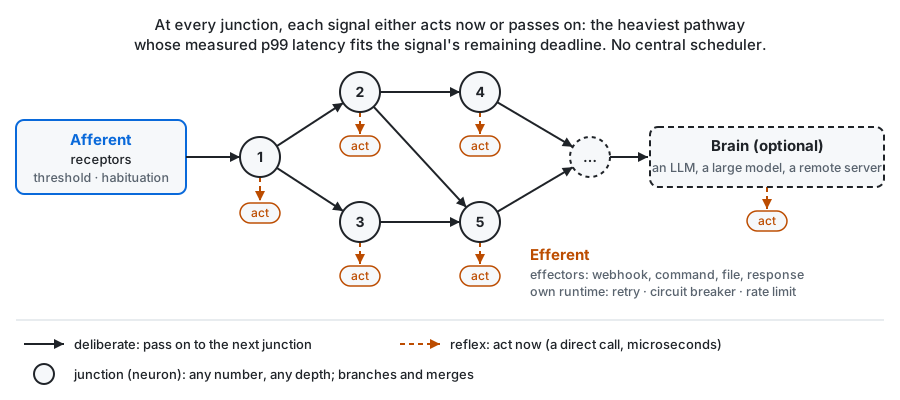
Furnace moves signals between sensors, models and actuators. Receptors gate each input (threshold, habituation to repeats, refractory period); then it runs through any number of junctions, chained, branching and merging as you wire them. At every junction a signal takes the heaviest pathway whose measured p99 latency fits its remaining deadline: a reflex that acts now (a direct call, microseconds) or a pass on to the next junction (a queue that sums signals into one firing). Latencies are measured as signals flow, so when the road ahead gets slow the reflex wins, with no central scheduler. Effectors act on their own runtime with retry, a circuit breaker and a rate limit. The brain (an LLM, any large model, a remote server) is optional. Depth has no limit but 32 hops per signal, a guard against wiring loops. Not a cache: only habituation is cache-like; the rest is routing at every junction and acting.
Between the brain and the body there is a spine and a nerve per body part, built in a few
lines (b.spine(brain), b.nerve("right_arm", |b| ...)). The brain talks to the spine only,
in a few actions ("get dressed", "stop"), and never reaches a joint. The spine carries what the
receptors should tell the brain up, and the actions down to motor neurons, whose programs
command the motor neurons and effectors below them, in turn or together, wait for what a
receptor senses and ask the brain a small question when stuck. Each nerve carries its own
part's load, the urgent first, so a jam in one arm holds up no other, and the part's own loops
close inside it: a slipped grip is tried again by the hand, not the brain. How the action
ended goes back up. cargo run --example get_dressed shows it, from the thermometer to the
knuckles and back.
On the same run, against a hand-written server doing the same work: 194 ns per hop, 0.9 µs from stimulus to effector call on a reflex arc, a brain fraction of 0.46 on a stream with half repeats, 39 µs added to a webhook. At 16 clients the fabric server serves 20% fewer requests per second than the bare handler (the server layer around it, not the fabric).
docs/NERVE.md has every measurement and its target.
use std::time::Duration;

use furnace::Server;
use furnace::llm::mock::MockEngine;
use furnace::nerve::prelude::*;
use serde_json::json;

#[tokio::main]
async fn main() -> furnace::Result<()> {
    tracing_subscriber::fmt::init();
    // Stands in for a real LLM (a GGUF file through furnace-candle, or your Burn model);
    // the brain's answer is commands for the actions it is told about
    let engine = MockEngine::new("mock", &[r#"{"effector": "log", "args": {"line": "seen"}}"#]);

    let mut b = Fabric::builder();
    let events = b.receptor(Http::new("events", "/events").text()); // POST /events
    let repeats = Habituation::new(Duration::from_secs(30));
    b.gate(events, Mechanisms::NONE.threshold(0.6).habituation(repeats)); // repeats die here
    let triage = b.neuron(FnNeuron::reflex("triage", |signal, _| {
        if signal.payload.as_text().is_some_and(|t| t.contains("ALERT")) {
            signal.command("alarm", json!({"text": signal.payload.as_text()})) // acts at once
        } else {
            signal // goes on to the brain
        }
    }));
    let brain = b.neuron(Llm::new("brain", engine));
    b.effector(Webhook::new("alarm", "http://127.0.0.1:9000/alarm")?);
    let log = b.effector(FileAppend::new("log", "journal.log"));
    // What the brain is told it may call: the journal, not the alarm
    b.action(log, "Write a line to the journal.", json!({"line": "text"}));
    b.reflex(events, triage);
    b.deliberative(triage, brain);
    Server::new().port(3000).nerve(b).serve().await
}
[dependencies]
furnace-server = { version = "0.16", features = ["llm"] }
tokio = { version = "1", features = ["macros", "rt-multi-thread"] }
serde_json = "1"
tracing-subscriber = "0.3"
docs/NERVE.md has the concepts, the API, the motor side, the demos
(furnace-demo, get_dressed and the full
cargo run --release -p furnace-burn --example nerve), how the server's own routes run on the
fabric, and the measurements.
Limits, and what is not done yet
- The API changes before 1.0. Any 0.x release may break it, with a migration note in the CHANGELOG and no deprecated aliases kept around. docs/ROADMAP-1.0.md says what will be frozen and what must happen first.
- One author. Furnace is written and maintained by one person, with what that means for reviews, response times and the bus factor.
- No long production record. CI runs unit, integration and KServe end-to-end tests, but nobody has reported running Furnace in production for months yet (ADOPTERS.md is empty).
- The TLS cryptography has not been audited. To stay pure Rust, the
tlsfeature uses a small rustls crypto provider of Furnace's own (rustls-pure) on RustCrypto primitives, not ring or aws-lc-rs. Nobody outside has reviewed that glue; it is checked mechanically against Google's Wycheproof test vectors instead. If you need audited TLS today, terminate TLS in a proxy in front of Furnace. - Almost no GPU numbers. Burn's wgpu, Metal and CUDA backends build through furnace-burn, but every published measurement is on CPU, apart from one old, untuned wgpu run on an integrated GPU (docs/PERFORMANCE.md).
- Junctions on other machines are wired by hand. A fabric lives in one process. To reach a
junction on another machine, connect fabrics with a
Webhookeffector on one side and anHttpreceptor on the other (or SSE out and in); the network hop is then an effector, not a pathway, so its latency does not take part in choosing between reflex and brain. - Outbound webhooks speak plain
http://; HTTPS webhooks are not supported yet.
docs/FAQ.md answers how Furnace differs from a cache, Ray Serve, Triton, BentoML, actors and message queues, whether it needs an LLM, and why pure Rust.
Install
As a library:
furnace-server, plusfurnace-burnto serve your own Burn models: see above and below.Release binaries for Linux (x86_64, musl, aarch64), macOS (Intel, Apple Silicon) and Windows come with
resnet18.bpkon the releases page. Put both in one directory and run./furnace --model-name resnet18. With cargo-binstall,cargo binstall furnace-clifetches the binary for your platform, and on macOS or Linuxbrew install gilfeather/tap/furnaceinstalls it with the ResNet-18 weights. Each release carries checksums, an SBOM and build provenance you can verify (SECURITY.md).Docker:
ghcr.io/gilfeather/furnace, for x86_64 and ARM64 (below).Kubernetes: a Helm chart and a KServe serving runtime in
deploy/.crates.io (package
furnace-cli, commandfurnace). ONNX models are compiled in, so point the build at your.onnxfiles:FURNACE_MODELS_DIR=/path/to/models cargo install furnace-cliBuilds from crates.io use Burn's stock CPU backend, which is several times slower than the release binaries until Furnace's CPU kernels ship in a Burn release.
From source: below.
Quick start
The standalone furnace command, built from source with an ONNX model compiled in:
Requires Rust 1.95 or later (on Windows, the Visual Studio C++ build tools).
git clone https://github.com/Gilfeather/furnace.git
cd furnace
mkdir -p furnace-burn/models
curl -L "https://github.com/onnx/models/raw/main/validated/vision/classification/resnet/model/resnet18-v1-7.onnx" -o furnace-burn/models/resnet18.onnx
cargo build --release
./target/release/furnace --model-name resnet18
Send it an image as JSON floats (/predict takes the 150,528 values of one preprocessed image):
cargo run --example resnet18_sample_data      # writes resnet18_single_sample.json
curl -X POST http://localhost:3000/predict -H "Content-Type: application/json" \
  --data-binary @resnet18_single_sample.json
# "output" holds 1000 logits
To send a JPEG or PNG as it is, with the ImageNet preprocessing done by the server, build with
the image feature (the release binaries and the Docker image above do not have it):
cargo build --release --features image
./target/release/furnace --model-name resnet18
curl -O https://github.com/pytorch/hub/raw/master/images/dog.jpg
curl -X POST http://localhost:3000/predict -H "Content-Type: image/jpeg" --data-binary @dog.jpg
# the largest of the 1000 logits is class 258 (Samoyed)
Or serve two models written in Burn, with no ONNX file at all:
cargo run --release --example serve_burn_model (see below).
ONNX models
The furnace command can also serve ONNX files without any Rust: every
furnace-burn/models/<name>.onnx (or $FURNACE_MODELS_DIR/<name>.onnx) becomes a built-in
model at build time:
curl -L "https://github.com/onnx/models/raw/main/validated/vision/classification/mnist/model/mnist-8.onnx" -o furnace-burn/models/mnist.onnx
cargo build --release
./target/release/furnace --model-name mnist
Inputs and outputs are float32, int64 or int32 tensors with the batch as their first
dimension, as many as the model has: an image classifier's one tensor in and out, a text model's token
ids and masks, a detector's several outputs. A model with one float32 input and one output of
fixed shapes is served on /predict too, with dynamic batching; any other takes its named
tensors on /v2/models/{model}/infer.
Models that burn-onnx can't convert (it supports opsets 1–24) are skipped with a build warning
saying why. docs/MODELS.md lists the models known to work, and the ones that
don't yet. If conversion fails, onnx-simplifier
often helps. furnace --help lists the models in a build.
API
| Endpoint | Purpose |
|---|---|
POST /predict | Inference, for models with one float tensor in and out |
GET /healthz / GET /readyz | Liveness / readiness (after the warm-up inference) |
GET /model/info | Input/output shapes and statistics |
GET /models, POST /models/{model}/predict | Several models side by side (details) |
POST /admin/models/{model}/reload | Swap in a model, e.g. new weights, without downtime (details) |
GET /metrics | Counters and latency percentiles as JSON, or the Prometheus format for a scraper |
/v2/... | KServe / Triton Open Inference Protocol: any model, by named tensors; Triton and KServe clients work unchanged |
/predict takes each input flattened (ResNet-18: 3 × 224 × 224 = 150,528 floats, CHW,
ImageNet-normalized) and returns raw logits:
{ "input": [0.12, -0.53, ...] }    →  { "output": [-1.59, -0.17, ...], "inference_time_ms": 8.1, ... }
{ "inputs": [[...], [...]] }       →  { "outputs": [[...], [...]], ... }
For speed, send Content-Type: application/octet-stream with little-endian float32 values
(and X-Batch-Size: N for a batch); add Accept: application/octet-stream to get raw floats
back. Every response carries an X-Request-Id (yours, or a generated one) that also tags the
server's log lines for that request. Full reference, including errors:
docs/API.md; OpenAPI spec: docs/openapi.json.
Options
| Option | Default | |
|---|---|---|
-m, --model-name <NAME> | the only built-in model | Model to serve; a,b serves several, the first by /predict |
-w, --weights <PATH> | <name>.bpk next to the binary, then in models/ | Weight file (one model) |
-b, --backend <BACKEND> | cpu | cpu, or wgpu / metal / cuda if built with that feature |
--host <HOST> / -p, --port <PORT> | 127.0.0.1 / 3000 | Listen address |
--max-concurrent-requests <N> | 100 | Beyond this, requests get 503 |
--max-body-mb <MB> | 100 | Request size limit |
--request-timeout-ms <MS> | none | Beyond this, requests get 504 |
--batch-workers <N> | 4 | With batching on: forward passes running at once; beyond this, concurrent requests are batched (details) |
--max-batch-size <N> | 1 | Most items per batched pass; the default leaves batching off. Try 8 for convolutional models and on GPUs |
--batch-timeout-us <US> | 2000 | Longest a batch waits for requests still arriving; a lone request never waits |
--threads <N> | one per physical core | Inference threads (also RAYON_NUM_THREADS) |
--grpc-port <PORT> | none | Also serve the KServe / Triton protocol over gRPC (builds with --features grpc; release binaries and the Docker image have it) |
--admin-token <TOKEN> | none | Enable the reload API for this bearer token (also FURNACE_ADMIN_TOKEN) |
--api-key <KEY> | none | Require a key on everything but health probes; repeatable (also FURNACE_API_KEYS) (details) |
--rate-limit <PER_SECOND> / --rate-limit-burst <N> | none | Per-client request rate (by API key, else IP address); beyond it, 429 |
--tls-cert <PEM> / --tls-key <PEM> | none | Serve HTTPS and gRPC over TLS; reloaded when the files change (details) |
--tls-client-ca <PEM> | none | Mutual TLS: only clients with a certificate from this CA |
-l, --log-level <LEVEL> | info | RUST_LOG sets per-module levels; FURNACE_ENV=production switches to JSON logs |
--config <PATH> | Read options from a TOML file (also FURNACE_CONFIG); the command line overrides it. See furnace.example.toml |
--model-path <PATH> serves the sample MLP format (<PATH>.bpk + <PATH>.json, see
furnace-burn/examples/basic_mnist_create.rs). For your own Burn architectures, use the
library.
Deploying
A deployment is two files, the binary and the weights:
cargo build --release
mkdir -p dist
cp target/release/furnace target/release/build/furnace-burn-*/out/models/resnet18.bpk dist/
The weights are memory-mapped, so replace the file by renaming a new one over it rather than
editing it in place (on Windows, stop the server first). For a single file, build with
--features embed-weights.
GPU backends are Cargo features: --features wgpu (Vulkan, DX12, Metal), metal or cuda.
Docker
Each release publishes an image with ResNet-18 and MNIST built in, for x86_64 and ARM64:
docker run --rm -p 3000:3000 -p 8001:8001 ghcr.io/gilfeather/furnace:latest   # HTTP 3000, gRPC 8001
docker run --rm -p 3000:3000 ghcr.io/gilfeather/furnace:latest --model-name mnist
To compile in your own models, build from the Dockerfile (distroless, non-root,
~80 MB with ResNet-18's weights). It compiles every furnace-burn/models/*.onnx in, and a
checkout has none; these two are what the release image carries:
mkdir -p furnace-burn/models
curl -fsSL https://github.com/onnx/models/raw/main/validated/vision/classification/resnet/model/resnet18-v1-7.onnx -o furnace-burn/models/resnet18.onnx
curl -fsSL https://github.com/onnx/models/raw/main/validated/vision/classification/mnist/model/mnist-8.onnx -o furnace-burn/models/mnist.onnx
docker build -t furnace .
docker run --rm -p 3000:3000 furnace                         # serves resnet18
docker run --rm -p 3000:3000 furnace --model-name mnist --threads 4
--build-arg FEATURES="grpc tls image" adds JPEG/PNG input. The server stops cleanly on SIGTERM.
Kubernetes
helm install furnace ./deploy/helm/furnace
The chart wires the probes to /healthz and /readyz, runs the container non-root and
read-only, and turns API keys, rate limits, TLS from a cert-manager Secret, Prometheus scraping
and autoscaling on from values. For KServe, deploy/kserve registers Furnace
as a serving runtime for the Open Inference Protocol. Details: deploy/README.md.
Development
cargo fmt --all
cargo clippy --all-targets -- -D warnings
cargo test             # needs furnace-burn/models/resnet18.onnx and mnist.onnx
The workspace has furnace-server (the server, the nervous system and the LLM layer, at the
root, no ML framework), furnace-burn (Burn models, the ONNX import),
furnace-cli (the furnace command), and three parts with no dependencies that anyone can use
on their own: amate (dynamic batching),
kuebiko (latency histograms, Prometheus text) and
kamui (the allocator that reuses large blocks), plus
rustls-pure (the pure-Rust crypto provider for rustls behind tls).
furnace-candle is built only with -p furnace-candle, and
furnace-demo only with -p furnace-demo. Debug builds optimize the dependencies, so cargo test needs no
--release and rebuilds in seconds after a change. Generated model code is in
target/*/build/furnace-burn-*/out/models/. Furnace ships a patched copy of Burn's CPU backend
in furnace-burn/vendor/burn-flex with faster convolutions; see
furnace-burn/vendor/README.md. Contributions are welcome, see
CONTRIBUTING.md, and benchmark results from other CPUs especially
(#52).
License
MIT. Built on Burn and burn-onnx; models from the ONNX Model Zoo.
Compatibility
- Runs on
- CUDA, WebGPU, Metal
What shows it
- CUDA: furnace-burn feature cuda, furnace-cli feature cuda
- WebGPU: furnace-burn feature wgpu, furnace-cli feature wgpu
- Metal: furnace-burn feature metal, furnace-cli feature metal
- Native code
- None found
- No native code found
- Python bindings
- No Python binding crate found
- License
- MIT
Compare with similar projects
Order: strongest tier first, then most downloads, then name, with unmeasured values last. A library counts downloads over 30 days. An app counts binary downloads per release. An app with none counts its crate downloads over 30 days. ML Rust runs this catalogue, so its closest project always gets a row.
| Project | Downloads | Dependents | Stars | Latest release | Runs on (GPU) | Native code | License |
|---|---|---|---|---|---|---|---|
|
Fast, unified, Rust-native, Axum-compatible inference endpoints and nervous system for tensor models and LLMs: KServe / Triton and OpenAI APIs from one pure-Rust server |
241 downloads over 30 days | 0 | 66 | 0.16.2 | CUDA, WebGPU, Metal | No native code found | MIT |
|
ort Featured
A safe Rust wrapper for ONNX Runtime 1.31 - Optimize and accelerate machine learning inference & training Also in Run and serve models. |
3,902,768 downloads over 30 days | 694 | 2,611 | 2.0.0-rc.15 | CUDA, WebGPU, ROCm | Binds native code: onnxruntime, ort-sys. Build uses a native toolchain: pkg-config (feature pkg-config) | Apache-2.0 OR MIT |
|
Efficent platform for inference and serving local LLMs including an OpenAI compatible API server. Also in Build LLM apps and agents. |
138 binary downloads per release | Not applicable | 739 | Not measured | Not measured | MIT | |
|
A rust mlx server, ui, and model router for fast, dependency free inference on apple architecture Also in Build LLM apps and agents. |
23 binary downloads per release | Not applicable | 34 | Not measured | Not measured | MIT | |
|
Inference server for LLMs, speech and embeddings: OpenAI-compatible routes with streaming, plus speech synthesis (TTS) and transcription (ASR). Serves Llama, Mistral, Qwen, Mamba2, MLA+MoE and hybrid models from SafeTensors, AWQ, GPTQ and GGUF. Also in Build LLM apps and agents. |
8 binary downloads per release | Not applicable | 7 | 0.7.1 | CUDA, WebGPU | Binds native code: ring (feature distributed) | Apache-2.0 |
|
needle-rs New
600 KB WASM runtime for Cactus Compute's Needle AI tool-calling models, Needle 3, 2 and 1 from one build. Browser, Cloudflare Workers, Node.js, Python, C FFI and no_std. Token-exact with the JAX reference. No backend, no API key. Also in Run and serve models. |
126 downloads over 30 days | 0 | 107 | 0.3.1 | GPU support unknown | No native code found | MIT |
All projects in Build LLM apps and agentsAll projects in Run and serve models
Why NewIts first release on 17 Oct 2026 is under 180 days old.
The check tests the Featured gates once the first release passes this age limit.
What else the check found
- The last activity is on 29 Oct 2026, 11 days ago. The rules expect an update within 365 days. Dormancy rule
Exact rules: New. The check on applied thresholds version 9.
Every rule outcome, as the check records it
expected-interval: version 0.16.2 base 300, raised to the 365-day floor: E = 365 daysdormancy: last activity 2026-10-29, 11 days ago, E = 365: activenew: new: first release 2026-10-17 is under 180 days old
Crates7 crates
Measurements and sources
Each signal row shows the raw value, its source and the fetch date. The Sources list gathers every distinct source on this page. Movement needs more history.
Sources6 sources
- Description: the crates.io description
- crates.io database dump, fetched
- RustSec advisory database, fetched
- GitHub repository, fetched
- crates.io package, fetched
- GitHub contributors, fetched
Adoption0 active dependents, 0 new dependents in 365 days1 not measured
| Signal | Value | Source | Fetched | Counts |
|---|---|---|---|---|
| Active dependents | 0 | crates.io database dump | Yes | |
| New dependents (365 days) | 0 | crates.io database dump | Yes | |
| Peak active dependents | 0 | crates.io database dump | Yes | |
| Active dependents as a share of the peak | 1 | crates.io database dump | Yes | |
| Binary downloads per release | Not measured | Yes |
MaintenanceLatest human commit: 11 days ago3 not measured
| Signal | Value | Source | Fetched | Counts |
|---|---|---|---|---|
| Latest human commit | 2026-10-29 | GitHub repository | Yes | |
| Latest release | 2026-10-27 | crates.io database dump | Yes | |
| First release | 2026-10-17 | crates.io database dump | Yes | |
| Latest version | 0.16.2 | crates.io database dump | Yes | |
| Days the oldest outside issue waits for a reply | 0 | GitHub repository | Yes | |
| Maintainer replies over 365 days | 8 | GitHub repository | Yes | |
| Repository archived | false | GitHub repository | Yes | |
| Repository gone | false | GitHub repository | Yes | |
| Release commit or manifest in the repo | true | crates.io package | Yes | |
| Published docs | true | crates.io database dump | Yes | |
| Latest release fails cargo check | Not measured | Yes | ||
| Build check date | Not measured | Yes | ||
| Build check toolchain | Not measured | Yes |
SecurityUnpatched vulnerabilities: none
| Signal | Value | Source | Fetched | Counts |
|---|---|---|---|---|
| Unpatched vulnerabilities past the grace window | none | RustSec advisory database | Yes | |
| RustSec unmaintained advisory | none | RustSec advisory database | Yes | |
| Deprecation notice | none | crates.io database dump | Yes | |
| Deprecated requirement | none | crates.io database dump | Yes |
Distribution14 releases, 241 downloads over 30 days5 not measured
| Signal | Value | Source | Fetched | Counts |
|---|---|---|---|---|
| Releases | 14 | crates.io database dump | Yes | |
| Downloads over 30 days | 241 | crates.io database dump | Yes | |
| Binary downloads over the last 3 releases | Not measured | Yes | ||
| Homebrew installs on request over 365 days | Not measured | Yes | ||
| Repology repository families | Not measured | Yes | ||
| Docker pull growth over 90 days | Not measured | Yes | ||
| Docker pulls at the growth baseline | Not measured | Yes | ||
| Every version a prerelease | false | crates.io database dump | Yes | |
| Every version 0.0.x | false | crates.io database dump | Yes | |
| Every version yanked | false | crates.io database dump | Yes | |
| Crate deleted from crates.io | false | crates.io database dump | Yes |
Repository66 stars, 6 forks, 4 contributors, 363 commits. Stars alone never qualify a project.
| Signal | Value | Source | Fetched | Counts |
|---|---|---|---|---|
| GitHub stars | 66 | GitHub repository | Yes — one part of the repository route | |
| GitHub forks | 6 | GitHub repository | Yes — one part of the repository route | |
| Contributors with a GitHub account | 4 | GitHub contributors | Yes — one part of the repository route | |
| Commits on the default branch | 363 | GitHub repository | No | |
| Repository's main crate left out of the entry | none | crates.io database dump | Yes |
Facts that never count
| Signal | Value | Source | Fetched | Counts |
|---|---|---|---|---|
| License | MIT | crates.io database dump | No | |
| Runs on, from listed crates and their direct dependencies | CUDA, WebGPU, Metal | crates.io database dump | No | |
| What shows each backend | CUDA: furnace-burn feature cuda, furnace-cli feature cuda; WebGPU: furnace-burn feature wgpu, furnace-cli feature wgpu; Metal: furnace-burn feature metal, furnace-cli feature metal | crates.io database dump | No | |
| Native code, from listed crates and their dependencies | No native code found | crates.io database dump | No | |
| Python bindings, from direct dependencies of listed crates | No Python binding crate found | crates.io database dump | No | |
| Crates that depend on a listed crate directly | 0 | crates.io database dump | No |
Corrections and review history
No correction applies to this entry.
Judgments
A judgment enters only through an approved issue and a merged pull request.
No judgment applies to this entry.