llmfit
App Featured
Right-size LLM models to your system hardware. Interactive TUI and CLI to match models against available RAM, CPU, and GPU.
- Downloads
- 3,821
- Dependents
- Not applicable
- Stars
- 38,787
- Forks
- 2,504
- Contributors
- 173
- Commits
- 1,372
- Latest release
- 1.1.20 ·
About

Find out which open-source Large Language Models (LLMs) your hardware can comfortably run. llmfit inspects your CPU, system RAM, GPU(s), VRAM, and accelerator configuration to recommend models across popular quantizations.
📊 New: benchmark & share — real numbers from your machine, better estimates for everyone. Download a model, serve it, and measure real tok/s on your hardware — then contribute the results back to the project as a PR, straight from the TUI. No gh CLI, no third-party account. Every run is saved locally first, your own measurements replace estimates in the fit table, and each merged submission ships in the next release: anyone on identical hardware gets measured ✓ numbers before they ever run a benchmark. Follow the step-by-step benchmarking guide →
Read the full README
Features
- Hardware Auto-Detection: Detects CPU cores, system RAM, available discrete/integrated GPUs, VRAM, and unified memory architecture (NVIDIA CUDA, Apple Silicon, AMD ROCm, Intel OneAPI).
- Model Compatibility Engine: Analyzes model parameter counts, context lengths, and quantization formats (GGUF, AWQ, GPTQ, EXL2) to project memory footprints and tokens-per-second performance.
- Interactive TUI & Web Dashboard: Choose between a lightweight, zero-dependency terminal interface or a feature-rich web dashboard.
- REST API Endpoint: Exposes standard HTTP JSON endpoints (
/api/v1/system,/api/v1/models) for integration into orchestrators, dashboards, and automated deployment pipelines. - Multi-Platform Support: macOS (Apple Silicon & Intel), Linux (x86_64 & ARM64), and Windows (x86_64).
- Hundreds of models & providers. One command to find what runs on your hardware.
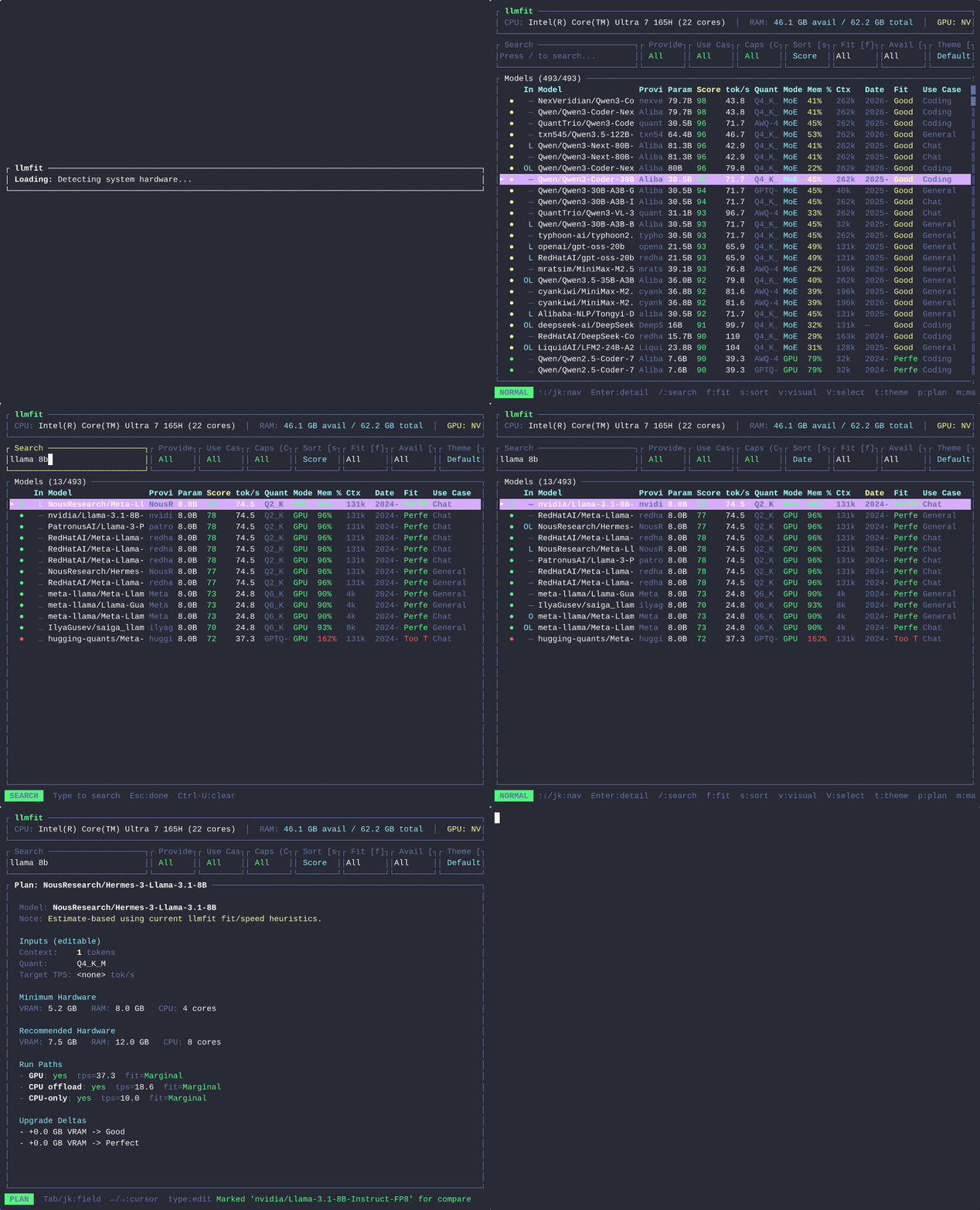
A terminal tool that right-sizes LLM models to your system's RAM, CPU, and GPU. Detects your hardware, scores each model across quality, speed, fit, and context dimensions, and tells you which ones will actually run well on your machine.
Ships with an interactive TUI (default) and a classic CLI mode. Supports multi-GPU setups, MoE architectures, dynamic quantization selection, speed estimation, and local runtime providers (Ollama, llama.cpp, MLX, Docker Model Runner, LM Studio).
Sister projects
- sympozium — managing agents in Kubernetes.
- llmserve — a simple TUI for serving local LLM models. Pick a model, pick a backend, serve it.
- llama-panel — a native macOS app for managing local llama-server instances.
- llmfit-gui — a Windows desktop GUI (PowerShell + WinForms) for llmfit: browse recommendations, download into LM Studio/Ollama, and benchmark, all point-and-click.
Documentation
| Get started | Install · Usage · How it works |
| Guides | TUI guide · Benchmarking step-by-step · CLI & automation · Cluster mode (Ray / multi-node) · Runtime providers · OpenClaw integration |
| Reference | How it works (full) · Platform & GPU support · Custom models · Development |
| Project | Contributing · Alternatives · Code signing · License |
Install
Windows
WinGet
winget install --exact --id AlexsJones.llmfit
Scoop
scoop install llmfit
If Scoop is not installed, follow the Scoop installation guide.
macOS / Linux
Homebrew
Prebuilt binary (recommended, works on all macOS/Linux versions):
brew install AlexsJones/llmfit/llmfit
Or from the homebrew-core formula, which builds from source on macOS versions without a bottle:
brew install llmfit
MacPorts
port install llmfit
Quick install
curl -fsSL https://llmfit.axjns.dev/install.sh | sh
Downloads the latest release binary from GitHub and installs it to /usr/local/bin (or ~/.local/bin if no sudo).
Install to ~/.local/bin without sudo:
curl -fsSL https://llmfit.axjns.dev/install.sh | sh -s -- --local
uv / pip
To install or update llmfit:
uv tool install -U llmfit
To run without installing:
uvx llmfit
You can also install llmfit as a Python package in the normal way with tools such as pip or uv.
Pre-built Binaries
Download release binaries for Linux, macOS, and Windows directly from the GitHub Releases page. Windows binaries are only published once that release's sign-windows job has signed, repackaged, and re-checksummed them; if signing is skipped or fails, the Windows assets are held back and attached by a re-run of the release workflow (with its fresh signing requests approved) rather than shipped unsigned. Releases before v1.1.19 did not have this guard, so verify the executable signature on older versions if you require a signed binary.
Container Deployment
llmfit provides a multi-architecture Docker image (ghcr.io/alexsjones/llmfit) supporting both interactive CLI/TUI and headless Web UI / API server modes.
Interactive TUI
To launch the interactive TUI instead, pass the global --tui flag:
docker run -it --rm ghcr.io/alexsjones/llmfit --tui
Non-Interactive
This prints JSON from llmfit recommend command.
docker run ghcr.io/alexsjones/llmfit
This prints JSON from llmfit recommend command. The JSON could be further queried with jq.
podman run ghcr.io/alexsjones/llmfit recommend --use-case coding | jq '.models[].name'
To launch the interactive TUI instead, pass the global --tui flag:
docker run --rm -it ghcr.io/alexsjones/llmfit --tui
From source
git clone https://github.com/AlexsJones/llmfit.git
cd llmfit
cargo build --release
# binary is at target/release/llmfit
Usage
Terminal Interface (TUI)
Launch llmfit in your terminal without flags to start the interactive browser:
llmfit # interactive TUI: your hardware, every model, ranked
The TUI shows your detected specs at the top and every model scored for fit, speed, quality, and context. See the TUI guide for navigation, planning, simulation, downloads, the community leaderboard, and benchmarking.
Keybindings inside the TUI:
b: Open community benchmarks;I: Open live inference benchmarksh: Show help and keybindings↑/↓ork/j: Navigate list items/: Filter models by name, family, or quantizationEsc: Clear search / Back
Command Line Options
# Print hardware telemetry and recommended models to standard output
llmfit recommend

# Output system profile and recommendations in raw JSON format
llmfit recommend --json

# Estimate SSD capacity for keeping three runnable models
llmfit storage --keep 3 --selection largest --json

# Start the native HTTP API server
llmfit serve --host 0.0.0.0 --port 8787
See model library storage for selection, OS reserve, download scratch, free-space headroom, and hardware simulation.
Web UI & API Server
docker run -d -p 8787:8787 ghcr.io/alexsjones/llmfit serve
Docker Compose
---
services:
  llmfit:
    image: ghcr.io/alexsjones/llmfit:latest
    container_name: llmfit
    restart: unless-stopped
    command: ["serve", "--host", "0.0.0.0", "--port", "8787"]
    ports:
      - "8787:8787"
    healthcheck:
      test: ["CMD", "curl", "-f", "http://localhost:8787/health"]
      interval: 15s
      timeout: 5s
      retries: 3
      start_period: 10s
For scripts, agents, and classic terminal output:
llmfit fit                    # table of all models ranked by fit
llmfit fit --show-incompatible # also show backend-incompatible models as non-runnable
llmfit recommend --json       # top picks as JSON (agent/script consumption)
llmfit info "<model>"         # one model: fit analysis, estimate basis, verify commands
llmfit bench                  # measure real tok/s/TTFT against your running provider
llmfit doctor                 # hardware detection report for bug reports
llmfit serve                  # start the api and web user interface
Full reference: CLI & automation.
Cluster mode (Ray / multi-node)
Preview: so far tested only against a mock Ray Dashboard. If you run Ray, please share the output of
curl <dashboard>/nodes?view=summaryin an issue.
Check which models fit across several machines, such as 3 × DGX Spark or a couple of multi-GPU servers running Ray and vLLM:
- Know before you launch: find out whether a model fits across your machines before you spend an hour starting vLLM.
- Catch splits vLLM would refuse: most models can't be split 3 ways across 3 GPUs. llmfit picks a split vLLM accepts, or says none fits, instead of letting vLLM crash at startup.
- One reviewable file: Ray discovery writes a single
cluster.toml, so you don't have to tally VRAM by hand. - Changes nothing: llmfit reads Ray's dashboard once and never launches or schedules anything.
llmfit cluster init --ray-url http://<head>:8265   # or hand-write cluster.toml
llmfit cluster status
llmfit --cluster fit
See the cluster guide for walkthroughs, Ray token handling and today's limits.
Community & Benchmarks
llmfit includes hardware detection and performance benchmarks contributed by the community. You can share your hardware benchmark results using:
llmfit bench --share
How it works
llmfit detects your hardware (RAM, CPU, GPU/VRAM, backend), then scores every model in its catalog across four dimensions: memory fit, estimated speed, quality, and context. Speed estimates come from a memory-bandwidth model grounded in runtime sampling and real community measurements — and every estimate ships its inputs, so llmfit info shows exactly what a number assumes and how to verify it on your machine.
Full detail, including the estimation formulas and the model database: How llmfit works.
Contributing
Contributions are welcome, especially new models.
Before submitting a PR
Please run cargo fmt before pushing your changes. Most CI check failures are caused by unformatted code:
cargo fmt
Guides for adding models — locally (no rebuild) or to the built-in catalog: Custom models.
Alternatives
If you're looking for a different approach, check out llm-checker -- a Node.js CLI tool with Ollama integration that can pull and benchmark models directly. It takes a more hands-on approach by actually running models on your hardware via Ollama, rather than estimating from specs. Good if you already have Ollama installed and want to test real-world performance. Note that it doesn't support MoE (Mixture-of-Experts) architectures -- all models are treated as dense, so memory estimates for models like Mixtral or DeepSeek-V3 will reflect total parameter count rather than the smaller active subset.
Code signing
llmfit's Windows release binaries are intended to be digitally signed (Authenticode) via SignPath.io, with a free code signing certificate provided by the SignPath Foundation. The release workflow only attaches Windows assets after the sign-windows job has signed, repackaged, and re-checksummed them; when signing is skipped or fails, the Windows zips (and the PyPI Windows wheels built from them) are held back until the workflow is re-run against the tag and the new signing requests that re-run submits are approved. Releases before v1.1.19 could publish an unsigned Windows artifact, so verify the executable signature on those before relying on it.
Signing happens automatically in the release pipeline: only artifacts built by GitHub Actions from this repository are submitted for signing, and signing requests are approved by the project maintainer (@AlexsJones).
Code signing policy: see the SignPath Foundation code signing policy and terms.
Privacy: this program will not transfer any information to other networked systems unless specifically requested by the user or the person installing or operating it. llmfit only contacts external services when you explicitly use the corresponding feature (e.g. model downloads, runtime provider queries, or the community leaderboard).
License
MIT
Compatibility
- Runs on
- Metal
What shows it
- Metal: llmfit-core dependency objc2-metal
- Native code
- None found
- No native code found
- Python bindings
- No Python binding crate found
- License
- MIT
Compare with similar projects
Order: strongest tier first, then most downloads, then name, with unmeasured values last. A library counts downloads over 30 days. An app counts binary downloads per release. An app with none counts its crate downloads over 30 days. ML Rust runs this catalogue, so its closest project always gets a row.
| Project | Downloads | Dependents | Stars | Latest release | Runs on (GPU) | Native code | License |
|---|---|---|---|---|---|---|---|
|
Right-size LLM models to your system hardware. Interactive TUI and CLI to match models against available RAM, CPU, and GPU. |
3,821 binary downloads per release | Not applicable | 38,787 | 1.1.20 | Metal | No native code found | MIT |
|
Ship your code, on autopilot. An open source agent that lives on your machines 24/7 and keeps your apps running. 🦀 Also in Build LLM apps and agents. |
19,860 binary downloads per release | Not applicable | 1,859 | 0.3.88 | GPU support unknown | Binds native code: tree-sitter, tree-sitter-language, tikv-jemalloc-sys (feature jemalloc) | Apache-2.0 |
|
dora Listed
DORA (Dataflow-Oriented Robotic Architecture) is middleware designed to streamline and simplify the creation of AI-based robotic applications. It offers low latency, composable, and distributed dataflow capabilities. Applications are modeled as directed graphs, also referred to as pipelines. Also in Run and serve models. |
4,491 downloads over 30 days | 18 | 4,072 | 1.1.0 | GPU support unknown | Binds native code: libgit2-sys, libz-sys, pnet_sys | Apache-2.0 |
|
A CLI tool to convert your codebase into a single LLM prompt with source tree, prompt templating, and token counting. Also in Build LLM apps and agents. |
2,317 binary downloads per release | Not applicable | 7,756 | 4.3.0 | GPU support unknown | Binds native code: libgit2-sys, libz-sys | MIT |
|
opentelemetry-langfuse Listed
OpenTelemetry components and utilities for Langfuse LLM observability Also in Build LLM apps and agents. |
2,119 downloads over 30 days | 2 | 4 | 0.7.2 | GPU support unknown | No native code found | Apache-2.0 OR MIT |
|
boostr Listed
ML framework on numr for training and inference on CPU, CUDA and WebGPU: attention, quantization, inference scheduling and distributed execution. Models include LLaMA, Mamba2, Qwen3.5, Whisper, Kokoro, VITS, VoxCPM2, Silero VAD, CLAP and super-resolution. Loads SafeTensors and GGUF. Also in Build LLM apps and agents. |
1,265 downloads over 30 days | 7 | 20 | 0.11.2 | CUDA, WebGPU | Binds native code: ring (feature distributed) | Apache-2.0 |
|
Rust Token Killer - High-performance CLI proxy to minimize LLM token consumption Also in Build LLM apps and agents. |
2,594 binary downloads per release | Not applicable | 85,939 | 0.42.4 | GPU support unknown | Binds native code: libsqlite3-sys | Apache-2.0 |
All projects in Build LLM apps and agentsAll projects in Run and serve models
Why FeaturedIt passes every Featured gate.
What it meets
- Its use signals read: binary downloads 11463, Homebrew unknown, Repology families unknown, Docker growth unknown. Featured needs 2 of these to reach their limits.
- It also passes the repository route, which counts as one use signal: 38,787 stars, 2,504 forks and 173 contributors. It needs 4,539 stars, 434 forks and 79 contributors together.
- The last activity is on 8 Nov 2026, 1 day ago. The rules expect an update within 365 days. Dormancy rule
Exact rules: Featured app. The check on applied thresholds version 9.
Every rule outcome, as the check records it
expected-interval: app: E = 365 daysdormancy: last activity 2026-11-08, 1 days ago, E = 365: activefeatured: featured: binary downloads 11463, Homebrew unknown, Repology families unknown, Docker growth unknown, repository route stars 38787 (needs 4539), forks 2504 (needs 434), contributors 173 (needs 79)
Crates2 crates
- llmfit Primary
- llmfit-core
Measurements and sources
Each signal row shows the raw value, its source and the fetch date. The Sources list gathers every distinct source on this page. Movement needs more history.
Sources6 sources
- Description: the crates.io description
- crates.io database dump, fetched
- GitHub releases, fetched
- GitHub repository, fetched
- crates.io package, fetched
- GitHub contributors, fetched
Adoption3,821 binary downloads per release4 not measured
| Signal | Value | Source | Fetched | Counts |
|---|---|---|---|---|
| Active dependents | Not measured | Yes | ||
| New dependents (365 days) | Not measured | Yes | ||
| Peak active dependents | Not measured | Yes | ||
| Active dependents as a share of the peak | Not measured | Yes | ||
| Binary downloads per release | 3821 | GitHub releases | Yes |
MaintenanceLatest human commit: 1 day ago4 not measured
| Signal | Value | Source | Fetched | Counts |
|---|---|---|---|---|
| Latest human commit | 2026-11-08 | GitHub repository | Yes | |
| Latest release | 2026-11-03 | GitHub releases | Yes | |
| First release | 2026-02-15 | crates.io database dump | Yes | |
| Latest version | 1.1.20 | crates.io database dump | No | |
| Days the oldest outside issue waits for a reply | 9 | GitHub repository | Yes | |
| Maintainer replies over 365 days | 73 | GitHub repository | Yes | |
| Repository archived | false | GitHub repository | Yes | |
| Repository gone | false | GitHub repository | Yes | |
| Release commit or manifest in the repo | true | crates.io package | No | |
| Published docs | Not measured | Yes | ||
| Latest release fails cargo check | Not measured | Yes | ||
| Build check date | Not measured | Yes | ||
| Build check toolchain | Not measured | Yes |
SecurityNot measured
| Signal | Value | Source | Fetched | Counts |
|---|---|---|---|---|
| Unpatched vulnerabilities past the grace window | Not measured | Yes | ||
| RustSec unmaintained advisory | Not measured | Yes | ||
| Deprecation notice | Not measured | Yes | ||
| Deprecated requirement | Not measured | Yes |
Distribution119 releases, 448 downloads over 30 days6 not measured
| Signal | Value | Source | Fetched | Counts |
|---|---|---|---|---|
| Releases | 119 | crates.io database dump | No | |
| Downloads over 30 days | 448 | crates.io database dump | No | |
| Binary downloads over the last 3 releases | 11463 | GitHub releases | Yes | |
| Homebrew installs on request over 365 days | Not measured | Yes | ||
| Repology repository families | Not measured | Yes | ||
| Docker pull growth over 90 days | Not measured | Yes | ||
| Docker pulls at the growth baseline | Not measured | Yes | ||
| Every version a prerelease | false | crates.io database dump | Yes | |
| Every version 0.0.x | false | crates.io database dump | Yes | |
| Every version yanked | Not measured | Yes | ||
| Crate deleted from crates.io | Not measured | Yes |
Repository38,787 stars, 2,504 forks, 173 contributors, 1,372 commits. Stars alone never qualify a project.
| Signal | Value | Source | Fetched | Counts |
|---|---|---|---|---|
| GitHub stars | 38787 | GitHub repository | Yes — one part of the repository route | |
| GitHub forks | 2504 | GitHub repository | Yes — one part of the repository route | |
| Contributors with a GitHub account | 173 | GitHub contributors | Yes — one part of the repository route | |
| Commits on the default branch | 1372 | GitHub repository | No | |
| Repository's main crate left out of the entry | none | crates.io database dump | Yes |
Facts that never count
| Signal | Value | Source | Fetched | Counts |
|---|---|---|---|---|
| License | MIT | crates.io database dump | No | |
| Runs on, from listed crates and their direct dependencies | Metal | crates.io database dump | No | |
| What shows each backend | Metal: llmfit-core dependency objc2-metal | crates.io database dump | No | |
| Native code, from listed crates and their dependencies | No native code found | crates.io database dump | No | |
| Python bindings, from direct dependencies of listed crates | No Python binding crate found | crates.io database dump | No | |
| Crates that depend on a listed crate directly | Not measured | No |
Corrections and review history
No correction applies to this entry.
Judgments
A judgment enters only through an approved issue and a merged pull request.
No judgment applies to this entry.