dora
Library Listed
DORA (Dataflow-Oriented Robotic Architecture) is middleware designed to streamline and simplify the creation of AI-based robotic applications. It offers low latency, composable, and distributed dataflow capabilities. Applications are modeled as directed graphs, also referred to as pipelines.
- Downloads
- 4,491
- Dependents
- 18
- Stars
- 4,072
- Forks
- 475
- Contributors
- 125
- Commits
- 6,290
- Latest release
- 1.1.0 ·
About

Website | Python API | Rust API | Guide | Discord
dora 1.0 is out. Read the 1.0 release post.
Dora
Agentic Dataflow-Oriented Robotic Architecture -- a 100% Rust framework for building real-time robotics and AI applications.
Built and maintained with agentic engineering -- AI agents do the heavy lifting on code generation, reviews, refactoring, and testing; humans set direction and gate every merge.
Table of Contents
- Features
- Installation
- Quick Start
- CLI Commands
- Dataflow Configuration
- Architecture
- Language Support
- Examples
- Development
- Contributing
- License
Read the full README
Features
Performance
- 10-17x faster than ROS2 Python -- 100% Rust internals with zero-copy shared memory IPC for messages >4KB, flat latency from 4KB to 4MB payloads
- Zenoh SHM data plane -- nodes publish directly via Zenoh shared memory, bypassing the daemon for 35% lower latency and 3-10x higher throughput on large payloads; automatic network fallback for cross-machine
- Apache Arrow native -- columnar memory format end-to-end with zero serialization overhead; payloads are Arrow IPC-encoded, so receivers always know the schema; shared across all language bindings
- Non-blocking event loop -- Zenoh publishes offloaded to a dedicated drain task; control commands respond in <500ms even under high data throughput
Developer experience
- Single CLI, full lifecycle --
dora runfor local dev,dora up/startfor distributed prod, plus build, logs, monitoring, record/replay all from one tool - Declarative YAML dataflows -- define pipelines as directed graphs, connect nodes through typed inputs/outputs, optional type annotations with static validation, override with environment variables
- Multi-language nodes -- write nodes in Rust, Python, C, or C++ with native APIs (not wrappers); mix languages freely in one dataflow
- Reusable modules -- compose sub-graphs as standalone YAML files with typed inputs/outputs, parameters, optional ports, and nested composition (compile-time expansion, zero runtime overhead)
- Hot reload -- live-reload Python operators without restarting the dataflow
- Programmatic builder -- construct dataflows in Python code as an alternative to YAML
Production readiness
- Fault tolerance -- per-node restart policies (never/on-failure/always), exponential backoff, health monitoring, circuit breakers with configurable input timeouts
- Distributed by default -- local shared memory between co-located nodes, automatic Zenoh pub-sub for cross-machine communication, SSH-based cluster management with label scheduling, rolling upgrades, and auto-recovery
- Coordinator HA -- persistent redb-backed state store (default), daemon auto-reconnect with exponential backoff, dataflow records survive coordinator restart (running dataflow reclaim-across-restart is partial, see the open issue tracker)
- Dynamic topology -- add and remove nodes from running dataflows via CLI (
dora node add/remove/connect/disconnect) without restarting - Soft real-time -- optional
--rtflag for mlockall + SCHED_FIFO; per-nodecpu_affinitypinning in YAML; comprehensive tuning guide for memory locking, kernel params, and container deployment - OpenTelemetry -- built-in structured logging with rotation/routing, metrics, distributed tracing, and zero-setup trace viewing via CLI
Debugging and observability
- Record/replay -- capture dataflow messages to
.drecfiles, replay offline at any speed with node substitution for regression testing - Topic inspection --
topic echoto print live data,topic hzTUI for frequency analysis,topic infofor schema and bandwidth - Resource monitoring --
dora topTUI showing per-node CPU, memory, queue depth, network I/O, restart count, and health status across all machines;--onceflag for scriptable JSON snapshots - Trace inspection --
trace listandtrace viewfor viewing coordinator spans without external infrastructure - Dataflow visualization -- generate interactive HTML or Mermaid graphs from YAML descriptors
Ecosystem
- Communication patterns -- built-in service (request/reply), action (goal/feedback/result), and streaming (session/segment/chunk) patterns via well-known metadata keys; no daemon or YAML changes required
- ROS2 bridge -- bidirectional topics, services, and actions over DDS or native
rmw_zenoh_cpp-compatible Zenoh; QoS mapping; Arrow-native type conversion - Node Hub (package manager) -- pull a reusable node into a dataflow with one line --
hub: dora-yolo@^0.5-- with cargo-style versioned resolution, reproducible lockfiles (--locked), and typed contracts checked at build time; backed by a git-based public catalog of ready-made nodes for cameras, YOLO, LLMs, TTS, and more. See the Hub guide (unstable) - In-process operators -- lightweight functions that run inside a shared runtime, avoiding per-node process overhead for simple transformations
Installation
From crates.io (recommended)
cargo install dora-cli           # CLI (dora command)
pip install dora-rs              # Python node/operator API
From source
git clone https://github.com/dora-rs/dora.git
cd dora
cargo build --release -p dora-cli
PATH=$PATH:$(pwd)/target/release

# Python API (requires maturin >= 1.8: pip install maturin)
# Must run from the package directory for dependency resolution
cd apis/python/node && maturin develop --uv && cd ../../..
Platform installers
macOS / Linux:
curl --proto '=https' --tlsv1.2 -LsSf \
  https://github.com/dora-rs/dora/releases/latest/download/dora-cli-installer.sh | sh
Windows:
powershell -ExecutionPolicy ByPass -c "irm https://github.com/dora-rs/dora/releases/latest/download/dora-cli-installer.ps1 | iex"
Build features
| Feature | Description | Default |
|---|---|---|
tracing | OpenTelemetry tracing support | Yes |
metrics | OpenTelemetry metrics collection | Yes |
python | Python operator support (PyO3) | No |
redb-backend | Persistent coordinator state (redb) | Yes |
cargo install dora-cli --features redb-backend
Quick Start
1. Run a Python dataflow
Important: The PyPI package is
dora-rs, notdora. The import name isdora(from dora import Node), butpip install dorainstalls an unrelated package.
cargo install dora-cli            # or use install script below
pip install dora-rs numpy pyarrow
git clone https://github.com/dora-rs/dora.git && cd dora
dora run examples/python-dataflow/dataflow.yml
This runs a sender -> transformer -> receiver pipeline. Here's what the Python node code looks like:
# sender.py -- sends messages and polls for STOP
from dora import Node
import pyarrow as pa
import time

node = Node()
sent = 0
while sent < 100:
    event = node.try_recv()
    if event is not None and event["type"] == "STOP":
        break
    node.send_output("message", pa.array([sent]))
    sent += 1
    time.sleep(0.1)
# receiver.py -- receives and prints messages
from dora import Node

node = Node()
for event in node:
    if event["type"] == "INPUT":
        print(f"Got {event['id']}: {event['value'].to_pylist()}")
    elif event["type"] == "STOP":
        break
See the Python Getting Started Guide for a full tutorial, or the Python API Reference for complete API docs.
2. Run a Rust dataflow
cd examples/rust-dataflow
dora run dataflow.yml
3. Distributed mode (ad-hoc)
# Terminal 1: start coordinator + daemon
dora up

# Terminal 2: start a dataflow (--debug enables topic inspection)
dora start dataflow.yml --attach --debug

# Terminal 3: monitor
dora list
dora logs <dataflow-id>
dora top

# Stop or restart
dora stop <dataflow-id>
dora restart --name <name>
dora down
4. Managed cluster
# Bring up a multi-machine cluster from a config file
dora cluster up cluster.yml

# Start a dataflow across the cluster
dora start dataflow.yml --name my-app --attach

# Check cluster health
dora cluster status

# Tear down
dora cluster down
See the Distributed Deployment Guide for cluster.yml configuration, label scheduling, systemd services, rolling upgrades, and operational runbooks. The network side — one LAN, a VPN mesh, or isolated subnets joined by zenoh routers — is the Multi-machine Guide.
CLI Commands
Lifecycle
| Command | Description |
|---|---|
dora run <PATH> | Run a dataflow locally (no coordinator/daemon needed) |
dora up | Start coordinator and daemon in local mode |
dora down | Tear down coordinator and daemon |
dora build <PATH> | Run build commands from a dataflow descriptor |
dora start <PATH> | Start a dataflow on a running coordinator |
dora stop <ID> | Stop a running dataflow |
dora restart <ID> | Restart a running dataflow (stop + re-start) |
Monitoring
| Command | Description |
|---|---|
dora list | List running dataflows (alias: ps) |
dora clean | Remove finished and failed dataflows from the coordinator |
dora logs <ID> [--node <NAME>] | Show logs for a dataflow or node |
dora top | Real-time resource monitor (TUI); also dora inspect top |
dora topic list | List topics in a dataflow |
dora topic hz <TOPIC> | Measure topic publish frequency (TUI) |
dora topic echo <TOPIC> | Print topic messages to stdout |
dora topic info <TOPIC> | Show topic type and metadata |
dora node list | List nodes in a dataflow |
dora node info <NODE> | Show detailed node status, inputs, outputs, and metrics |
dora node add --from-yaml <FILE> | Add a node to a running dataflow |
dora node remove <NODE> | Remove a node from a running dataflow |
dora node connect <SRC> <DST> | Add a live mapping between nodes |
dora node disconnect <SRC> <DST> | Remove a live mapping between nodes |
dora node restart <NODE> | Restart a single node within a running dataflow |
dora node stop <NODE> | Stop a single node within a running dataflow |
dora topic pub <TOPIC> <DATA> | Publish JSON data to a topic |
dora param list <NODE> | List runtime parameters for a node |
dora param get <NODE> <KEY> | Get a runtime parameter value |
dora param set <NODE> <KEY> <VALUE> | Set a runtime parameter (JSON value) |
dora param delete <NODE> <KEY> | Delete a runtime parameter |
dora trace list | List recent traces captured by the coordinator |
dora trace view <ID> | View spans for a specific trace (supports prefix matching) |
dora record <PATH> | Record dataflow messages to .drec file |
dora replay <FILE> | Replay recorded messages from .drec file |
Cluster management
| Command | Description |
|---|---|
dora cluster up <PATH> | Bring up a cluster from a cluster.yml file |
dora cluster status | Show connected daemons and active dataflows |
dora cluster down | Tear down the cluster |
dora cluster install <PATH> | Install daemons as systemd services |
dora cluster uninstall <PATH> | Remove systemd services |
dora cluster upgrade <PATH> | Rolling upgrade: SCP binary + restart per-machine |
dora cluster restart <NAME> | Restart a dataflow by name or UUID |
Setup and utilities
| Command | Description |
|---|---|
dora doctor | Diagnose environment, connectivity, and dataflow health |
dora status | Check system health (alias: check) |
dora new | Generate a new project or node |
dora graph <PATH> | Visualize a dataflow (Mermaid or HTML) |
dora expand <PATH> | Expand module references and print flat YAML |
dora validate <PATH> | Validate dataflow YAML and check type annotations |
dora system | System management (daemon/coordinator control) |
dora completion <SHELL> | Generate shell completions |
dora self update | Update dora CLI |
Node Hub (unstable)
| Command | Description |
|---|---|
dora hub search <query> | Find nodes by name, keyword, or category |
dora hub info <pkg>[@<ver>] | Show a package's typed contracts + example |
dora hub init [PATH] | Scaffold a dora-node.yml manifest |
dora hub publish [PATH] | Validate + add a pinned index entry (--dry-run) |
dora hub yank <pkg>@<ver> | Yank/restore a published version (--undo) |
dora hub list/outdated/update <dataflow> | Inspect, check, and refresh lockfile pins |
dora hub fetch <target> | Mirror pinned sources locally (inspection / CI / transfer) |
Reference a node with one line of YAML -- hub: dora-yolo@^0.5 -- and dora build resolves, pins, and type-checks it. See the Hub guide.
For full CLI documentation, see docs/cli.md. For running a dataflow across several machines, start with docs/multi-machine.md; for cluster management, see docs/distributed-deployment.md.
Dataflow Configuration
Dataflows are defined in YAML. Each node declares its binary/script, inputs, and outputs:
nodes:
  - id: camera
    build: pip install opencv-video-capture
    path: opencv-video-capture
    inputs:
      tick: dora/timer/millis/20
    outputs:
      - image
    env:
      CAPTURE_PATH: 0
      IMAGE_WIDTH: 640
      IMAGE_HEIGHT: 480

  - id: object-detection
    build: pip install dora-yolo
    path: dora-yolo
    inputs:
      image: camera/image
    outputs:
      - bbox

  - id: plot
    build: pip install dora-rerun
    path: dora-rerun
    inputs:
      image: camera/image
      boxes2d: object-detection/bbox
Built-in timer nodes: dora/timer/millis/<N> and dora/timer/hz/<N>.
Input format: <node-id>/<output-name> to subscribe to another node's output. Long form supports queue_size, queue_policy (drop_oldest or backpressure), and input_timeout. See the YAML Specification for details.
Type annotations: Optionally annotate ports with type URNs for static and runtime validation. See the Type Annotations Guide for the full type library.
nodes:
  - id: camera
    path: camera.py
    outputs:
      - image
    output_types:
      image: std/media/v1/Image
dora validate dataflow.yml                        # static check (warnings)
dora validate --strict-types dataflow.yml         # fail on warnings (CI)
dora build dataflow.yml --strict-types            # type check during build
DORA_RUNTIME_TYPE_CHECK=warn dora run dataflow.yml  # runtime check
Modules: Extract reusable sub-graphs into separate files with module: instead of path:. See the Modules Guide for details.
nodes:
  - id: nav_stack
    module: modules/navigation.module.yml
    inputs:
      goal_pose: localization/goal
Architecture
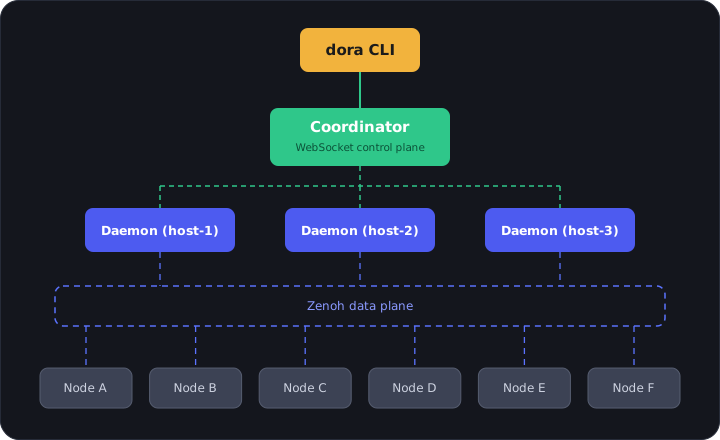
| Layer | Protocol | Purpose |
|---|---|---|
| CLI <-> Coordinator | WebSocket (port 6013) | Build, run, stop commands |
| Coordinator <-> Daemon | WebSocket | Node spawning, dataflow lifecycle |
| Daemon <-> Daemon | Zenoh | Distributed cross-machine communication |
| Node <-> Node | Zenoh SHM | Direct zero-copy data plane for messages >4KB |
| Daemon <-> Node | Shared memory / TCP | Control plane + small message delivery |
Key components
- Coordinator -- orchestrates dataflow lifecycle across daemons. Persistent redb state store by default; daemons auto-reconnect on coordinator restart.
- Daemon -- spawns and manages nodes on a single machine. Routes messages and manages Zenoh SHM data plane.
- Runtime -- in-process operator execution engine. Operators run inside the runtime process, avoiding per-operator process overhead.
- Nodes -- standalone processes that communicate via inputs/outputs. Written in Rust, Python, C, or C++.
- Operators -- lightweight functions that run inside the runtime. Faster than nodes for simple transformations.
Workspace layout
binaries/
  cli/                  # dora CLI binary
  coordinator/          # Orchestration service
  daemon/               # Node manager + IPC
  runtime/              # In-process operator runtime
  ros2-bridge-node/     # ROS2 bridge binary
  mavlink2-bridge-node/ # MAVLink 2 bridge binary
  record-node/          # Dataflow message recorder
  replay-node/          # Recorded message replayer
libraries/
  core/                 # Descriptor parsing, build utilities
  message/              # Inter-component message types
  arrow-convert/        # Arrow data conversion
  recording/            # .drec recording format
  log-utils/            # Log parsing, merging, formatting
  coordinator-store/    # Persistent coordinator state (redb)
  extensions/
    telemetry/          # OpenTelemetry tracing + metrics
    ros2-bridge/        # ROS2 interop (bridge, msg-gen, arrow, python)
    mavlink2-bridge/    # MAVLink 2 interop (Arrow ↔ MAVLink, TCP/UDP/serial)
    download/           # Download utilities
apis/
  rust/node/            # Rust node API (dora-node-api)
  rust/operator/        # Rust operator API (dora-operator-api)
  python/node/          # Python node API (PyO3)
  python/operator/      # Python operator API (PyO3)
  python/cli/           # Python CLI interface
  c/node/               # C node API
  c/operator/           # C operator API
  c++/node/             # C++ node API (CXX bridge)
  c++/operator/         # C++ operator API (CXX bridge)
examples/               # Example dataflows
Language Support
| Language | Node API | Operator API | Docs | Status |
|---|---|---|---|---|
| Rust | dora-node-api | dora-operator-api | API Reference | First-class |
| Python >= 3.11 | pip install dora-rs | included | Getting Started, API Reference | First-class |
| C | dora-node-api-c | dora-operator-api-c | API Reference | Supported |
| C++ | dora-node-api-cxx | dora-operator-api-cxx | API Reference | Supported |
| ROS2 >= Foxy | dora-ros2-bridge | -- | Bridge Guide | Experimental |
Platform support
| Platform | Rust / Python | C / C++ templates |
|---|---|---|
| Linux (x86_64, ARM64, ARM32) | First-class (PR-gated) | First-class (nightly-gated) |
| macOS (ARM64) | First-class (nightly-gated) | Best effort (nightly-gated) |
| Windows (x86_64) | Best effort (nightly-gated) | Best effort (not gated) |
| WSL (x86_64) | Best effort | Best effort (not gated) |
Gate meanings (#1716):
- PR-gated — every PR to
mainruns these tests; merge is blocked on failure. - Nightly-gated — the daily scheduled run (
.github/workflows/nightly.yml) runs these. A failure auto-files anightly-regressionissue but does NOT block PRs. - Not gated — no automated CI coverage. Regressions surface via user reports.
dora new --lang rust/python template tests run in nightly across all three platforms;
C/C++ variants run in nightly on Linux only. Developers who need cross-platform
verification before merge can run make qa-test / make qa-examples / make qa-nightly
locally. See docs/testing-matrix.md for the full rationale.
Examples
Core language examples
| Example | Language | Description |
|---|---|---|
| rust-dataflow | Rust | Basic Rust node pipeline |
| python-dataflow | Python | Python sender/transformer/receiver |
| python-operator-dataflow | Python | Python operators (in-process) |
| python-dataflow-builder | Python | Pythonic imperative API |
| c-dataflow | C | C node example |
| c++-dataflow | C++ | C++ node example |
| c++-arrow-dataflow | C++ | C++ with Arrow data |
| cmake-dataflow | C/C++ | CMake-based build |
Composition
| Example | Language | Description |
|---|---|---|
| module-dataflow | Python | Reusable module composition |
| typed-dataflow | Python | Type annotations with dora validate |
Communication patterns
| Example | Language | Description |
|---|---|---|
| service-example | Rust | Request/reply with request_id correlation |
| action-example | Rust | Goal/feedback/result with cancellation |
| streaming-example | Python | Token-by-token generation with session/seq/fin metadata |
See docs/patterns.md for the full guide.
Dynamic topology
| Example | Language | Description |
|---|---|---|
| dynamic-add-remove | Python | Add/remove nodes from running dataflows |
| dynamic-agent-tools | Python | AI agent with dynamically-added tools |
Advanced patterns
| Example | Language | Description |
|---|---|---|
| python-async | Python | Async Python nodes |
| python-concurrent-rw | Python | Concurrent read-write patterns |
| python-multiple-arrays | Python | Multi-array handling |
| python-drain | Python | Event draining patterns |
| multiple-daemons | Rust | Distributed multi-daemon setup |
| rust-dataflow-git | Rust | Git-based dataflow loading |
| rust-dataflow-url | Rust | URL-based dataflow loading |
Logging
| Example | Language | Description |
|---|---|---|
| python-logging | Python | Python logging integration |
| python-log | Python | Basic Python log output |
| log-sink-tcp | YAML | TCP-based log sink |
| log-sink-file | YAML | File-based log sink |
| log-sink-alert | YAML | Alert-based log sink |
| log-aggregator | Python | Centralized log aggregation via dora/logs |
Performance
| Example | Language | Description |
|---|---|---|
| benchmark | Rust/Python | Latency and throughput benchmark |
| ros2-comparison | Python | Dora vs ROS2 comparison |
| cuda-benchmark | Rust/CUDA | GPU zero-copy benchmark |
ROS2 integration
| Example | Description |
|---|---|
| ros2-bridge/rust | Rust ROS2 topics, services, actions |
| ros2-bridge/python | Python ROS2 integration |
| ros2-bridge/c++ | C++ ROS2 integration |
| ros2-bridge/yaml-bridge | YAML-based ROS2 topic bridge |
| ros2-bridge/yaml-bridge-service | YAML ROS2 service bridge |
| ros2-bridge/yaml-bridge-action | YAML ROS2 action client |
| ros2-bridge/yaml-bridge-action-server | YAML ROS2 action server |
MAVLink 2 integration
| Example | Description |
|---|---|
| mavlink2-bridge (Rust) | MAVLink 2 ↔ dora bridge, Rust telemetry consumer |
| mavlink2-bridge (Python) | Same bridge, Python telemetry consumer (--uv) |
| mavlink2-bridge (C++) | Same bridge, C++ telemetry consumer (cargo run --example mavlink2-bridge-cxx) |
| mavlink2-bridge-sitl-mission | Closed-loop ArduCopter SITL: arm + takeoff + hover + land driven from a Python dora node (Ubuntu / macOS, local-only) |
Development
Rust edition 2024; MSRV and default workspace package metadata are
tracked in [workspace.package] of the root Cargo.toml. Most crates
inherit the workspace version via version.workspace = true; a handful
(e.g. apis/rust/operator/types, the examples/error-propagation/*
samples) pin their own version independently.
Build
# Build all (excluding Python packages which require maturin)
cargo build --all \
  --exclude dora-node-api-python \
  --exclude dora-operator-api-python \
  --exclude dora-ros2-bridge-python

# Build specific package
cargo build -p dora-cli
Test
# Run all tests
cargo test --all \
  --exclude dora-runtime-python \
  --exclude dora-node-api-python \
  --exclude dora-operator-api-python \
  --exclude dora-ros2-bridge-python

# Test single package
cargo test -p dora-core

# Smoke tests (requires coordinator/daemon)
cargo test --test example-smoke -- --test-threads=1
Lint and format
cargo clippy --all
cargo fmt --all -- --check
Run examples
cargo run --example rust-dataflow
cargo run --example python-dataflow
cargo run --example benchmark --release
Quality assurance
Dora ships with a three-tier QA system designed for AI-authored code. Everything runs locally first; CI mirrors the same scripts.
make qa-install        # one-time: install cargo-audit, cargo-deny, cargo-llvm-cov, cargo-mutants, cargo-semver-checks
make qa-fast           # ~15s    -- fmt + clippy + audit + unwrap-budget + secret-files + typos + publish-graph (pre-commit)
make qa-full           # ~5-10m  -- qa-fast + tests + coverage (pre-push)
make qa-deep           # ~15m    -- qa-full + mutation testing + semver (target Tier 1 gate, stronger than today's CI; alias: qa-tier1)
make qa-nightly        # ~3-4h -- qa-deep + proptest@1000 + miri + example-smoke + ci-nightly-jobs (full parity with .github/workflows/nightly.yml)
make qa-release-gate   #         -- qa-deep + semver (Tier 3 automatable; audit/dogfood are human)
make qa-mutation-audit # ~10-18h -- full-repo cargo-mutants; deliberate test-quality audit
make qa-examples       # ~15-20m -- run all smoke-eligible example dataflows end-to-end (skips CUDA/ROS2/C++/interactive)
On Ubuntu, install ripgrep separately and install typos-cli with Cargo:
sudo apt update
sudo apt install ripgrep
cargo install typos-cli
Gates in place:
- Supply chain --
cargo-audit+cargo-denyfor CVEs, license policy, dependency bans - Unwrap ratchet -- counts
.unwrap()/.expect(in production code; can only go down (.unwrap-budget) - Coverage --
cargo-llvm-covwith diff-coverage gate (70% on PR-touched lines) - Mutation testing --
cargo-mutantsagainst critical crates (library crates at package scope, binary crates withtest_workspace = true) - Property testing --
propteston wire-protocol types; catches edge cases unit tests miss - Miri -- UB detection on pure-Rust unsafe hotspots (e.g.,
dora-core::metadata) - SemVer check --
cargo-semver-checksagainst the last git tag - Breaking-change gate -- every surface dora 1.x freezes, diffed against the last release tag: the C header, the cxx bridge, the dataflow YAML schema, the postcard wire format, the
doracommand, the Python floor, and the Rust API of the covered crates. Runs on every PR; the surface half needs no build (make qa-breaking) - Adversarial LLM review --
scripts/qa/adversarial.shruns a different model on your diff to catch single-model blind spots (local today; CI pending API secret)
Reference docs:
- Contributor QA Cheat Sheet -- contributor-oriented setup, day-to-day commands, and PR validation checklist
- QA Runbook -- day-to-day command reference, failure modes, and fixes
- Agentic QA Strategy -- full three-tier design and rationale
- POC Report -- case studies, metrics, lessons learned, recommendations for the wider ecosystem
Contributing
We welcome contributors of all experience levels. See the contributing guide to get started.
For non-trivial work, discuss the approach in a GitHub issue, discussion, or Discord thread before implementing it. Before opening or updating a PR, run the QA level appropriate for the change and include the validation you ran in the PR description. The Contributor QA Cheat Sheet is the fastest day-to-day reference; the stricter per-change policy lives in docs/agentic-qa-policy.md.
Communication
Agentic Engineering
This repository is built with agentic engineering. AI agents collaborate on day-to-day work -- code generation, reviews, refactoring, testing, drafting PR comments, triaging nightly regressions -- while maintainers set direction, review judgments, and authorize what ships. The two roles compound: AI agents move fast on mechanical work; humans catch the things that matter.
License
Apache-2.0. See NOTICE.md for details.
Compatibility
- Runs on
- GPU support unknown
What shows it
- no dependency or feature matches a backend row
- Native code
- Required
- Binds native code: libgit2-sys, libz-sys, pnet_sys
- Python bindings
- No Python binding crate found
- License
- Apache-2.0
Compare with similar projects
Order: strongest tier first, then most downloads, then name, with unmeasured values last. A library counts downloads over 30 days. An app counts binary downloads per release. An app with none counts its crate downloads over 30 days. ML Rust runs this catalogue, so its closest project always gets a row.
| Project | Downloads | Dependents | Stars | Latest release | Runs on (GPU) | Native code | License |
|---|---|---|---|---|---|---|---|
|
DORA (Dataflow-Oriented Robotic Architecture) is middleware designed to streamline and simplify the creation of AI-based robotic applications. It offers low latency, composable, and distributed dataflow capabilities. Applications are modeled as directed graphs, also referred to as pipelines. |
4,491 downloads over 30 days | 18 | 4,072 | 1.1.0 | GPU support unknown | Binds native code: libgit2-sys, libz-sys, pnet_sys | Apache-2.0 |
|
Right-size LLM models to your system hardware. Interactive TUI and CLI to match models against available RAM, CPU, and GPU. |
3,821 binary downloads per release | Not applicable | 38,787 | 1.1.20 | Metal | No native code found | MIT |
|
Ready-to-use NLP pipelines and language models |
24,605 downloads over 30 days | 23 | 3,091 | 0.23.0 | CUDA | Binds native code: torch-sys, ort-sys (feature onnx) | Apache-2.0 |
|
silero Listed
Production-oriented Rust wrapper for the Silero VAD ONNX model. |
1,888 downloads over 30 days | 3 | 6 | 0.7.0 | CUDA, ROCm | Binds native code: ort-sys (feature coreml) | Apache-2.0 OR MIT |
|
Distributed AI/LLM for the people. Share compute privately or publicly to power your agents and chat. |
1,411 binary downloads per release | Not applicable | 3,993 | 0.78.1 | GPU support unknown | Binds native code: libsqlite3-sys, netlink-sys, ring, secp256k1-sys | Apache-2.0 OR MIT |
|
A high-performance ML model serving framework, offers dynamic batching and CPU/GPU pipelines to fully exploit your compute machine |
1 downloads over 30 days | Not applicable | 903 | 0.9.0 | GPU support unknown | No native code found | Apache-2.0 |
|
Model conversion and quantization with no Python: reads SafeTensors, GGUF, TCF and PyTorch state dicts, writes SafeTensors, GGUF and TCF, and quantizes to Q2_K through Q8_0 and IQ4 formats, including Q4_K_M mixes. GPTQ, AWQ, NF4, FP8, EXL2 and ONNX input are not implemented. Python bindings |
23 downloads over 30 days | Not applicable | 0 | 0.2.1 | GPU support unknown | No native code found | Apache-2.0 |
Why ListedNo archive, New or Featured rule places it, so it is Listed.
What it lacks for Featured
- It has 0.25 active dependents and 0 new dependents in 365 days. Featured needs 11 active dependents or 9 new dependents in 365 days. The repository route reads 4,072 stars, 475 forks and 125 contributors. It needs 4,539 stars, 434 forks and 79 contributors together.
What else the check found
- The last activity is on 6 Nov 2026, 3 days ago. The rules expect an update within 365 days. Dormancy rule
Exact rules: Listed, Featured library. The check on applied thresholds version 9.
Every rule outcome, as the check records it
expected-interval: version 1.1.0 base 200, raised to the 365-day floor: E = 365 daysdormancy: last activity 2026-11-06, 3 days ago, E = 365: activefeatured: not featured: active_users 0.25 < 11 and new_adopters 0 < 9 and repository route stars 4072 (needs 4539), forks 475 (needs 434), contributors 125 (needs 79)listed: listed: no archive, new or featured rule applies
Crates2 crates
- dora-node-api Primary
- dora-cli
Measurements and sources
Each signal row shows the raw value, its source and the fetch date. The Sources list gathers every distinct source on this page. Movement needs more history.
Sources6 sources
- Description: the GitHub repository description
- crates.io database dump, fetched
- RustSec advisory database, fetched
- GitHub repository, fetched
- crates.io package, fetched
- GitHub contributors, fetched
Adoption0 active dependents, 0 new dependents in 365 days1 not measured
| Signal | Value | Source | Fetched | Counts |
|---|---|---|---|---|
| Active dependents | 0.25 | crates.io database dump | Yes | |
| New dependents (365 days) | 0 | crates.io database dump | Yes | |
| Peak active dependents | 2.25 | crates.io database dump | Yes | |
| Active dependents as a share of the peak | 0.975 | crates.io database dump | Yes | |
| Binary downloads per release | Not measured | Yes |
MaintenanceLatest human commit: 3 days ago3 not measured
| Signal | Value | Source | Fetched | Counts |
|---|---|---|---|---|
| Latest human commit | 2026-11-06 | GitHub repository | Yes | |
| Latest release | 2026-10-08 | crates.io database dump | Yes | |
| First release | 2022-06-24 | crates.io database dump | Yes | |
| Latest version | 1.1.0 | crates.io database dump | Yes | |
| Days the oldest outside issue waits for a reply | 9 | GitHub repository | Yes | |
| Maintainer replies over 365 days | 54 | GitHub repository | Yes | |
| Repository archived | false | GitHub repository | Yes | |
| Repository gone | false | GitHub repository | Yes | |
| Release commit or manifest in the repo | true | crates.io package | Yes | |
| Published docs | true | crates.io database dump | Yes | |
| Latest release fails cargo check | Not measured | Yes | ||
| Build check date | Not measured | Yes | ||
| Build check toolchain | Not measured | Yes |
SecurityUnpatched vulnerabilities: none
| Signal | Value | Source | Fetched | Counts |
|---|---|---|---|---|
| Unpatched vulnerabilities past the grace window | none | RustSec advisory database | Yes | |
| RustSec unmaintained advisory | none | RustSec advisory database | Yes | |
| Deprecation notice | none | crates.io database dump | Yes | |
| Deprecated requirement | none | crates.io database dump | Yes |
Distribution69 releases, 4,491 downloads over 30 days5 not measured
| Signal | Value | Source | Fetched | Counts |
|---|---|---|---|---|
| Releases | 69 | crates.io database dump | Yes | |
| Downloads over 30 days | 4491 | crates.io database dump | Yes | |
| Binary downloads over the last 3 releases | Not measured | Yes | ||
| Homebrew installs on request over 365 days | Not measured | Yes | ||
| Repology repository families | Not measured | Yes | ||
| Docker pull growth over 90 days | Not measured | Yes | ||
| Docker pulls at the growth baseline | Not measured | Yes | ||
| Every version a prerelease | false | crates.io database dump | Yes | |
| Every version 0.0.x | false | crates.io database dump | Yes | |
| Every version yanked | false | crates.io database dump | Yes | |
| Crate deleted from crates.io | false | crates.io database dump | Yes |
Repository4,072 stars, 475 forks, 125 contributors, 6,290 commits. Stars alone never qualify a project.
| Signal | Value | Source | Fetched | Counts |
|---|---|---|---|---|
| GitHub stars | 4072 | GitHub repository | Yes — one part of the repository route | |
| GitHub forks | 475 | GitHub repository | Yes — one part of the repository route | |
| Contributors with a GitHub account | 125 | GitHub contributors | Yes — one part of the repository route | |
| Commits on the default branch | 6290 | GitHub repository | No | |
| Repository's main crate left out of the entry | none | crates.io database dump | Yes |
Facts that never count
| Signal | Value | Source | Fetched | Counts |
|---|---|---|---|---|
| License | Apache-2.0 | crates.io database dump | No | |
| Runs on, from listed crates and their direct dependencies | GPU support unknown | crates.io database dump | No | |
| What shows each backend | no dependency or feature matches a backend row | crates.io database dump | No | |
| Native code, from listed crates and their dependencies | Binds native code: libgit2-sys, libz-sys, pnet_sys | crates.io database dump | No | |
| Python bindings, from direct dependencies of listed crates | No Python binding crate found | crates.io database dump | No | |
| Crates that depend on a listed crate directly | 18 | crates.io database dump | No |
Corrections and review history
No correction applies to this entry.
Judgments
A judgment enters only through an approved issue and a merged pull request.
No judgment applies to this entry.