rust-mcp-sdk
Library Featured
An asynchronous SDK and framework for building MCP-Servers and MCP-Clients, leveraging the rust-mcp-schema for type safe MCP Schema Objects.
- Downloads
- 29,764
- Dependents
- 51
- Stars
- 199
- Forks
- 31
- Contributors
- 13
- Commits
- 361
- Latest release
- 2.0.0 ·
About
A high-performance, asynchronous Rust toolkit for building MCP servers and clients.
📖 Documentation · Tutorials · Examples · Upgrade Guide · Changelog
Contributing · Report a bug · Request a Feature
🥇 Tier 1 SDK: passes 100% of scored conformance scenarios, and the official MCP conformance tool's tier-check reports Tier 1 under SEP-1730. Tier-check runs · release reports
✅ This SDK fully implements the MCP 2026-07-28 stateless protocol and passes 100% of official MCP conformance tests.
rust-mcp-sdk provides the necessary components for developing both servers and clients in the MCP ecosystem. It leverages the rust-mcp-schema crate for type-safe schema objects and includes powerful procedural macros.
Focus on your application logic, rust-mcp-sdk handles the protocol, transports, and the rest.
Version notice: This is rust-mcp-sdk 2.x, implementing the new MCP 2026-07-28 (stateless) specification.
For the previous MCP 2025-11-25 specification, use rust-mcp-sdk 1.x.
See the upgrade guide to migrate from 1.x to 2.0.
Version matrix:
| SDK version | Protocol | Branch |
|---|---|---|
| 2.0 | MCP 2026-07-28 (stateless) | main |
| 1.x (LTS) | MCP 2025-11-25 | release-1.x |
Upgrading? See the upgrade guide.
Key Features
Read the full README
- ✅ Latest MCP protocol specification supported: 2026-07-28
- 🥇 Tier 1 SDK - official MCP conformance tool's
tier-checkreports Tier 1 under SEP-1730. see tier-check runs· - ✅ 100% MCP Conformance - passes all official client (254/254) and server (40/40) conformance tests
- ✅ Transports: Stdio, Streamable HTTP, and backward-compatible SSE support
- ✅ Framework Agnostic: Axum, Actix, and BYO Server integrations
- ✅ MRTR (Mid-Request Turn-Around) for server→client input requests
- ✅ Response cache (SEP-2549) with principal-scoped privacy + auto-pagination
- ✅ Per-request
_metawithRequestContext - ✅ Multi-client concurrency
- ✅ DNS Rebinding Protection
- ✅ Message Observer (Telemetry & Monitoring)
- ✅ HTTP Health Checks (for load balancers & container orchestration)
- ✅ OAuth Authentication for MCP Servers
- ✅ Remote Oauth Provider
- Keycloak Provider (via rust-mcp-extra)
- WorkOS Authkit Provider (via rust-mcp-extra)
- Scalekit Authkit Provider (via rust-mcp-extra)
- ✅ Remote Oauth Provider
- ✅ OAuth Authentication for MCP Clients (metadata discovery, CIMD, PKCE, token refresh, pluggable storage)
- ✅ Issuer-bound credentials (SEP-2352), strict
issvalidation (SEP-2468)
Table of Contents
- Quick Start
- Minimal MCP Server (Stdio)
- Minimal MCP Server (Streamable HTTP)
- Minimal MCP Client (Stdio)
- Usage Examples
- Macros
- mcp_tool
- tool_box
- mcp_elicit
- mcp_resource
- mcp_resource_template
- mcp_prompt
- mcp_icon
- Authentication
- HTTP Server Backends (Axum & Actix)
- Cargo features
- Handler Traits
- Message Observer (Telemetry & Monitoring)
- Health Check Endpoint
- Contributing
- Development
- License
Quick Start
Add to your Cargo.toml:
[dependencies]
rust-mcp-sdk = "2.0.0"  # Check crates.io for the latest version
Minimal MCP Server (Stdio)
use async_trait::async_trait;
use rust_mcp_sdk::{
    error::SdkResult, macros, mcp_icon,
    mcp_server::{server_runtime, McpServerOptions, ServerHandler},
    schema::*,
    McpServer, RequestContext, ServerDetails, StdioTransport, ToMcpServerHandler,
    TransportOptions,
};

// Define an MCP tool
#[macros::mcp_tool(name = "say_hello", description = "returns \"Hello from Rust MCP SDK!\" message")]
#[derive(Debug, ::serde::Deserialize, ::serde::Serialize, macros::JsonSchema)]
pub struct SayHelloTool {}

// Define a custom handler
#[derive(Default)]
struct HelloHandler;

#[async_trait]
impl ServerHandler for HelloHandler {
    async fn handle_list_tools_request(
        &self,
        _request: Option<PaginatedRequestParams>,
        _context: &RequestContext,
        _runtime: std::sync::Arc<dyn McpServer>,
    ) -> std::result::Result<ListToolsResult, RpcError> {
        Ok(ListToolsResult {
            tools: vec![SayHelloTool::tool()],
            meta: None,
            next_cursor: None,
            cache_scope: Default::default(),
            result_type: "complete".to_string(),
            ttl_ms: 0,
        })
    }

    async fn handle_call_tool_request(
        &self,
        params: CallToolRequestParams,
        _context: &RequestContext,
        _runtime: std::sync::Arc<dyn McpServer>,
    ) -> std::result::Result<ServerResult, CallToolError> {
        if params.name == "say_hello" {
            Ok(ServerResult::CallToolResult(CallToolResult {
                content: vec![ContentBlock::TextContent(TextContent::new(
                    "Hello from Rust MCP SDK!".to_string(),
                    None,
                    None,
                ))],
                is_error: None,
                meta: None,
                result_type: "complete".to_string(),
            }))
        } else {
            Err(CallToolError::unknown_tool(params.name))
        }
    }
}

#[tokio::main]
async fn main() -> SdkResult<()> {
    let server_details = ServerDetails {
        server_info: Implementation {
            name: "hello-rust-mcp".into(),
            version: "0.1.0".into(),
            title: Some("Hello World MCP Server".into()),
            description: Some("A minimal Rust MCP server".into()),
            icons: vec![mcp_icon!(
                src = "https://raw.githubusercontent.com/rust-mcp-stack/rust-mcp-sdk/main/assets/rust-mcp-icon.png",
                mime_type = "image/png",
                sizes = ["128x128"],
                theme = "light"
            )],
            website_url: Some("https://github.com/rust-mcp-stack/rust-mcp-sdk".into()),
        },
        capabilities: ServerCapabilities {
            tools: Some(ServerCapabilitiesTools { list_changed: None }),
            ..Default::default()
        },
        instructions: None,
        meta: None,
    };

    let transport = StdioTransport::new(TransportOptions::default())?;
    let handler = HelloHandler::default().to_mcp_server_handler();
    let server = server_runtime::create_server(McpServerOptions {
        server_details,
        transport,
        handler,
        message_observer: None,
    });
    server.start().await
}
HTTP Server Backends (Axum & Actix)
Creating a Streamable HTTP MCP server in rust-mcp-sdk allows multiple clients to connect simultaneously with no additional setup. The setup is nearly identical to the stdio example , the only difference is which HTTP backend crate you install and which function you call to create the server.
Post only - the 2026-07-28 protocol is stateless. GET and DELETE endpoints return 405 Method Not Allowed.
Axum Backend (rust-mcp-axum)
Add rust-mcp-axum to your dependencies and use create_axum_server() with AxumServerOptions.
use async_trait::async_trait;
use rust_mcp_axum::{create_axum_server, AxumServerOptions};
use rust_mcp_sdk::{
    error::SdkResult, macros,
    mcp_server::ServerHandler, schema::*,
};

// ... (define SayHelloTool and HelloHandler as shown above)

#[tokio::main]
async fn main() -> SdkResult<()> {
    let server_details = ServerDetails { /* ... */ };

    let handler = HelloHandler::default().to_mcp_server_handler();
    let server = create_axum_server(
        server_details,
        handler,
        AxumServerOptions {
            host: "127.0.0.1".to_string(),
            ..Default::default()
        },
    );
    server.start().await?;
    Ok(())
}
Actix-web Backend (rust-mcp-actix)
Add rust-mcp-actix to your dependencies and use create_actix_server() with ActixServerOptions.
use rust_mcp_actix::{create_actix_server, ActixServerOptions};
use rust_mcp_sdk::{
    error::SdkResult,
    mcp_server::ServerHandler, schema::*,
};

// ... (define SayHelloTool and HelloHandler as shown above)

#[tokio::main]
async fn main() -> SdkResult<()> {
    let server_details = ServerDetails { /* ... */ };

    let handler = HelloHandler::default().to_mcp_server_handler();
    let server = create_actix_server(
        server_details,
        handler,
        ActixServerOptions {
            host: "127.0.0.1".to_string(),
            ..Default::default()
        },
    );
    server.start().await?;
    Ok(())
}
BYO-server: Embed MCP in your Existing App
Both backends support a BYO-server (Bring Your Own Server) mode, letting you mount MCP endpoints onto a router or app you already control - no need to hand over the server lifecycle.
| Backend | Function | Docs |
|---|---|---|
| Axum | mcp_routes(state, &mount_opts, http_handler) | rust-mcp-axum README |
| Actix-web | mcp_scope(state, http_handler, &mount_opts) | rust-mcp-actix README |
Custom HTTP Framework Integrations
The SDK is completely framework-agnostic. If you are using a different HTTP framework (like Rocket, Salvo, or Warp), you can build a custom integration by adapting your framework's native Request/Response types to the SDK's core HTTP handling logic.
See the Custom HTTP Framework Integration Guide for architectural details.
AxumServerOptions
Axum server is highly customizable through AxumServerOptions:
let server = create_axum_server(
    server_details,
    handler.to_mcp_server_handler(),
    AxumServerOptions {
        host: "127.0.0.1".to_string(),
        port: 8080,
        auth: Some(Arc::new(auth_provider)),           // enable authentication
        health_endpoint: Some("/health".into()),         // health check
        sse_support: true,                               // backward-compat SSE
        ..Default::default()
    },
);
server.start().await?;
Security Considerations
- DNS rebinding protection is enabled by default. If
allowed_hostsis not set, it auto-derives fromhost:port. - When running locally, bind only to localhost (127.0.0.1 / localhost) rather than all network interfaces (0.0.0.0)
- Use TLS/HTTPS for production deployments
Following is implementation of an MCP client that starts the @modelcontextprotocol/server-everything server, discovers the server's capabilities, lists available tools, and calls a tool.
use async_trait::async_trait;
use rust_mcp_sdk::{
    error::SdkResult,
    mcp_client::{client_runtime, ClientHandler, McpClientOptions},
    schema::*,
    ClientDetails, McpClient, StdioTransport, ToMcpClientHandler, TransportOptions,
};

pub struct MyClientHandler;
#[async_trait]
impl ClientHandler for MyClientHandler {
    // Override handler methods as needed.
    // See: crates/rust-mcp-sdk/src/mcp_handlers/mcp_client_handler.rs
}

#[tokio::main]
async fn main() -> SdkResult<()> {
    let client_details = ClientDetails {
        client_info: Implementation {
            name: "simple-rust-mcp-client".into(),
            version: "0.1.0".into(),
            description: None,
            icons: vec![],
            title: None,
            website_url: None,
        },
        capabilities: ClientCapabilities::default(),
    };

    let transport = StdioTransport::create_with_server_launch(
        "npx",
        vec!["-y".to_string(), "@modelcontextprotocol/server-everything@latest".to_string()],
        None,
        TransportOptions::default(),
    )?;

    let handler = MyClientHandler {};
    let client = client_runtime::create_client(McpClientOptions::new(
        client_details,
        transport,
        handler.to_mcp_client_handler(),
    ));
    client.clone().start().await?;

    // Discover the server
    let discover = client.request_discover(Default::default()).await?;
    println!("Supported protocol versions: {:?}", discover.supported_versions);

    // List tools
    let tools = client.request_tool_list(None).await?.tools;
    tools.iter().enumerate().for_each(|(i, tool)| {
        println!("  {}. {} : {}", i + 1, tool.name, tool.description.unwrap_or_default());
    });

    // Call a tool (supports MRTR auto-retry)
    let result = client.call_tool(CallToolRequestParams {
        name: "say_hello".to_string(),
        arguments: None,
        input_responses: None,
        request_state: None,
        meta: RequestMetaObject::default(),
    }).await?;

    client.shut_down().await?;
    Ok(())
}
Usage Examples
For more examples (stdio, Streamable HTTP, clients, auth, etc.), see the examples/ directory.
👉 For step-by-step tutorials (server, client, HTTP deployment, OAuth, and more), see the documentation site.
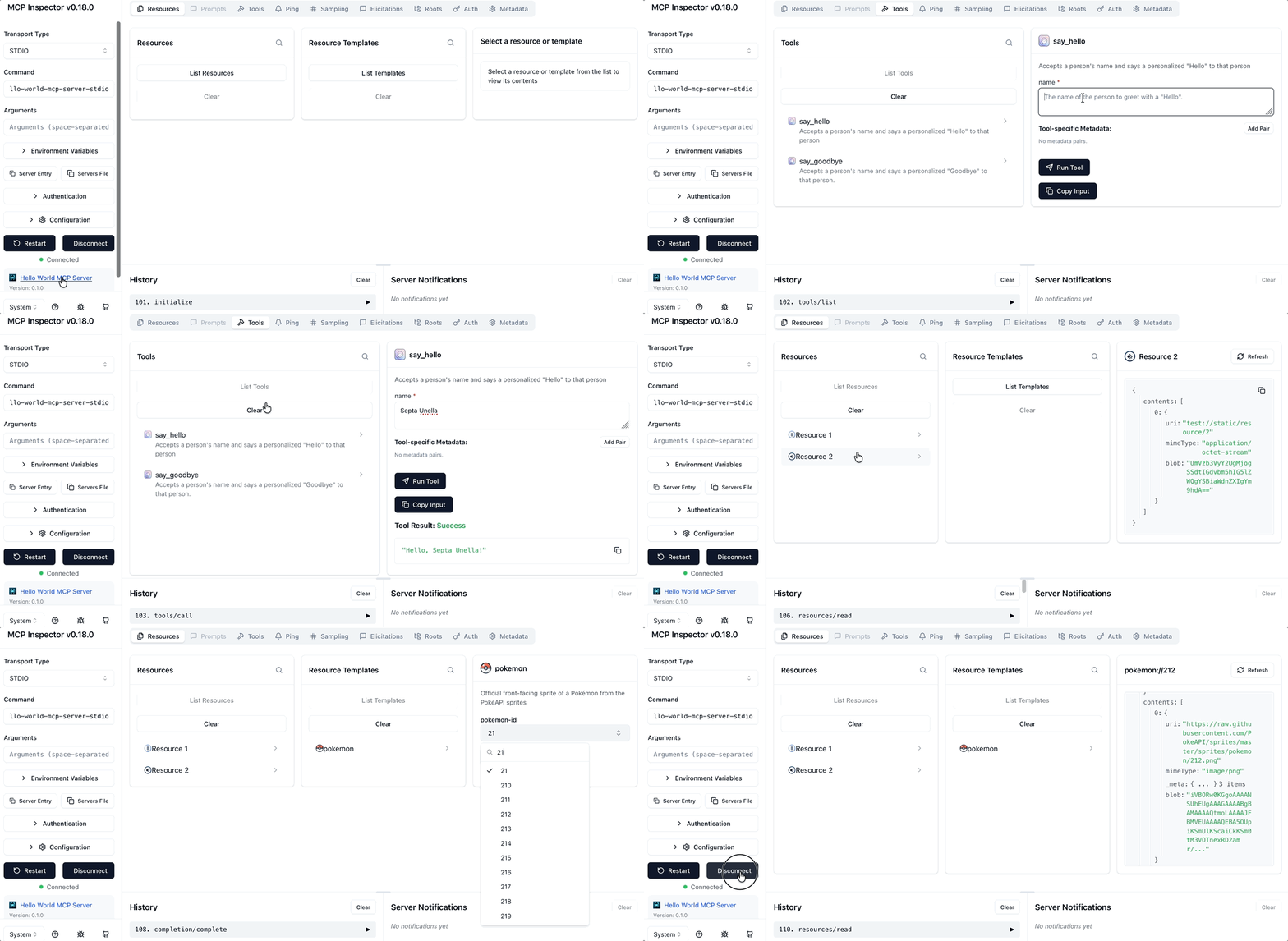
See the hello-world-mcp-server-stdio example running in the MCP Inspector:
Macros
Enable with the macros feature.
mcp_tool
Generate a Tool from a struct, with metadata (icons, hints, etc.).
#[mcp_tool(
    name = "write_file",
    title = "Write File Tool",
    description = "Create or overwrite a file with new content.",
    destructive_hint = false, idempotent_hint = false, open_world_hint = false, read_only_hint = false,
    meta = r#"{ "key": "value" }"#,
    icons = [(src = "https://website.com/write.png", mime_type = "image/png", sizes = ["128x128"], theme = "light")]
)]
#[derive(rust_mcp_macros::JsonSchema)]
pub struct WriteFileTool {
    /// The target file's path for writing content.
    pub path: String,
    /// The string content to be written to the file
    pub content: String,
}
tool_box!()
Automatically generates an enum based on the provided list of tools.
tool_box!(GreetingTools, [SayHelloTool, SayGoodbyeTool]);
let tools: Vec<Tool> = GreetingTools::tools();
mcp_elicit()
Generates type-safe elicitation (Form or URL mode) for user input.
#[mcp_elicit(message = "Please enter your info", mode = form)]
#[derive(JsonSchema)]
pub struct UserInfo {
    #[json_schema(title = "Name", min_length = 5, max_length = 100)]
    pub name: String,
    #[json_schema(title = "Email", format = "email")]
    pub email: Option<String>,
    #[json_schema(title = "Age", minimum = 15, maximum = 125)]
    pub age: i32,
    #[json_schema(title = "Tags")]
    pub tags: Vec<String>,
}
◾ mcp_resource()
A procedural macro attribute that generates utility methods to create fully populated Resource instances from compile-time metadata , usually used for exposing static assets like files, images, or documents. Also generates a RESOURCE_URI associated constant, usable in match patterns, and a resource_mime_type() accessor.
📝 For complete documentation, example usage, and a list of all available attributes, please refer to https://crates.io/crates/rust-mcp-macros.
◾ mcp_resource_template()
A procedural macro attribute that generates utility methods to create fully populated ResourceTemplate instances from compile-time metadata for exposing parameterized server resources. Also generates a RESOURCE_URI_TEMPLATE associated constant, usable in match patterns, and a resource_template_mime_type() accessor.
📝 For complete documentation, example usage, and a list of all available attributes, please refer to https://crates.io/crates/rust-mcp-macros.
◾ mcp_prompt()
A procedural macro attribute that generates utility methods to create fully populated Prompt instances from compile-time metadata, and , when the optional messages attribute is provided , to parse request arguments (from_arguments) and render them into a GetPromptResult (render). Struct fields become typed prompt arguments (String = required, Option<String> = optional, String + default = fallback), the prompts/get handler itself is left to the user.
📝 For complete documentation, example usage, and a list of all available attributes, please refer to https://crates.io/crates/rust-mcp-macros.
◾ mcp_icon!()
A convenient icon builder for implementations and tools, offering full attribute support including theme, size, mime, and more.
example usage:
let icon: crate::schema::Icon = mcp_icon!(
    src = "http://website.com/icon.png",
    mime_type = "image/png",
    sizes = ["64x64"],
    theme = "dark"
);
Authentication
MCP servers can verify tokens issued by other systems, integrate with external identity providers, or manage the entire authentication process.
RemoteAuthProvider
RemoteAuthProvider enables authentication with identity providers that support Dynamic Client Registration (DCR), letting MCP clients auto-register and obtain credentials.
OAuthProxy
OAuthProxy enables authentication with OAuth providers that don't support DCR.
Cargo Features
Available Features
server: Activates MCP server capabilitiesclient: Activates MCP client capabilitiesmacros: Procedural macros for Tool, Elicit, Resource structuressse: Server-Sent Events (SSE) transportstreamable-http: Streamable HTTP transportstdio: Standard input/output (stdio) transportauth: OAuth authentication support for MCP serverstls-no-provider: TLS without a crypto provider
Default Features
All features are enabled by default:
[dependencies]
rust-mcp-sdk = "2.0.0"
Using Only the Server Features
[dependencies]
rust-mcp-sdk = { version = "2.0.0", default-features = false, features = ["server", "macros", "stdio"] }
Using Only the Client Features
[dependencies]
rust-mcp-sdk = { version = "2.0.0", default-features = false, features = ["client", "stdio"] }
Handler Traits
Choosing Between ServerHandler and ServerHandlerCore
- ServerHandler: Recommended. Default implementations for all MCP messages. Override only what you need.
- ServerHandlerCore: Full control over request/notification/error dispatch.
Note: Use server_runtime::create_server() or server_runtime_core::create_server() depending on which handler you implement.
Choosing Between ClientHandler and ClientHandlerCore
Same principles apply on the client side: use client_runtime::create_client() with ClientHandler, or client_runtime_core::create_client() with ClientHandlerCore.
Message Observer (Telemetry & Monitoring)
Implement McpObserver to intercept all incoming and outgoing MCP messages for telemetry, logging, debugging, or monitoring.
let server = server_runtime::create_server(McpServerOptions {
    server_details,
    transport,
    handler: handler.to_mcp_server_handler(),
    message_observer: Some(SimpleServerObserver::new()),
});
Health Check Endpoint
An optional HTTP health check endpoint for load balancers and container orchestration:
let server = create_axum_server(
    server_details,
    handler.to_mcp_server_handler(),
    AxumServerOptions {
        host: "127.0.0.1".into(),
        health_endpoint: Some("/health".into()),
        ..Default::default()
    },
);
Contributing
We welcome everyone who wishes to contribute! Please refer to the contributing guidelines for more details.
Check out our development guide for instructions on setting up, building, testing, formatting, and trying out example projects.
All contributions, including issues and pull requests, must follow Rust's Code of Conduct.
Unless explicitly stated otherwise, any contribution you submit for inclusion in rust-mcp-sdk is provided under the terms of the MIT License, without any additional conditions or restrictions.
Development
Check out our development guide for instructions on setting up, building, testing, formatting, and trying out example projects.
License
This project is licensed under the MIT License. see the LICENSE file for details.
Compatibility
- Runs on
- GPU support unknown
What shows it
- no dependency or feature matches a backend row
- Native code
- None found
- No native code found
- Python bindings
- No Python binding crate found
- License
- MIT
Compare with similar projects
Order: strongest tier first, then most downloads, then name, with unmeasured values last. A library counts downloads over 30 days. An app counts binary downloads per release. An app with none counts its crate downloads over 30 days. ML Rust runs this catalogue, so its closest project always gets a row.
| Project | Downloads | Dependents | Stars | Latest release | Runs on (GPU) | Native code | License |
|---|---|---|---|---|---|---|---|
|
An asynchronous SDK and framework for building MCP-Servers and MCP-Clients, leveraging the rust-mcp-schema for type safe MCP Schema Objects. |
29,764 downloads over 30 days | 51 | 199 | 2.0.0 | GPU support unknown | No native code found | MIT |
|
rust-mcp-schema Featured
Type-safe implementation of the Model Context Protocol in Rust, designed to reduce errors and accelerate development with powerful utilities. |
107,187 downloads over 30 days | 19 | 79 | 2.0.0 | GPU support unknown | No native code found | MIT |
|
rs-graph-llm Listed
A high-performance, type-safe framework for building multi-agent workflow systems in Rust |
5,308 downloads over 30 days | 8 | 388 | 0.8.1 | GPU support unknown | No native code found | MIT |
|
chidori Listed
The agent framework where every run is durable, replayable, and resumable by default. Plain async TypeScript agents on an embedded pure-Rust JS engine. Python bindings |
257 downloads over 30 days | 0 | 1,372 | 3.8.1 | GPU support unknown | Binds native code: aws-lc-rs, aws-lc-sys, lcms2-sys, libffi-sys, libsqlite3-sys and 4 more | Apache-2.0 |
|
cortex-mem Listed
🧠 The production-ready cognitive foundation for autonomous systems such as Embodied-AI and OpenClaw. For memory management, from extraction and search to automated optimization, with SKILL, CLI, API, MCP, and insights dashboard out-of-the-box. |
126 downloads over 30 days | 6 | 318 | 2.7.0 | GPU support unknown | No native code found | MIT |
|
The autonomous, self-improving AI agent. Single Rust binary. Every channel. Recommended: the 40MB prebuilt binary for macOS, Linux and Windows: https://github.com/opencrabs/opencrabs/releases |
125 binary downloads per release | Not applicable | 1,027 | 0.5.15 | GPU support unknown | Binds native code: libsqlite3-sys, llama-cpp-sys-2, opusic-sys (feature local-tts), tree-sitter (feature code-graph), alsa-sys (feature local-stt) and 1 more | MIT |
|
An open protocol that gives AI agents a secure, sandboxed place to run code and use tools — with lean context usage. AXP works alongside MCP |
Not measured | Not applicable | 3 | Not measured | Not measured | Not measured | Apache-2.0 |
Why FeaturedIt passes every Featured gate.
What it meets
- It has 26 active dependents and 23 new dependents in 365 days. Featured needs 11 active dependents or 9 new dependents in 365 days.
- Active dependents are at 90% of their peak. Featured needs at least 50%.
- Docs are present. The release commit or a manifest ties the crate to the repository.
- No vulnerability advisory stays unpatched past the grace window. At least one version is neither a prerelease nor 0.0.x.
- The last activity is on 26 Oct 2026, 14 days ago. The rules expect an update within 400 days. Dormancy rule
Exact rules: Featured library. The check on applied thresholds version 9.
Every rule outcome, as the check records it
expected-interval: version 2.0.0 base 200, doubled for 26 active users: E = 400 daysdormancy: last activity 2026-10-26, 14 days ago, E = 400: activefeatured: featured: active_users 26, new_adopters 23, former_glory 0.9
Crates6 crates
Measurements and sources
Each signal row shows the raw value, its source and the fetch date. The Sources list gathers every distinct source on this page. Movement needs more history.
Sources6 sources
- Description: the crates.io description
- crates.io database dump, fetched
- RustSec advisory database, fetched
- GitHub repository, fetched
- crates.io package, fetched
- GitHub contributors, fetched
Adoption26 active dependents, 23 new dependents in 365 days1 not measured
| Signal | Value | Source | Fetched | Counts |
|---|---|---|---|---|
| Active dependents | 26 | crates.io database dump | Yes | |
| New dependents (365 days) | 23 | crates.io database dump | Yes | |
| Peak active dependents | 31 | crates.io database dump | Yes | |
| Active dependents as a share of the peak | 0.9024 | crates.io database dump | Yes | |
| Binary downloads per release | Not measured | Yes |
MaintenanceLatest human commit: 14 days ago3 not measured
| Signal | Value | Source | Fetched | Counts |
|---|---|---|---|---|
| Latest human commit | 2026-10-26 | GitHub repository | Yes | |
| Latest release | 2026-08-27 | crates.io database dump | Yes | |
| First release | 2025-03-29 | crates.io database dump | Yes | |
| Latest version | 2.0.0 | crates.io database dump | Yes | |
| Days the oldest outside issue waits for a reply | 0 | GitHub repository | Yes | |
| Maintainer replies over 365 days | 16 | GitHub repository | Yes | |
| Repository archived | false | GitHub repository | Yes | |
| Repository gone | false | GitHub repository | Yes | |
| Release commit or manifest in the repo | true | crates.io package | Yes | |
| Published docs | true | crates.io database dump | Yes | |
| Latest release fails cargo check | Not measured | Yes | ||
| Build check date | Not measured | Yes | ||
| Build check toolchain | Not measured | Yes |
SecurityUnpatched vulnerabilities: none
| Signal | Value | Source | Fetched | Counts |
|---|---|---|---|---|
| Unpatched vulnerabilities past the grace window | none | RustSec advisory database | Yes | |
| RustSec unmaintained advisory | none | RustSec advisory database | Yes | |
| Deprecation notice | none | crates.io database dump | Yes | |
| Deprecated requirement | none | crates.io database dump | Yes |
Distribution45 releases, 29,764 downloads over 30 days5 not measured
| Signal | Value | Source | Fetched | Counts |
|---|---|---|---|---|
| Releases | 45 | crates.io database dump | Yes | |
| Downloads over 30 days | 29764 | crates.io database dump | Yes | |
| Binary downloads over the last 3 releases | Not measured | Yes | ||
| Homebrew installs on request over 365 days | Not measured | Yes | ||
| Repology repository families | Not measured | Yes | ||
| Docker pull growth over 90 days | Not measured | Yes | ||
| Docker pulls at the growth baseline | Not measured | Yes | ||
| Every version a prerelease | false | crates.io database dump | Yes | |
| Every version 0.0.x | false | crates.io database dump | Yes | |
| Every version yanked | false | crates.io database dump | Yes | |
| Crate deleted from crates.io | false | crates.io database dump | Yes |
Repository199 stars, 31 forks, 13 contributors, 361 commits. Stars alone never qualify a project.
| Signal | Value | Source | Fetched | Counts |
|---|---|---|---|---|
| GitHub stars | 199 | GitHub repository | Yes — one part of the repository route | |
| GitHub forks | 31 | GitHub repository | Yes — one part of the repository route | |
| Contributors with a GitHub account | 13 | GitHub contributors | Yes — one part of the repository route | |
| Commits on the default branch | 361 | GitHub repository | No | |
| Repository's main crate left out of the entry | none | crates.io database dump | Yes |
Facts that never count
| Signal | Value | Source | Fetched | Counts |
|---|---|---|---|---|
| License | MIT | crates.io database dump | No | |
| Runs on, from listed crates and their direct dependencies | GPU support unknown | crates.io database dump | No | |
| What shows each backend | no dependency or feature matches a backend row | crates.io database dump | No | |
| Native code, from listed crates and their dependencies | No native code found | crates.io database dump | No | |
| Python bindings, from direct dependencies of listed crates | No Python binding crate found | crates.io database dump | No | |
| Crates that depend on a listed crate directly | 51 | crates.io database dump | No |
Corrections and review history
No correction applies to this entry.
Judgments
A judgment enters only through an approved issue and a merged pull request.
No judgment applies to this entry.