bashkit
Library Listed
Awesomely fast virtual sandbox with bash and file system
- Downloads
- 31,092
- Dependents
- 6
- Stars
- 325
- Forks
- 32
- Contributors
- 11
- Commits
- 2,206
- Latest release
- 0.20.3 ·
About
Awesomely fast virtual sandbox with bash and file system. Written in Rust.
Homepage: bashkit.sh
Read the full README
Features
- Secure by default - No process spawning, no filesystem access, no network access unless explicitly enabled. 280+ threats analyzed and mitigated
- POSIX compliant - Substantial IEEE 1003.1-2024 Shell Command Language compliance
- Sandboxed, in-process execution - All 167 commands reimplemented in Rust, no
fork/exec - Virtual filesystem - InMemoryFs, OverlayFs, MountableFs with optional RealFs backend (
realfsfeature) - Resource limits - Command count, loop iterations, function depth, output size, filesystem size, parser fuel
- Network allowlist - HTTP access denied by default, per-domain control
- Multi-tenant isolation - Each interpreter instance is fully independent
- Custom builtins - Extend with domain-specific commands
- LLM tool contract -
BashToolwith discovery metadata, streaming output, and system prompts - Script analysis - Inspect commands, arguments, and file writes before running, to drive permission prompts (guide)
- Snapshotting - Serialize shell state and VFS contents for checkpoint/resume workflows
- Scripted tool orchestration - Compose ToolDef+callback pairs into multi-tool bash scripts (
bashkit-scripted-toolcrate) - Async-first - Built on tokio
- Language bindings - Python (PyO3) and JavaScript/TypeScript (NAPI-RS) for Node.js, Bun, and Deno
- Experimental: Git support - Virtual git operations on the virtual filesystem (
gitfeature) - Experimental: Python support - Embedded Python interpreter via Monty (
pythonfeature), or real CPython 3.14 in a WebAssembly sandbox (cpythonfeature) - Experimental: TypeScript support - Embedded TypeScript interpreter via ZapCode (
typescriptfeature) - Experimental: SQLite support - Embedded SQLite-compatible engine via Turso (
sqlitefeature)
Install
cargo add bashkit
Optional features:
cargo add bashkit --features git              # Virtual git operations
cargo add bashkit --features python           # Embedded Python interpreter
cargo add bashkit --features cpython          # Real CPython 3.14 (WebAssembly sandbox)
cargo add bashkit --features typescript       # Embedded TypeScript interpreter
cargo add bashkit --features sqlite           # Embedded SQLite engine (Turso)
cargo add bashkit --features realfs           # Real filesystem backend
Tool orchestration (ScriptedTool, ToolDef, ToolRegistry) is a separate crate:
cargo add bashkit-scripted-tool
Agent Development
Install the Bashkit skill before asking a coding agent to build against the runtime:
npx skills add everruns/bashkit
Then ask your coding agent to wire Bashkit into the host project:
Using bashkit, add support for a bash tool
Enjoy :)
Quick Start
use bashkit::Bash;

#[tokio::main]
async fn main() -> anyhow::Result<()> {
    let mut bash = Bash::new();
    let result = bash.exec("echo hello world").await?;
    println!("{}", result.stdout); // "hello world\n"
    Ok(())
}
LLM Tool Contract
BashTool follows the toolkit-library contract: builder for reusable config,
immutable tool metadata for discovery, and single-use executions for each call.
use bashkit::{BashTool, Tool};
use futures::StreamExt;

# #[tokio::main]
# async fn main() -> anyhow::Result<()> {
let tool = BashTool::builder()
    .username("agent")
    .hostname("sandbox")
    .build();

println!("{}", tool.description());
println!("{}", tool.system_prompt());

let execution = tool.execution(serde_json::json!({
    "commands": "printf 'hello\nworld\n'"
}))?;
let mut stream = execution.output_stream().expect("stream available");

let handle = tokio::spawn(async move { execution.execute().await });
while let Some(chunk) = stream.next().await {
    println!("{}: {}", chunk.kind, chunk.data);
}

let output = handle.await??;
assert_eq!(output.result["stdout"], "hello\nworld\n");
# Ok(())
# }
Script Analysis
analyze() reports what a script statically refers to, commands, arguments,
redirect targets, functions, without running it. Hosts use it to decide whether
a model-produced command needs user approval.
use bashkit::Bash;

# fn main() -> bashkit::Result<()> {
let bash = Bash::new();
let analysis = bash.analyze("cat notes.txt | grep -i todo > out.txt")?;

assert_eq!(analysis.command_names(), ["cat", "grep"]);
assert_eq!(analysis.redirects[0].path.as_deref(), Some("out.txt"));
assert!(analysis.redirects[0].mode.is_write());
assert!(!analysis.is_opaque());
# Ok(())
# }
Advisory only: names built at runtime ($cmd, $(echo rm)), eval/source,
and truncated walks report as unknown and set is_opaque(), an allowlist
check must consult it. Available in Rust, Node (bash.analyze()), and Python
(bash.analyze()). See docs/script-analysis.md.
Overview
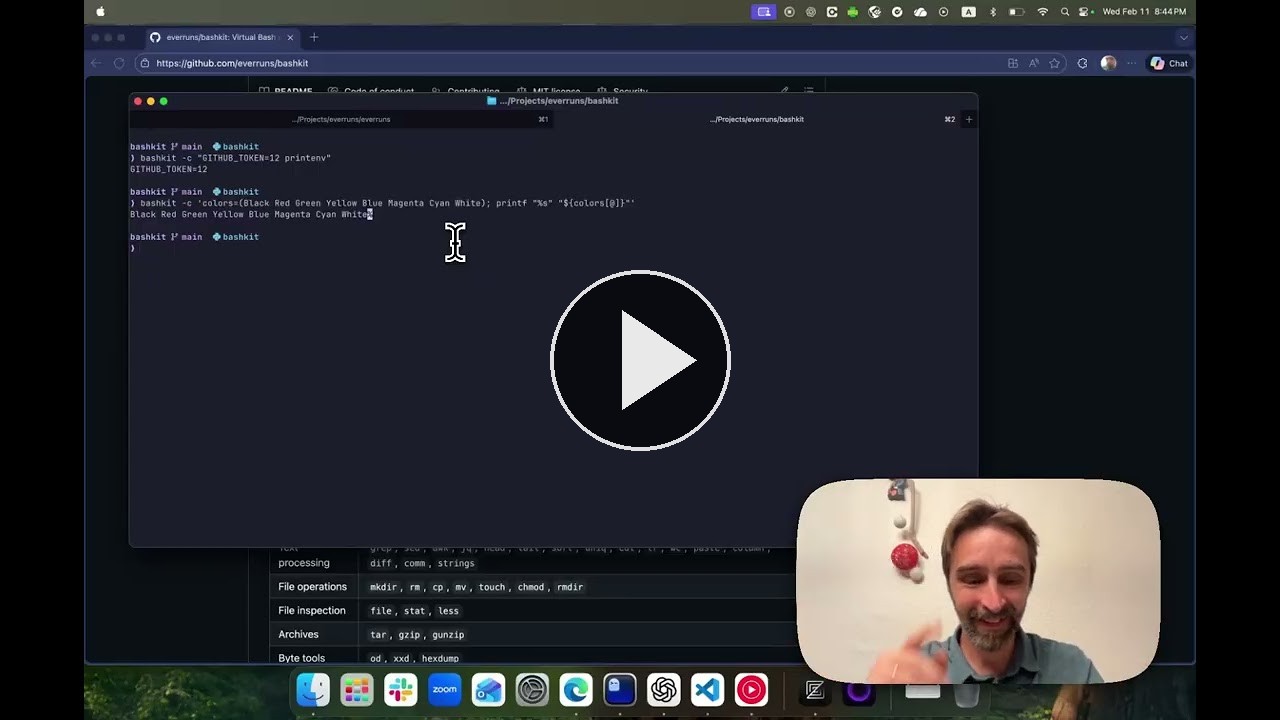
▶ Watch the 10-minute overview
Built-in Commands (167)
| Category | Commands |
|---|---|
| Core | echo, printf, cat, nl, read, mapfile, readarray |
| Navigation | cd, pwd, ls, tree, find, pushd, popd, dirs |
| Flow control | true, false, exit, return, break, continue, test, [ |
| Variables | export, set, unset, local, shift, source, ., eval, readonly, times, declare, typeset, let, alias, unalias |
| Shell | bash, sh (virtual re-invocation), exec, :, trap, caller, getopts, shopt, command, builtin, enable, umask, ulimit, type, which, hash, compgen, fc, help |
| Text processing | grep, rg, sed, awk, jq (requires jq feature), head, tail, sort, uniq, cut, tr, wc, paste, column, diff, comm, strings, tac, rev, seq, expr, fold, expand, unexpand, join, iconv, shuf |
| File operations | mkdir, mktemp, mkfifo, rm, cp, mv, touch, chmod, chown, ln, rmdir, realpath, readlink, split, truncate, install, dd |
| File inspection | file, stat, less |
| Archives | tar, gzip, gunzip, zip, unzip |
| Byte tools | od, xxd, hexdump, base64, base32, basenc, cmp |
| Checksums | md5sum, sha1sum, sha224sum, sha256sum, sha384sum, sha512sum, b2sum, cksum (all *sum support -c) |
| Utilities | sleep, date, basename, dirname, timeout, wait, watch, yes, kill, bc, clear, numfmt, factor, tsort |
| Disk | df, du |
| Pipeline | xargs, tee |
| System info | whoami, hostname, uname, id, nproc, locale, env, printenv, history |
| Data formats | csv, json, yaml, tomlq, template, envsubst |
| Network | curl, wget (requires allowlist), http |
| DevOps | assert, dotenv, glob, log, retry, semver, verify, parallel, patch |
| Experimental | python, python3 (requires python or cpython feature), ts, typescript, node, deno, bun (requires typescript feature), git (requires git feature), ssh, scp, sftp (requires ssh feature), sqlite, sqlite3 (requires sqlite feature) |
Shell Features
- Variables and parameter expansion (
$VAR,${VAR:-default},${#VAR},${var@Q}, case conversion${var^^}) - Command substitution (
$(cmd),`cmd`) - Arithmetic expansion (
$((1 + 2)),declare -i,let) - Pipelines and redirections (
|,>,>>,<,<<<,2>&1,&>) - Control flow (
if/elif/else,for,while,until,casewith;;/;&/;;&,select) - Functions (POSIX and bash-style) with dynamic scoping, FUNCNAME stack,
caller - Indexed arrays (
arr=(a b c),${arr[@]},${#arr[@]}, slicing,+=) - Associative arrays (
declare -A map=([key]=val)) - Nameref variables (
declare -n) - Brace expansion (
{a,b,c},{1..10},{01..05}) - Glob expansion (
*,?) and extended globs (@(),?(),*(),+(),!()) - Glob options (
dotglob,nullglob,failglob,nocaseglob,globstar) - Here documents (
<<EOF,<<-EOFwith tab stripping,<<<here-strings) - Process substitution (
<(cmd),>(cmd)) - Coprocesses (
coproc) - Background execution (
&) withwait - Shell options (
set -euxo pipefail,shopt) - Alias expansion
- Trap handling (
trap cmd EXIT,trap cmd ERR) [[ ]]conditionals with regex matching (=~, BASH_REMATCH)
Configuration
use bashkit::{Bash, ExecutionLimits, InMemoryFs};
use std::sync::Arc;

let limits = ExecutionLimits::new()
    .max_commands(1000)
    .max_loop_iterations(10000)
    .max_function_depth(100);

let mut bash = Bash::builder()
    .fs(Arc::new(InMemoryFs::new()))
    .env("HOME", "/home/user")
    .cwd("/home/user")
    .limits(limits)
    .build();
Virtual Identity
Configure the virtual username and hostname for whoami, hostname, id, and uname:
let mut bash = Bash::builder()
    .username("deploy")      // Sets whoami, id, and $USER env var
    .hostname("my-server")   // Sets hostname, uname -n
    .build();

// whoami → "deploy"
// hostname → "my-server"
// id → "uid=1000(deploy) gid=1000(deploy)..."
// echo $USER → "deploy"
Snapshotting
Checkpoint an interpreter to bytes, then restore it later:
use bashkit::{Bash, SnapshotOptions};

# #[tokio::main]
# async fn main() -> bashkit::Result<()> {
let mut bash = Bash::new();
bash.exec("export BUILD_ID=42; echo ready > /tmp/state.txt").await?;

let snapshot = bash.snapshot()?;
let shell_only = bash.snapshot_with_options(SnapshotOptions {
    exclude_filesystem: true,
})?;
let mut restored = Bash::from_snapshot(&snapshot)?;
assert_eq!(restored.exec("echo $BUILD_ID").await?.stdout.trim(), "42");
restored.restore_snapshot(&shell_only)?;
# Ok(())
# }
See docs/snapshotting.md for Rust, Python, and Node examples, plus snapshot security notes.
Custom Builtins
Register your own commands as bash builtins. They share the interpreter's VFS
and shell state, so mybuiltin > /scratch/out.json writes through and the
next call sees the file.
Rust (any embedder):
use bashkit::{Bash, Builtin, BuiltinContext, BuiltinRegistry, ExecResult, async_trait};
use std::sync::Arc;

struct Greet;

#[async_trait]
impl Builtin for Greet {
    async fn execute(&self, ctx: BuiltinContext<'_>) -> bashkit::Result<ExecResult> {
        let who = ctx.args.first().map(String::as_str).unwrap_or("world");
        Ok(ExecResult::ok(format!("hello {}\n", who)))
    }
}

# #[tokio::main]
# async fn main() -> bashkit::Result<()> {
let registry = BuiltinRegistry::new();
let mut bash = Bash::builder().builtin_registry(registry.clone()).build();

// Register after construction — visible immediately, VFS untouched.
registry.insert("greet", Arc::new(Greet));
assert_eq!(bash.exec("greet Alice").await?.stdout, "hello Alice\n");
# Ok(())
# }
Registry builtins get execution-scoped VFS/request handles by default. Only
trusted host code that intentionally needs a session-lived VFS handle should
use registry.insert_trusted(...).
Node (@everruns/bashkit):
import { Bash } from "@everruns/bashkit";

const bash = new Bash({
  customBuiltins: {
    "get-order": (ctx) =>
      JSON.stringify({ id: ctx.argv[0], status: "shipped" }) + "\n",
  },
});

await bash.execute("mkdir -p /scratch");
await bash.execute("get-order 42 > /scratch/order.json");
console.log((await bash.execute("cat /scratch/order.json")).stdout);
// {"id":"42","status":"shipped"}

// Post-construction registration / removal too:
bash.addBuiltin("greet", (ctx) => `hello ${ctx.argv[0] ?? "world"}\n`);
bash.removeBuiltin("greet");
Resolution order: shell function → POSIX special builtin → custom builtin →
baked-in builtin → $PATH, so custom builtins can override baked-ins
(e.g. wrap cat with tracing) but a shell function defined in the script
still wins.
See docs/custom_builtins_js.md for the full JS guide
(sync vs async, BashTool, error handling, snapshot/restore behavior).
Working example: examples/custom_builtins.mjs.
Experimental: Git Support
Enable the git feature for virtual git operations on the virtual filesystem.
All git data lives in the VFS, no host filesystem access.
cargo add bashkit --features git
use bashkit::{Bash, GitConfig};

let mut bash = Bash::builder()
    .git(GitConfig::new()
        .author("Deploy Bot", "deploy@example.com"))
    .build();

// Local operations: init, add, commit, status, log
// Branch operations: branch, checkout, diff, reset
// Remote operations: remote add/remove, clone/push/pull/fetch (virtual mode)
See knowledge/integrations/git-support.md for the full specification.
Experimental: Python Support
Enable the python feature to embed the Monty Python interpreter (pure Rust, Python 3.12).
Bashkit uses a slightly patched Monty 1.5, published as bashkit-monty and bashkit-monty-types: the patch adds a per-run memory probe and a VM checkpoint hook, so concurrent runs in one process get separate memory limits and honour cancellation. The upstream proposal is pydantic/monty#740; the forks go away once upstream has the hooks.
Python code runs in-memory with configurable resource limits and VFS bridging, files created
by bash are readable from Python and vice versa.
cargo add bashkit --features python
use bashkit::Bash;

let mut bash = Bash::builder().python().build();

// Inline code
bash.exec("python3 -c \"print(2 ** 10)\"").await?;

// Script files from VFS
bash.exec("python3 /tmp/script.py").await?;

// VFS bridging: open() and pathlib.Path work with the virtual filesystem
bash.exec(r#"python3 -c "
with open('/tmp/data.txt', 'w') as f:
    f.write('hello from python')
""#).await?;
bash.exec("cat /tmp/data.txt").await?; // "hello from python"
Stdlib modules: json, math, re, datetime, pathlib, os, sys, typing, csv, collections, and more.
Rust embedders install bashkit::MeteredAllocator as the global allocator; it gives each run its own memory limit.
Limitations: file I/O is VFS-scoped, no network, simple classes only (no inheritance), no third-party imports.
See crates/bashkit/docs/python.md for the full guide.
For full CPython 3.14 (complete language and stdlib, CPython CLI semantics), enable the
cpython feature and call .cpython() instead. The interpreter runs as a WebAssembly guest,
one fresh instance per call. See crates/bashkit/docs/cpython.md
for the trade-offs against Monty and the limitations.
Experimental: TypeScript Support
Enable the typescript feature to embed the ZapCode TypeScript interpreter (pure Rust, no V8).
TypeScript code runs in-memory with configurable resource limits and VFS bridging via external function suspend/resume.
cargo add bashkit --features typescript
use bashkit::Bash;

let mut bash = Bash::builder().typescript().build();

// Inline code (ts, node, deno, bun aliases all work)
bash.exec("ts -c \"console.log(2 ** 10)\"").await?;
bash.exec("node -e \"console.log('hello')\"").await?;

// Script files from VFS
bash.exec("ts /tmp/script.ts").await?;

// VFS bridging: readFile/writeFile async functions
bash.exec(r#"ts -c "await writeFile('/tmp/data.txt', 'hello from ts')"#).await?;
bash.exec("cat /tmp/data.txt").await?; // "hello from ts"
Compat aliases (node, deno, bun) and unsupported-mode hints are configurable:
use bashkit::{Bash, TypeScriptConfig};

// Only ts/typescript, no compat aliases
let bash = Bash::builder()
    .typescript_with_config(TypeScriptConfig::default().compat_aliases(false))
    .build();
Limitations: no import/require, no eval(), no network, no process/Deno/Bun globals.
See crates/bashkit/docs/typescript.md for the full guide.
Experimental: SQLite Support
Enable the sqlite feature to embed Turso, a pure-Rust, SQLite-compatible engine, backed by the bashkit virtual filesystem. Turso is BETA upstream, so the builtin is opt-in at both the cargo and runtime layer.
[dependencies]
bashkit = { version = "0.20.3", features = ["sqlite"] }
use bashkit::Bash;

let mut bash = Bash::builder()
    .sqlite()
    .env("BASHKIT_ALLOW_INPROCESS_SQLITE", "1")
    .build();

// In-memory query
bash.exec("sqlite :memory: 'SELECT 1 + 2'").await?;

// VFS-backed database — persists across invocations
bash.exec(r#"sqlite /tmp/notes.sqlite '
  CREATE TABLE IF NOT EXISTS notes(id INTEGER PRIMARY KEY, body TEXT);
  INSERT INTO notes(body) VALUES ("hello");
'"#).await?;
bash.exec("sqlite -header /tmp/notes.sqlite 'SELECT * FROM notes'").await?;
Sqlite3-shell-compatible flags (-csv, -json, -markdown, -header, -separator, -nullvalue, -cmd) and dot-commands (.tables, .schema, .dump, .read, .headers, .mode) are supported. Two IO backends are available: Memory (default, load/flush against the VFS at command boundaries) and Vfs (custom turso IO impl).
Limits via SqliteLimits cap script size, result-set rows, DB file size, wall-clock duration, and statement count. See crates/bashkit/docs/sqlite.md for the full guide.
Virtual Filesystem
use bashkit::{InMemoryFs, OverlayFs, MountableFs, FileSystem};
use std::sync::Arc;

// Layer filesystems
let base = Arc::new(InMemoryFs::new());
let overlay = Arc::new(OverlayFs::new(base));

// Mount points
let mut mountable = MountableFs::new(Arc::new(InMemoryFs::new()));
mountable.mount("/data", Arc::new(InMemoryFs::new()));
CLI Usage
# Run a script
bashkit script.sh

# Interactive REPL
bashkit


# Mount real filesystem (read-only or read-write)
bashkit --mount-ro /data script.sh
bashkit --mount-rw /workspace script.sh
Development
just build        # Build project
just test         # Run tests
just check        # fmt + clippy + test
just pre-pr       # Pre-PR checks
LLM Eval Results
Bashkit includes a mira eval study that measures how well LLMs use bashkit: one tagged 88-task dataset (bashkit_bash) covering agent tool use (58 basic, 8 multi-turn repo, 10 hard) and 12 runtime tasks (python3, sqlite3, state on the VFS), plus a 15-task one-shot script generation eval (bashkit_generate).
Latest run: 2026-10-09 (GPT-6 models added 2026-10-12), on the mira eval framework.
| Model | Score | Tasks Passed | Basic | Repo | Hard | Runtime | Generate |
|---|---|---|---|---|---|---|---|
| Claude Opus 5.5 | 99% | 87/88 | 58/58 | 7/8 | 10/10 | 12/12 | 13/15 |
| Kimi K3 | 98% | 86/88 | 57/58 | 8/8 | 9/10 | 12/12 | 15/15 |
| Claude Sonnet 5.5 | 97% | 85/88 | 56/58 | 8/8 | 9/10 | 12/12 | 15/15 |
| Muse Spark 1.3 Contributor | 95% | 84/88 | 58/58 | 5/8 | 9/10 | 12/12 | 15/15 |
| GPT-6.1 Sol | 86% | 76/88 | 54/58 | 3/8 | 8/10 | 11/12 | 14/15 |
| Gemini 3.8 Flash | 84% | 74/88 | 55/58 | 4/8 | 6/10 | 9/12 | 13/15 |
| GPT-6 Luna | 81% | 71/88 | 53/58 | 1/8 | 5/10 | 12/12 | 14/15 |
Repo and hard tasks carry most of the spread; the new runtime tasks (python3 and sqlite3 inside the sandbox) are near-saturated, with only Gemini and GPT-6.1 Sol missing any. See the detailed analysis.
cargo install mira-cli       # one-time: the `mira` host CLI
just eval-list               # list evals, samples, scorers, targets
just eval                    # run the bash eval across the model matrix
just eval-scripting          # run the scripting-tool eval
just eval-generate           # run the one-shot generation eval
Benchmarks
Bashkit includes a benchmark tool to compare performance against bash and just-bash.
just bench              # Quick benchmark run
just bench --save       # Save results with system identifier
just bench-verbose      # Detailed output
just bench-list         # List all benchmarks
See crates/bashkit-bench/README.md for methodology and assumptions.
Language Bindings
C API
The experimental libbashkit native C ABI exposes opaque handles, synchronous
execution, and binary-safe virtual filesystem access. See
crates/bashkit-capi, including two runnable C
examples.
Python
Python bindings with LangChain integration are available in crates/bashkit-python.
from bashkit import BashTool

tool = BashTool()
print(tool.description())
print(tool.help())
result = await tool.execute("echo 'Hello, World!'")
print(result.stdout)
JavaScript / TypeScript
NAPI-RS bindings for Node.js, Bun, and Deno. Available as @everruns/bashkit on npm.
import { BashTool } from '@everruns/bashkit';

const tool = new BashTool({ username: 'agent', hostname: 'sandbox' });
const result = await tool.execute("echo 'Hello, World!'");
console.log(result.stdout);

// Direct VFS access
await tool.writeFile('/tmp/data.txt', 'hello');
const content = await tool.readFile('/tmp/data.txt');
Platform matrix: macOS (x86_64, aarch64), Linux (x86_64, aarch64), Windows (x86_64), WASM. See crates/bashkit-js for details.
Browser / edge (WebAssembly)
A slim, single-threaded WebAssembly build for the browser and any other
JavaScript runtime, edge/serverless workers (Cloudflare Workers, Vercel Edge,
Deno Deploy), Node, Deno, and Bun. Available as @everruns/bashkit-wasm on npm.
It needs no SharedArrayBuffer and no COOP/COEP headers, so it drops
into any web app (including iframes) and into thread-less edge runtimes.
import { initBashkit, Bash } from "@everruns/bashkit-wasm";

await initBashkit();
const bash = new Bash();
console.log(bash.executeSync('echo "Hello, browser!" | tr a-z A-Z').stdout); // HELLO, BROWSER!
Use this when a native addon can't load (browsers, edge); for a native
Node.js / Bun / Deno addon use @everruns/bashkit above. See
crates/bashkit-wasm for details.
Java (community)
bashkit4j — Java 17+ binding over
the libbashkit C ABI via JNA (no JNI code of its own, no Docker daemon, no
host bash binary). It bundles the native libraries for Windows / Linux / macOS
(x86-64 + ARM64) inside the jar and covers sandboxed execution, in-memory VFS,
opt-in host-directory mounts, resource limits, wall-clock timeout, and
cancellation. Published on Maven Central as
io.github.terseprompts:bashkit4j
(javadoc).
Independent community project, unaffiliated with Everruns.
Elixir (community)
ex_bashkit — Elixir NIF binding with
precompiled binaries for macOS / Linux (x86-64 + ARM64). It offers stateless
execution plus persistent sessions backed by the in-memory VFS. Published on
Hex as ex_bashkit. Independent community project, unaffiliated with Everruns.
.NET (community)
computerwelt — Community .NET binding for Bashkit. Independent community project, unaffiliated with Everruns.
Security
Bashkit is built for running untrusted scripts from AI agents and users. Security is a core design goal, not an afterthought.
Defense in Depth
| Layer | Protection |
|---|---|
| No process spawning | All 167 commands are reimplemented in Rust, no fork, exec, or shell escape |
| Virtual filesystem | Scripts see an in-memory FS by default; no host filesystem access unless explicitly mounted |
| Network allowlist | HTTP access is denied by default; each domain must be explicitly allowed |
| Resource limits | Configurable caps on commands (10K), loop iterations (10K per loop, 1M total), function depth (100), stdout/stderr (1MiB each), input (10MB) |
| Filesystem limits | Max total bytes (100MB), max file size (10MB), max file count (10K), prevents zip bombs, tar bombs, and append floods |
| Parser limits | Timeout (5s), fuel budget (100K ops), AST depth (100), prevents pathological input from hanging the interpreter |
| Multi-tenant isolation | Each Bash instance is fully isolated, no shared state between tenants |
| Panic recovery | All builtins wrapped in catch_unwind, a panic in one command doesn't crash the host |
| Path traversal prevention | RealFs backend canonicalizes paths to prevent ../../etc/passwd escapes |
| Unicode security | 68 byte-boundary tests across builtins; zero-width character rejection in VFS paths |
Threat Model
280+ identified threats across 17 categories (DoS, sandbox escape, info disclosure, injection, network, isolation, internal errors, git, SSH, logging, crypto, Python, TypeScript, SQLite, Unicode, filesystem, snapshots), each with a stable ID, mitigation status, and test coverage.
See the threat model for the full analysis and security policy for reporting vulnerabilities.
Other Virtual Bash Implementations
- just-bash (TypeScript, Apache-2.0), Virtual bash interpreter for AI agents by Vercel Labs. Custom recursive descent parser, 75+ reimplemented commands (including full awk/sed/jq), in-memory VFS, defense-in-depth sandboxing, AST transform plugins. Runs in Node.js and browser.
- gbash (Go, Apache-2.0), Deterministic, sandbox-only bash runtime for AI agents. Delegates parsing to
mvdan/sh. Registry-backed commands, policy enforcement, structured tracing, JSON-RPC server mode.
Acknowledgments
Bashkit is an independent implementation that draws design inspiration from several open source projects:
- just-bash (Vercel Labs, Apache-2.0), Pioneered the idea of a virtual bash interpreter for AI-powered environments. Bashkit's sandboxing architecture and multi-tenant design was inspired by their approach.
- Oils (Andy Chu, Apache-2.0), Comprehensive bash compatibility testing approach inspired our spec test methodology.
- One True AWK (Lucent Technologies), AWK language semantics reference for our awk builtin.
- jq (Stephen Dolan, MIT), jq query syntax and behavior reference. Our implementation uses the jaq Rust crates.
No code was copied from any of these projects. See NOTICE for full details.
How can I support this project?
Bashkit is a free, open-source hobby project. There are many ways to help:
- Use Bashkit and tell us about your experience on Discord or by email (mykhailo@everruns.com)
- Report bugs in GitHub Issues; a minimal script that behaves differently from real bash is the best bug report
- Star the repository, it helps other people find it
- Write a blog post or share what you built with it
- Help with the docs by asking questions or sending PRs
- Contribute code, such as a builtin or a compatibility test (see below, and say hi on Discord)
- Talk about Bashkit around you
Contributing
The best way to contribute is to open an issue, bug reports, feature requests, and questions all help improve bashkit. If you'd like to contribute code, see CONTRIBUTING.md for setup and workflow details.
Ecosystem
Bashkit is part of the Everruns ecosystem.
License
MIT
Compatibility
- Runs on
- GPU support unknown
What shows it
- no dependency or feature matches a backend row
- Native code
- None found
- No native code found
- Python bindings
- No Python binding crate found
- License
- MIT
Compare with similar projects
Order: strongest tier first, then most downloads, then name, with unmeasured values last. A library counts downloads over 30 days. An app counts binary downloads per release. An app with none counts its crate downloads over 30 days. ML Rust runs this catalogue, so its closest project always gets a row.
| Project | Downloads | Dependents | Stars | Latest release | Runs on (GPU) | Native code | License |
|---|---|---|---|---|---|---|---|
|
Awesomely fast virtual sandbox with bash and file system |
31,092 downloads over 30 days | 6 | 325 | 0.20.3 | GPU support unknown | No native code found | MIT |
|
rust-mcp-schema Featured
Type-safe implementation of the Model Context Protocol in Rust, designed to reduce errors and accelerate development with powerful utilities. |
107,187 downloads over 30 days | 19 | 79 | 2.0.0 | GPU support unknown | No native code found | MIT |
|
an open source, extensible AI agent that goes beyond code suggestions - install, execute, edit, and test with any LLM |
63,795 binary downloads per release | Not applicable | 56,377 | Not measured | Not measured | Apache-2.0 | |
|
adk-rust Listed
Rust Agent Development Kit - Build AI agents in Rust with modular components for models, tools, memory, and more. |
5,419 downloads over 30 days | 25 | 743 | 2.3.0 | CUDA, Metal | Binds native code: alsa-sys (feature desktop-audio), audiopus_sys (feature openai-webrtc), cxx (feature livekit), espeak-rs-sys (feature kokoro), libsqlite3-sys (feature sqlite) and 4 more | Apache-2.0 |
|
Fast, lightweight Firecrawl and Tavily alternative in Rust for web scraping. |
444 binary downloads per release | Not applicable | 1,237 | 0.42.1 | GPU support unknown | Binds native code: btls-sys (feature impersonated) | AGPL-3.0 |
|
bamboo-agent Listed
A fully self-contained AI agent backend framework with built-in web services, multi-LLM provider support, and comprehensive tool execution |
331 downloads over 30 days | 10 | 22 | 2026.11.14 | GPU support unknown | Binds native code: libsqlite3-sys, mac-notification-sys, openssl-sys, ring, tree-sitter and 1 more | MIT |
|
An open protocol that gives AI agents a secure, sandboxed place to run code and use tools — with lean context usage. AXP works alongside MCP |
Not measured | Not applicable | 3 | Not measured | Not measured | Not measured | Apache-2.0 |
Why ListedNo archive, New or Featured rule places it, so it is Listed.
What it lacks for Featured
- It has 5 active dependents and 5 new dependents in 365 days. Featured needs 11 active dependents or 9 new dependents in 365 days. The repository route reads 325 stars, 32 forks and 11 contributors. It needs 4,539 stars, 434 forks and 79 contributors together.
What else the check found
- The last activity is on 8 Nov 2026, 1 day ago. The rules expect an update within 365 days. Dormancy rule
Exact rules: Listed, Featured library. The check on applied thresholds version 9.
Every rule outcome, as the check records it
expected-interval: version 0.20.3 base 300, raised to the 365-day floor: E = 365 daysdormancy: last activity 2026-11-08, 1 days ago, E = 365: activefeatured: not featured: active_users 5 < 11 and new_adopters 5 < 9 and repository route stars 325 (needs 4539), forks 32 (needs 434), contributors 11 (needs 79)listed: listed: no archive, new or featured rule applies
Crates3 crates
- bashkit Primary
- bashkit-cli
- bashkit-scripted-tool
Measurements and sources
Each signal row shows the raw value, its source and the fetch date. The Sources list gathers every distinct source on this page. Movement needs more history.
Sources6 sources
- Description: the crates.io description
- crates.io database dump, fetched
- RustSec advisory database, fetched
- GitHub repository, fetched
- crates.io package, fetched
- GitHub contributors, fetched
Adoption5 active dependents, 5 new dependents in 365 days1 not measured
| Signal | Value | Source | Fetched | Counts |
|---|---|---|---|---|
| Active dependents | 5 | crates.io database dump | Yes | |
| New dependents (365 days) | 5 | crates.io database dump | Yes | |
| Peak active dependents | 5 | crates.io database dump | Yes | |
| Active dependents as a share of the peak | 1 | crates.io database dump | Yes | |
| Binary downloads per release | Not measured | Yes |
MaintenanceLatest human commit: 1 day ago3 not measured
| Signal | Value | Source | Fetched | Counts |
|---|---|---|---|---|
| Latest human commit | 2026-11-08 | GitHub repository | Yes | |
| Latest release | 2026-11-04 | crates.io database dump | Yes | |
| First release | 2026-02-03 | crates.io database dump | Yes | |
| Latest version | 0.20.3 | crates.io database dump | Yes | |
| Days the oldest outside issue waits for a reply | 0 | GitHub repository | Yes | |
| Maintainer replies over 365 days | 0 | GitHub repository | Yes | |
| Repository archived | false | GitHub repository | Yes | |
| Repository gone | false | GitHub repository | Yes | |
| Release commit or manifest in the repo | true | crates.io package | Yes | |
| Published docs | true | crates.io database dump | Yes | |
| Latest release fails cargo check | Not measured | Yes | ||
| Build check date | Not measured | Yes | ||
| Build check toolchain | Not measured | Yes |
SecurityUnpatched vulnerabilities: none
| Signal | Value | Source | Fetched | Counts |
|---|---|---|---|---|
| Unpatched vulnerabilities past the grace window | none | RustSec advisory database | Yes | |
| RustSec unmaintained advisory | none | RustSec advisory database | Yes | |
| Deprecation notice | none | crates.io database dump | Yes | |
| Deprecated requirement | none | crates.io database dump | Yes |
Distribution56 releases, 31,092 downloads over 30 days5 not measured
| Signal | Value | Source | Fetched | Counts |
|---|---|---|---|---|
| Releases | 56 | crates.io database dump | Yes | |
| Downloads over 30 days | 31092 | crates.io database dump | Yes | |
| Binary downloads over the last 3 releases | Not measured | Yes | ||
| Homebrew installs on request over 365 days | Not measured | Yes | ||
| Repology repository families | Not measured | Yes | ||
| Docker pull growth over 90 days | Not measured | Yes | ||
| Docker pulls at the growth baseline | Not measured | Yes | ||
| Every version a prerelease | false | crates.io database dump | Yes | |
| Every version 0.0.x | false | crates.io database dump | Yes | |
| Every version yanked | false | crates.io database dump | Yes | |
| Crate deleted from crates.io | false | crates.io database dump | Yes |
Repository325 stars, 32 forks, 11 contributors, 2,206 commits. Stars alone never qualify a project.
| Signal | Value | Source | Fetched | Counts |
|---|---|---|---|---|
| GitHub stars | 325 | GitHub repository | Yes — one part of the repository route | |
| GitHub forks | 32 | GitHub repository | Yes — one part of the repository route | |
| Contributors with a GitHub account | 11 | GitHub contributors | Yes — one part of the repository route | |
| Commits on the default branch | 2206 | GitHub repository | No | |
| Repository's main crate left out of the entry | none | crates.io database dump | Yes |
Facts that never count
| Signal | Value | Source | Fetched | Counts |
|---|---|---|---|---|
| License | MIT | crates.io database dump | No | |
| Runs on, from listed crates and their direct dependencies | GPU support unknown | crates.io database dump | No | |
| What shows each backend | no dependency or feature matches a backend row | crates.io database dump | No | |
| Native code, from listed crates and their dependencies | No native code found | crates.io database dump | No | |
| Python bindings, from direct dependencies of listed crates | No Python binding crate found | crates.io database dump | No | |
| Crates that depend on a listed crate directly | 6 | crates.io database dump | No |
Corrections and review history
No correction applies to this entry.
Judgments
A judgment enters only through an approved issue and a merged pull request.
No judgment applies to this entry.