ai00_server
App Listed
The all-in-one RWKV runtime box with embed, RAG, AI agents, and more.
- Downloads
- 238
- Dependents
- Not applicable
- Stars
- 624
- Forks
- 74
- Contributors
- 19
- Commits
- 819
- Latest release
About
💯AI00 RWKV Server

AI00 RWKV Server is an inference API server for the RWKV language model based upon the web-rwkv inference engine.
It supports Vulkan parallel and concurrent batched inference and can run on all GPUs that support Vulkan. No need for Nvidia cards!!! AMD cards and even integrated graphics can be accelerated!!!
No need for bulky pytorch, CUDA and other runtime environments, it's compact and ready to use out of the box!
Compatible with OpenAI's ChatGPT API interface.
100% open source and commercially usable, under the MIT license.
If you are looking for a fast, efficient, and easy-to-use LLM API server, then AI00 RWKV Server is your best choice. It can be used for various tasks, including chatbots, text generation, translation, and Q&A.
Join the AI00 RWKV Server community now and experience the charm of AI!
QQ Group for communication: 30920262
Read the full README
💥Features
- Based on the
RWKVmodel, it has high performance and accuracy - Supports
Vulkaninference acceleration, you can enjoy GPU acceleration without the need forCUDA! Supports AMD cards, integrated graphics, and all GPUs that supportVulkan - No need for bulky
pytorch,CUDAand other runtime environments, it's compact and ready to use out of the box! - Compatible with OpenAI's ChatGPT API interface
⭕Usages
- Chatbot
- Text generation
- Translation
- Q&A
- Any other tasks that LLM can do
👻Other
Installation, Compilation, and Usage
📦Download Pre-built Executables
Directly download the latest version from Release
After downloading the model, place the model in the
assets/models/path, for example,assets/models/RWKV-x060-World-3B-v2-20240228-ctx4096.stOptionally modify
assets/configs/Config.tomlfor model configurations like model path, quantization layers, etc.Run in the command line
$ ./ai00_rwkv_serverOpen the browser and visit the WebUI at http://localhost:65530 (https://localhost:65530 if
tlsis enabled)
📜(Optional) Build from Source
Clone this repository
$ git clone https://github.com/cgisky1980/ai00_rwkv_server.git
$ cd ai00_rwkv_server
After downloading the model, place the model in the
assets/models/path, for example,assets/models/RWKV-x060-World-3B-v2-20240228-ctx4096.stCompile
$ cargo build --releaseAfter compilation, run
$ cargo run --releaseOpen the browser and visit the WebUI at http://localhost:65530 (https://localhost:65530 if
tlsis enabled)
📒Convert the Model
It only supports Safetensors models with the .st extension now. Models saved with the .pth extension using torch need to be converted before use.
(Recommended) Run the python script
convert_safetensors.py:$ python assets/scripts/convert_safetensors.py --input /path/to/model.pth --output /path/to/model.stRequirements: Python, with
torchandsafetensorsinstalled.If you do not want to install python, In the Release you could find an executable called
converter. Run
$ ./converter --input /path/to/model.pth --output /path/to/model.st
- If you are building from source, run
$ cargo run --release --package converter -- --input /path/to/model.pth --output /path/to/model.st
- Just like the steps mentioned above, place the model in the
.stmodel in theassets/models/path and modify the model path inassets/configs/Config.toml
📝Supported Arguments
--config: Configure file path (default:assets/configs/Config.toml)--ip: The IP address the server is bound to--port: Running port
📙Currently Available APIs
The API service starts at port 65530, and the data input and output format follow the Openai API specification.
Note that some APIs like chat and completions have additional optional fields for advanced functionalities. Visit http://localhost:65530/api-docs for API schema.
/api/oai/v1/models/api/oai/models/api/oai/v1/chat/completions/api/oai/chat/completions/api/oai/v1/completions/api/oai/completions/api/oai/v1/embeddings/api/oai/embeddings
The following is an out-of-box example of Ai00 API invocations in Python:
import openai

class Ai00:
    def __init__(self,model="model",port=65530,api_key="JUSTSECRET_KEY") :
        openai.api_base = f"http://127.0.0.1:{port}/api/oai"
        openai.api_key = api_key
        self.ctx = []
        self.params = {
            "system_name": "System",
            "user_name": "User",
            "assistant_name": "Assistant",
            "model": model,
            "max_tokens": 4096,
            "top_p": 0.6,
            "temperature": 1,
            "presence_penalty": 0.3,
            "frequency_penalty": 0.3,
            "half_life": 400,
            "stop": ['\x00','\n\n']
        }

    def set_params(self,**kwargs):
        self.params.update(kwargs)

    def clear_ctx(self):
        self.ctx = []

    def get_ctx(self):
        return self.ctx

    def continuation(self, message):
        response = openai.Completion.create(
            model=self.params['model'],
            prompt=message,
            max_tokens=self.params['max_tokens'],
            half_life=self.params['half_life'],
            top_p=self.params['top_p'],
            temperature=self.params['temperature'],
            presence_penalty=self.params['presence_penalty'],
            frequency_penalty=self.params['frequency_penalty'],
            stop=self.params['stop']
        )
        result = response.choices[0].text
        return result

    def append_ctx(self,role,content):
        self.ctx.append({
            "role": role,
            "content": content
        })

    def send_message(self, message,role="user"):
        self.ctx.append({
            "role": role,
            "content": message
        })
        result = openai.ChatCompletion.create(
            model=self.params['model'],
            messages=self.ctx,
            names={
                "system": self.params['system_name'],
                "user": self.params['user_name'],
                "assistant": self.params['assistant_name']
            },
            max_tokens=self.params['max_tokens'],
            half_life=self.params['half_life'],
            top_p=self.params['top_p'],
            temperature=self.params['temperature'],
            presence_penalty=self.params['presence_penalty'],
            frequency_penalty=self.params['frequency_penalty'],
            stop=self.params['stop']
        )
        result = result.choices[0].message['content']
        self.ctx.append({
            "role": "assistant",
            "content": result
        })
        return result

ai00 = Ai00()
ai00.set_params(
    max_tokens = 4096,
    top_p = 0.55,
    temperature = 2,
    presence_penalty = 0.3,
    frequency_penalty = 0.8,
    half_life = 400,
    stop = ['\x00','\n\n']
)
print(ai00.send_message("how are you?"))
print(ai00.send_message("me too!"))
print(ai00.get_ctx())
ai00.clear_ctx()
print(ai00.continuation("i like"))
BNF Sampling
Since v0.5, Ai00 has a unique feature called BNF sampling. BNF forces the model to output in specified formats (e.g., JSON or markdown with specified fields) by limiting the possible next tokens the model can choose from.
Here is an example BNF for JSON with fields "name", "age" and "job":
start ::= json_object;
json_object ::= "{\n" object_members "\n}";
object_members ::= json_member | json_member ",\n" object_members;
json_member ::= "\t" json_key ": " json_value;
json_key ::= '"' "name" '"' | '"' "age" '"' | '"' "job" '"';
json_value ::= json_string | json_number;
json_string ::= '"'content'"';
content ::= #"\\w*";
json_number ::= positive_digit digits|'0';
digits ::= digit|digit digits;
digit ::= '0'|positive_digit;
positive_digit::="1"|"2"|"3"|"4"|"5"|"6"|"7"|"8"|"9";
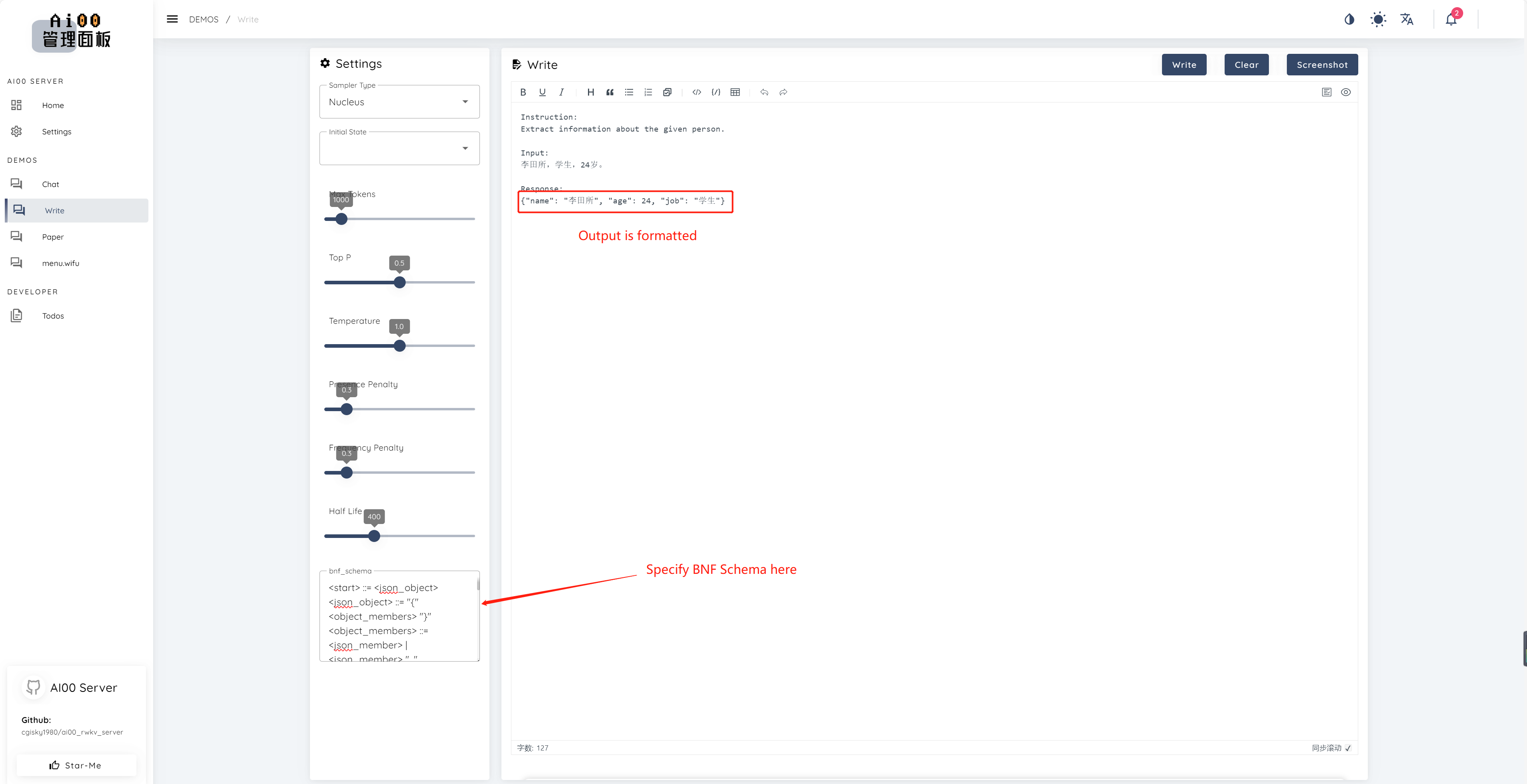
📙WebUI Screenshots
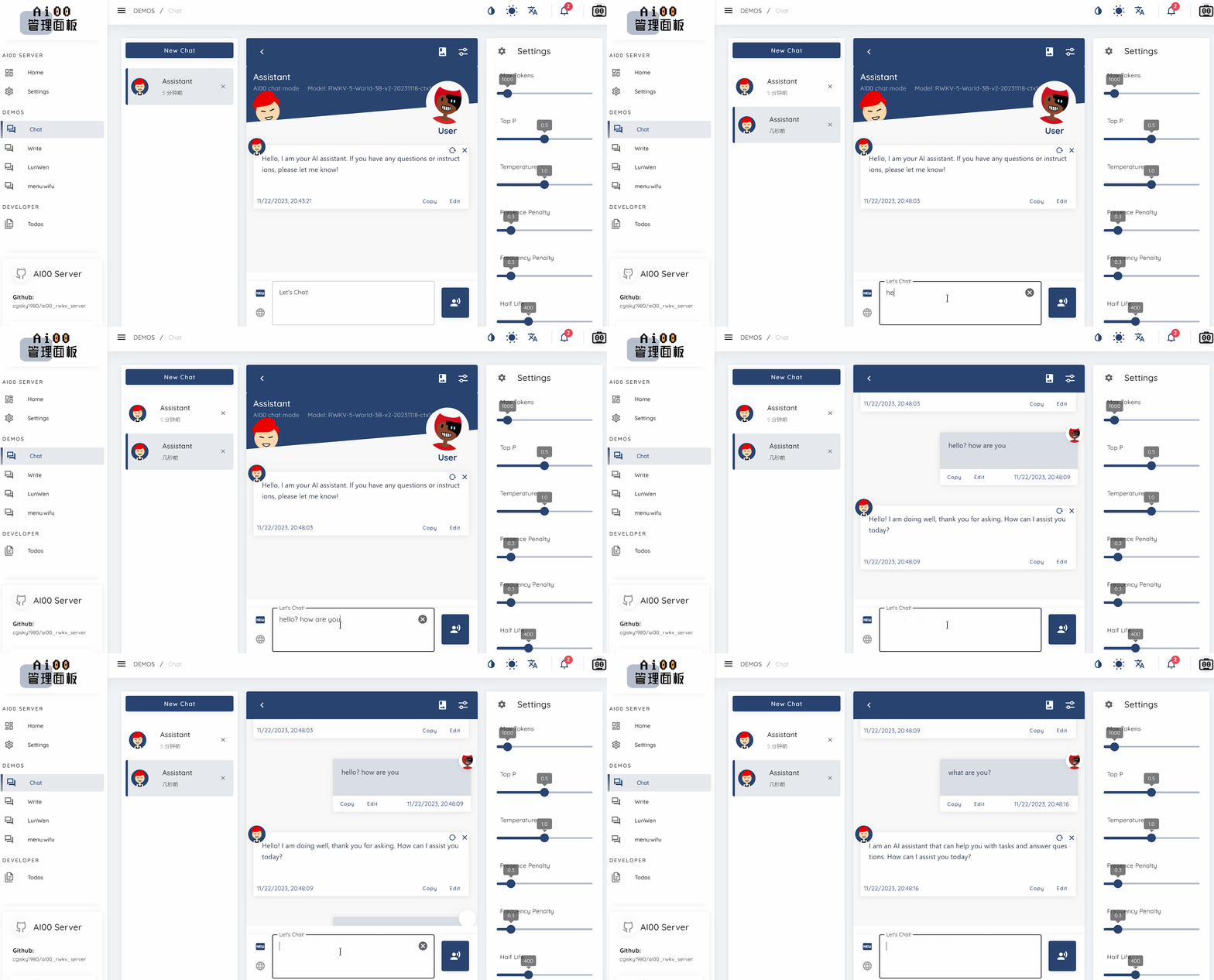
Chat
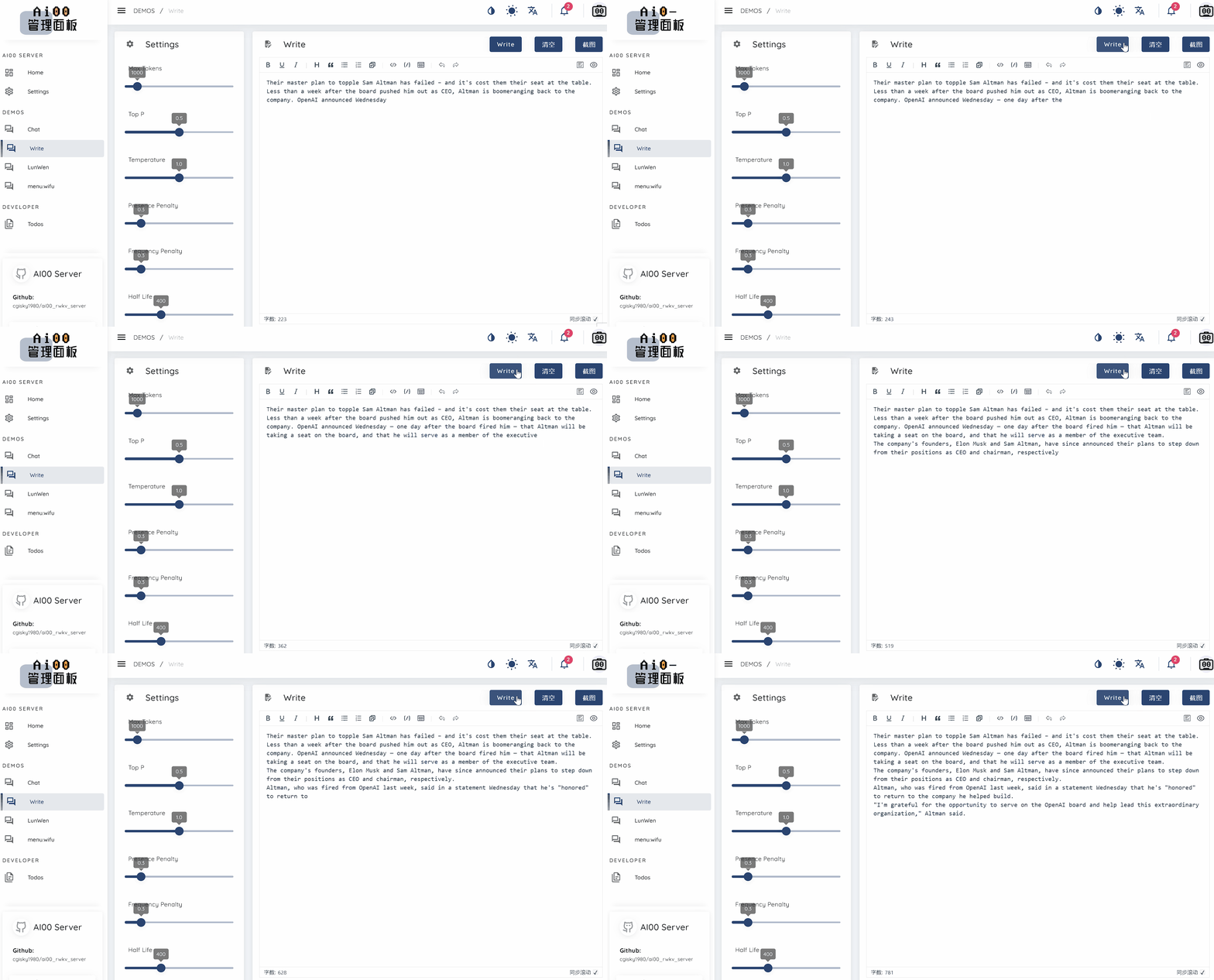
Continuation
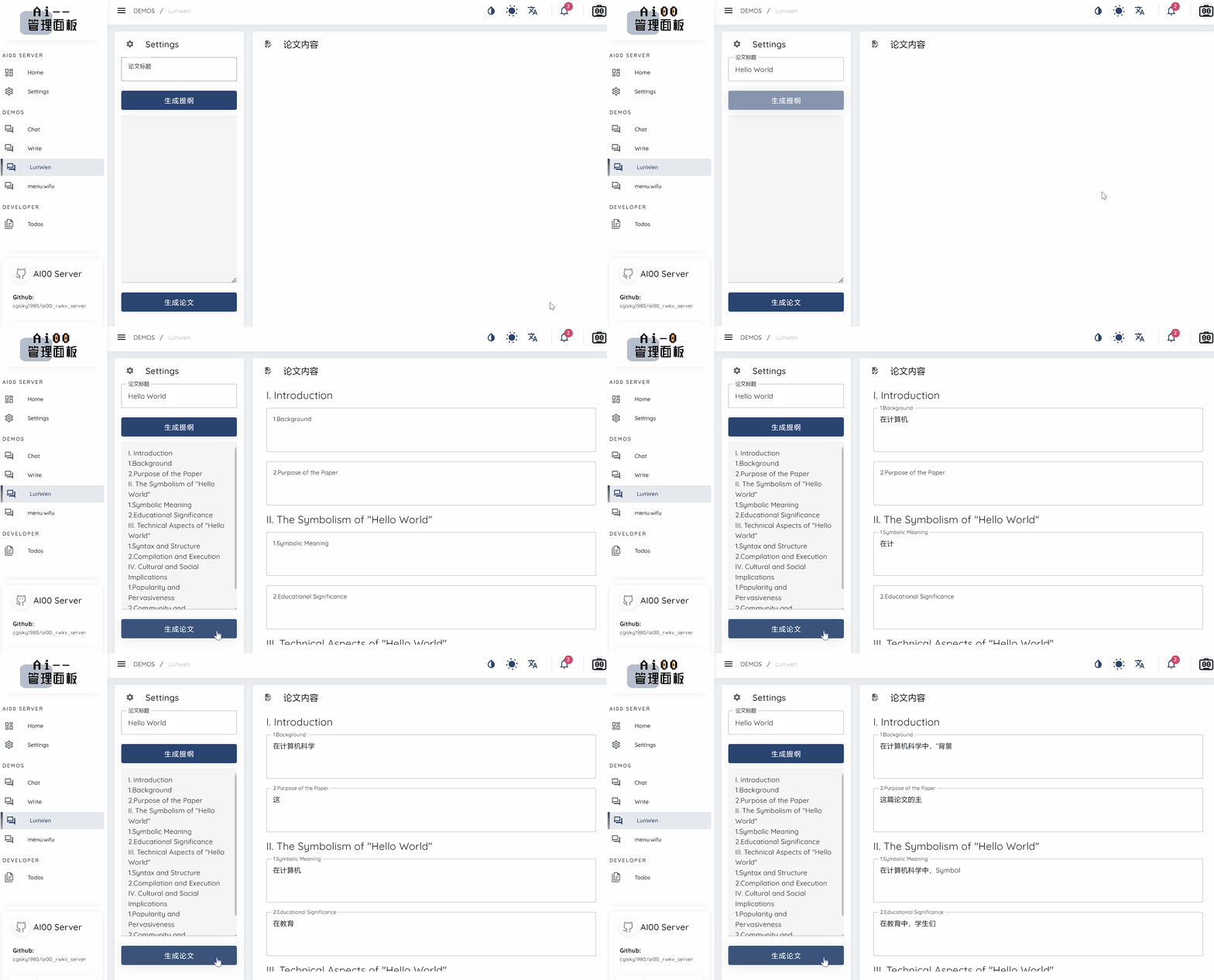
Paper (Parallel Inference Demo)
📝TODO List
- [x] Support for
text_completionsandchat_completions - [x] Support for sse push
- [x] Integrate basic front-end
- [x] Parallel inference via
batch serve - [x] Support for
int8quantization - [x] Support for
NF4quantization - [x] Support for
LoRAmodel - [x] Support for tuned initial states
- [ ] Hot loading and switching of
LoRAmodel - [x] Hot loading and switching of tuned initial states
- [x] BNF sampling
👥Join Us
We are always looking for people interested in helping us improve the project. If you are interested in any of the following, please join us!
- 💀Writing code
- 💬Providing feedback
- 🔆Proposing ideas or needs
- 🔍Testing new features
- ✏Translating documentation
- 📣Promoting the project
- 🏅Anything else that would be helpful to us
No matter your skill level, we welcome you to join us. You can join us in the following ways:
- Join our Discord channel
- Join our QQ group
- Submit issues or pull requests on GitHub
- Leave feedback on our website
We can't wait to work with you to make this project better! We hope the project is helpful to you!
Acknowledgement
Thank you to these awesome individuals who are insightful and outstanding for their support and selfless dedication to the project!
Stargazers over time
Compatibility
- License
- MIT
- Crate facts
- Not measured
- Runs on, Native code and Python bindings read crates on crates.io. This entry lists no crate.
Compare with similar projects
Order: strongest tier first, then most downloads, then name, with unmeasured values last. A library counts downloads over 30 days. An app counts binary downloads per release. An app with none counts its crate downloads over 30 days. ML Rust runs this catalogue, so its closest project always gets a row.
| Project | Downloads | Dependents | Stars | Latest release | Runs on (GPU) | Native code | License |
|---|---|---|---|---|---|---|---|
|
The all-in-one RWKV runtime box with embed, RAG, AI agents, and more. |
238 binary downloads per release | Not applicable | 624 | Not measured | Not measured | MIT | |
|
llama-gguf Listed
A high-performance Rust implementation of llama.cpp - LLM inference engine with full GGUF support |
1,787 downloads over 30 days | 3 | 21 | 0.14.0 | CUDA, Metal, Vulkan | Binds native code: hailort-sys (feature hailo), libsqlite3-sys (feature rag-sqlite) | Apache-2.0 OR MIT |
|
Distributed AI/LLM for the people. Share compute privately or publicly to power your agents and chat. |
1,411 binary downloads per release | Not applicable | 3,993 | 0.78.1 | GPU support unknown | Binds native code: libsqlite3-sys, netlink-sys, ring, secp256k1-sys | Apache-2.0 OR MIT |
|
The easiest & fastest way to run customized and fine-tuned LLMs locally or on the edge |
841 binary downloads per release | Not applicable | 1,663 | Not measured | Not measured | Apache-2.0 | |
|
Inference server for LLMs, speech and embeddings: OpenAI-compatible routes with streaming, plus speech synthesis (TTS) and transcription (ASR). Serves Llama, Mistral, Qwen, Mamba2, MLA+MoE and hybrid models from SafeTensors, AWQ, GPTQ and GGUF. |
8 binary downloads per release | Not applicable | 7 | 0.7.1 | CUDA, WebGPU | Binds native code: ring (feature distributed) | Apache-2.0 |
|
furnace New
Fast, unified, Rust-native, Axum-compatible inference endpoints and nervous system for tensor models and LLMs: KServe / Triton and OpenAI APIs from one pure-Rust server |
241 downloads over 30 days | 0 | 66 | 0.16.2 | CUDA, WebGPU, Metal | No native code found | MIT |
Why ListedNo archive, New or Featured rule places it, so it is Listed.
What it lacks for Featured
- The check holds no value for Homebrew installs on request over 365 days, Repology repository families, Docker pull growth over 90 days. A gate that lacks its signal does not pass.
What else the check found
- The last activity is on 9 Jun 2026, 153 days ago. The rules expect an update within 365 days. Dormancy rule
- The oldest outside issue waits 1010 days for a reply, past the limit of 270. No maintainer replied in 365 days. Rot signals rule
Not measured: First release, Homebrew installs on request over 365 days, Repology repository families, Docker pull growth over 90 days.
Exact rules: Listed, Featured app. The check on applied thresholds version 9.
Every rule outcome, as the check records it
expected-interval: app: E = 365 daysdormancy: last activity 2026-06-09, 153 days ago, E = 365: activerot: oldest unanswered issue 1010 days (limit 270), no maintainer reply in 365 daysfeatured: not featured: unknown homebrew_on_request_365d, repology_families, docker_pull_growth_90dlisted: listed: no archive, new or featured rule applies
Measurements and sources
Each signal row shows the raw value, its source and the fetch date. The Sources list gathers every distinct source on this page. Movement needs more history.
Sources4 sources
- Description: the GitHub repository description
- GitHub releases, fetched
- GitHub repository, fetched
- GitHub contributors, fetched
Adoption238 binary downloads per release4 not measured
| Signal | Value | Source | Fetched | Counts |
|---|---|---|---|---|
| Active dependents | Not measured | Yes | ||
| New dependents (365 days) | Not measured | Yes | ||
| Peak active dependents | Not measured | Yes | ||
| Active dependents as a share of the peak | Not measured | Yes | ||
| Binary downloads per release | 238 | GitHub releases | Yes |
MaintenanceLatest human commit: 5 months ago7 not measured
| Signal | Value | Source | Fetched | Counts |
|---|---|---|---|---|
| Latest human commit | 2026-06-09 | GitHub repository | Yes | |
| Latest release | 2026-06-09 | GitHub releases | Yes | |
| First release | Not measured | Yes | ||
| Latest version | Not measured | Yes | ||
| Days the oldest outside issue waits for a reply | 1010 | GitHub repository | Yes | |
| Maintainer replies over 365 days | 0 | GitHub repository | Yes | |
| Repository archived | false | GitHub repository | Yes | |
| Repository gone | false | GitHub repository | Yes | |
| Release commit or manifest in the repo | Not measured | Yes | ||
| Published docs | Not measured | Yes | ||
| Latest release fails cargo check | Not measured | Yes | ||
| Build check date | Not measured | Yes | ||
| Build check toolchain | Not measured | Yes |
SecurityNot measured
| Signal | Value | Source | Fetched | Counts |
|---|---|---|---|---|
| Unpatched vulnerabilities past the grace window | Not measured | Yes | ||
| RustSec unmaintained advisory | Not measured | Yes | ||
| Deprecation notice | Not measured | Yes | ||
| Deprecated requirement | Not measured | Yes |
Distribution714 binary downloads over the last 3 releases10 not measured
| Signal | Value | Source | Fetched | Counts |
|---|---|---|---|---|
| Releases | Not measured | Yes | ||
| Downloads over 30 days | Not measured | Yes | ||
| Binary downloads over the last 3 releases | 714 | GitHub releases | Yes | |
| Homebrew installs on request over 365 days | Not measured | Yes | ||
| Repology repository families | Not measured | Yes | ||
| Docker pull growth over 90 days | Not measured | Yes | ||
| Docker pulls at the growth baseline | Not measured | Yes | ||
| Every version a prerelease | Not measured | Yes | ||
| Every version 0.0.x | Not measured | Yes | ||
| Every version yanked | Not measured | Yes | ||
| Crate deleted from crates.io | Not measured | Yes |
Repository624 stars, 74 forks, 19 contributors, 819 commits. Stars alone never qualify a project.1 not measured
| Signal | Value | Source | Fetched | Counts |
|---|---|---|---|---|
| GitHub stars | 624 | GitHub repository | Yes — one part of the repository route | |
| GitHub forks | 74 | GitHub repository | Yes — one part of the repository route | |
| Contributors with a GitHub account | 19 | GitHub contributors | Yes — one part of the repository route | |
| Commits on the default branch | 819 | GitHub repository | No | |
| Repository's main crate left out of the entry | Not measured | Yes |
Facts that never count
| Signal | Value | Source | Fetched | Counts |
|---|---|---|---|---|
| License | MIT | GitHub repository | No | |
| Runs on, from listed crates and their direct dependencies | Not measured | No | ||
| What shows each backend | Not measured | No | ||
| Native code, from listed crates and their dependencies | Not measured | No | ||
| Python bindings, from direct dependencies of listed crates | Not measured | No | ||
| Crates that depend on a listed crate directly | Not measured | No |
Corrections and review history
No correction applies to this entry.
Judgments
A judgment enters only through an approved issue and a merged pull request.
No judgment applies to this entry.