yantrikdb-server
App Listed
YantrikDB database server — multi-tenant cognitive memory with wire protocol, HTTP gateway, replication, auto-failover, and at-rest encryption
- Downloads
- 39
- Dependents
- Not applicable
- Stars
- 179
- Forks
- 15
- Contributors
- 2
- Commits
- 288
- Latest release
- 0.20.0 ·
About
YantrikDB
⚠ Correction notice (2026-04-19): Phase 3 benchmark writeups committed earlier today (
docs/phase3a/,docs/phase3b/,docs/phase3c/,docs/phase3d/) used a Python simulator for the "structured memory" condition — NOT the actual yantrikdb engine. Rerun with real yantrikdb is indocs/phase3e/. Full audit trail, preliminary corrected numbers, and the exact publication gate for a findings post are inCORRECTIONS.md.
A memory database that forgets, consolidates, and detects contradictions.
Vector databases store memories. They don't manage them. After 10,000 memories, recall quality degrades because there's no consolidation, no forgetting, no conflict resolution. Your AI agent just gets noisier.
YantrikDB is different. It's a cognitive memory engine — embed it, run it as a server, or connect via MCP. It thinks about what it stores.
Shortest path to try it: MCP setup for Claude Code / Cursor / Windsurf → (one pip install, one config block).
The bigger picture: YantrikDB is the memory layer being built on the road to YantrikOS — an AI-native operating system where agents are first-class primitives, not apps on top. Memory was the bottleneck, so we're shipping it first.
Read the full README
📄 New paper (May 2026): Skill as Memory, Not Document — measuring three failure modes when agent skill catalogs scale to 5,000 skills. Code + raw CSVs reproducible in
benchmarks/skill_recall/.
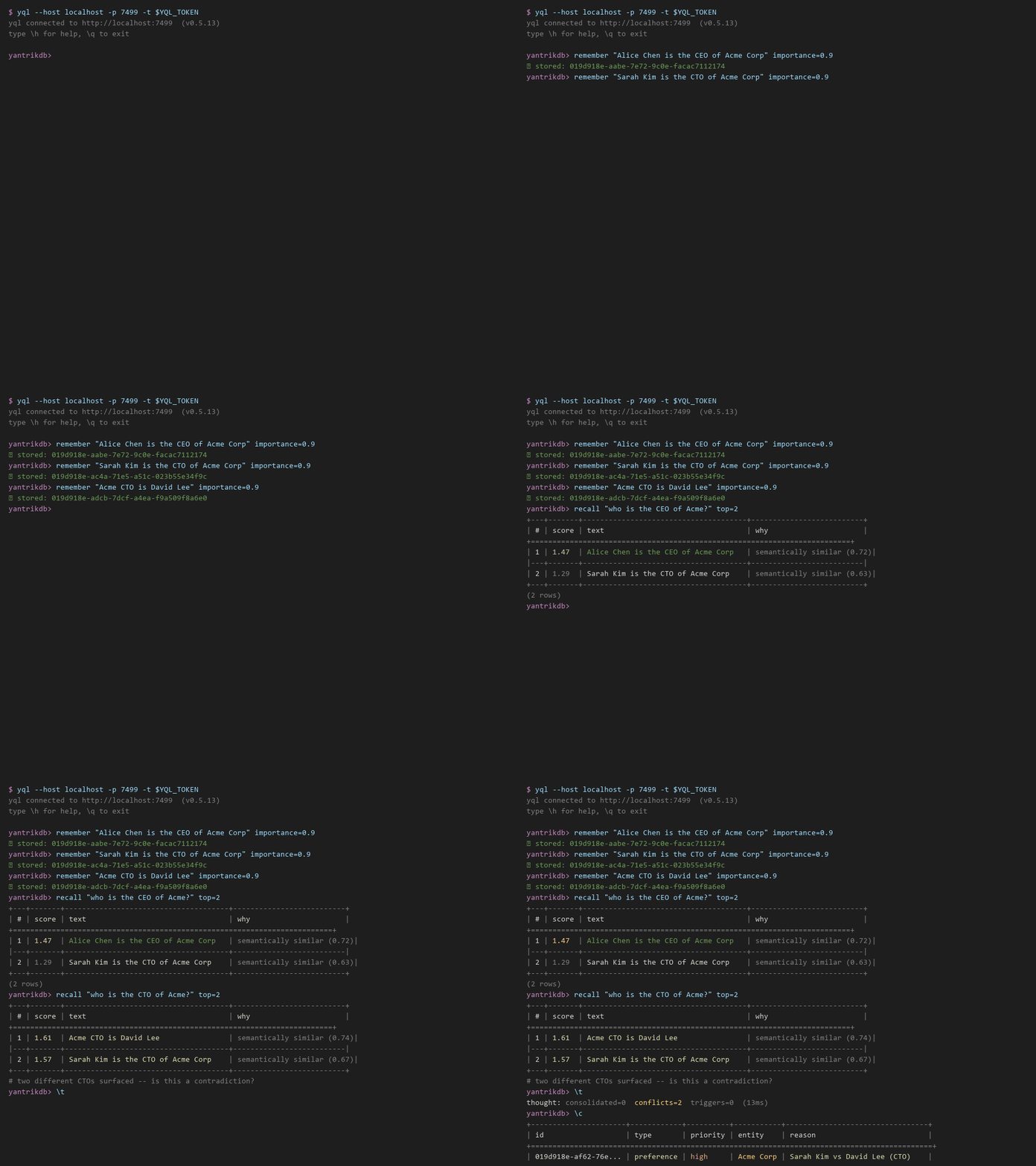
99.9% token savings vs file-based memory
| Memories | File-Based (CLAUDE.md) | YantrikDB | Token Savings | Recall Precision |
|---|---|---|---|---|
| 100 | 1,770 tokens | 69 tokens | 96% | 66% |
| 500 | 9,807 tokens | 72 tokens | 99.3% | 77% |
| 1,000 | 19,988 tokens | 72 tokens | 99.6% | 84% |
| 5,000 | 101,739 tokens | 53 tokens | 99.9% | 88% |
At 500 memories, file-based memory exceeds 32K context. At 5,000, it doesn't fit in any model — not even 200K. YantrikDB stays at ~70 tokens per query. Precision improves with more data — the opposite of context stuffing.
Reproduce: the script lives in yantrikdb-mcp, not this repo -- git clone https://github.com/yantrikos/yantrikdb-mcp && cd yantrikdb-mcp && python benchmarks/bench_token_savings.py
Three things no other database does
1. It forgets
db.record("read the SLA doc by Friday", importance=0.4, half_life=86400)  # 1 day
# 24 hours later, this memory's relevance score has decayed
# 7 days later, recall stops surfacing it unless explicitly queried
2. It consolidates
# 20 similar memories about the same meeting
for note in meeting_notes:
    db.record(note, namespace="standup-2026-04-12")

db.think()
# → {"consolidation_count": 5}  # collapsed 20 fragments into 5 canonical memories
3. It detects contradictions
db.record("Acme is based in Boston.")
db.record("Acme is based in Denver.")   # added later, in another conversation

db.think()
# → {"conflicts_found": 1, ...}
db.get_conflicts()
# → [{"kind": "identity_fact", ...}]
Detection runs over the relations the extractor recognises — here a location relation, single-valued at any moment — not over arbitrary sentences. Two limits are worth knowing before you rely on it:
- Claims are keyed by subject.
"Alice is the CEO of Acme"and"Bob is the CEO of Acme"have different subjects with one value each, so nothing compares. The constraint here is inverse-functional — it lives on the object ("CEO of Acme" admits one filler) — and that direction is not modelled. - Copular attribute claims are off by default.
"The logo is blue"→"The logo is green"needsThinkConfig.extract_attribute_claims; without it the copular path never runs.
Both are tracked in #95.
Plus: temporal decay with configurable half-life, entity graph with relationship edges, personality derivation from memory patterns, session-aware context surfacing, multi-signal scoring (recency × importance × similarity × graph proximity).
What makes this different
YantrikDB isn't just storage with operations. The engine has a layer that makes agents feel less reactive:
- Proactive triggers — the system surfaces what needs attention: pending conflicts, decaying important memories, approaching deadlines, patterns across domains. Agents don't have to ask what they should care about. The memory tells them.
- Derived personality — stable tendencies extracted from memory patterns over time. "This user prefers X, reacts to Y, values Z." Informs default agent behavior across sessions.
- Procedural memory — strategies that worked before get recorded and reinforced. Agents learn what to do, not just what they know.
- Temporal awareness —
stalesurfaces important memories that haven't been touched recently.upcomingsurfaces memories with approaching deadlines.
Full cognitive architecture lives in the standalone engine repo. This server repo focuses on deployment, HTTP API, and cluster operations.
Get started in 60 seconds — Claude Code / Cursor / Windsurf
The fastest adoption path. One pip install, one config block, and your agent gets persistent memory that auto-recalls on conversation start, auto-remembers decisions, and flags contradictions — without you prompting it.
pip install yantrikdb-mcp
Add this to your MCP client config — typically ~/.claude.json or .mcp.json in your project for Claude Code, and the equivalent mcp block in settings for Cursor/Windsurf (Claude Code · Cursor · Windsurf):
{
  "mcpServers": {
    "yantrikdb": {
      "command": "yantrikdb-mcp"
    }
  }
}
That's it. No env vars. Uses a local SQLite memory file at ~/.yantrikdb/memory.db. First call auto-initializes the schema. Restart your client — the yantrikdb MCP server will show up with 15 memory tools (see below).
Want a shared memory across machines or teammates? Point at a YantrikDB cluster instead of local SQLite:
{
  "mcpServers": {
    "yantrikdb": {
      "command": "yantrikdb-mcp",
      "env": {
        "YANTRIKDB_SERVER_URL": "http://node1:7438,http://node2:7438",
        "YANTRIKDB_TOKEN": "ydb_your_database_token"
      }
    }
  }
}
Want it over HTTP/SSE instead of stdio? (For IDE integrations that don't support stdio MCP servers.)
{
  "mcpServers": {
    "yantrikdb": {
      "type": "sse",
      "url": "http://your-server:8420/sse",
      "headers": { "Authorization": "Bearer YOUR_API_KEY" }
    }
  }
}
Then start: yantrikdb-mcp --transport sse --port 8420.
The 15 MCP tools your agent gets
| Tools | |
|---|---|
| Core memory | remember · recall · forget · correct |
| Cognition | think (consolidate + conflict-detect) · memory · trigger (proactive insights) |
| Knowledge graph | graph (entities + relations) · category |
| Conflicts & corrections | conflict (list + resolve contradictions) |
| Time | session · temporal (stale/upcoming queries) |
| Behavior | procedure (strategies) · personality (derived traits) |
| Ops | stats (engine health + diagnostics) |
Full tool reference and agent-integration patterns: yantrikdb-mcp → · docs
Other ways to use it
As a network server (binary API + HA cluster)
docker run -p 7438:7438 ghcr.io/yantrikos/yantrikdb:latest
curl -X POST http://localhost:7438/v1/remember -d '{"text":"hello"}'
Single Rust binary. HTTP + binary wire protocol. 2-voter + 1-witness HA cluster via Docker Compose or Kubernetes. Per-tenant quotas, Prometheus metrics, AES-256-GCM at-rest encryption, runtime deadlock detection. See docker-compose.cluster.yml and k8s manifests.
As an embedded library (Python or Rust)
pip install yantrikdb
# or
cargo add yantrikdb
import yantrikdb
db = yantrikdb.YantrikDB("memory.db", embedding_dim=384)
db.set_embedder(SentenceTransformer("all-MiniLM-L6-v2"))
db.record("Alice leads engineering", importance=0.8)
db.recall("who leads the team?", top_k=3)
db.think()  # consolidate, detect conflicts, derive personality
Performance
The numbers previously published here (1,689 memories, 112ms recall p50, 76 writes/sec) were from an April-2026 snapshot that didn't trace to any benchmark checked into this repo. They've been removed rather than repeated.
The most recent throughput investigation actually in-repo is a 2-core LXC reliability bench from 2026-05-20 (benchmarks/throughput_2core_lxc/results_2026-05-20.md). It found fresh installs wedging permanently after 256 writes over HTTP, and read throughput collapsing under write load. The fix shipped the same day in v0.19.1's ancestor release (then v0.8.18, see CHANGELOG.md):
| Behavior — 2-core LXC, fresh install | Pre-fix | Post-fix (v0.8.18) |
|---|---|---|
| Sustained write throughput, HTTP, concurrency 4, pre-computed embeddings | locks at 256 writes | 381/s |
| Engine ceiling, direct call (no HTTP), 32 concurrent writers | n/a — compactor wasn't spawned | 1,115/s |
That's the newest throughput data checked into the repo — it hasn't been re-run since (the server is 20+ releases past it now), and the read-collapses-under-write-load issue that same bench documented is still open. See benchmarks/ for raw results, harnesses, and caveats across every run; performance work is ongoing.
Status
v0.20.0 — in production use. The embeddable engine has been used in production by the YantrikOS ecosystem since early 2026; the network server runs live on a multi-node Proxmox cluster with multiple tenants.
Since the early alpha line, the server has moved from a raft-lite prototype to openraft-based HA clustering (2-voter + 1-witness), added mounted read-only memory packs (/v1/packs, /v1/pack-context), reached HTTP route parity with the embedded engine (RFC 032), and picked up the engine's claim grounding + temporal validity windows on recalled claims and its more precise entity/relation extraction. As of v0.20.0 it also ships Studio, a built-in admin console at /admin (dashboard, memory browser, query console, conflict review, and cluster ops), embedded in the binary with no separate install. Operational hardening from the original hardening sprint — parking_lot mutexes with runtime deadlock detection, per-handler Prometheus metrics, chaos-tested failover, per-tenant quotas — remains in place and has kept pace release-to-release.
Full per-release detail, including engine-pin changes and test-suite results for each version, is in CHANGELOG.md.
Read the maturity notes: https://yantrikdb.com/server/quickstart/#maturity
The Problem
Current AI memory is:
Store everything → Embed → Retrieve top-k → Inject into context → Hope it helps.
That's not memory. That's a search engine with extra steps.
Real memory is hierarchical, compressed, contextual, self-updating, emotionally weighted, time-aware, and predictive. YantrikDB is built for that.
Why Not Existing Solutions?
| Solution | What it does | What it lacks |
|---|---|---|
| Vector DBs (Pinecone, Weaviate) | Nearest-neighbor lookup | No decay, no causality, no self-organization |
| Knowledge Graphs (Neo4j) | Structured relations | Poor for fuzzy memory, not adaptive |
| Memory Frameworks (LangChain, Mem0) | Retrieval wrappers | Not a memory architecture — just middleware |
| File-based (CLAUDE.md, memory files) | Dump everything into context | O(n) token cost, no relevance filtering |
Benchmark: Selective Recall vs. File-Based Memory
| Memories | File-Based | YantrikDB | Token Savings | Precision |
|---|---|---|---|---|
| 100 | 1,770 tokens | 69 tokens | 96% | 66% |
| 500 | 9,807 tokens | 72 tokens | 99.3% | 77% |
| 1,000 | 19,988 tokens | 72 tokens | 99.6% | 84% |
| 5,000 | 101,739 tokens | 53 tokens | 99.9% | 88% |
At 500 memories, file-based exceeds 32K context windows. At 5,000, it doesn't fit in any context window — not even 200K. YantrikDB stays at ~70 tokens per query. Precision improves with more data — the opposite of context stuffing.
Architecture
Design Principles
- Embedded, not client-server — single file, no server process (like SQLite)
- Local-first, sync-native — works offline, syncs when connected
- Cognitive operations, not SQL —
record(),recall(),relate(), notSELECT - Living system, not passive store — does work between conversations
- Thread-safe —
Send + Syncwith internal Mutex/RwLock, safe for concurrent access
Five Indexes, One Engine
┌──────────────────────────────────────────────────────┐
│                   YantrikDB Engine                    │
│                                                      │
│  ┌──────────┬──────────┬──────────┬──────────┐       │
│  │  Vector  │  Graph   │ Temporal │  Decay   │       │
│  │  (HNSW)  │(Entities)│ (Events) │  (Heap)  │       │
│  └──────────┴──────────┴──────────┴──────────┘       │
│  ┌──────────┐                                        │
│  │ Key-Value│  WAL + Replication Log (CRDT)          │
│  └──────────┘                                        │
└──────────────────────────────────────────────────────┘
- Vector Index (HNSW) — semantic similarity search across memories
- Graph Index — entity relationships, profile aggregation, bridge detection
- Temporal Index — time-aware queries ("what happened Tuesday", "upcoming deadlines")
- Decay Heap — importance scores that degrade over time, like human memory
- Key-Value Store — fast facts, session state, scoring weights
Memory Types (Tulving's Taxonomy)
| Type | What it stores | Example |
|---|---|---|
| Semantic | Facts, knowledge | "User is a software engineer at Meta" |
| Episodic | Events with context | "Had a rough day at work on Feb 20" |
| Procedural | Strategies, what worked | "Deploy with blue-green, not rolling update" |
All memories carry importance, valence (emotional tone), domain, source, certainty, and timestamps — used in a multi-signal scoring function that goes far beyond cosine similarity.
Key Capabilities
Relevance-Conditioned Scoring
Not just vector similarity. Every recall combines:
- Semantic similarity (HNSW) — what's topically related
- Temporal decay — recent memories score higher
- Importance weighting — critical decisions beat trivia
- Graph proximity — entity relationships boost connected memories
- Retrieval feedback — learns from past recall quality
Weights are tuned automatically from usage patterns.
Conflict Detection & Resolution
When memories contradict, YantrikDB doesn't guess — it creates a conflict segment:
"works at Google" (recorded Jan 15) vs. "works at Meta" (recorded Mar 1)
→ Conflict: identity_fact, priority: high, strategy: ask_user
Resolution is conversational: the AI asks naturally, not programmatically.
Semantic Consolidation
After many conversations, memories pile up. think() runs:
- Consolidation — merge similar memories, extract patterns
- Conflict scan — find contradictions across the knowledge base
- Pattern mining — cross-domain discovery ("work stress correlates with health entries")
- Trigger evaluation — proactive insights worth surfacing
Proactive Triggers
The engine generates triggers when it detects something worth reaching out about:
- Memory conflicts needing resolution
- Approaching deadlines (temporal awareness)
- Patterns detected across domains
- High-importance memories about to decay
- Goal tracking ("how's the marathon training?")
Every trigger is grounded in real memory data — not engagement farming.
Multi-Device Sync (CRDT)
Local-first with append-only replication log:
- CRDT merging — graph edges, memories, and metadata merge without conflicts
- Vector indexes rebuild locally — raw memories sync, each device rebuilds HNSW
- Forget propagation — tombstones ensure forgotten memories stay forgotten
- Conflict detection — contradictions across devices are flagged for resolution
Sessions & Temporal Awareness
sid = db.session_start("default", "claude-code")
db.record("decided to use PostgreSQL")  # auto-linked to session
db.record("Alice suggested Redis for caching")
db.session_end(sid)
# → computes: memory_count, avg_valence, topics, duration

db.stale(days=14)    # high-importance memories not accessed recently
db.upcoming(days=7)  # memories with approaching deadlines
Full API
| Operation | Methods |
|---|---|
| Core | record, record_batch, recall, recall_with_response, recall_refine, forget, correct |
| Knowledge Graph | relate, get_edges, search_entities, entity_profile, relationship_depth, link_memory_entity |
| Cognition | think, get_patterns, scan_conflicts, resolve_conflict, derive_personality |
| Triggers | get_pending_triggers, acknowledge_trigger, deliver_trigger, act_on_trigger, dismiss_trigger |
| Sessions | session_start, session_end, session_history, active_session, session_abandon_stale |
| Temporal | stale, upcoming |
| Procedural | record_procedural, surface_procedural, reinforce_procedural |
| Lifecycle | archive, hydrate, decay, evict, list_memories, stats |
| Sync | extract_ops_since, apply_ops, get_peer_watermark, set_peer_watermark |
| Maintenance | rebuild_vec_index, rebuild_graph_index, learned_weights |
Technical Decisions
| Decision | Choice | Rationale |
|---|---|---|
| Core language | Rust | Memory safety, no GC, ideal for embedded engines |
| Architecture | Embedded (like SQLite) | No server overhead, sub-ms reads, single-tenant |
| Bindings | Python (PyO3), TypeScript | Agent/AI layer integration |
| Storage | Single file per user | Portable, backupable, no infrastructure |
| Sync | CRDTs + append-only log | Conflict-free for most operations, deterministic |
| Thread safety | Mutex/RwLock, Send+Sync | Safe concurrent access from multiple threads |
| Query interface | Cognitive operations API | Not SQL — designed for how agents think |
Ecosystem
| Package | What | Install | Source |
|---|---|---|---|
| yantrikdb-mcp | MCP server for Claude Code / Cursor / Windsurf — start here | pip install yantrikdb-mcp | GitHub · PyPI |
| yantrikdb-client | Python client SDK for the HTTP server (typed memory, reflect, character primitives) | pip install yantrikdb-client | GitHub · PyPI |
| yantrikdb-server | HTTP + wire-protocol server, HA cluster | docker run ghcr.io/yantrikos/yantrikdb | GitHub |
| yantrikdb (Rust) | Embedded Rust engine | cargo add yantrikdb | GitHub |
| yantrikdb (Python) | Python bindings via PyO3 | pip install yantrikdb | GitHub |
| langchain-yantrikdb | LangChain VectorStore + ChatMessageHistory with explainable recall | pip install langchain-yantrikdb | GitHub · PyPI |
| yantrikdb-hermes-plugin | Memory provider for NousResearch/hermes-agent, with a reproducible recall benchmark | pip install yantrikdb-hermes-plugin | GitHub · PyPI |
| yantrik-memory | Framework-agnostic Python memory layer — traits, bond evolution, knowledge graph | pip install yantrik-memory | GitHub · PyPI |
| openclaw-memory-yantrikdb | OpenClaw memory plugin — conflict-aware session briefings, recall with retrieval reasons, auto-capture | openclaw plugins install npm:@yantrikos/openclaw-memory-yantrikdb | GitHub |
Roadmap
- [x] V0 — Embedded engine, core memory model (record, recall, relate, consolidate, decay)
- [x] V1 — Replication log, CRDT-based sync between devices
- [x] V2 — Conflict resolution with human-in-the-loop
- [x] V3 — Proactive cognition loop, pattern detection, trigger system
- [x] V4 — Sessions, temporal awareness, cross-domain pattern mining, entity profiles
- [ ] V5 — Multi-agent shared memory, federated learning across users
Research & Publications
📄 Skill as Memory, Not Document (May 2026)
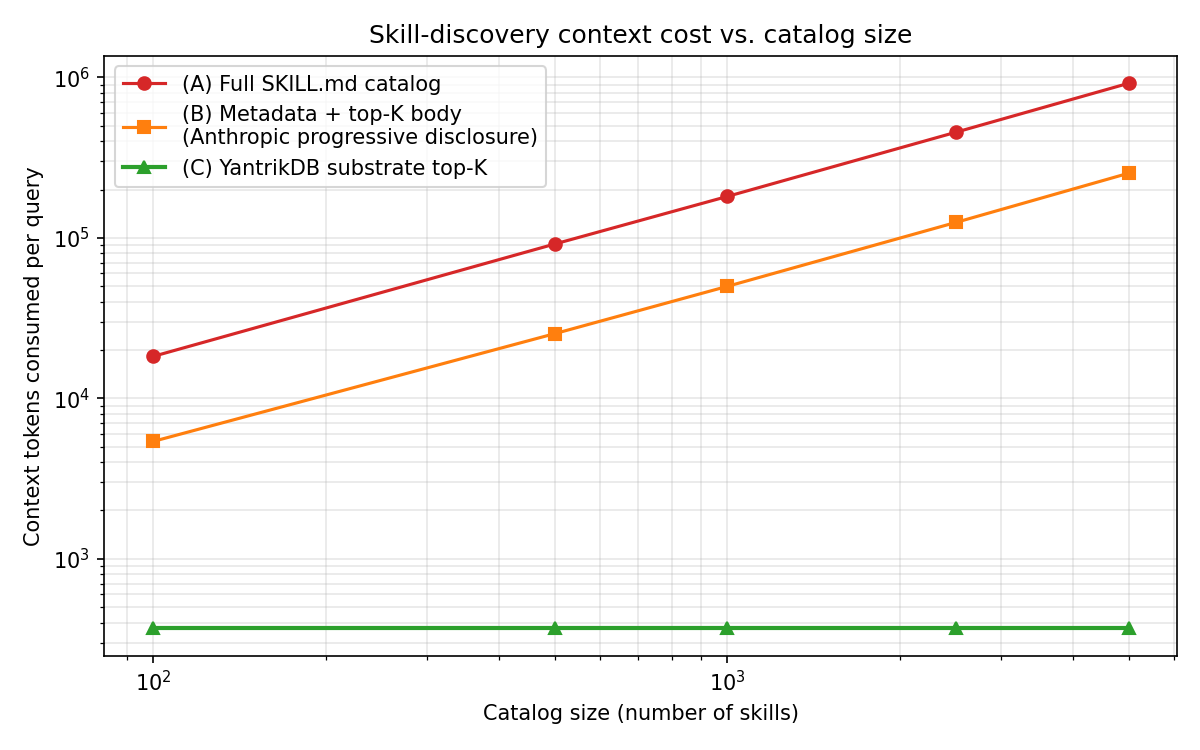
A measurement paper on what happens when LLM agent skill catalogs scale. On a 5,000-skill corpus:
- Token cost: full-catalog disclosure consumes 919,200 tokens (exceeds Claude 3.7's 200K window). YantrikDB's indexed top-K disclosure: 369 tokens, constant in catalog size. The honest ratio against an indexed filesystem baseline is 1.49× — an ablation pinpoints the entire gap as YAML frontmatter overhead.
- Latency: p50 = 87.3 ms, p95 = 106.3 ms at 5,000-skill scale, single-node.
- Invalid-skill admission: YantrikDB rejects 70/70 adversarially-malformed skills (0%) at write time; a document-only baseline admits 68/70 (97%).
Three failure modes for filesystem-shaped skill catalogs (token burn, slowdown, invalid-skill admission). One unifying framing: skill catalogs for autonomous learning aren't documents; they're memory.
Code + scripts + raw CSVs are reproducible at benchmarks/skill_recall/. Full deposit (PDF + source + data + scripts) on Zenodo. Companion blog post: yantrikdb.com/papers/skill-substrate.
Earlier work
- U.S. Patent Application 19/573,392 (March 2026): "Cognitive Memory Database System with Relevance-Conditioned Scoring and Autonomous Knowledge Management"
- Zenodo (software): YantrikDB: A Cognitive Memory Engine for Persistent AI Systems
Author
Pranab Sarkar — ORCID · LinkedIn · developer@pranab.co.in
License
Apache-2.0. See LICENSE for the full text.
The MCP server is MIT-licensed.
Compatibility
- Runs on
- GPU support unknown
What shows it
- no dependency or feature matches a backend row
- Native code
- Required
- Binds native code: libsqlite3-sys, zstd-sys
- Python bindings
- No Python binding crate found
- License
- Apache-2.0
Compare with similar projects
Order: strongest tier first, then most downloads, then name, with unmeasured values last. A library counts downloads over 30 days. An app counts binary downloads per release. An app with none counts its crate downloads over 30 days. ML Rust runs this catalogue, so its closest project always gets a row.
| Project | Downloads | Dependents | Stars | Latest release | Runs on (GPU) | Native code | License |
|---|---|---|---|---|---|---|---|
|
YantrikDB database server — multi-tenant cognitive memory with wire protocol, HTTP gateway, replication, auto-failover, and at-rest encryption |
39 binary downloads per release | Not applicable | 179 | 0.20.0 | GPU support unknown | Binds native code: libsqlite3-sys, zstd-sys | Apache-2.0 |
|
ruvector Listed
High-performance Rust vector database core with HNSW indexing Also in Build LLM apps and agents. |
39,411 downloads over 30 days | 51 | 4,675 | 2.5.0 | CUDA, WebGPU, Metal | Binds native code: libsqlite3-sys, napi-sys, ort-sys, pgrx-pg-sys, pqcrypto-internals and 5 more | MIT |
|
mentedb Listed
A purpose-built database engine for AI agent memory Also in Build LLM apps and agents. |
1,605 downloads over 30 days | 1 | 124 | 0.47.1 | GPU support unknown | No native code found | Apache-2.0 |
|
hyperspace-db Listed
[H] HyperspaceDB is a high-performance, vector database. It features 1-bit quantization, async replication, and native support for hierarchical datasets (Lorentz, Poincaré ball & Hybrid models). Also in Text, embeddings and search. |
96 downloads over 30 days | 3 | 163 | 4.2.0 | GPU support unknown | Binds native code: ort-sys (feature local-onnx) | MIT |
|
nodedb Listed
Local-first, real-time, edge-to-cloud hybrid database for multi-modal workloads Also in Build LLM apps and agents. |
35 downloads over 30 days | 3 | 246 | 0.6.2 | GPU support unknown | Binds native code: libz-sys, rdkafka-sys, ring, tikv-jemalloc-sys, zstd-sys | BUSL-1.1 |
|
In-memory vector store with efficient read and write performance for semantic caching and retrieval system. Redis for Semantic Caching. Also in Text, embeddings and search. |
0 binary downloads per release | Not applicable | 376 | Not measured | Not measured | Apache-2.0 | |
|
An open protocol that gives AI agents a secure, sandboxed place to run code and use tools — with lean context usage. AXP works alongside MCP Also in Build LLM apps and agents. |
Not measured | Not applicable | 3 | Not measured | Not measured | Not measured | Apache-2.0 |
All projects in Build LLM apps and agentsAll projects in Text, embeddings and search
Why ListedNo archive, New or Featured rule places it, so it is Listed.
What it lacks for Featured
- The check holds no value for Homebrew installs on request over 365 days, Repology repository families, Docker pull growth over 90 days. A gate that lacks its signal does not pass.
What else the check found
- The last activity is on 28 Oct 2026, 12 days ago. The rules expect an update within 365 days. Dormancy rule
Not measured: Homebrew installs on request over 365 days, Repology repository families, Docker pull growth over 90 days.
Exact rules: Listed, Featured app. The check on applied thresholds version 9.
Every rule outcome, as the check records it
expected-interval: app: E = 365 daysdormancy: last activity 2026-10-28, 12 days ago, E = 365: activefeatured: not featured: unknown homebrew_on_request_365d, repology_families, docker_pull_growth_90dlisted: listed: no archive, new or featured rule applies
Crates4 crates
Measurements and sources
Each signal row shows the raw value, its source and the fetch date. The Sources list gathers every distinct source on this page. Movement needs more history.
Sources6 sources
- Description: the crates.io description
- crates.io database dump, fetched
- GitHub releases, fetched
- GitHub repository, fetched
- crates.io package, fetched
- GitHub contributors, fetched
Adoption39 binary downloads per release4 not measured
| Signal | Value | Source | Fetched | Counts |
|---|---|---|---|---|
| Active dependents | Not measured | Yes | ||
| New dependents (365 days) | Not measured | Yes | ||
| Peak active dependents | Not measured | Yes | ||
| Active dependents as a share of the peak | Not measured | Yes | ||
| Binary downloads per release | 39 | GitHub releases | Yes |
MaintenanceLatest human commit: 12 days ago4 not measured
| Signal | Value | Source | Fetched | Counts |
|---|---|---|---|---|
| Latest human commit | 2026-10-28 | GitHub repository | Yes | |
| Latest release | 2026-10-15 | GitHub releases | Yes | |
| First release | 2026-04-06 | crates.io database dump | Yes | |
| Latest version | 0.20.0 | crates.io database dump | No | |
| Days the oldest outside issue waits for a reply | 0 | GitHub repository | Yes | |
| Maintainer replies over 365 days | 43 | GitHub repository | Yes | |
| Repository archived | false | GitHub repository | Yes | |
| Repository gone | false | GitHub repository | Yes | |
| Release commit or manifest in the repo | true | crates.io package | No | |
| Published docs | Not measured | Yes | ||
| Latest release fails cargo check | Not measured | Yes | ||
| Build check date | Not measured | Yes | ||
| Build check toolchain | Not measured | Yes |
SecurityNot measured
| Signal | Value | Source | Fetched | Counts |
|---|---|---|---|---|
| Unpatched vulnerabilities past the grace window | Not measured | Yes | ||
| RustSec unmaintained advisory | Not measured | Yes | ||
| Deprecation notice | Not measured | Yes | ||
| Deprecated requirement | Not measured | Yes |
Distribution65 releases, 13 downloads over 30 days6 not measured
| Signal | Value | Source | Fetched | Counts |
|---|---|---|---|---|
| Releases | 65 | crates.io database dump | No | |
| Downloads over 30 days | 13 | crates.io database dump | No | |
| Binary downloads over the last 3 releases | 119 | GitHub releases | Yes | |
| Homebrew installs on request over 365 days | Not measured | Yes | ||
| Repology repository families | Not measured | Yes | ||
| Docker pull growth over 90 days | Not measured | Yes | ||
| Docker pulls at the growth baseline | Not measured | Yes | ||
| Every version a prerelease | false | crates.io database dump | Yes | |
| Every version 0.0.x | false | crates.io database dump | Yes | |
| Every version yanked | Not measured | Yes | ||
| Crate deleted from crates.io | Not measured | Yes |
Repository179 stars, 15 forks, 2 contributors, 288 commits. Stars alone never qualify a project.
| Signal | Value | Source | Fetched | Counts |
|---|---|---|---|---|
| GitHub stars | 179 | GitHub repository | Yes — one part of the repository route | |
| GitHub forks | 15 | GitHub repository | Yes — one part of the repository route | |
| Contributors with a GitHub account | 2 | GitHub contributors | Yes — one part of the repository route | |
| Commits on the default branch | 288 | GitHub repository | No | |
| Repository's main crate left out of the entry | none | crates.io database dump | Yes |
Facts that never count
| Signal | Value | Source | Fetched | Counts |
|---|---|---|---|---|
| License | Apache-2.0 | crates.io database dump | No | |
| Runs on, from listed crates and their direct dependencies | GPU support unknown | crates.io database dump | No | |
| What shows each backend | no dependency or feature matches a backend row | crates.io database dump | No | |
| Native code, from listed crates and their dependencies | Binds native code: libsqlite3-sys, zstd-sys | crates.io database dump | No | |
| Python bindings, from direct dependencies of listed crates | No Python binding crate found | crates.io database dump | No | |
| Crates that depend on a listed crate directly | Not measured | No |
Corrections and review history
No correction applies to this entry.
Judgments
A judgment enters only through an approved issue and a merged pull request.
No judgment applies to this entry.