venus
App Listed
Reactive notebook environment for Rust
- Downloads
- 10
- Dependents
- Not applicable
- Stars
- 49
- Forks
- 4
- Contributors
- 1
- Commits
- 82
- Latest release
- 0.1.4 ·
About

Reactive notebooks for Rust. Notebooks are plain `.rs` files.
Cells are functions marked with `#[venus::cell]`. Dependencies between cells come from function parameters, so rust-analyzer works on the notebook source.
Docs · Crate · Cells · CLI · Example · Contributing
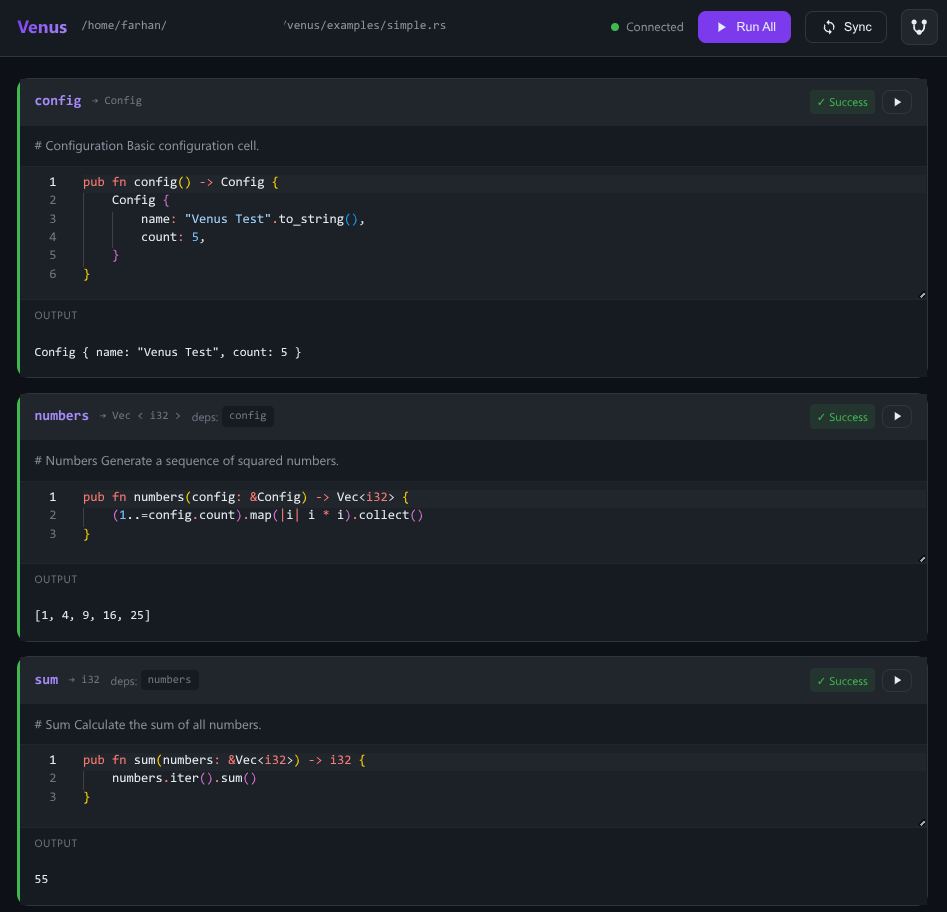
Venus is a reactive notebook environment for Rust, for data exploration, prototyping, and teaching. It runs notebooks from .rs source files and serves them through a web UI. When an upstream cell changes, Venus marks its dependent cells dirty. Unlike Jupyter with the evcxr_jupyter kernel, a Venus notebook is a normal Rust file, not .ipynb JSON. Venus writes .ipynb only for preview.
- Language: all code is Rust. Venus compiles each cell to a native library, with LLVM or the optional Cranelift backend. No Python or Jupyter kernel is needed.
- Requirements: Rust 1.85 or later on Linux, macOS, or Windows. Cranelift needs a nightly toolchain component.
- Output: text, HTML, images, and JSON through the
Rendertrait. DataFrames need thepolarsfeature. - Built on:
synfor parsing cells,petgraphfor the dependency graph,salsafor incremental computation, andaxumfor the web server.
Read the full README
Not supported yet
- Async cells. A cell is a synchronous function, so block on a future inside the cell.
- Sandboxing. See Security.
Security
Venus executes arbitrary Rust code with full system access. It provides no sandboxing. Cells can read and write files, open network connections, and spawn processes.
- Use Venus for local development, testing, and learning.
- Do not run Venus on production servers, shared servers, or with untrusted code.
- Cloud providers must isolate Venus in containers or virtual machines.
You are responsible for running Venus in a secure environment. See SECURITY.md for details.
Quick Start
Install the venus and venus-worker binaries:
cargo install venus
Create a notebook, run it, and start the web server:
venus new hello
venus run hello.rs
venus serve hello.rs
venus new adds the notebook as a binary to Cargo.toml. This enables rust-analyzer support. Open http://localhost:8080 in your browser to use the web UI.
Example
use venus::prelude::*;

#[derive(Debug, Clone)]
pub struct Config {
    pub count: i32,
}

/// Analysis config
#[venus::cell]
pub fn config() -> Config {
    Config { count: 10 }
}

/// Generate squared numbers
#[venus::cell]
pub fn numbers(config: &Config) -> Vec<i32> {
    (1..=config.count).map(|i| i * i).collect()
}

/// Calculate the sum
#[venus::cell]
pub fn total(numbers: &Vec<i32>) -> i32 {
    numbers.iter().sum()
}
Cells
- A cell is a function marked with
#[venus::cell]. - A parameter name refers to the cell with that name. In the example,
numbersreads theconfigcell. - The return type is the cell output that other cells read.
- Each
///doc comment becomes the cell description in the UI.
Features
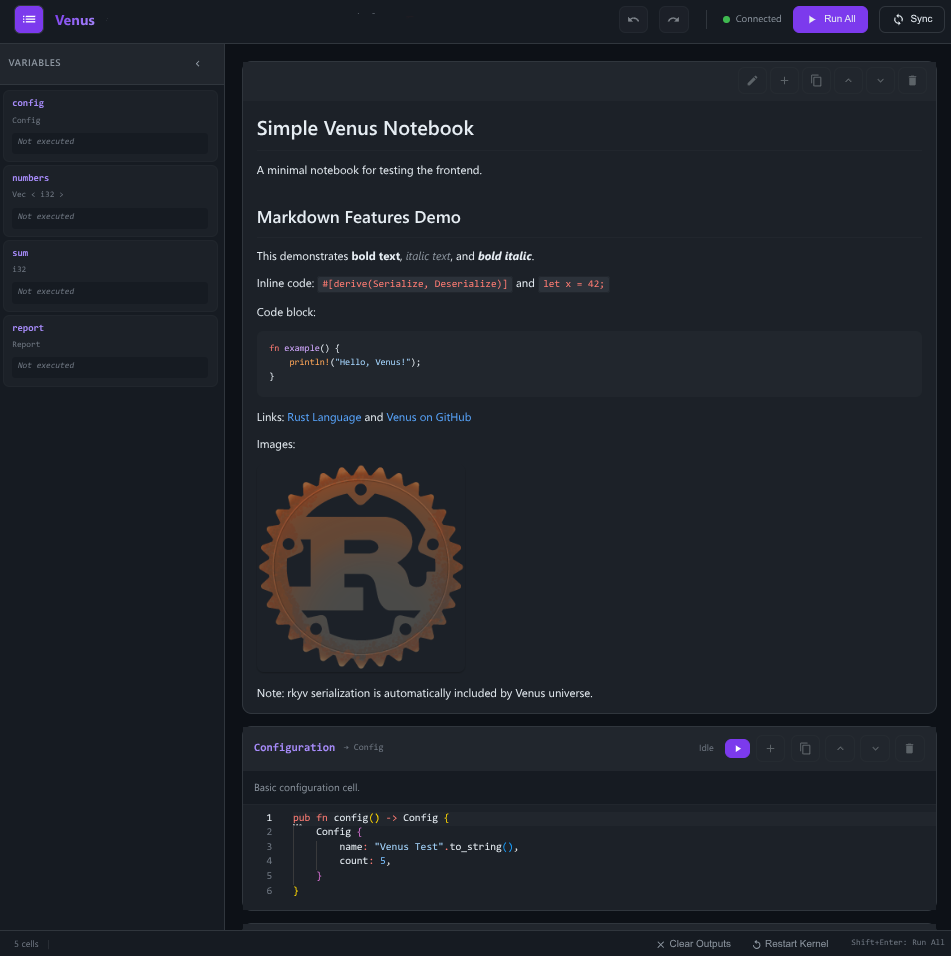
- Web UI: Monaco editor, cell outputs, and execution status.
- Native Rust files: notebooks are
.rsfiles with full rust-analyzer support. - Reactive dependencies: Venus marks dependent cells dirty when an upstream cell changes.
- Hot reload: modified cells re-run and keep state from the other cells.
- Widgets:
input_slider,input_text,input_select, andinput_checkboxbuild interactive inputs. - Rich output: the
Rendertrait produces text, HTML, image, and JSON output. Thepolarsfeature renders DataFrames. Theimagefeature renders PNG output. - Markdown cells: notes between code cells in the web UI.
- Jupyter export:
venus syncwrites an.ipynbfile for GitHub preview. - Optional Cranelift: the Cranelift backend speeds debug builds of cells. Without it, Venus uses the LLVM backend.
See docs/widgets.md and docs/render.md for details.
Optional: Cranelift backend
Install the Cranelift component on nightly:
rustup toolchain install nightly
rustup component add rustc-codegen-cranelift-preview --toolchain nightly
Venus detects the component and uses it when available. No config is needed.
CLI Commands
| Command | Description | Flags |
|---|---|---|
venus run <notebook> | Run the notebook headlessly | --cell <name>, --release |
venus serve <path> | Start the interactive web server | -p, --port <port> (default 8080) |
venus sync <notebook> | Generate an .ipynb file | -w, --watch |
venus build <notebook> | Build a standalone binary | -o, --output <path>, --release |
venus new <name> | Create a notebook from a template | --workspace |
venus export <notebook> | Export the notebook as a standalone HTML file | -o, --output <path>, --release, --dark |
venus watch <notebook> | Run the notebook on file changes | --cell <name>, --release, --clear |
Pass -v or --verbose with any subcommand for verbose logging. The --release flag uses the LLVM backend with optimizations. venus new --workspace creates the notebook as a workspace member in a separate directory.
Documentation
- Installation: platform setup and the optional Cranelift backend
- Getting Started: create your first notebook
- How It Works: execution model and architecture
- Cells: cell syntax and dependencies
- Widgets: interactive inputs
- Render Trait: custom output formatting
- CLI Reference: command-line flags
- API Reference: build custom frontends
- Deployment: deployment guidance
- FAQ and Troubleshooting
- API Stability: versioning and breaking change policy
Contributing
Contributions are welcome. See CONTRIBUTING.md for conventions and checks.
Questions and design discussion happen on Discord.
License
Licensed under Apache-2.0. See LICENSE.
Compatibility
- Runs on
- GPU support unknown
What shows it
- no dependency or feature matches a backend row
- Native code
- None found
- No native code found
- Python bindings
- No Python binding crate found
- License
- Apache-2.0
Compare with similar projects
Order: strongest tier first, then most downloads, then name, with unmeasured values last. A library counts downloads over 30 days. An app counts binary downloads per release. An app with none counts its crate downloads over 30 days.
| Project | Downloads | Dependents | Stars | Latest release | Runs on (GPU) | Native code | License |
|---|---|---|---|---|---|---|---|
|
Reactive notebook environment for Rust |
10 binary downloads per release | Not applicable | 49 | 0.1.4 | GPU support unknown | No native code found | Apache-2.0 |
|
statrs Featured
Statistical computing library for Rust |
4,515,476 downloads over 30 days | 444 | 839 | 0.19.1 | GPU support unknown | No native code found | MIT |
|
Pure-Rust implementation of linear algebra routines for ndarray |
198,623 downloads over 30 days | 20 | 39 | 0.2.1 | GPU support unknown | No native code found | Apache-2.0 OR MIT |
|
differential-equations Listed
A Rust library for solving differential equations. |
4,465 downloads over 30 days | 4 | 83 | 0.7.0 | GPU support unknown | No native code found | Apache-2.0 |
|
numr Listed
The base for numerical code in Rust, in the role NumPy has in Python: n-dimensional tensors, linear algebra, FFT, statistics and autograd on CPU, CUDA and WebGPU. The backends use native kernels, with no cuBLAS, MKL or other vendor math library. |
1,673 downloads over 30 days | 7 | 59 | 0.15.2 | CUDA, WebGPU | Binds native code: ring (feature distributed) | Apache-2.0 |
|
pounce New
Single-crate facade for POUNCE from Rust: re-exports the TNLP trait, the IpoptApplication driver, and the supporting types in one place (plus a prelude), with feature-gated modules for the convex/LP/QP, active-set QP, and sensitivity paths. |
2,486 downloads over 30 days | 9 | 81 | 0.16.0 | GPU support unknown | Binds native code: pounce-hsl (feature ma57) | EPL-2.0 |
Why ListedNo archive, New or Featured rule places it, so it is Listed.
What it lacks for Featured
- The check holds no value for Homebrew installs on request over 365 days, Repology repository families, Docker pull growth over 90 days. A gate that lacks its signal does not pass.
What else the check found
- The last activity is on 6 Nov 2026, 3 days ago. The rules expect an update within 365 days. Dormancy rule
Not measured: Homebrew installs on request over 365 days, Repology repository families, Docker pull growth over 90 days.
Exact rules: Listed, Featured app. The check on applied thresholds version 9.
Every rule outcome, as the check records it
expected-interval: app: E = 365 daysdormancy: last activity 2026-11-06, 3 days ago, E = 365: activefeatured: not featured: unknown homebrew_on_request_365d, repology_families, docker_pull_growth_90dlisted: listed: no archive, new or featured rule applies
Crates5 crates
Measurements and sources
Each signal row shows the raw value, its source and the fetch date. The Sources list gathers every distinct source on this page. Movement needs more history.
Sources6 sources
- Description: the crates.io description
- crates.io database dump, fetched
- GitHub releases, fetched
- GitHub repository, fetched
- crates.io package, fetched
- GitHub contributors, fetched
Adoption10 binary downloads per release4 not measured
| Signal | Value | Source | Fetched | Counts |
|---|---|---|---|---|
| Active dependents | Not measured | Yes | ||
| New dependents (365 days) | Not measured | Yes | ||
| Peak active dependents | Not measured | Yes | ||
| Active dependents as a share of the peak | Not measured | Yes | ||
| Binary downloads per release | 10 | GitHub releases | Yes |
MaintenanceLatest human commit: 3 days ago4 not measured
| Signal | Value | Source | Fetched | Counts |
|---|---|---|---|---|
| Latest human commit | 2026-11-06 | GitHub repository | Yes | |
| Latest release | 2026-11-06 | GitHub releases | Yes | |
| First release | 2026-01-02 | crates.io database dump | Yes | |
| Latest version | 0.1.4 | crates.io database dump | No | |
| Days the oldest outside issue waits for a reply | 0 | GitHub repository | Yes | |
| Maintainer replies over 365 days | 6 | GitHub repository | Yes | |
| Repository archived | false | GitHub repository | Yes | |
| Repository gone | false | GitHub repository | Yes | |
| Release commit or manifest in the repo | true | crates.io package | No | |
| Published docs | Not measured | Yes | ||
| Latest release fails cargo check | Not measured | Yes | ||
| Build check date | Not measured | Yes | ||
| Build check toolchain | Not measured | Yes |
SecurityNot measured
| Signal | Value | Source | Fetched | Counts |
|---|---|---|---|---|
| Unpatched vulnerabilities past the grace window | Not measured | Yes | ||
| RustSec unmaintained advisory | Not measured | Yes | ||
| Deprecation notice | Not measured | Yes | ||
| Deprecated requirement | Not measured | Yes |
Distribution9 releases, 26 downloads over 30 days6 not measured
| Signal | Value | Source | Fetched | Counts |
|---|---|---|---|---|
| Releases | 9 | crates.io database dump | No | |
| Downloads over 30 days | 26 | crates.io database dump | No | |
| Binary downloads over the last 3 releases | 31 | GitHub releases | Yes | |
| Homebrew installs on request over 365 days | Not measured | Yes | ||
| Repology repository families | Not measured | Yes | ||
| Docker pull growth over 90 days | Not measured | Yes | ||
| Docker pulls at the growth baseline | Not measured | Yes | ||
| Every version a prerelease | false | crates.io database dump | Yes | |
| Every version 0.0.x | false | crates.io database dump | Yes | |
| Every version yanked | Not measured | Yes | ||
| Crate deleted from crates.io | Not measured | Yes |
Repository49 stars, 4 forks, 1 contributors, 82 commits. Stars alone never qualify a project.
| Signal | Value | Source | Fetched | Counts |
|---|---|---|---|---|
| GitHub stars | 49 | GitHub repository | Yes — one part of the repository route | |
| GitHub forks | 4 | GitHub repository | Yes — one part of the repository route | |
| Contributors with a GitHub account | 1 | GitHub contributors | Yes — one part of the repository route | |
| Commits on the default branch | 82 | GitHub repository | No | |
| Repository's main crate left out of the entry | none | crates.io database dump | Yes |
Facts that never count
| Signal | Value | Source | Fetched | Counts |
|---|---|---|---|---|
| License | Apache-2.0 | crates.io database dump | No | |
| Runs on, from listed crates and their direct dependencies | GPU support unknown | crates.io database dump | No | |
| What shows each backend | no dependency or feature matches a backend row | crates.io database dump | No | |
| Native code, from listed crates and their dependencies | No native code found | crates.io database dump | No | |
| Python bindings, from direct dependencies of listed crates | No Python binding crate found | crates.io database dump | No | |
| Crates that depend on a listed crate directly | Not measured | No |
Corrections and review history
No correction applies to this entry.
Judgments
A judgment enters only through an approved issue and a merged pull request.
No judgment applies to this entry.