seekstorm
Library Listed
Vector & lexical search engine library & multi-tenancy server
- Downloads
- 871
- Dependents
- 3
- Stars
- 1,936
- Forks
- 74
- Contributors
- 10
- Commits
- 349
- Latest release
- 4.0.1 ·
About

Sub-millisecond lexical, vector & hybrid search in Rust.
Embed as a library, run as a multi-tenant server, or give your agents search via MCP.
Website · Live demo · Quick start · Benchmarks · Docs · REST API · Blog · Discord · X
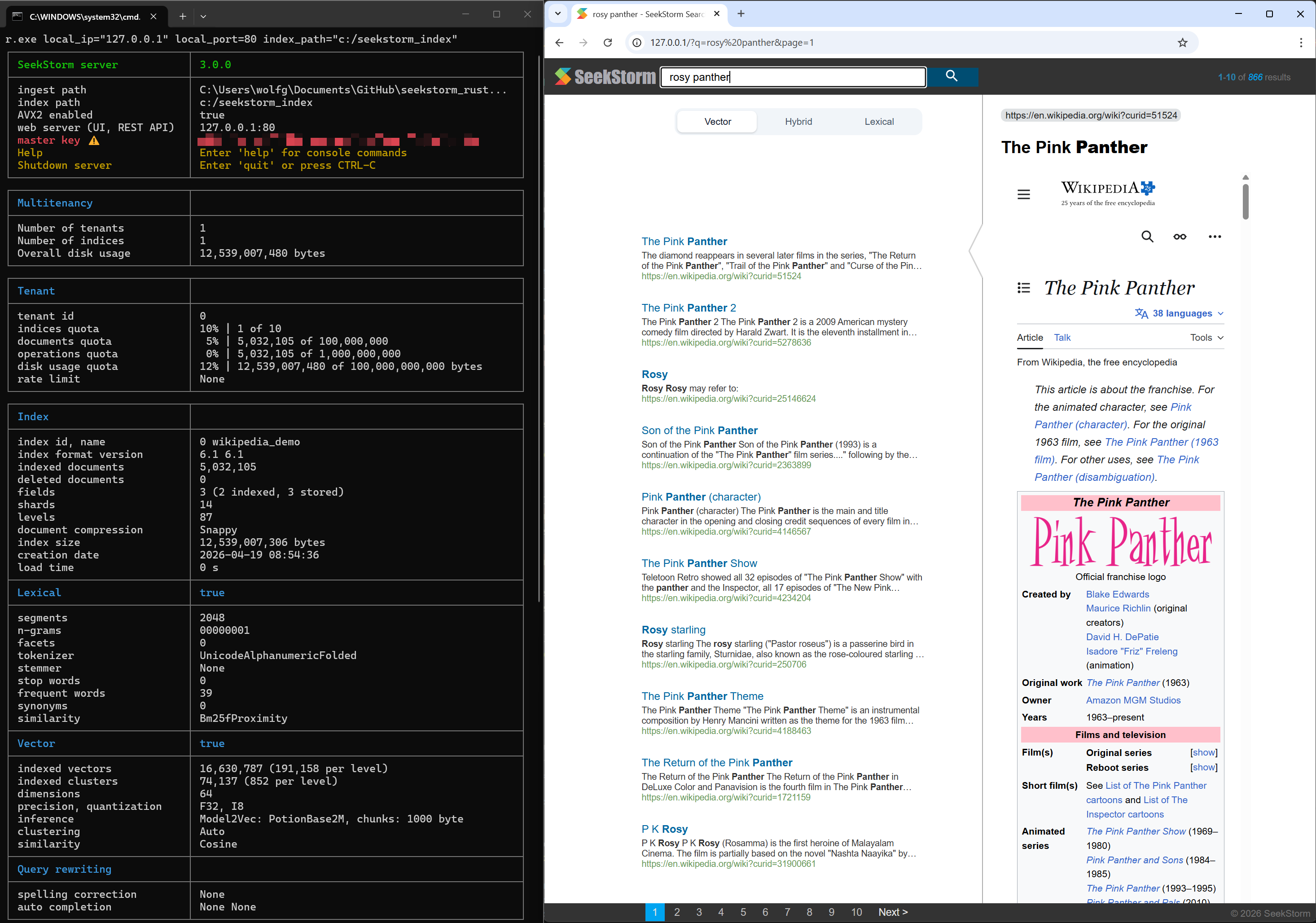
5M Wikipedia articles · 16.6M vectors · hybrid search (click to enlarge)
In production since 2020. Open source under the Apache License 2.0. Independent & bootstrapped, no VC.
From the author of SymSpell (typo tolerance), PruningRadixTrie (auto complete) and WordSegmentationTM (word segmentation).
Read the full README
| ⚡ Fast | 306 µs average lexical latency: 8x lower latency and 21x lower P99 than Lucene. All query types, single field, 5M Wikipedia docs, details. |
| 🔀 Native hybrid | Two first-class engines (inverted index + IVF ANN) behind one query planner. Lexical, vector or hybrid per query, fused with Reciprocal Rank Fusion (RRF). Filters & facets are active during vector & lexical search. |
| 🔤 Lexical search | BM25F and BM25F_Proximity, intersection / union / phrase / NOT queries, 6 tokenizers incl. Chinese word segmentation, stemming for 38 languages, N-gram phrase indexing, Block-max WAND and Maxscore. |
| 📐 Vector search | Multi-vector indexing, embedded Model2Vec inference or bring-your-own embeddings, F32 / I8, cosine / dot / Euclidean, TurboQuant and scalar quantization, sentence-aware chunking, sharded leveled IVF index. |
| ⏱️ Real-time | True real-time, not near-real-time: every document is searchable immediately, even before and during commit. No segment merges, no JIT warm-up, no GC pauses. |
| 🔎 Search features | Faceting (string and numeric range facets, histogram), sorting, result boosting, geo proximity search, typo tolerance, query completion, instant search, KWIC highlighting, synonyms. |
| 📈 Scales on one box | Billion-scale indices with low latency and low RAM consumption, unlimited fields, field length and index size. 35K docs/sec indexing on a laptop, RAM or memory-mapped files. SIMD on x86-64 (AVX2) and AArch64 (NEON). Windows, Linux, macOS. |
| 🔁 Portable index | The same binary index works in the library, the server and the cloud. No re-indexing, no lock-in. More |
| 🤖 Agent-ready | Built-in MCP server for RAG and agentic search. |
| 🖥️ Server & SDKs | REST API with CORS, multi-tenancy, embedded web UI, CSV / JSON / NDJSON / PDF ingestion, Docker image. Client SDKs for Python, TypeScript, Rust, C#, Java. |
About "sub-millisecond": it refers to average latency. Lexical search average latency is 0.3 ms on 5M Wikipedia documents, P99 is 0.8-6.8 ms depending on query type.
Vector search is sub-millisecond on SIFT1M-sized indices (188 µs at 95% recall@10), but not at larger scale:
2.7 ms on 16M Wikipedia vectors and 3.2 ms on GIST1M (960 dimensions), both at 95% recall@10. All numbers
Full feature list
Architecture
- Fast sharded indexing: 35K docs/sec = 3 billion docs/day on a laptop.
- Fast sharded search: 7x lower query latency and 17x lower tail latency (P99) than the better of Lucene and Tantivy, 8x / 21x vs. Lucene alone, for lexical search.
- Billion-scale index
- Index either in RAM or memory mapped files
- Cross-platform (Windows, Linux, MacOS)
- SIMD (Single Instruction, Multiple Data) hardware acceleration support,
both for x86-64 (AMD64 and Intel 64) and AArch64 (ARM, Apple Silicon). - Single-machine scalability: serving thousands of concurrent queries with low latency from a single commodity server without needing clusters or proprietary hardware accelerators.
Vector Features
- Multi-Vector indexing: both from multiple fields and from multiple chunks per field.
- Integrated inference: Generate and index embeddings from any text document field, using Model2Vec from MinishLab.
- Alternatively, import and index externally generated embeddings.
- Multiple vector precisions: F32, I8.
- Multiple similarity measures: Cosine similarity, Dot product, Euclidean distance.
- TurboQuant (TQ) and affine Scalar Quantization (SQ).
- Chunking that respects sentence boundaries and Unicode segmentation for multilingual text.
- K-Medoid clustering: PAM (Partition Around Medoids) with actual data points as centers.
- Sharded and leveled IVF index.
- Approximate Nearest Neighbor Search (ANNS) in a Leveled IVF index.
- All field filters are directly active during vector search, not just as post-search filtering step.
- SIMD (AVX2) acceleration for vector quantization and similarity calculation.
Lexical Features
- BM25F and BM25F_Proximity ranking
- 6 tokenizers, including Chinese word segmentation.
- Stemming for 38 languages.
- Optional stopword lists, custom and predefined, for smaller indices and faster search.
- Frequent word lists, custom and predefined, for faster phrase search by N-gram indexing.
- Inverted index
- Roaring-bitmap posting list compression.
- N-gram indexing
- Block-max WAND and Maxscore acceleration
General Features
- True real-time search, both for vector search and lexical search, with negligible performance impact
- Incremental indexing
- MCP server for agentic search
- Unlimited field number, field length & index size
- Compressed document store: ZStandard
- Field filtering
- Faceted search: Counting & filtering of String & Numeric range facets (with Histogram/Bucket & Min/Max aggregation)
- Result sorting by any field, ascending or descending, multiple fields combined by "tie-breaking".
- Geo proximity search, filtering and sorting.
- Iterator to iterate through all documents of an index, in both directions, e.g., for index export, conversion, analytics and inspection.
- Search with empty query, but query facets, facet filter, and result sort parameters, ascending and descending.
- Typo tolerance / Fuzzy queries / Query spelling correction: return results if the query contains spelling errors.
- Typo-tolerant Query Auto-Completion (QAC) and Instant search.
- KWIC snippets, highlighting
- One-way and multi-way synonyms
- Language independent
Field types
- U8..U64
- I8..I64
- F32, F64
- Timestamp
- Bool
- String16, String32
- StringSet16, StringSet32
- Text (Multi-vector: automatically generated embeddings for each text field)
- Point
- Json
- Binary (embedded images, audio, video, pdf)
- Vector (externally generated embeddings)
Query types
- OR disjunction union
- AND conjunction intersection
- "" phrase
- - NOT
Result types
- TopK
- Count
- TopKCount
SeekStorm multi-tenancy search server
- Index and search via RESTful API with CORS.
- Ingest local data files in CSV, JSON, Newline-delimited JSON (ndjson), and Concatenated JSON formats via console command.
- Ingest local PDF files via console command (single file or all files in a directory).
- Multi-tenancy index management.
- API-key management.
- Embedded web server and web UI to search and display results from any index without coding.
- Web UI with query auto correction, query auto-completion, instant search, keyword highlighting, histogram, date filter, faceting, result sorting, document preview (as demo, for testing, as template).
- Code first OpenAPI generated REST API documentation
- Cross-platform: runs on Linux, Windows, and macOS (other OS untested).
- Docker file and container image at Docker Hub
- Client libraries/SDK in Rust, Python, C#, Java, TypeScript.
Quick start
Server (Docker)
docker run -ti -p "8000:80" -v "$(pwd)/seekstorm_storage:/seekstorm_index:z" wolfgarbe/seekstorm_server
Then open the embedded web UI at http://127.0.0.1:8000. Index and search via the REST API, or follow the Wikipedia tutorial to ingest data and search it in the web UI.
⚠ Set the MASTER_KEY_SECRET environment variable to a secret (e.g. add -e MASTER_KEY_SECRET=<your-secret> to the command above), otherwise your generated API keys will be compromised.
MCP server for AI agents
cargo install seekstorm_mcp_server
Add it to your MCP client configuration (Claude Desktop, Cursor, ...):
{
  "mcpServers": {
    "seekstorm": {
      "command": "seekstorm_mcp_server",
      "env": { "SEEKSTORM_INDEX_PATH": "/path/to/seekstorm-index" }
    }
  }
}
The MCP server runs as a child process over stdio and embeds SeekStorm directly: no server process or network connection required.
If no index exists at SEEKSTORM_INDEX_PATH, one is created with a default schema (title, body, path).
It exposes lexical, vector and hybrid search, plus document indexing, JSON/NDJSON ingestion, PDF indexing and index management as MCP tools.
See the MCP server README for the full tool list and configuration, and AI agents, RAG and MCP explained for background.
Rust library
cargo add seekstorm serde_json
cargo add tokio --features full
use std::path::Path;
use seekstorm::commit::Commit;
use seekstorm::index::{create_index, AccessType, Clustering, DocumentCompression, FrequentwordType, IndexDocuments, IndexMetaObject, LexicalSimilarity, NgramSet, StemmerType, StopwordType, TokenizerType};
use seekstorm::search::{QueryRewriting, QueryType, ResultType, Search, SearchMode};
use seekstorm::vector::Inference;

#[tokio::main]
async fn main() {
    // 1. Schema: which fields exist and how they are indexed
    let schema = serde_json::from_str(r#"[
        {"field":"title","field_type":"Text","store":true,"index_lexical":true},
        {"field":"body","field_type":"Text","store":true,"index_lexical":true}
    ]"#).unwrap();

    // 2. Create the index
    let meta = IndexMetaObject {
        id: 0,
        name: "quickstart".into(),
        lexical_similarity: LexicalSimilarity::Bm25f,
        tokenizer: TokenizerType::UnicodeAlphanumeric,
        stemmer: StemmerType::None,
        stop_words: StopwordType::None,
        frequent_words: FrequentwordType::English,
        ngram_indexing: NgramSet::NgramFF as u8,
        document_compression: DocumentCompression::Snappy,
        access_type: AccessType::Mmap,
        spelling_correction: None,
        query_completion: None,
        clustering: Clustering::None,
        inference: Inference::None,
        segment_number_bits:11
    };
    let mut index_arc = create_index(Path::new("./seekstorm_index"), meta, &schema, &Vec::new(), false, None).await.unwrap();

    // 3. Index documents
    let docs = r#"[{"title":"title1 test","body":"body1"}, {"title":"title2","body":"body2 test"}]"#;
    index_arc.index_documents(serde_json::from_str(docs).unwrap()).await;
    index_arc.commit().await;

    // 4. Search
    let result_object = index_arc.search(
        "test".to_string(), None, QueryType::Intersection, SearchMode::Lexical, false, 0, 10, ResultType::TopkCount, false,
        Vec::new(), Vec::new(), Vec::new(), Vec::new(), QueryRewriting::SearchOnly,
    ).await;

    println!("{} hits", result_object.result_count_total);
    for r in result_object.results.iter() {
        println!("doc {} score {}", r.doc_id, r.score);
    }
}
Vector search, hybrid search, facets and more: see Usage of the library.
⭐ If SeekStorm looks useful, a star helps other developers find it.
What can you build?
- Search for your app or site: product and site search with facets, typo tolerance, query completion and instant search.
- RAG and agent retrieval: hybrid search over MCP, searchable the moment a document is indexed.
- Search over your own data: JSON, CSV, NDJSON and PDF, e.g. an English Wikipedia search engine in 5 steps (tutorial).
- Search inside your application: embed the library, no server to run.
- Instant search UIs: build on the InstantSearch widgets, or keep your existing Algolia InstantSearch frontend and swap only the backend with the adapter.
More in Search API use cases and Search API features.
Why SeekStorm?
Twin-core native vector & keyword search
Two separate, first-class, native index architectures for vector search and keyword search under one roof ensures hybrid search with maximum performance.
A query planner with dedicated QueryModes and FusionTypes automatically decide how to combine the results for maximum query understanding.
Performance
Lower latency, higher throughput, lower cost & energy consumption, esp. for multi-field and concurrent queries.
Low tail latencies ensure a smooth user experience and prevent loss of customers and revenue.
While some rely on proprietary hardware accelerators (FPGA/ASIC) or clusters to improve performance,
SeekStorm achieves a similar boost algorithmically on a single commodity server.
Consistency
No unpredictable query latency during and after large-volume indexing as SeekStorm doesn't require resource-intensive segment merges.
Stable latencies - no cold start costs due to just-in-time compilation, no unpredictable garbage collection delays.
Scaling
Maintains low latency, high throughput, and low RAM consumption even for billion-scale indices.
Unlimited field number, field length & index size.
Relevance
Term proximity ranking provides more relevant results compared to BM25.
Real-time
True real-time search, as opposed to NRT: every indexed document is immediately searchable, even before and during commit.
How hybrid search works
SeekStorm doesn't try to make one index do everything. It runs two native engines, an inverted index for lexical relevance and an ANN (IVF) index for vector similarity, each with its own storage layout, indexing, search, scoring and top-k candidates.
A unified query planner (QueryModes and FusionTypes, including Reciprocal Rank Fusion) combines them per query: pure lexical, pure vector, or hybrid. Hybrid search is exhaustive, not just re-ranking of preliminary candidates.
You are shielded from the complexity, as if it was a single index. See ARCHITECTURE.md and architecture page.
flowchart TD
    Q["Query: lexical / vector / hybrid"] --> P["Query planner"]
    P --> L["Lexical engine<br/>inverted index, BM25F"]
    P --> V["Vector engine<br/>leveled IVF, ANN"]
    L --> F["Result fusion<br/>RRF"]
    V --> F
    F --> R["Final ranked results"]
Why hybrid search?
Because lexical search and vector search complement each other. Combining them improves result quality by combining their strengths while compensating their shortcomings.
- Lexical search is fast, precise, exact, and language independent, but unable to deal with meaning and semantic similarity.
- Vector search understands similarity, but is language dependent, can't deal with new or rare terms it wasn't trained for, and is slower and more expensive.
Vector search is not a replacement for keyword search, but a complementary addition.
Keyword search vs. vector search: the long version
Despite what the hype-cycles https://www.bitecode.dev/p/hype-cycles want you to believe, keyword search is not dead, as NoSQL wasn't the death of SQL.
You should maintain a toolbox, and choose the best tool for your task at hand. https://seekstorm.com/blog/vector-search-vs-keyword-search1/
Keyword search is just a filter for a set of documents, returning those where certain keywords occur in, usually combined with a ranking metric like BM25. A very basic and core functionality is very challenging to implement at scale with low latency. Because the functionality is so basic, there is an unlimited number of application fields. It is a component, to be used together with other components. There are use cases which can be solved better today with vector search and LLMs, but for many more keyword search is still the best solution. Keyword search is exact, lossless, and it is very fast, with better scaling, better latency, lower cost and energy consumption. Vector search works with semantic similarity, returning results within a given proximity and probability.
Why hybrid search?
Because lexical search and vector search complement each other. We can significantly improve result quality with hybrid search by combining their strengths, while compensating their shortcomings.
- Lexical search is fast, precise, exact, and language independent - but unable to deal with meaning and semantic similarity.
- Vector search understands similarities - but is language dependent, can't deal with new or rare terms it wasn't trained for, it is slower and more expensive.
Keyword search (lexical search)
If you search for exact results like proper names, numbers, license plates, domain names, and phrases (e.g. plagiarism detection) then keyword search is your friend. Vector search, on the other hand, will bury the exact result that you are looking for among a myriad of results that are only somehow semantically related. At the same time, if you don’t know the exact terms, or you are interested in a broader topic, meaning or synonym, no matter what exact terms are used, then keyword search will fail you.
- works with text data only
- unable to capture context, meaning and semantic similarity
- low recall for semantic meaning
+ perfect recall for exact keyword match
+ perfect precision (for exact keyword match)
+ high query speed and throughput (for large document numbers)
+ high indexing speed (for large document numbers)
+ incremental indexing fully supported
+ smaller index size
+ lower infrastructure cost per document and per query, lower energy consumption
+ good scalability (for large document numbers)
+ perfect for exact keyword and phrase search, no false positives
+ perfect explainability
+ efficient and lossless for exact keyword and phrase search
+ works with new vocabulary out of the box
+ works with any language out of the box
+ works perfect with long-tail vocabulary out of the box
+ works perfect with any rare language or domain-specific vocabulary out of the box
+ RAG (Retrieval-augmented generation) based on keyword search offers unrestricted real-time capabilities.
Vector search
Vector search is perfect if you don’t know the exact query terms, or you are interested in a broader topic, meaning or synonym, no matter what exact query terms are used. But if you are looking for exact terms, e.g. proper names, numbers, license plates, domain names, and phrases (e.g. plagiarism detection) then you should always use keyword search. Vector search will instead bury the exact result that you are looking for among a myriad of results that are only somehow related. It has a good recall, but low precision, and higher latency. It is prone to false positives, e.g., in plagiarism detection as exact words and word order get lost.
Vector search enables you to search not only for similar text, but for everything that can be transformed into a vector: text, images (face recognition, fingerprints), audio, enabling you to do magic things like "queen - woman + man = king."
+ works with any data that can be transformed to a vector: text, image, audio ...
+ able to capture context, meaning, and semantic similarity
+ high recall for semantic meaning (90%)
- lower recall for exact keyword match (for Approximate Similarity Search)
- lower precision (for exact keyword match)
- lower query speed and throughput (for large document numbers)
- lower indexing speed (for large document numbers)
- incremental indexing is expensive and requires rebuilding the entire index periodically, which is extremely time-consuming and resource intensive.
- larger index size
- higher infrastructure cost per document and per query, higher energy consumption
- limited scalability (for large document numbers)
- unsuitable for exact keyword and phrase search, many false positives
- low explainability makes it difficult to spot manipulations, bias and root cause of retrieval/ranking problems
- inefficient and lossy for exact keyword and phrase search
- Additional effort and cost to create embeddings and keep them updated for every language and domain. Even if the number of indexed documents is small, the embeddings have to created from a large corpus before nevertheless.
- Limited real-time capability due to limited recency of embeddings
- works only with vocabulary known at the time of embedding creation
- works only with the languages of the corpus from which the embeddings have been derived
- works only with long-tail vocabulary that was sufficiently represented in the corpus from which the embeddings have been derived
- works only with rare language or domain-specific vocabulary that was sufficiently represented in the corpus from which the embeddings have been derived
- RAG (Retrieval-augmented generation) based on vector search offers only limited real-time capabilities, as it can't process new vocabulary that arrived after the embedding generation
Vector search is not a replacement for keyword search, but a complementary addition - best to be used within a hybrid solution where the strengths of both approaches are combined. Keyword search is not outdated, but time-proven.
Architecture - under the hood
- A shard per processor core. Search engines shard an index across servers. SeekStorm applies the same principle one level down, so a CPU works like a miniature data center. Shards are lock-free, a query fans out to all shards in parallel, and the aggregated top-k is re-scored with global document frequencies and average document length, so BM25 ranking stays consistent across shards. Measured on 5 million Wikipedia documents: roughly 4-6x faster indexing and 3x lower query latency than a non-sharded index.
- Leveled index. Documents accumulate in RAM. Every 64k documents per shard form a level that is committed to disk and becomes immutable. Lexical and vector indices use the same layout, which is why there are no segment merges.
- N-gram indexing for phrase search. Bigrams and trigrams of frequent terms are indexed directly, moving the intersection and the position check from query time to index time. Phrase queries improved by 2.18x in mean latency and 7.63x at p99.9, with some individual queries up to three orders of magnitude faster, while BM25 scores stay almost identical.
- Lexical engine. Document-at-a-time processing, SIMD-accelerated (AVX2 / NEON) roaring-bitmap intersection and union, galloping intersection, and a faster-than-Block-Max-WAND top-k union for early termination.
- Vector engine. An IVF index per level and shard, clustered with K-Medoid (PAM) instead of K-Means: cluster centers are actual data points.
nprobecontrols the recall/latency trade-off. Field filters are applied during the ANN search, not afterwards. - Plain on-disk layout. API key → index → shard → level, with
index.bin,vector.bin,facet.binand a Zstandard-compresseddocstore.bin. No external dependencies.
More in ARCHITECTURE.md and on the architecture page.
Portable index: library ↔ server ↔ cloud
The same binary index works everywhere: embed the seekstorm library in your app, run the multi-tenancy server on your own infrastructure, or let SeekStorm Cloud run it for you.
No re-indexing, no export/import, and you can move in either direction. No vendor lock-in.
- An index is a plain directory tree of self-contained files, no database engine needed. Backup and restore is a file copy.
- The index runs fully in RAM or memory-mapped. Both modes share one file format, so an existing index can switch access mode at any time.
Benchmarks
Lexical search (Wikipedia)

5 million English Wikipedia documents, result type top-k + count, via the search_benchmark_game (Lucene 10.3.0-bp, Tantivy 0.25, SeekStorm 1.0.0).
| Query type, single field | Lucene (µs) | Tantivy (µs) | SeekStorm (µs) | vs. best of the two | vs. Lucene |
|---|---|---|---|---|---|
| all queries, average latency | 2,656 | 2,205 | 306 | 7.2x | 8.7x |
| all queries, tail latency (P99) | 34,920 | 27,084 | 1,591 | 17.0x | 21.9x |
Across all eight query categories SeekStorm is 2.0x-9.5x lower in average latency and 3.1x-17.0x lower at P99 than the better of Lucene and Tantivy. Detailed results per query: single-field · multi-field
Average latency and P99 per query category (µs)
Average latency
| Query type | Lucene | Tantivy | SeekStorm | vs. best of the two | vs. Lucene |
|---|---|---|---|---|---|
| phrase, single field | 1,426 | 1,214 | 221 | 5.5x | 6.5x |
| phrase, multi field | 1,449 | 1,213 | 247 | 4.9x | 5.9x |
| intersection, single field | 524 | 683 | 257 | 2.0x | 2.0x |
| intersection, multi field | 746 | 2,321 | 290 | 2.6x | 2.6x |
| union, single field | 5,894 | 4,150 | 439 | 9.5x | 13.4x |
| union, multi field | 6,227 | 4,197 | 764 | 5.5x | 8.2x |
| all, single field | 2,656 | 2,205 | 306 | 7.2x | 8.7x |
| all, multi field | 2,860 | 2,768 | 434 | 6.4x | 6.6x |
Tail latency (P99)
| Query type | Lucene | Tantivy | SeekStorm | vs. best of the two | vs. Lucene |
|---|---|---|---|---|---|
| phrase, single field | 12,503 | 13,062 | 819 | 15.3x | 15.3x |
| phrase, multi field | 12,256 | 12,859 | 1,015 | 12.1x | 12.1x |
| intersection, single field | 3,454 | 3,740 | 1,119 | 3.1x | 3.1x |
| intersection, multi field | 5,618 | 15,861 | 1,473 | 3.8x | 3.8x |
| union, single field | 41,512 | 28,844 | 5,389 | 5.4x | 7.7x |
| union, multi field | 43,030 | 28,681 | 6,806 | 4.2x | 6.3x |
| all, single field | 34,920 | 27,084 | 1,591 | 17.0x | 21.9x |
| all, multi field | 35,541 | 27,087 | 2,451 | 11.1x | 14.5x |
Benchmark charts


the who: vanilla BM25 ranking vs. SeekStorm proximity ranking
Methodology and benchmark code
Methodology
Comparing different open-source search engine libraries (BM25 lexical search) using the open-source search_benchmark_game developed by Tantivy and Jason Wolfe.
Benefits
- using a proven open-source benchmark used by other search libraries for comparability
- adapters written mostly by search library authors themselves for maximum authenticity and faithfulness
- results can be replicated by everybody on their own infrastructure
- detailed results per query, per query type and per result type to investigate optimization potential
Detailed benchmark results single-field · multi-field · overview
Benchmark code repository https://github.com/SeekStorm/search-benchmark-game/
See our blog posts for more detailed information: SeekStorm is now Open Source and SeekStorm gets Faceted search, Geo proximity search, Result sorting
Vector search (SIFT1M, GIST1M)

SIFT1M dataset 1 million vectors, 128 dimensions, f32 precision, Euclidean
- 8-bit Scalar Quantization, nprobe=16 -> recall@10=95%, average latency=188 microseconds
- 8-bit Scalar Quantization, nprobe=33 -> recall@10=99%, average latency=302 microseconds
GIST1M dataset 1 million vectors, 960 dimensions, f32 precision, Euclidean
- 8-bit Scalar Quantization, nprobe=38 -> recall@10=95%, average latency=3,198 microseconds
- 8-bit Scalar Quantization, nprobe=80 -> recall@10=98%, average latency=5,737 microseconds
Benchmark code
Vector search vs. lexical search (Wikipedia)
There are benchmarks of vector search engines, and benchmarks of lexical search engines.
But seeing the latency of lexical search and vector search stacked up against each other might offer some unique insight.

English Wikipedia: 5 million documents, 16 million vectors
Lexical: 2 fields, top10, BM25, average latency 305 microseconds
Vector: 2 fields, nprobe=68 -> recall@10=95%, average latency 2,700 microseconds
Vector: 2 fields, nprobe=200 -> recall@10=99%, average latency 6,370 microseconds
Using Model2Vec from MinishLab: PotionBase2M, chunks: 1000 byte
We are using the English Wikipedia data (5 million entries) and queries (300 intersection queries) derived from the AOL query dataset, both from Tantivy’s search-benchmark-game.
Embedded benchmark
While the lexical benchmark mentioned above is used for our published benchmark results, we also have a benchmark embedded into this repository for development purposes.
Lexical search benchmark of SeekStorm over 5 million Wikipedia articles, with 903 search queries
- of different query types (AND, OR, PHRASE)
- of different keyword numbers,
- of different result types (Count, TopkCount, Topk),
- measuring total result number, average latency, and percentile latencies.
Start benchmark with cargo bench --features gxhash.
- ⚠️ Before running the benchmark, copy the Wikipedia data manually from https://www.dropbox.com/s/wwnfnu441w1ec9p/wiki-articles.json.bz2 into the
benches/test_datadirectory and decompress. - ⚠️ Make sure the console buffer of your IDE is large enough to display all benchmark output.
This benchmark is loosely based on https://github.com/quickwit-oss/search-benchmark-game (benchmark data and methodology).
- It is intended mainly for development regression tests when evaluating future search improvements.
- It runs on any platform, whereas the original search-benchmark-game relies on unix-specific dependencies, commands and shell syntax.
- By using per-query median latency (of 5 non-consecutive runs per query), it separates the latency attributable to the search algorithm/implementation from incidental execution noise that is outside your control.
Why latency matters
- Tail latency. Average latency isn't enough. Search infrastructure needs headroom for thousands of concurrent queries, complex queries and traffic spikes (why tail latency costs you customers).
- Machines don't perceive like humans. Real-time systems, high-frequency applications and AI agents issue requests at machine speed, often many in parallel.
- Latency compounds. When search is one step in a larger application or agent workflow, every millisecond adds up.
- Cost. Performant search serves many concurrent users with fewer servers, less energy and a lower carbon footprint.
Components
| Component | What it is | Links |
|---|---|---|
| seekstorm | In-process search library (lexical, vector, hybrid) | |
| seekstorm_mcp_server | Local MCP server over stdio for agentic search, embeds the library | |
| seekstorm_server | Multi-tenancy search server with REST API and web UI, embeds the library | |
| Client SDK | A client for every stack: Same REST API underneath, idiomatic on top. | |
| Rust | ||
| Python | ||
| TypeScript | ||
| C# | ||
| Java | ||
| InstantSearch adapter | Drop-in adapter to redirect an existing Algolia InstantSearch.js frontend to a SeekStorm backend, no UI rewrite required. Or build a fresh UI with the InstantSearch widget library and SeekStorm's REST API as backend. MIT licensed. |
Demos
Online demo: DeepHN, Hacker News search
Full-text search over 30M Hacker News posts AND linked web pages: DeepHN.org (about DeepHN)

The DeepHN demo is still based on the SeekStorm C# codebase.
We are currently porting all required missing features. See the roadmap.
Run it yourself
Build a Wikipedia search engine with the SeekStorm server (5 steps)
A quick step-by-step tutorial on how to build a Wikipedia search engine from a Wikipedia corpus using the SeekStorm server in 5 easy steps.

Download SeekStorm
Download SeekStorm from the GitHub repository
Unzip in a directory of your choice, open in Visual Studio code.
or alternatively
git clone https://github.com/SeekStorm/SeekStorm.git
Build SeekStorm
Install Rust (if not yet present): https://www.rust-lang.org/tools/install
In the terminal of Visual Studio Code type:
cargo build --release
Get Wikipedia corpus
Preprocessed English Wikipedia corpus (5,032,105 documents, 8,28 GB decompressed). Although wiki-articles.json has a .JSON extension, it is not a valid JSON file. It is a text file, where every line contains a JSON object with url, title and body attributes. The format is called ndjson ("Newline delimited JSON").
Decompresss Wikipedia corpus.
https://gnuwin32.sourceforge.net/packages/bzip2.htm
bunzip2 wiki-articles.json.bz2
Move the decompressed wiki-articles.json to the release directory
Start SeekStorm server
cd target/release
./seekstorm_server local_ip="0.0.0.0" local_port=80
Indexing
Type 'ingest' into the command line of the running SeekStorm server:
ingest
This creates the demo index and indexes the local wikipedia file.
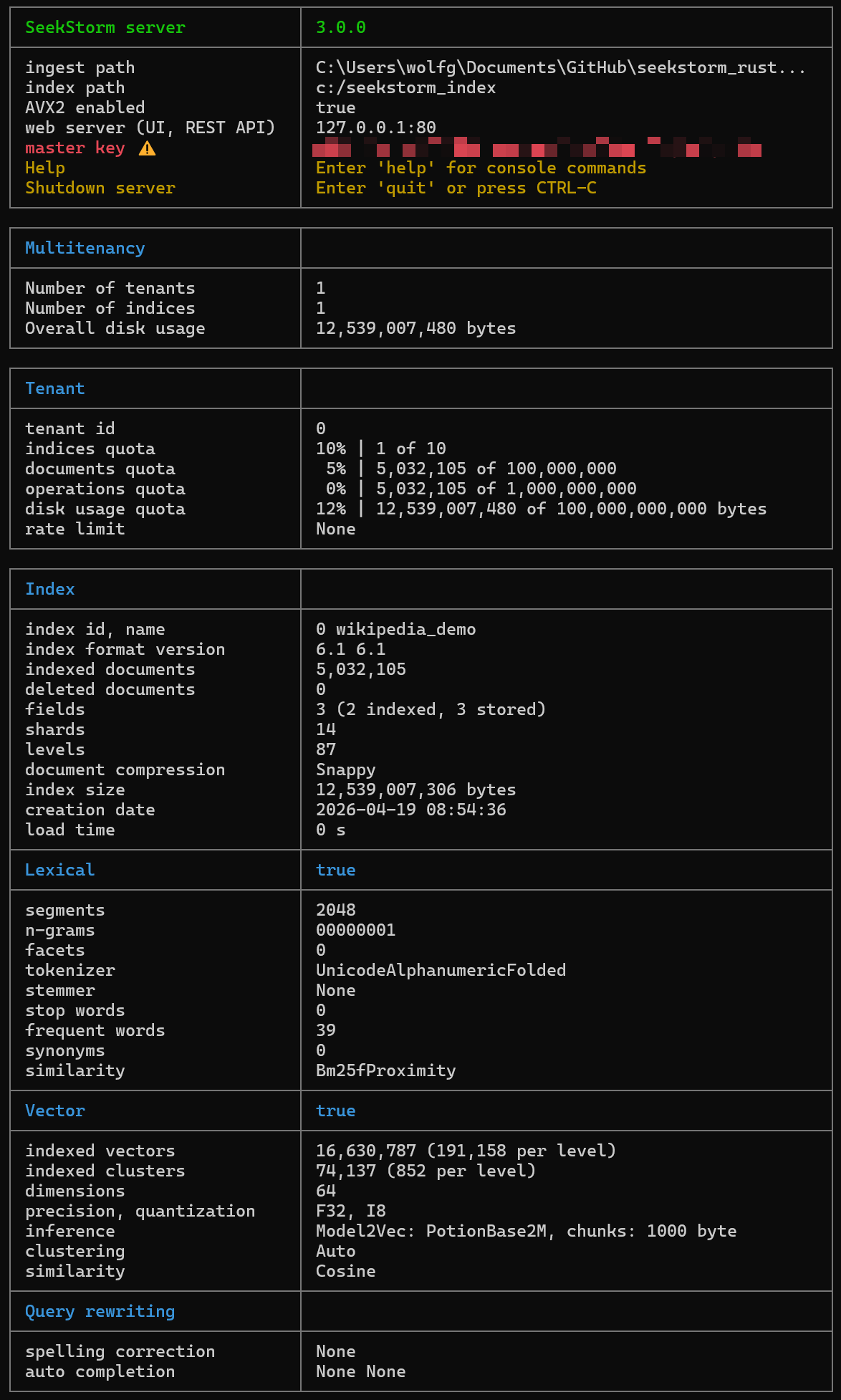
Start searching within the embedded WebUI
Open embedded Web UI in browser: http://127.0.0.1
Enter a query into the search box
Testing the REST API endpoints
Open src/seekstorm_server/test_api.rest in VSC together with the VSC extension "Rest client" to execute API calls and inspect responses
interactive API endpoint examples
Set the 'individual API key' in test_api.rest to the api key displayed in the server console when you typed 'index' above.
Remove demo index
Type 'delete' into the command line of the running SeekStorm server:
delete
Shutdown server
Type 'quit' into the commandline of the running SeekStorm server.
quit
Customizing
Do you want to use something similar for your own project? Have a look at the ingest and web UI documentation.
Build a PDF search engine with the SeekStorm server
A quick step-by-step tutorial on how to build a PDF search engine from a directory that contains PDF files using the SeekStorm server.
Make all your scientific papers, ebooks, resumes, reports, contracts, documentation, manuals, letters, bank statements, invoices, delivery notes searchable - at home or in your organisation.

Build SeekStorm
Install Rust (if not yet present): https://www.rust-lang.org/tools/install
In the terminal of Visual Studio Code type:
cargo build --release
Download PDFium
Download and copy the Pdfium library into the same folder as the seekstorm_server.exe: https://github.com/bblanchon/pdfium-binaries
Start SeekStorm server
cd target/release
./seekstorm_server local_ip="0.0.0.0" local_port=80
Indexing
Choose a directory that contains PDF files you want to index and search, e.g. your documents or download directory.
Type 'ingest' into the command line of the running SeekStorm server:
ingest C:\Users\JohnDoe\Downloads
This creates the pdf_index and indexes all PDF files from the specified directory, including subdirectories.
Start searching within the embedded WebUI
Open embedded Web UI in browser: http://127.0.0.1
Enter a query into the search box
Remove demo index
Type 'delete' into the command line of the running SeekStorm server:
delete
Shutdown server
Type 'quit' into the commandline of the running SeekStorm server.
quit
Why Rust
We have (partially) ported the SeekStorm codebase from C# to Rust
- Factor 2..4x performance gain vs. C# (latency and throughput)
- No slow first run (no cold start costs due to just-in-time compilation)
- Stable latencies (no garbage collection delays)
- Less memory consumption (no ramping up until the next garbage collection)
- No framework dependencies (CLR or JVM virtual machines)
- Ahead-of-time instead of just-in-time compilation
- Memory safe language
Rust is great for performance-critical applications 🚀 that deal with big data and/or many concurrent users. Fast algorithms will shine even more with a performance-conscious programming language 🙂
Building
cargo build --release
⚠ WARNING: make sure to set the MASTER_KEY_SECRET environment variable to a secret, otherwise your generated API keys will be compromised.
Documentation
Build documentation
cargo doc --no-deps
Access documentation locally
SeekStorm\target\doc\seekstorm\index.html
SeekStorm\target\doc\seekstorm_server\index.html
Feature Flags
zh(default): Enables TokenizerType.UnicodeAlphanumericZH that implements Chinese word segmentation to segment continuous Chinese text into tokens for indexing and search.pdf(default): Enables PDF ingestion viapdfiumcrate.vb(default): vb (verbose) adds additional properties to theResultstruct:- field_id
- chunk_id
- level_id
- shard_id
- cluster_id
- cluster_score
- vector_score
- lexical_score
- source: ResultSource (Lexical/Vector/Hybrid)
gxhash: high-performance hashing viagxhash, both forx86_64andaarch64. Otherwise fallback toahash.
You can disable the SeekStorm default features by using default-features = false in the cargo.toml of your application.
This can be useful to reduce the size of your application or if there are dependency version conflicts.
cargo add seekstorm --no-default-features
Usage of the library
Lexical search
Show code
Add required crates to your project
cargo add seekstorm
cargo add tokio
cargo add serde_json
Use an asynchronous Rust runtime
use std::error::Error;
#[tokio::main]
async fn main() -> Result<(), Box<dyn Error + Send + Sync>> {

  // your SeekStorm code here

   Ok(())
}
create schema (from JSON)
use seekstorm::index::SchemaField;

let schema_json = r#"
[{"field":"title","field_type":"Text","store":false,"index_lexical":false,"dictionary_source":true,"completion_source":true},
{"field":"body","field_type":"Text","store":true,"index_lexical":true},
{"field":"url","field_type":"Text","store":false,"index_lexical":false}]"#;
let schema:Vec<SchemaField>=serde_json::from_str(schema_json).unwrap();
create schema (from SchemaField)
use seekstorm::index::{SchemaField,FieldType};

let schema= vec![
    SchemaField::new("title".to_owned(), false, false,false, FieldType::Text, false,false, 1.0,true,true),
    SchemaField::new("body".to_owned(),true,true,false,FieldType::Text,false,true,1.0,false,false),
    SchemaField::new("url".to_owned(), false, false,false, FieldType::Text,false,false,1.0,false,false),
];
create index
# tokio_test::block_on(async {

use std::path::Path;
use seekstorm::index::{IndexMetaObject, Clustering, LexicalSimilarity,TokenizerType,StopwordType,FrequentwordType,AccessType,StemmerType,NgramSet,SchemaField,FieldType,SpellingCorrection,QueryCompletion,DocumentCompression,create_index};
use seekstorm::vector::Inference;
use seekstorm::vector_similarity::VectorSimilarity;

let index_path=Path::new("C:/index/");

let schema= vec![
    SchemaField::new("title".to_owned(), false, false,false, FieldType::Text, false,false, 1.0,true,true),
    SchemaField::new("body".to_owned(),true,true,false,FieldType::Text,false,true,1.0,false,false),
    SchemaField::new("url".to_owned(), false, false, false,FieldType::Text,false,false,1.0,false,false),
];

let meta = IndexMetaObject {
    id: 0,
    name: "test_index".into(),
    lexical_similarity: LexicalSimilarity::Bm25f,
    tokenizer: TokenizerType::UnicodeAlphanumeric,
    stemmer: StemmerType::None,
    stop_words: StopwordType::None,
    frequent_words: FrequentwordType::English,
    ngram_indexing: NgramSet::NgramFF as u8,
    document_compression: DocumentCompression::Snappy,
    access_type: AccessType::Mmap,
    spelling_correction: Some(SpellingCorrection { max_dictionary_edit_distance: 1, term_length_threshold: Some([2,8].into()),count_threshold: 20,max_dictionary_entries:500_000 }),
    query_completion: Some(QueryCompletion{max_completion_entries:10_000_000}),
    clustering: Clustering::None,
    inference: Inference::None,
    segment_number_bits:11
};

let index_arc=create_index(index_path,meta,&schema,&Vec::new(),false,None).await.unwrap();

# });
open index (alternatively to create index)
# tokio_test::block_on(async {

use std::path::Path;
use seekstorm::index::open_index;

let index_path=Path::new("C:/index/");
let mut index_arc=open_index(index_path).await.unwrap();

# });
index documents (from JSON)
# tokio_test::block_on(async {

use std::path::Path;
use seekstorm::index::{open_index, IndexDocuments};

let index_path=Path::new("C:/index/");
let mut index_arc=open_index(index_path).await.unwrap();

let documents_json = r#"
[{"title":"title1 test","body":"body1","url":"url1"},
{"title":"title2","body":"body2 test","url":"url2"},
{"title":"title3 test","body":"body3 test","url":"url3"}]"#;
let documents_vec=serde_json::from_str(documents_json).unwrap();

index_arc.index_documents(documents_vec).await;

# });
index document (from Document)
# tokio_test::block_on(async {

use seekstorm::index::{FileType, Document, IndexDocument, open_index};
use std::path::Path;
use serde_json::Value;

let index_path=Path::new("C:/index/");
let mut index_arc=open_index(index_path).await.unwrap();

let document= Document::from([
    ("title".to_string(), Value::String("title4 test".to_string())),
    ("body".to_string(), Value::String("body4 test".to_string())),
    ("url".to_string(), Value::String("url4".to_string())),
]);

index_arc.index_document(document,FileType::None).await;

# });
commit documents
# tokio_test::block_on(async {

use seekstorm::commit::Commit;
use seekstorm::index::open_index;
use std::path::Path;

let index_path=Path::new("C:/index/");
let mut index_arc=open_index(index_path).await.unwrap();

index_arc.commit().await;

# });
search index
# tokio_test::block_on(async {

use seekstorm::search::{Search, SearchMode, QueryType, ResultType, QueryRewriting};
use seekstorm::index::open_index;
use std::path::Path;

let index_path=Path::new("C:/index/");
let mut index_arc=open_index(index_path).await.unwrap();

let query="test".to_string();
let query_vector=None;
let search_mode=SearchMode::Lexical;
let enable_empty_query=false;
let offset=0;
let length=10;
let query_type=QueryType::Intersection;
let result_type=ResultType::TopkCount;
let include_uncommitted=false;
let field_filter=Vec::new();
let query_facets=Vec::new();
let facet_filter=Vec::new();
let result_sort=Vec::new();
let query_rewriting= QueryRewriting::SearchRewrite { distance: 1, term_length_threshold: Some([2,8].into()), correct:Some(2),complete: Some(3), length: Some(5) };
let result_object = index_arc.search(query, query_vector, query_type, search_mode, enable_empty_query, offset, length, result_type,include_uncommitted,field_filter,query_facets,facet_filter,result_sort,query_rewriting).await;

// ### display results

use seekstorm::highlighter::{Highlight, highlighter};
use std::collections::HashSet;

let highlights:Vec<Highlight>= vec![
    Highlight {
        field: "body".to_string(),
        name:String::new(),
        fragment_number: 2,
        fragment_size: 160,
        highlight_markup: true,
        ..Default::default()
    },
];

let highlighter=Some(highlighter(&index_arc,highlights, result_object.query_terms).await);
let return_fields_filter= HashSet::new();
let distance_fields=Vec::new();
let mut index=index_arc.write().await;
for result in result_object.results.iter() {
  let doc=index.get_document(result.doc_id,false,&highlighter,&return_fields_filter,&distance_fields).await.unwrap();
  println!("result {} rank {} body field {:?}" , result.doc_id,result.score, doc.get("body"));
}

println!("result counts {} {} {}",result_object.results.len(), result_object.result_count, result_object.result_count_total);

// ### display suggestions

println!("original query string: {} query string after correction/completion {}",result_object.original_query, result_object.query);

for suggesion in result_object.suggestions.iter() {
    println!("suggestion: {}", suggesion);
}

# })
Query operators and query type
Boolean queries are specified in the search method either via the query_type parameter or via operator chars within the query parameter.
The interpretation of operator chars within the query string (set query_type=QueryType::Union) allows to specify advanced search operations via a simple search box.
Intersection, AND +
use seekstorm::search::QueryType;
let query_type=QueryType::Union;
let query="+red +apple".to_string();
use seekstorm::search::QueryType;
let query_type=QueryType::Intersection;
let query="red apple".to_string();
Union, OR
use seekstorm::search::QueryType;
let query_type=QueryType::Union;
let query="red apple".to_string();
Phrase ""
use seekstorm::search::QueryType;
let query_type=QueryType::Union;
let query="\"red apple\"".to_string();
use seekstorm::search::QueryType;
let query_type=QueryType::Phrase;
let query="red apple".to_string();
Except, minus, NOT -
use seekstorm::search::QueryType;
let query_type=QueryType::Union;
let query="apple -red".to_string();
Mixed phrase and intersection
use seekstorm::search::QueryType;
let query_type=QueryType::Union;
let query="+\"the who\" +uk".to_string();
multi-threaded search
# tokio_test::block_on(async {

use seekstorm::search::{QueryType, SearchMode, ResultType, QueryRewriting, Search};
use std::sync::Arc;
use tokio::sync::Semaphore;
use seekstorm::index::open_index;
use std::path::Path;

let index_path=Path::new("C:/index/");
let mut index_arc=open_index(index_path).await.unwrap();

let query_vec=vec!["house".to_string(),"car".to_string(),"bird".to_string(),"sky".to_string()];
let query_vector=None;
let offset=0;
let length=10;
let search_mode=SearchMode::Lexical;
let enable_empty_query=false;
let query_type=QueryType::Union;
let result_type=ResultType::TopkCount;

let include_uncommitted=false;
let field_filter=Vec::new();
let query_facets=Vec::new();
let facet_filter=Vec::new();
let result_sort=Vec::new();

let thread_number = 4;
let permits = Arc::new(Semaphore::new(thread_number));
for query in query_vec {
    let permit_thread = permits.clone().acquire_owned().await.unwrap();

    let query_clone = query.clone();
    let query_vector_clone=query_vector.clone();
    let index_arc_clone = index_arc.clone();
    let search_mode_clone=search_mode.clone();
    let enable_empty_query_clone=enable_empty_query.clone();
    let offset_clone = offset;
    let length_clone = length;
    let query_type_clone = query_type.clone();
    let result_type_clone = result_type.clone();
    let include_uncommitted_clone=include_uncommitted;
    let field_filter_clone=field_filter.clone();
    let query_facets_clone=query_facets.clone();
    let facet_filter_clone=facet_filter.clone();
    let result_sort_clone=result_sort.clone();

    tokio::spawn(async move {
        let rlo = index_arc_clone
            .search(
                query_clone,
                query_vector_clone,
                query_type_clone,
                search_mode_clone,
                enable_empty_query_clone,
                offset_clone,
                length_clone,
                result_type_clone,
                include_uncommitted_clone,
                field_filter_clone,
                query_facets_clone,
                facet_filter_clone,
                result_sort_clone,
                QueryRewriting::SearchOnly
            )
            .await;

        println!("result count {}", rlo.result_count);

        drop(permit_thread);
    });
}

# })
First, you need to create an index with a schema matching the JSON file fields to ingest:
# tokio_test::block_on(async {

use std::path::Path;
use seekstorm::index::{IndexMetaObject,Clustering,LexicalSimilarity,TokenizerType,StopwordType,FrequentwordType,AccessType,StemmerType,NgramSet,SchemaField,FieldType,SpellingCorrection,QueryCompletion,DocumentCompression,create_index};
use seekstorm::vector::Inference;
use seekstorm::vector_similarity::VectorSimilarity;

let index_path=Path::new("C:/index/");

let schema= vec![
    // field, stored, indexed, field_type, facet, longest, boost
    SchemaField::new("title".to_owned(), true, true, false,FieldType::Text, false,false, 10.0,false,false),
    SchemaField::new("body".to_owned(),true,true,false,FieldType::Text,false,true,1.0,false,false),
    SchemaField::new("url".to_owned(), true, false,false, FieldType::Text,false,false,1.0,false,false),
];

let meta = IndexMetaObject {
    id: 0,
    name: "wikipedia_index".into(),
    lexical_similarity: LexicalSimilarity::Bm25f,
    tokenizer: TokenizerType::UnicodeAlphanumeric,
    stemmer: StemmerType::None,
    stop_words: StopwordType::None,
    frequent_words: FrequentwordType::English,
    ngram_indexing: NgramSet::NgramFF as u8,
    document_compression: DocumentCompression::Snappy,
    access_type: AccessType::Mmap,
    spelling_correction: Some(SpellingCorrection { max_dictionary_edit_distance: 1, term_length_threshold: Some([2,8].into()),count_threshold: 20,max_dictionary_entries:500_000 }),
    query_completion: Some(QueryCompletion{max_completion_entries:10_000_000}),
    clustering: Clustering::None,
    inference: Inference::None,
    segment_number_bits:11
};

let index_arc=create_index(index_path,meta,&schema,&Vec::new(),false,None).await.unwrap();

# });
Then, index JSON file in JSON, Newline-delimited JSON and Concatenated JSON format
# tokio_test::block_on(async {

use seekstorm::ingest::IngestJson;
use seekstorm::index::open_index;
use std::path::Path;

let index_path=Path::new("C:/index/");
let mut index_arc=open_index(index_path).await.unwrap();

let file_path=Path::new("wiki-articles.json");
let _ =index_arc.ingest_json(file_path).await;

# })
index all PDF files in directory and sub-directories
- converts pdf to text and indexes it
- extracts title from metatag, or first line of text, or from filename
- extracts creation date from metatag, or from file creation date (Unix timestamp: the number of seconds since 1 January 1970)
- copies all ingested PDF files to the "files" subdirectory in the index.
First, you need to create an index with the following PDF specific schema (index/schema are automatically created when ingesting via the console ingest command):
# tokio_test::block_on(async {

use std::path::Path;
use seekstorm::index::{IndexMetaObject,Clustering,LexicalSimilarity,TokenizerType,StopwordType,FrequentwordType,AccessType,StemmerType,NgramSet,SchemaField,FieldType,SpellingCorrection,QueryCompletion,DocumentCompression,create_index};
use seekstorm::vector::Inference;
use seekstorm::vector_similarity::VectorSimilarity;

let index_path=Path::new("C:/index/");

let schema= vec![
    // field, stored, indexed, field_type, facet, longest, boost
    SchemaField::new("title".to_owned(), true, true,false, FieldType::Text, false,false, 10.0,false,false),
    SchemaField::new("body".to_owned(),true,true,false,FieldType::Text,false,true,1.0,false,false),
    SchemaField::new("url".to_owned(), true, false,false, FieldType::Text,false,false,1.0,false,false),
    SchemaField::new("date".to_owned(), true, false,false, FieldType::Timestamp,true,false,1.0,false,false),
];

let meta = IndexMetaObject {
    id: 0,
    name: "pdf_index".into(),
    lexical_similarity: LexicalSimilarity::Bm25fProximity,
    tokenizer: TokenizerType::UnicodeAlphanumeric,
    stemmer: StemmerType::None,
    stop_words: StopwordType::None,
    frequent_words: FrequentwordType::English,
    ngram_indexing: NgramSet::NgramFF as u8,
    document_compression: DocumentCompression::Snappy,
    access_type: AccessType::Mmap,
    spelling_correction: Some(SpellingCorrection { max_dictionary_edit_distance: 1, term_length_threshold: Some([2,8].into()),count_threshold: 20,max_dictionary_entries:500_000 }),
    query_completion: Some(QueryCompletion{max_completion_entries:10_000_000}),
    clustering: Clustering::None,
    inference: Inference::None,
    segment_number_bits:11
};

let index_arc=create_index(index_path,meta,&schema,&Vec::new(),false,None).await.unwrap();

# });
Then, ingest all PDF files from a given path:
# tokio_test::block_on(async {

use seekstorm::index::open_index;
use std::path::Path;
use seekstorm::ingest::IngestPdf;

let index_path=Path::new("C:/index/");
let mut index_arc=open_index(index_path).await.unwrap();

let file_path=Path::new("C:/Users/johndoe/Downloads");
let _ =index_arc.ingest_pdf(file_path).await;

# });
index PDF file
# tokio_test::block_on(async {

use seekstorm::index::open_index;
use std::path::Path;
use seekstorm::ingest::IndexPdfFile;

let index_path=Path::new("C:/index/");
let mut index_arc=open_index(index_path).await.unwrap();

let file_path=Path::new("C:/test.pdf");
let _ =index_arc.index_pdf_file(file_path).await;

# });
index PDF file bytes
# tokio_test::block_on(async {

use seekstorm::index::open_index;
use std::path::Path;
use std::fs;
use chrono::Utc;
use seekstorm::ingest::IndexPdfBytes;

let index_path=Path::new("C:/index/");
let mut index_arc=open_index(index_path).await.unwrap();

//solely used as meta data if it can't be extracted from document bytes
let file_date=Utc::now().timestamp();
let file_path=Path::new("C:/test.pdf");

let document = fs::read(file_path).unwrap();
let _ =index_arc.index_pdf_bytes(file_path, file_date, &document).await;

# });
get PDF file bytes
# tokio_test::block_on(async {

use seekstorm::index::open_index;
use std::path::Path;

let index_path=Path::new("C:/index/");
let mut index_arc=open_index(index_path).await.unwrap();

let doc_id=0;
let _file=index_arc.read().await.get_file(doc_id).await.unwrap();

# });
clear index
# tokio_test::block_on(async {
use seekstorm::index::open_index;
use std::path::Path;

let index_path=Path::new("C:/index/");
let mut index_arc=open_index(index_path).await.unwrap();

index_arc.write().await.clear_index().await;

# });
delete index
# tokio_test::block_on(async {

use seekstorm::index::open_index;
use std::path::Path;

let index_path=Path::new("C:/index/");
let mut index_arc=open_index(index_path).await.unwrap();

index_arc.write().await.delete_index();

# });
iterate through document ID of an index
# tokio_test::block_on(async {

use seekstorm::{index::open_index,iterator::GetIterator};
use std::path::Path;

let index_path=Path::new("C:/index/");
let mut index_arc=open_index(index_path).await.unwrap();

//display min_docid: the min_docid is NOT always 0, if the first shards are empty!
let iterator=index_arc.get_iterator(None,0,1,false,false,vec![]).await;
println!("min doc_id: {}",iterator.results.first().unwrap().doc_id);

//display max_docid
let iterator=index_arc.get_iterator(None,0,-1,false,false,vec![]).await;
println!("max doc_id: {}",iterator.results.first().unwrap().doc_id);

//iterate doc_id ascending, display the lowest 10 and then every 10_000th document ID
let mut iterator=index_arc.get_iterator(None,0,1,false,false,vec![]).await;
let mut i=0;
if !iterator.results.is_empty() {println!("$ i: {} doc_id: {}",i,iterator.results.first().unwrap().doc_id);}
while !iterator.results.is_empty() {
    iterator=index_arc.get_iterator(Some(iterator.results.first().unwrap().doc_id),1,1,false,false,vec![]).await;
    i+=1;
    if !iterator.results.is_empty() && ( i % 10_000 ==0 || i<=10 )  {println!("i: {} doc_id: {}",i,iterator.results.first().unwrap().doc_id);}
}

//iterate doc_id descending, display the highest 10 and then every 10_000th document ID
let mut iterator=index_arc.get_iterator(None,0,-1,false,false,vec![]).await;
let mut i=0;
if !iterator.results.is_empty() {println!("$ i: {} doc_id: {}",i,iterator.results.first().unwrap().doc_id);}
while !iterator.results.is_empty() {
    iterator=index_arc.get_iterator(Some(iterator.results.first().unwrap().doc_id),1,-1,false,false,vec![]).await;
    i+=1;
    if !iterator.results.is_empty() && ( i % 10_000 ==0 || i<=10 )  {println!("i: {} doc_id: {}",i,iterator.results.first().unwrap().doc_id);}
}

index_arc.write().await.delete_index();

# });
close index
# tokio_test::block_on(async {

use seekstorm::index::open_index;
use seekstorm::index::Close;
use std::path::Path;

let index_path=Path::new("C:/index/");
let mut index_arc=open_index(index_path).await.unwrap();

index_arc.close().await;

# });
seekstorm library version string
use seekstorm::index::version;

let version=version();
println!("version {}",version);
Faceted search - Quick start
Show code
Facets are defined in 3 different places:
- The facet fields are defined in the schema at create_index.
- The facet field values are set in index_document at index time.
- The query_facets/facet_filter parameters are specified at query time.
Facets are then returned in the search result object.
A minimal working example of faceted indexing & search requires just 60 lines of code. But to puzzle it all together from the documentation alone might be tedious. This is why we provide a quick start example here:
Add required crates to your project
cargo add seekstorm
cargo add tokio
cargo add serde_json
Use an asynchronous Rust runtime
use std::error::Error;
#[tokio::main]
async fn main() -> Result<(), Box<dyn Error + Send + Sync>> {

  // your SeekStorm code here

   Ok(())
}
create index
# tokio_test::block_on(async {

use std::path::Path;
use std::sync::{Arc, RwLock};
use seekstorm::index::{IndexMetaObject, Clustering,LexicalSimilarity,TokenizerType,StopwordType,FrequentwordType,AccessType,StemmerType,NgramSet,DocumentCompression,create_index};
use seekstorm::vector::Inference;
use seekstorm::vector_similarity::VectorSimilarity;

let index_path=Path::new("C:/index/");//x

let schema_json = r#"
[{"field":"title","field_type":"Text","store":false,"index_lexical":false},
{"field":"body","field_type":"Text","store":true,"index_lexical":true},
{"field":"url","field_type":"Text","store":true,"index_lexical":false},
{"field":"town","field_type":"String16","store":false,"index_lexical":false,"facet":true}]"#;
let schema=serde_json::from_str(schema_json).unwrap();

let meta = IndexMetaObject {
    id: 0,
    name: "test_index".into(),
    lexical_similarity: LexicalSimilarity::Bm25f,
    tokenizer: TokenizerType::AsciiAlphabetic,
    stemmer: StemmerType::None,
    stop_words: StopwordType::None,
    frequent_words: FrequentwordType::English,
    ngram_indexing: NgramSet::NgramFF as u8,
    document_compression: DocumentCompression::Snappy,
    access_type: AccessType::Mmap,
    spelling_correction: None,
    query_completion: None,
    clustering: Clustering::None,
    inference: Inference::None,
    segment_number_bits:11
};

let synonyms=Vec::new();

let index_arc=create_index(index_path,meta,&schema,&synonyms,false,None).await.unwrap();

# });
index documents
# tokio_test::block_on(async {

use std::path::Path;
use seekstorm::index::{IndexDocuments,open_index};
use seekstorm::commit::Commit;

let index_path=Path::new("C:/index/");
let index_arc=open_index(index_path).await.unwrap();

let documents_json = r#"
[{"title":"title1 test","body":"body1","url":"url1","town":"Berlin"},
{"title":"title2","body":"body2 test","url":"url2","town":"Warsaw"},
{"title":"title3 test","body":"body3 test","url":"url3","town":"New York"}]"#;
let documents_vec=serde_json::from_str(documents_json).unwrap();

index_arc.index_documents(documents_vec).await;

// ### commit documents

index_arc.commit().await;

# });
search index
# tokio_test::block_on(async {

use std::path::Path;
use seekstorm::index::{IndexDocuments,open_index};
use seekstorm::search::{Search,SearchMode,QueryType,ResultType,QueryFacet,QueryRewriting};
use seekstorm::highlighter::{Highlight,highlighter};
use std::collections::HashSet;

let index_path=Path::new("C:/index/");
let index_arc=open_index(index_path).await.unwrap();
let query="test".to_string();
let query_vector=None;
let search_mode=SearchMode::Lexical;
let enable_empty_query=false;
let offset=0;
let length=10;
let query_type=QueryType::Intersection;
let result_type=ResultType::TopkCount;
let include_uncommitted=false;
let field_filter=Vec::new();
let query_facets = vec![QueryFacet::String16 {field: "age".to_string(),prefix: "".to_string(),length:u16::MAX}];
let facet_filter=Vec::new();
//let facet_filter = vec![FacetFilter::String { field: "town".to_string(),filter: vec!["Berlin".to_string()],}];
let result_sort=Vec::new();

let result_object = index_arc.search(query, query_vector, query_type, search_mode, enable_empty_query, offset, length, result_type,include_uncommitted,field_filter,query_facets,facet_filter,result_sort,QueryRewriting::SearchOnly).await;

// ### display results

let highlights:Vec<Highlight>= vec![
        Highlight {
            field: "body".to_owned(),
            name:String::new(),
            fragment_number: 2,
            fragment_size: 160,
            highlight_markup: true,
            ..Default::default()
        },
    ];

let highlighter=Some(highlighter(&index_arc,highlights, result_object.query_terms).await);
let return_fields_filter= HashSet::new();
let distance_fields=Vec::new();
let index=index_arc.write().await;
for result in result_object.results.iter() {
  let doc=index.get_document(result.doc_id,false,&highlighter,&return_fields_filter,&distance_fields).await.unwrap();
  println!("result {} rank {} body field {:?}" , result.doc_id,result.score, doc.get("body"));
}
println!("result counts {} {} {}",result_object.results.len(), result_object.result_count, result_object.result_count_total);

// ### display facets

println!("{}", serde_json::to_string_pretty(&result_object.facets).unwrap());

# });
Vector search: internal inference
Show code
create index
# tokio_test::block_on(async {

    use std::path::Path;
    use std::sync::{Arc, RwLock};
    use seekstorm::index::{IndexMetaObject, Clustering,LexicalSimilarity,TokenizerType,StopwordType,FrequentwordType,AccessType,StemmerType,NgramSet,DocumentCompression,create_index};
    use seekstorm::vector::{Embedding, Inference, Model, Precision, Quantization};
    use seekstorm::vector_similarity::VectorSimilarity;

    let index_path=Path::new("tests/index_test/");

    let schema_json = r#"
    [{"field":"title","field_type":"Text","store":false,"index_lexical":false,"index_vector":true},
    {"field":"body","field_type":"Text","store":true,"index_lexical":false,"index_vector":true},
    {"field":"url","field_type":"Text","store":false,"index_lexical":false,"index_vector":false}]"#;
    let schema=serde_json::from_str(schema_json).unwrap();

    let meta = IndexMetaObject {
        id: 0,
        name: "test_index".into(),
        lexical_similarity: LexicalSimilarity::Bm25f,
        tokenizer: TokenizerType::UnicodeAlphanumeric,
        stemmer: StemmerType::None,
        stop_words: StopwordType::None ,
        frequent_words: FrequentwordType::English,
        ngram_indexing: NgramSet::SingleTerm as u8 ,
        document_compression: DocumentCompression::Snappy,
        access_type: AccessType::Mmap,
        spelling_correction: None,
        query_completion: None,
        clustering: Clustering::None,
        inference: Inference::Model2Vec { model: Model::PotionBase2M, chunk_size: 1000, quantization: Quantization::ScalarQuantizationI8 },
        segment_number_bits:11
    };

    let index_arc=create_index(index_path,meta,&schema,&Vec::new(),false,None).await.unwrap();
    let index=index_arc.read().await;

    let result=index.meta.id;
    assert_eq!(result, 0);
# });
index documents/vectors
# tokio_test::block_on(async {

    use std::path::Path;
    use seekstorm::index::{IndexDocuments,open_index};
    use seekstorm::commit::Commit;

    // open index
    let index_path=Path::new("tests/index_test/");
    let index_arc=open_index(index_path).await.unwrap();

    // index documents
    let documents_json = r#"
    [{"title":"pink panther","body":"animal from a comedy","url":"url1"},
    {"title":"blue whale","body":"largest mammal in the ocean","url":"url2"},
    {"title":"red fox","body":"small carnivorous mammal","url":"url3"}]"#;
    let documents_vec=serde_json::from_str(documents_json).unwrap();
    index_arc.index_documents(documents_vec).await;

    // wait until all index threads are finished and commit
    index_arc.commit().await;

    let result=index_arc.read().await.indexed_doc_count().await;
    assert_eq!(result, 3);
# });
query documents/vectors
# tokio_test::block_on(async {

    use std::path::Path;
    use seekstorm::index::{IndexDocuments,open_index};
    use seekstorm::search::{Search,SearchMode,QueryType,ResultType,QueryFacet,QueryRewriting};
    use seekstorm::vector_similarity::{AnnMode, VectorSimilarity};
    use seekstorm::commit::Commit;
    use seekstorm::highlighter::{Highlight,highlighter};
    use std::collections::HashSet;

   // open index
    let index_path=Path::new("tests/index_test/");
    let index_arc=open_index(index_path).await.unwrap();

    let result=index_arc.read().await.indexed_doc_count().await;
    assert_eq!(result, 3);

    let query="rosy panther".into();
    let result_object = index_arc
        .search(
            query,
            None,
            QueryType::Union,
            SearchMode::Vector { similarity_threshold: Some(0.7), ann_mode: AnnMode::All },
            false,
            0,
            10,
            ResultType::TopkCount,
            false,
            Vec::new(),
            Vec::new(),
            Vec::new(),
            Vec::new(),
            QueryRewriting::SearchOnly,
        )
        .await;

    let result=result_object.results.len();
    assert_eq!(result, 1);

    let result=result_object.result_count;
    assert_eq!(result, 1);

    let result=result_object.result_count_total;
    assert_eq!(result, 1);
# });
Vector search: external inference
Show code
create index
# tokio_test::block_on(async {

    use std::path::Path;
    use std::sync::{Arc, RwLock};
    use seekstorm::index::{IndexMetaObject, Clustering,LexicalSimilarity,TokenizerType,StopwordType,FrequentwordType,AccessType,StemmerType,NgramSet,DocumentCompression,create_index};
    use seekstorm::vector::{Embedding, Inference, Model, Precision, Quantization};
    use seekstorm::vector_similarity::VectorSimilarity;

   let index_path=Path::new("tests/index_test/");

    let schema_json = r#"
    [{"field":"vector","field_type":"Json","store":false,"index_lexical":false,"index_vector":true},
    {"field":"index","field_type":"Text","store":true,"index_lexical":false,"index_vector":false}]"#;
    let schema=serde_json::from_str(schema_json).unwrap();

    let meta = IndexMetaObject {
        id: 0,
        name: "test_index".into(),
        lexical_similarity: LexicalSimilarity::Bm25f,
        tokenizer: TokenizerType::UnicodeAlphanumeric,
        stemmer: StemmerType::None,
        stop_words: StopwordType::None ,
        frequent_words: FrequentwordType::English,
        ngram_indexing: NgramSet::SingleTerm as u8 ,
        document_compression: DocumentCompression::Snappy,
        access_type: AccessType::Mmap,
        spelling_correction: None,
        query_completion: None,
        clustering: Clustering::None,
        inference: Inference::External { dimensions: 128, precision: Precision::F32,  quantization: Quantization::None,similarity:VectorSimilarity::Euclidean },
        segment_number_bits:11
    };

    let index_arc=create_index(index_path,meta,&schema,&Vec::new(),false,None).await.unwrap();
    let index=index_arc.read().await;

    let result=index.meta.id;
    assert_eq!(result, 0);

# });
index documents/vectors
# tokio_test::block_on(async {

    use std::path::Path;
    use seekstorm::index::{IndexDocuments,open_index};
    use seekstorm::commit::Commit;

    // open index
    let index_path=Path::new("tests/index_test/");
    let index_arc=open_index(index_path).await.unwrap();

    // index documents
    let documents_json = r#"
    [{"vector":[0.001, 0.002, 0.003, 0.004, 0.005, 0.006, 0.007, 0.008, 0.009, 0.010, 0.011, 0.012, 0.013, 0.014, 0.015, 0.016, 0.017, 0.018, 0.019, 0.020, 0.021, 0.022, 0.023, 0.024, 0.025, 0.026, 0.027, 0.028, 0.029, 0.030, 0.031, 0.032, 0.033, 0.034, 0.035, 0.036, 0.037, 0.038, 0.039, 0.040, 0.041, 0.042, 0.043, 0.044, 0.045, 0.046, 0.047, 0.048, 0.049, 0.050, 0.051, 0.052, 0.053, 0.054, 0.055, 0.056, 0.057, 0.058, 0.059, 0.060, 0.061, 0.062, 0.063, 0.064, 0.065, 0.066, 0.067, 0.068, 0.069, 0.070, 0.071, 0.072, 0.073, 0.074, 0.075, 0.076, 0.077, 0.078, 0.079, 0.080, 0.081, 0.082, 0.083, 0.084, 0.085, 0.086, 0.087, 0.088, 0.089, 0.090, 0.091, 0.092, 0.093, 0.094, 0.095, 0.096, 0.097, 0.098, 0.099, 0.100, 0.101, 0.102, 0.103, 0.104, 0.105, 0.106, 0.107, 0.108, 0.109, 0.110, 0.111, 0.112, 0.113, 0.114, 0.115, 0.116, 0.117, 0.118, 0.119, 0.120, 0.121, 0.122, 0.123, 0.124, 0.125, 0.126, 0.127, 0.128],"index":"0"},
    {"vector":[0.129, 0.130, 0.131, 0.132, 0.133, 0.134, 0.135, 0.136, 0.137, 0.138, 0.139, 0.140, 0.141, 0.142, 0.143, 0.144, 0.145, 0.146, 0.147, 0.148, 0.149, 0.150, 0.151, 0.152, 0.153, 0.154, 0.155, 0.156, 0.157, 0.158, 0.159, 0.160, 0.161, 0.162, 0.163, 0.164, 0.165, 0.166, 0.167, 0.168, 0.169, 0.170, 0.171, 0.172, 0.173, 0.174, 0.175, 0.176, 0.177, 0.178, 0.179, 0.180, 0.181, 0.182, 0.183, 0.184, 0.185, 0.186, 0.187, 0.188, 0.189, 0.190, 0.191, 0.192, 0.193, 0.194, 0.195, 0.196, 0.197, 0.198, 0.199, 0.200, 0.201, 0.202, 0.203, 0.204, 0.205, 0.206, 0.207, 0.208, 0.209, 0.210, 0.211, 0.212, 0.213, 0.214, 0.215, 0.216, 0.217, 0.218, 0.219, 0.220, 0.221, 0.222, 0.223, 0.224, 0.225, 0.226, 0.227, 0.228, 0.229, 0.230, 0.231, 0.232, 0.233, 0.234, 0.235, 0.236, 0.237, 0.238, 0.239, 0.240, 0.241, 0.242, 0.243, 0.244, 0.245, 0.246, 0.247, 0.248, 0.249, 0.250, 0.251, 0.252, 0.253, 0.254, 0.255, 0.256],"index":"1"},
    {"vector":[0.257, 0.258, 0.259, 0.260, 0.261, 0.262, 0.263, 0.264, 0.265, 0.266, 0.267, 0.268, 0.269, 0.270, 0.271, 0.272, 0.273, 0.274, 0.275, 0.276, 0.277, 0.278, 0.279, 0.280, 0.281, 0.282, 0.283, 0.284, 0.285, 0.286, 0.287, 0.288, 0.289, 0.290, 0.291, 0.292, 0.293, 0.294, 0.295, 0.296, 0.297, 0.298, 0.299, 0.300, 0.301, 0.302, 0.303, 0.304, 0.305, 0.306, 0.307, 0.308, 0.309, 0.310, 0.311, 0.312, 0.313, 0.314, 0.315, 0.316, 0.317, 0.318, 0.319, 0.320, 0.321, 0.322, 0.323, 0.324, 0.325, 0.326, 0.327, 0.328, 0.329, 0.330, 0.331, 0.332, 0.333, 0.334, 0.335, 0.336, 0.337, 0.338, 0.339, 0.340, 0.341, 0.342, 0.343, 0.344, 0.345, 0.346, 0.347, 0.348, 0.349, 0.350, 0.351, 0.352, 0.353, 0.354, 0.355, 0.356, 0.357, 0.358, 0.359, 0.360, 0.361, 0.362, 0.363, 0.364, 0.365, 0.366, 0.367, 0.368, 0.369, 0.370, 0.371, 0.372, 0.373, 0.374, 0.375, 0.376, 0.377, 0.378, 0.379, 0.380, 0.381, 0.382, 0.383, 0.384],"index":"2"}]"#;
    let documents_vec=serde_json::from_str(documents_json).unwrap();
    index_arc.index_documents(documents_vec).await;

    // wait until all index threads are finished and commit
    index_arc.commit().await;

    let result=index_arc.read().await.indexed_doc_count().await;
    assert_eq!(result, 3);

# });
query documents/vectors
# tokio_test::block_on(async {

    use std::path::Path;
    use seekstorm::index::{IndexDocuments,open_index};
    use seekstorm::search::{Search,SearchMode,QueryType,ResultType,QueryFacet,QueryRewriting};
    use seekstorm::vector_similarity::{AnnMode, VectorSimilarity};
    use seekstorm::commit::Commit;
    use seekstorm::vector::Embedding;
    use seekstorm::highlighter::{Highlight,highlighter};
    use std::collections::HashSet;

  // open index
    let index_path=Path::new("tests/index_test/");
    let index_arc=open_index(index_path).await.unwrap();

    let result=index_arc.read().await.indexed_doc_count().await;
    assert_eq!(result, 3);

    let query=String::new();
    let query_vector = vec![0.001, 0.002, 0.003, 0.004, 0.005, 0.006, 0.007, 0.008, 0.009, 0.010, 0.011, 0.012, 0.013, 0.014, 0.015, 0.016, 0.017, 0.018, 0.019, 0.020, 0.021, 0.022, 0.023, 0.024, 0.025, 0.026, 0.027, 0.028, 0.029, 0.030, 0.031, 0.032, 0.033, 0.034, 0.035, 0.036, 0.037, 0.038, 0.039, 0.040, 0.041, 0.042, 0.043, 0.044, 0.045, 0.046, 0.047, 0.048, 0.049, 0.050, 0.051, 0.052, 0.053, 0.054, 0.055, 0.056, 0.057, 0.058, 0.059, 0.060, 0.061, 0.062, 0.063, 0.064, 0.065, 0.066, 0.067, 0.068, 0.069, 0.070, 0.071, 0.072, 0.073, 0.074, 0.075, 0.076, 0.077, 0.078, 0.079, 0.080, 0.081, 0.082, 0.083, 0.084, 0.085, 0.086, 0.087, 0.088, 0.089, 0.090, 0.091, 0.092, 0.093, 0.094, 0.095, 0.096, 0.097, 0.098, 0.099, 0.100, 0.101, 0.102, 0.103, 0.104, 0.105, 0.106, 0.107, 0.108, 0.109, 0.110, 0.111, 0.112, 0.113, 0.114, 0.115, 0.116, 0.117, 0.118, 0.119, 0.120, 0.121, 0.122, 0.123, 0.124, 0.125, 0.126, 0.127, 0.128];
    let query_embedding=Embedding::F32(query_vector);
    let result_object = index_arc
        .search(
            query,
            Some(query_embedding),
            QueryType::Union,
            SearchMode::Vector { similarity_threshold: None, ann_mode: AnnMode::All },
            false,
            0,
            10,
            ResultType::TopkCount,
            false,
            Vec::new(),
            Vec::new(),
            Vec::new(),
            Vec::new(),
            QueryRewriting::SearchOnly,
        )
        .await;

    let result=result_object.results.len();
    assert_eq!(result, 3);

    let result=result_object.result_count;
    assert_eq!(result, 3);

    let result=result_object.result_count_total;
    assert_eq!(result, 3);

# });
Vector search: SIFT1M dataset
Show code
- 1 million vectors, 128 dimensions, f32 precision
- nprobe=16 -> recall@10=95%, average latency=188 microseconds
- nprobe=33 -> recall@10=99%, average latency=302 microseconds
create index
# tokio_test::block_on(async {

    use std::path::Path;
    use std::sync::{Arc, RwLock};
    use seekstorm::index::{IndexMetaObject, Clustering,LexicalSimilarity,TokenizerType,StopwordType,FrequentwordType,AccessType,StemmerType,NgramSet,DocumentCompression,create_index};
    use seekstorm::vector::{Embedding, Inference, Model, Precision, Quantization};
    use seekstorm::vector_similarity::VectorSimilarity;

   let index_path=Path::new("tests/index_test/");

    let schema_json = r#"
    [{"field":"vector","field_type":"Json","store":false,"index_lexical":false,"index_vector":true},
    {"field":"index","field_type":"Text","store":true,"index_lexical":false,"index_vector":false}]"#;
    let schema=serde_json::from_str(schema_json).unwrap();

    let meta = IndexMetaObject {
        id: 0,
        name: "test_index".into(),
        lexical_similarity: LexicalSimilarity::Bm25f,
        tokenizer: TokenizerType::UnicodeAlphanumeric,
        stemmer: StemmerType::None,
        stop_words: StopwordType::None ,
        frequent_words: FrequentwordType::English,
        ngram_indexing: NgramSet::SingleTerm as u8 ,
        document_compression: DocumentCompression::Snappy,
        access_type: AccessType::Mmap,
        spelling_correction: None,
        query_completion: None,
        clustering: Clustering::Auto,
        inference: Inference::External { dimensions: 128, precision: Precision::F32, quantization: Quantization::ScalarQuantizationI8, similarity:VectorSimilarity::Euclidean },
        segment_number_bits:11
    };

    let index_arc=create_index(index_path,meta,&schema,&Vec::new(),false,None).await.unwrap();
    let index=index_arc.read().await;

    let result=index.meta.id;
    assert_eq!(result, 0);

# });
index documents/vectors
# tokio_test::block_on(async {

    use std::path::Path;
    use seekstorm::index::{IndexDocuments,open_index};
    use seekstorm::commit::Commit;
    use seekstorm::ingest::{read_fvecs,ingest_sift};

    // open index
    let index_path=Path::new("tests/index_test/");
    let index_arc=open_index(index_path).await.unwrap();

    // index documents
    // download data from http://corpus-texmex.irisa.fr/
    ingest_sift(&index_arc, Path::new(r"C:\testset\sift_base.fvecs"), None).await;

    let result=index_arc.read().await.indexed_doc_count().await;
    assert_eq!(result, 3);

# });
query documents/vectors
# tokio_test::block_on(async {

    use std::path::Path;
    use std::collections::HashSet;
    use std::time::Instant;
    use indexmap::IndexMap;
    use seekstorm::index::{IndexDocuments,open_index};
    use seekstorm::search::{Search,SearchMode,QueryType,ResultType,QueryFacet,QueryRewriting};
    use seekstorm::vector_similarity::{AnnMode, VectorSimilarity};
    use seekstorm::commit::Commit;
    use seekstorm::vector::Embedding;
    use seekstorm::ingest::{read_fvecs, read_ivecs, ingest_sift};
    use seekstorm::highlighter::{Highlight,highlighter};
    use num_format::{Locale, ToFormattedString};
    use serde_json::Value;

    // open index
    let index_path=Path::new("tests/index_test/");
    let index_arc=open_index(index_path).await.unwrap();

    let result=index_arc.read().await.indexed_doc_count().await;
    assert_eq!(result, 1000_000);

    let query="";

    let len=10;
    let similarity_threshold=None;
    let field_filter=Vec::new();
    let fields_hashset=HashSet::new();

    let mut search_time_sum=0;
    let mut results_sum=0;
    let mut result_count_total_sum=0;
    let mut observed_cluster_count_sum=0;
    let mut observed_vector_count_sum=0;
    let mut recall_count_sum=0;

    if let Ok(ground_truth) = read_ivecs(r"C:\testset\sift_groundtruth.ivecs") {

        if let Ok(queries) = read_fvecs(r"C:\testset\sift_query.fvecs") {

            let queries_len=queries.len();

            for (query_idx, query_embedding) in queries.into_iter().enumerate().take(queries_len) {

                let ground_truth_for_query:IndexMap<usize, usize> = ground_truth[query_idx].iter().take(len).enumerate().map(|(i, x)| (*x as usize, i)).collect();

                let query_embedding=Embedding::F32(query_embedding);

                let start_time = Instant::now();

                let result_object_vector = index_arc
                .search(
                    query.to_string(),
                    Some(query_embedding),
                    QueryType::Intersection,
                    SearchMode::Vector { similarity_threshold , ann_mode: AnnMode::Nprobe(16)},
                    false,
                    0,
                    len,
                    ResultType::Topk,
                    false,
                    field_filter.clone(),
                    Vec::new(),
                    Vec::new(),
                    Vec::new(),
                    QueryRewriting::SearchOnly,
                )
                .await;

                let search_time = start_time.elapsed().as_nanos() as i64;
                search_time_sum+=search_time;
                results_sum+=result_object_vector.results.len();
                result_count_total_sum+=result_object_vector.result_count_total;
                observed_cluster_count_sum+=result_object_vector.observed_cluster_count;
                observed_vector_count_sum+=result_object_vector.observed_vector_count;

                let mut recall_count=0;
                for (i, result) in result_object_vector.results.iter().enumerate() {
                    let doc = index_arc.read().await.get_document(result.doc_id, false,&None, &fields_hashset, &Vec::new()).await.ok();
                    let index_value= if let Some(doc) = &doc {
                          if let Some(index_field) = doc.get("index") { index_field } else { &Value::String("".to_string()) }
                        }
                        else { &Value::String("".to_string()) };
                    let index_string=serde_json::from_value::<String>(index_value.clone()).unwrap_or(index_value.to_string());
                    let idx=index_string.parse::<usize>().unwrap_or(0);
                    if ground_truth_for_query.contains_key(&idx) { recall_count+=1; }

                }

                recall_count_sum+=recall_count;
            }

            let indexed_vector_count=index_arc.read().await.indexed_vector_count().await;
            let indexed_cluster_count=index_arc.read().await.indexed_cluster_count().await;

            println!("Search time: {} µs  result count {} result count total: {} clusters observed: {:.2}% ({} of {}) vectors observed: {:.2}% ({} of {}) recall: {:.2}%",
            (search_time_sum as usize/1000/queries_len).to_formatted_string(&Locale::en),
            results_sum.to_formatted_string(&Locale::en),
            result_count_total_sum.to_formatted_string(&Locale::en),
            (observed_cluster_count_sum as f64) / queries_len as f64 / (indexed_cluster_count as f64) * 100.0,
            (observed_cluster_count_sum/queries_len).to_formatted_string(&Locale::en),
            indexed_cluster_count.to_formatted_string(&Locale::en),
            (observed_vector_count_sum as f64) / queries_len as f64 / (indexed_vector_count as f64) * 100.0,
            (observed_vector_count_sum/queries_len).to_formatted_string(&Locale::en),
            indexed_vector_count.to_formatted_string(&Locale::en),
            (recall_count_sum as f64) / queries_len as f64 / (len as f64) * 100.0);
            println!();
        }
    }

# });
Blog Posts
- Search
- Introducing the SeekStorm MCP server
- SeekStorm 3.0 adds vector search & hybrid search
- Document iterator and search with empty query string
- N-gram index for faster phrase search: latency vs. size
- SeekStorm sharded index architecture - using a multi-core processor like a miniature data center
- SeekStorm gets Faceted search, Geo proximity search, Result sorting
- What is faceted search?
- SeekStorm is now Open Source
- Tail latencies and percentiles
- Query auto-completion
- Query spelling correction
- Chinese word segmentation
Roadmap
The following new features are planned to be implemented.
Are you missing something? Let us know via issue or discussions, or on Discord.
Done ✅
- Native vector search
- TurboQuant (TQ) for vector search
- Model Context Protocol (MCP) server for Retrieval Augmented Generation (RAG) and agentic search
- Client libraries/SDK for the SeekStorm server REST API: Rust, Python, C#, Java, TypeScript
- SIMD for lexical and vector search: x86_64 AVX2, AArch64 NEON
Proof of concept
- Distributed search cluster
Planned
- Split of storage and compute
- Use S3 object storage as index backend
- Use Distributed Key-Value store as index backend
- Elasticity: automatic spawning and winding down of shards in the cloud depending on index size and load
- Late Interaction Multimodal Retrieval
- Geocoding, reverse geocoding, GeoJSON
- More tokenizer types (Japanese, Korean)
- WebAssembly (Wasm)
- Wrapper/bindings in JavaScript, Python, Java, C#, C, Go for the SeekStorm Rust library
- Client library/SDK for the SeekStorm server REST API: Go, C
- Improved SIMD support for lexical and vector search: AVX512, AVX10, SVE/SVE2, GPU (NVIDIA)
- Relevancy benchmarks: BeIR, MS MARCO
Issues are welcome
Something doesn’t work as expected? Please open an issue instead of working around it. If it’s a bug, it gets fixed, fast.
Don’t know how to use a function, or it behaved differently than you expected? That’s a documentation bug, and we want to know about it.
Not all heroes 🦸 write code. Some file issues, and make life better for every SeekStorm user to come.
⭐ If SeekStorm is useful to you, please star the repo. Questions, ideas, missing features? Open an issue, start a discussion, or join us on Discord.
Compatibility
- Runs on
- GPU support unknown
What shows it
- no dependency or feature matches a backend row
- Native code
- Required
- Binds native code: zstd-sys
- Python bindings
- No Python binding crate found
- License
- Apache-2.0
Compare with similar projects
Order: strongest tier first, then most downloads, then name, with unmeasured values last. A library counts downloads over 30 days. An app counts binary downloads per release. An app with none counts its crate downloads over 30 days. ML Rust runs this catalogue, so its closest project always gets a row.
| Project | Downloads | Dependents | Stars | Latest release | Runs on (GPU) | Native code | License |
|---|---|---|---|---|---|---|---|
|
Vector & lexical search engine library & multi-tenancy server |
871 downloads over 30 days | 3 | 1,936 | 4.0.1 | GPU support unknown | Binds native code: zstd-sys | Apache-2.0 |
|
tantivy Featured
Search engine library |
2,082,786 downloads over 30 days | 345 | 16,408 | 0.27.0 | GPU support unknown | Binds native code: zstd-sys (feature zstd-compression) | MIT |
|
bm25 Featured
BM25 embedder, scorer, and search engine |
1,283,242 downloads over 30 days | 42 | 78 | 2.3.2 | GPU support unknown | No native code found | MIT |
|
regexr Listed
A high-performance regex engine built from scratch with JIT compilation and SIMD acceleration |
8,809 downloads over 30 days | 4 | 28 | 0.6.2 | GPU support unknown | No native code found | Apache-2.0 OR MIT |
|
summa Listed
Core async search engine library with WASM support |
369 downloads over 30 days | 1 | 299 | 2.2.6 | GPU support unknown | Binds native code: k8s-openapi, tikv-jemalloc-sys, zstd-sys | MIT |
|
infino New
A fast retrieval engine that stores data on object storage and runs SQL, full-text search, and vector search over it from a single system — search-on-Parquet. |
587 downloads over 30 days | 1 | 152 | 0.11.27 | GPU support unknown | Binds native code: zstd-sys, libmimalloc-sys (feature mimalloc) | Apache-2.0 |
|
Search engine library for Meilisearch ⚡️ |
0 binary downloads per release | Not applicable | 465 | Not measured | Not measured | MIT |
Why ListedNo archive, New or Featured rule places it, so it is Listed.
What it lacks for Featured
- It has 1 active dependents and 1 new dependents in 365 days. Featured needs 11 active dependents or 9 new dependents in 365 days. The repository route reads 1,936 stars, 74 forks and 10 contributors. It needs 4,539 stars, 434 forks and 79 contributors together.
What else the check found
- The last activity is on 6 Nov 2026, 3 days ago. The rules expect an update within 365 days. Dormancy rule
Exact rules: Listed, Featured library. The check on applied thresholds version 9.
Every rule outcome, as the check records it
expected-interval: version 4.0.1 base 300, raised to the 365-day floor: E = 365 daysdormancy: last activity 2026-11-06, 3 days ago, E = 365: activefeatured: not featured: active_users 1 < 11 and new_adopters 1 < 9 and repository route stars 1936 (needs 4539), forks 74 (needs 434), contributors 10 (needs 79)listed: listed: no archive, new or featured rule applies
Crates2 crates
- seekstorm Primary
- seekstorm_server
Measurements and sources
Each signal row shows the raw value, its source and the fetch date. The Sources list gathers every distinct source on this page. Movement needs more history.
Sources6 sources
- Description: the crates.io description
- crates.io database dump, fetched
- RustSec advisory database, fetched
- GitHub repository, fetched
- crates.io package, fetched
- GitHub contributors, fetched
Adoption1 active dependents, 1 new dependents in 365 days1 not measured
| Signal | Value | Source | Fetched | Counts |
|---|---|---|---|---|
| Active dependents | 1 | crates.io database dump | Yes | |
| New dependents (365 days) | 1 | crates.io database dump | Yes | |
| Peak active dependents | 1 | crates.io database dump | Yes | |
| Active dependents as a share of the peak | 1 | crates.io database dump | Yes | |
| Binary downloads per release | Not measured | Yes |
MaintenanceLatest human commit: 3 days ago3 not measured
| Signal | Value | Source | Fetched | Counts |
|---|---|---|---|---|
| Latest human commit | 2026-11-06 | GitHub repository | Yes | |
| Latest release | 2026-10-31 | crates.io database dump | Yes | |
| First release | 2024-03-17 | crates.io database dump | Yes | |
| Latest version | 4.0.1 | crates.io database dump | Yes | |
| Days the oldest outside issue waits for a reply | 640 | GitHub repository | Yes | |
| Maintainer replies over 365 days | 64 | GitHub repository | Yes | |
| Repository archived | false | GitHub repository | Yes | |
| Repository gone | false | GitHub repository | Yes | |
| Release commit or manifest in the repo | true | crates.io package | Yes | |
| Published docs | true | crates.io database dump | Yes | |
| Latest release fails cargo check | Not measured | Yes | ||
| Build check date | Not measured | Yes | ||
| Build check toolchain | Not measured | Yes |
SecurityUnpatched vulnerabilities: none
| Signal | Value | Source | Fetched | Counts |
|---|---|---|---|---|
| Unpatched vulnerabilities past the grace window | none | RustSec advisory database | Yes | |
| RustSec unmaintained advisory | none | RustSec advisory database | Yes | |
| Deprecation notice | none | crates.io database dump | Yes | |
| Deprecated requirement | none | crates.io database dump | Yes |
Distribution113 releases, 871 downloads over 30 days5 not measured
| Signal | Value | Source | Fetched | Counts |
|---|---|---|---|---|
| Releases | 113 | crates.io database dump | Yes | |
| Downloads over 30 days | 871 | crates.io database dump | Yes | |
| Binary downloads over the last 3 releases | Not measured | Yes | ||
| Homebrew installs on request over 365 days | Not measured | Yes | ||
| Repology repository families | Not measured | Yes | ||
| Docker pull growth over 90 days | Not measured | Yes | ||
| Docker pulls at the growth baseline | Not measured | Yes | ||
| Every version a prerelease | false | crates.io database dump | Yes | |
| Every version 0.0.x | false | crates.io database dump | Yes | |
| Every version yanked | false | crates.io database dump | Yes | |
| Crate deleted from crates.io | false | crates.io database dump | Yes |
Repository1,936 stars, 74 forks, 10 contributors, 349 commits. Stars alone never qualify a project.
| Signal | Value | Source | Fetched | Counts |
|---|---|---|---|---|
| GitHub stars | 1936 | GitHub repository | Yes — one part of the repository route | |
| GitHub forks | 74 | GitHub repository | Yes — one part of the repository route | |
| Contributors with a GitHub account | 10 | GitHub contributors | Yes — one part of the repository route | |
| Commits on the default branch | 349 | GitHub repository | No | |
| Repository's main crate left out of the entry | none | crates.io database dump | Yes |
Facts that never count
| Signal | Value | Source | Fetched | Counts |
|---|---|---|---|---|
| License | Apache-2.0 | crates.io database dump | No | |
| Runs on, from listed crates and their direct dependencies | GPU support unknown | crates.io database dump | No | |
| What shows each backend | no dependency or feature matches a backend row | crates.io database dump | No | |
| Native code, from listed crates and their dependencies | Binds native code: zstd-sys | crates.io database dump | No | |
| Python bindings, from direct dependencies of listed crates | No Python binding crate found | crates.io database dump | No | |
| Crates that depend on a listed crate directly | 3 | crates.io database dump | No |
Corrections and review history
No correction applies to this entry.
Judgments
A judgment enters only through an approved issue and a merged pull request.
No judgment applies to this entry.