rustfst
Library Listed
Library for constructing, combining, optimizing, and searching weighted finite-state transducers (FSTs).
- Downloads
- 24,531
- Dependents
- 10
- Stars
- 192
- Forks
- 26
- Contributors
- 20
- Commits
- 1,874
- Latest release
- 1.3.1 ·
About
Rust
Python
Rust implementation of Weighted Finite States Transducers.
Rustfst is a library for constructing, combining, optimizing, and searching weighted finite-state transducers (FSTs). Weighted finite-state transducers are automata where each transition has an input label, an output label, and a weight. The more familiar finite-state acceptor is represented as a transducer with each transition's input and output label equal. Finite-state acceptors are used to represent sets of strings (specifically, regular or rational sets); finite-state transducers are used to represent binary relations between pairs of strings (specifically, rational transductions). The weights can be used to represent the cost of taking a particular transition.
Read the full README
FSTs have key applications in speech recognition and synthesis, machine translation, optical character recognition, pattern matching, string processing, machine learning, information extraction and retrieval among others. Often a weighted transducer is used to represent a probabilistic model (e.g., an n-gram model, pronunciation model). FSTs can be optimized by determinization and minimization, models can be applied to hypothesis sets (also represented as automata) or cascaded by finite-state composition, and the best results can be selected by shortest-path algorithms.
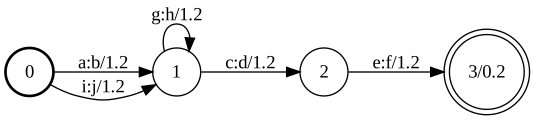
Overview
For a basic example see the section below.
Some simple and commonly encountered types of FSTs can be easily
created with the macro [fst] or the functions
acceptor and
transducer.
For more complex cases you will likely start with the
VectorFst type, which will be imported
in the [prelude] along with most everything else you need.
VectorFst<TropicalWeight> corresponds
directly to the OpenFST StdVectorFst, and can be used to load
its files using read or
read_text.
Because "iteration" over an FST can mean many different things,
there are a variety of different iterators. To iterate over state
IDs you may use
states_iter, while to
iterate over transitions out of a state, you may use
get_trs. Since it is common to
iterate over both, this can be done using
fst_iter or
fst_into_iter. It
is also very common to iterate over paths accepted by an FST,
which can be done with
paths_iter, and as a convenience
for generating text,
string_paths_iter.
Alternately, in the case of a linear FST, you may retrieve the
only possible path with
decode_linear_fst.
Note that iterating over paths is not the same thing as finding
the shortest path or paths, which is done with
shortest_path (for a single path)
or
shortest_path_with_config
(for N-shortest paths).
For the complete list of algorithms, see the [algorithms] module.
You may now be wondering, especially if you have previously used
such linguist-friendly tools as
pyfoma, "what if I just want
to transduce some text???" The unfriendly answer is that
rustfst is a somewhat lower-level library, designed for
implementing things like speech recognizers. The somewhat more
helpful answer is that you would do this by constructing an
acceptor for your input, which you will
compose with a
transducer, then
project the result to itsoutput, and finally
iterate over the paths in
the resulting FST.
References
Implementation heavily inspired from Mehryar Mohri's, Cyril Allauzen's and Michael Riley's work :
- Weighted automata algorithms
- The design principles of a weighted finite-state transducer library
- OpenFst: A general and efficient weighted finite-state transducer library
- Weighted finite-state transducers in speech recognition
The API closely resembles that of OpenFST, with some
simplifications and changes to make it more idiomatic in Rust, notably
the use of Tr instead of Arc. See Differences fromOpenFST for more information.
Example
use anyhow::Result;
use rustfst::prelude::*;
use rustfst::algorithms::determinize::{DeterminizeType, determinize};
use rustfst::algorithms::rm_epsilon::rm_epsilon;

fn main() -> Result<()> {
    // Creates a empty wFST
    let mut fst = VectorFst::<TropicalWeight>::new();

    // Add some states
    let s0 = fst.add_state();
    let s1 = fst.add_state();
    let s2 = fst.add_state();

    // Set s0 as the start state
    fst.set_start(s0)?;

    // Add a transition from s0 to s1
    fst.add_tr(s0, Tr::new(3, 5, 10.0, s1))?;

    // Add a transition from s0 to s2
    fst.add_tr(s0, Tr::new(5, 7, 18.0, s2))?;

    // Set s1 and s2 as final states
    fst.set_final(s1, 31.0)?;
    fst.set_final(s2, 45.0)?;

    // Iter over all the paths in the wFST
    for p in fst.paths_iter() {
         println!("{:?}", p);
    }

    // A lot of operations are available to modify/optimize the FST.
    // Here are a few examples :

    // - Remove useless states.
    connect(&mut fst)?;

    // - Optimize the FST by merging states with the same behaviour.
    minimize(&mut fst)?;

    // - Copy all the input labels in the output.
    project(&mut fst, ProjectType::ProjectInput);

    // - Remove epsilon transitions.
    rm_epsilon(&mut fst)?;

    // - Compute an equivalent FST but deterministic.
    fst = determinize(&fst)?;

    Ok(())
}
Differences from OpenFST
Here is a non-exhaustive list of ways in which Rustfst's API differs from OpenFST:
- The default epsilon symbol is
<eps>and not<epsilon>. - Functions and methods follow Rust naming conventions,
e.g.
add_staterather thanAddState, but are otherwise mostly equivalent, except that: - Transitions are called
Trand notArc, becauseArchas a rather different and well-established meaning in Rust, and rustfst uses it (std::sync::Arc, that is) to reference-count symbol tables. All associated functions also usetr. - Final states are not indicated by a final weight of
zero. You can test for finality usingis_final, andfinal_weightreturns an [Option]. This requires some care when converting OpenFST code. - Transitions can be accessed directly as a slice rather than requiring an iterator.
- Semiring operations are expressed as plain old methods rather
than strange C++ things. So write
w1.plus(w2)rather thanPlus(w1, w2), for instance. - Weights have in-place operations for ⊕
(
plus_assign) and ⊗ (times_assign). - Most of the type aliases (which would be trait aliases in Rust) such
as
StdArc,StdFst, and so forth, are missing, but type inference allows us to avoid explicit type arguments in most cases, such as when calling [Tr::new], for instance. - State IDs are unsigned, with [
NO_STATE_ID] used for a missing value. They are also 32 bits by default (presumably, 4 billion states is enough for most applications). This means you must take care to cast them to [usize] when using them as indices, and vice-versa, preferably checking for overflows - Symbol IDs are also unsigned and 32-bits, with [
NO_LABEL] used for a missing value. - Floating-point weights are not generic, so are always single-precision.
Benchmark with OpenFST
I did a benchmark some time ago on almost every linear fst algorithm and compared the results with OpenFst. You can find the results here :
Spoiler alert: Rustfst is faster on all those algorithms 😅
Documentation
The documentation of the last released version is available here : https://docs.rs/rustfst
Release process
- Use the script
update_version.shto update the version of every package. - Push
- Push a new tag with the prefix
rustfst-v
Example :
./update_version.sh 0.9.1-alpha.6
git commit -am "Release 0.9.1-alpha.6"
git push
git tag -a rustfst-v0.9.1-alpha.6 -m "Release rustfst 0.9.1-alpha.6"
git push --tags
Optionally, if this is a major release, create a GitHub release in the UI.
Projects contained in this repository
This repository contains two main projects:
rustfstis the Rust re-implementation.rustfst-pythonis the python binding ofrustfst.
License
Licensed under either of
- Apache License, Version 2.0 (LICENSE-APACHE or http://www.apache.org/licenses/LICENSE-2.0)
- MIT license (LICENSE-MIT) or http://opensource.org/licenses/MIT)
at your option.
Contribution
Unless you explicitly state otherwise, any contribution intentionally submitted for inclusion in the work by you, as defined in the Apache-2.0 license, shall be dual licensed as above, without any additional terms or conditions.
Compatibility
- Runs on
- GPU support unknown
What shows it
- no dependency or feature matches a backend row
- Native code
- None found
- No native code found
- Python bindings
- No Python binding crate found
- License
- Apache-2.0 OR MIT
Compare with similar projects
Order: strongest tier first, then most downloads, then name, with unmeasured values last. A library counts downloads over 30 days. An app counts binary downloads per release. An app with none counts its crate downloads over 30 days. ML Rust runs this catalogue, so its closest project always gets a row.
| Project | Downloads | Dependents | Stars | Latest release | Runs on (GPU) | Native code | License |
|---|---|---|---|---|---|---|---|
|
Library for constructing, combining, optimizing, and searching weighted finite-state transducers (FSTs). |
24,531 downloads over 30 days | 10 | 192 | 1.3.1 | GPU support unknown | No native code found | Apache-2.0 OR MIT |
|
text-processing-rs Listed
Inverse Text Normalization (ITN) — convert spoken-form ASR output to written form |
3,608 downloads over 30 days | 2 | 48 | 0.2.2 | GPU support unknown | No native code found | Apache-2.0 |
|
any-tts Listed
A Rust TTS library with Candle backends and runtime adapters for modern open TTS models |
3,404 downloads over 30 days | 2 | 23 | 0.2.0 | CUDA, Metal | No native code found | Apache-2.0 OR MIT |
|
Voice for the Linux desktop: dictation, read-aloud (TTS), and voice-driven LLM commands, with Groq, OpenAI, Deepgram, and local Whisper backends |
61 binary downloads per release | Not applicable | 149 | 0.2.0 | CUDA, Vulkan | Binds native code: alsa-sys, mac-notification-sys, wayland-sys (feature overlay), whisper-rs-sys (feature local-whisper) | MIT |
|
cohere-transcribe-rs Listed
Rust implementation for the CohereLabs/cohere-transcribe-03-2026 speech-to-text model. Includes a CLI and an OpenAI-compatible API server. |
0 downloads over 30 days | 0 | 101 | 0.1.1 | CUDA | Binds native code: torch-sys (feature tch-backend). Build uses a native toolchain: cmake | Apache-2.0 |
|
voxr New
Audio and speech on boostr: compressed-audio decode, resampling, DSP and grapheme to phoneme, with speech synthesis (Kokoro, VITS), voice cloning (VoxCPM2), transcription with word timings (Whisper), voice activity (Silero) and audio-text scoring (CLAP), on CPU or CUDA. |
642 downloads over 30 days | 2 | 2 | 0.9.1 | CUDA | No native code found | Apache-2.0 |
|
sherpa-rs Archived
Rust bindings to https://github.com/k2-fsa/sherpa-onnx |
9,888 downloads over 30 days | 4 | 313 | 0.6.8 | CUDA | Binds native code: sherpa-rs-sys. Build uses a native toolchain: bindgen, cmake | MIT |
All projects in Speech and audioAll projects in Text, embeddings and search
Why ListedNo archive, New or Featured rule places it, so it is Listed.
What it lacks for Featured
- It has 5 active dependents and 4 new dependents in 365 days. Featured needs 11 active dependents or 9 new dependents in 365 days. The repository route reads 192 stars, 26 forks and 20 contributors. It needs 4,539 stars, 434 forks and 79 contributors together.
What else the check found
- The last activity is on 21 Apr 2026, 202 days ago. The rules expect an update within 365 days. Dormancy rule
Exact rules: Listed, Featured library. The check on applied thresholds version 9.
Every rule outcome, as the check records it
expected-interval: version 1.3.1 base 300, raised to the 365-day floor: E = 365 daysdormancy: last activity 2026-04-21, 202 days ago, E = 365: activefeatured: not featured: active_users 5 < 11 and new_adopters 4 < 9 and repository route stars 192 (needs 4539), forks 26 (needs 434), contributors 20 (needs 79)listed: listed: no archive, new or featured rule applies
Crates2 crates
- rustfst Primary
- rustfst-ffi
Measurements and sources
Each signal row shows the raw value, its source and the fetch date. The Sources list gathers every distinct source on this page. Movement needs more history.
Sources6 sources
- Description: the crates.io description
- crates.io database dump, fetched
- RustSec advisory database, fetched
- GitHub repository, fetched
- crates.io package, fetched
- GitHub contributors, fetched
Adoption5 active dependents, 4 new dependents in 365 days1 not measured
| Signal | Value | Source | Fetched | Counts |
|---|---|---|---|---|
| Active dependents | 5 | crates.io database dump | Yes | |
| New dependents (365 days) | 4 | crates.io database dump | Yes | |
| Peak active dependents | 4.5 | crates.io database dump | Yes | |
| Active dependents as a share of the peak | 1 | crates.io database dump | Yes | |
| Binary downloads per release | Not measured | Yes |
MaintenanceLatest human commit: 6 months ago3 not measured
| Signal | Value | Source | Fetched | Counts |
|---|---|---|---|---|
| Latest human commit | 2026-04-21 | GitHub repository | Yes | |
| Latest release | 2026-04-21 | crates.io database dump | Yes | |
| First release | 2018-10-22 | crates.io database dump | Yes | |
| Latest version | 1.3.1 | crates.io database dump | Yes | |
| Days the oldest outside issue waits for a reply | 2119 | GitHub repository | Yes | |
| Maintainer replies over 365 days | 7 | GitHub repository | Yes | |
| Repository archived | false | GitHub repository | Yes | |
| Repository gone | false | GitHub repository | Yes | |
| Release commit or manifest in the repo | true | crates.io package | Yes | |
| Published docs | true | crates.io database dump | Yes | |
| Latest release fails cargo check | Not measured | Yes | ||
| Build check date | Not measured | Yes | ||
| Build check toolchain | Not measured | Yes |
SecurityUnpatched vulnerabilities: none
| Signal | Value | Source | Fetched | Counts |
|---|---|---|---|---|
| Unpatched vulnerabilities past the grace window | none | RustSec advisory database | Yes | |
| RustSec unmaintained advisory | none | RustSec advisory database | Yes | |
| Deprecation notice | none | crates.io database dump | Yes | |
| Deprecated requirement | none | crates.io database dump | Yes |
Distribution59 releases, 24,531 downloads over 30 days5 not measured
| Signal | Value | Source | Fetched | Counts |
|---|---|---|---|---|
| Releases | 59 | crates.io database dump | Yes | |
| Downloads over 30 days | 24531 | crates.io database dump | Yes | |
| Binary downloads over the last 3 releases | Not measured | Yes | ||
| Homebrew installs on request over 365 days | Not measured | Yes | ||
| Repology repository families | Not measured | Yes | ||
| Docker pull growth over 90 days | Not measured | Yes | ||
| Docker pulls at the growth baseline | Not measured | Yes | ||
| Every version a prerelease | false | crates.io database dump | Yes | |
| Every version 0.0.x | false | crates.io database dump | Yes | |
| Every version yanked | false | crates.io database dump | Yes | |
| Crate deleted from crates.io | false | crates.io database dump | Yes |
Repository192 stars, 26 forks, 20 contributors, 1,874 commits. Stars alone never qualify a project.
| Signal | Value | Source | Fetched | Counts |
|---|---|---|---|---|
| GitHub stars | 192 | GitHub repository | Yes — one part of the repository route | |
| GitHub forks | 26 | GitHub repository | Yes — one part of the repository route | |
| Contributors with a GitHub account | 20 | GitHub contributors | Yes — one part of the repository route | |
| Commits on the default branch | 1874 | GitHub repository | No | |
| Repository's main crate left out of the entry | none | crates.io database dump | Yes |
Facts that never count
| Signal | Value | Source | Fetched | Counts |
|---|---|---|---|---|
| License | Apache-2.0 OR MIT | crates.io database dump | No | |
| Runs on, from listed crates and their direct dependencies | GPU support unknown | crates.io database dump | No | |
| What shows each backend | no dependency or feature matches a backend row | crates.io database dump | No | |
| Native code, from listed crates and their dependencies | No native code found | crates.io database dump | No | |
| Python bindings, from direct dependencies of listed crates | No Python binding crate found | crates.io database dump | No | |
| Crates that depend on a listed crate directly | 10 | crates.io database dump | No |
Corrections and review history
No correction applies to this entry.
Judgments
A judgment enters only through an approved issue and a merged pull request.
No judgment applies to this entry.