pmetal
Library Listed
High-performance LLM fine-tuning framework for Apple Silicon
- Downloads
- 13
- Dependents
- 0
- Stars
- 332
- Forks
- 27
- Contributors
- 3
- Commits
- 1,971
- Latest release
- 0.7.0 ·
About
Powdered Metal: fine-tuning, inference and serving for Apple Silicon, written in Rust.
PMetal trains and runs large language models on the Mac's GPU and Neural Engine, with no Python or CUDA in the loop. One tensor runtime (MLX under it, PMetal's own Metal kernels beside it) sits under a command line, a terminal UI, a desktop app, an MCP server, Python bindings and a Rust SDK.
What sets it apart:
Read the full README
- One job spec for every surface. Each command's fields, defaults, ranges and checks are defined once in
pmetal-core; the CLI, TUI, GUI, MCP server and Python bindings are generated from it, so they cannot drift apart. - Fine-tuning with the full LoRA family. LoRA, QLoRA, DoRA, rsLoRA, LoRA+ and PiSSA/OLoRA/LoftQ initialisation, with one adapter per routed expert on MoE models and QLoRA on NVFP4 checkpoints (the base stays packed). Adapters are written in the PEFT layout and agree with PEFT to 4e-6 in logits both ways.
- Training adapts the model the server runs. LoRA attaches to the same module graph inference uses, and the architectures are checked against reference outputs from
transformers, so what you tune is what you serve. - Drafters trained on a Mac.
train-mtpandtrain-draftproduce MTP predictors and DFlash block-diffusion drafts;infer --mtp,infer --draft-modelanddflashuse them for exact speculative decoding (every drafted token is verified). - Packed weights stay packed. NVFP4, FP8 and MXFP4 checkpoints run in their stored form, MoE experts can be offloaded to SSD, and the KV cache can be TurboQuant-compressed to 2 to 4 bits.
- One server, both API families. OpenAI Chat Completions, Completions, Responses and Embeddings plus Anthropic Messages, with tool calls, grammar-constrained JSON-schema output, vision input and continuous batching.
- The Neural Engine, for training and inference. Whole-model inference on the ANE (with DFlash drafting), and an ANE training path.
- Quantization you can budget. GGUF output with importance matrices and KL-calibrated per-tensor types under a bits-per-weight target.
- Multi-Mac training. Thunderbolt-aware ring all-reduce with authenticated, encrypted links; ZeRO-1/2 optimizer sharding and DiLoCo are in the
pmetal-distributedlibrary.
Around that: GRPO, DAPO and GSPO; DPO, IPO, SimPO, ORPO and KTO; distillation; embedding-model training; pretraining; Hugging Face Hub search, download, upload and verification; model merging; and LoRA fusing.
Quick start
brew install epistates/tap/pmetal

pmetal train --model Qwen/Qwen3-0.6B --dataset train.jsonl --output ./output
pmetal infer --model Qwen/Qwen3-0.6B --lora ./output/adapter_model.safetensors \
  --prompt "Explain quantum entanglement" --chat
pmetal serve --model Qwen/Qwen3-0.6B --port 8080
train.jsonl holds chat messages, ShareGPT, Alpaca, prompt/completion or plain text rows; the format is detected from the columns (see Dataset formats). Models download from the Hugging Face Hub on first use. Other ways to install are under Installation.
Use PMetal your way
Command line
# Fine-tune with LoRA (sequence packing and gradient checkpointing are on by default)
pmetal train --model Qwen/Qwen3-0.6B --dataset train.jsonl --output ./output \
  --lora-r 16 --batch-size 4 --learning-rate 2e-4

# QLoRA: the base model is packed to NF4 on the GPU
pmetal train --model Qwen/Qwen3-0.6B --dataset train.jsonl --quantization nf4

# Preference tuning, GRPO and distillation
pmetal preference --model Qwen/Qwen3-0.6B --dataset pairs.jsonl --loss dpo
pmetal grpo --model Qwen/Qwen3-0.6B --dataset reasoning.jsonl --reasoning-rewards
pmetal distill --teacher Qwen/Qwen3-4B --student Qwen/Qwen3.5-0.8B-Base --dataset train.jsonl

# Search the Hub with a fit estimate for this Mac, then merge, fuse and quantize
pmetal search "qwen 0.6b" --detailed
pmetal merge --model-a model-a --model-b model-b --method slerp --t 0.5 --output merged
pmetal fuse --model Qwen/Qwen3-0.6B --lora ./output/adapter_model.safetensors --output ./fused
pmetal quantize --model ./fused --output model.gguf --method q4_k_m

# Perplexity on a dataset, and a benchmark
pmetal eval --model Qwen/Qwen3-0.6B --dataset eval.jsonl
pmetal eval --model Qwen/Qwen3-0.6B --task gsm8k --limit 50
Speculative decoding with a Qwen3.6 checkpoint that bundles its own multi-token-prediction head, and with a predictor you trained yourself:
pmetal infer --model Qwen/Qwen3.6-35B-A3B --mtp --prompt "Explain monotonic queues."

pmetal tokenize --input train.jsonl --output ./tok --tokenizer Qwen/Qwen3.6-35B-A3B
pmetal train-mtp --model Qwen/Qwen3.6-35B-A3B --family qwen3-next \
  --shards ./tok/shard_00000.bin --output ./qwen-mtp
pmetal infer --model Qwen/Qwen3.6-35B-A3B --mtp --mtp-model ./qwen-mtp --prompt "Explain monotonic queues."
pmetal <command> --help lists every option; each command is documented under docs/cli/.
| Command | Description |
|---|---|
train | LoRA/QLoRA/DoRA fine-tuning (SFT); --full trains every weight and saves a whole model; --ane trains on the Neural Engine |
train-mtp | Train a Gemma 4 assistant or a Qwen3Next/Qwen3.6 MTP predictor for speculative decoding |
train-draft | Train a DFlash block-diffusion draft checkpoint |
train-diffusion | LoRA/QLoRA fine-tune a DiffusionGemma block-diffusion model |
pretrain | Pretrain from scratch (full-parameter, no LoRA) on tokenized shards |
preference | DPO, Robust DPO, IPO, hinge, SimPO, ORPO or KTO with LoRA (alias dpo) |
grpo | GRPO, DAPO, Dr. GRPO and GSPO reasoning training (VLM, reward models, reward commands, verifiers, async rewards) |
rlkd | GRPO with a distillation term from a teacher |
distill | Knowledge distillation (online, offline, progressive) |
embed-train | Sentence-embedding fine-tuning (InfoNCE, triplet, CoSENT) |
infer | Generation with chat, tools, thinking mode, images and video, speculative decoding |
decide | Typed decisions from a Clef decision model in one forward pass |
serve | OpenAI- and Anthropic-compatible server |
dflash | Block-diffusion speculative decoding |
search, download, upload, verify | Hugging Face Hub search with device fit, download, publish, integrity check |
merge, fuse, quantize | Model merging, LoRA fusing, GGUF and MLX quantization |
imatrix | Measure an importance matrix on calibration data, for quantize --imatrix |
eval | Perplexity on a dataset, or a benchmark: GSM8K, MMLU, ARC, HellaSwag, IFEval subset, your own |
dataset, tokenize | Dataset analysis, conversion and preparation; pretraining shards |
vocode | Mel spectrogram to waveform with a BigVGAN vocoder |
ollama | Modelfile generation for Ollama |
tui, dashboard | The terminal UI; dashboard opens it on the Monitor tab |
mcp | MCP server over stdio (57 tools) |
cluster | Multi-Mac cluster: keys, discovery, status, benchmarks |
info, memory, init, completions | Device report, memory report, sample training config, shell completions |
bench, bench-gen, bench-workload, bench-corpus, bench-gdn | Training, generation, workload and kernel benchmarks |
pack-experts | Pack MoE expert weights for SSD-offloaded inference |
serve and mcp are in the prebuilt binary and the Homebrew formula; if you build from source, add --features serve,mcp.
Terminal UI
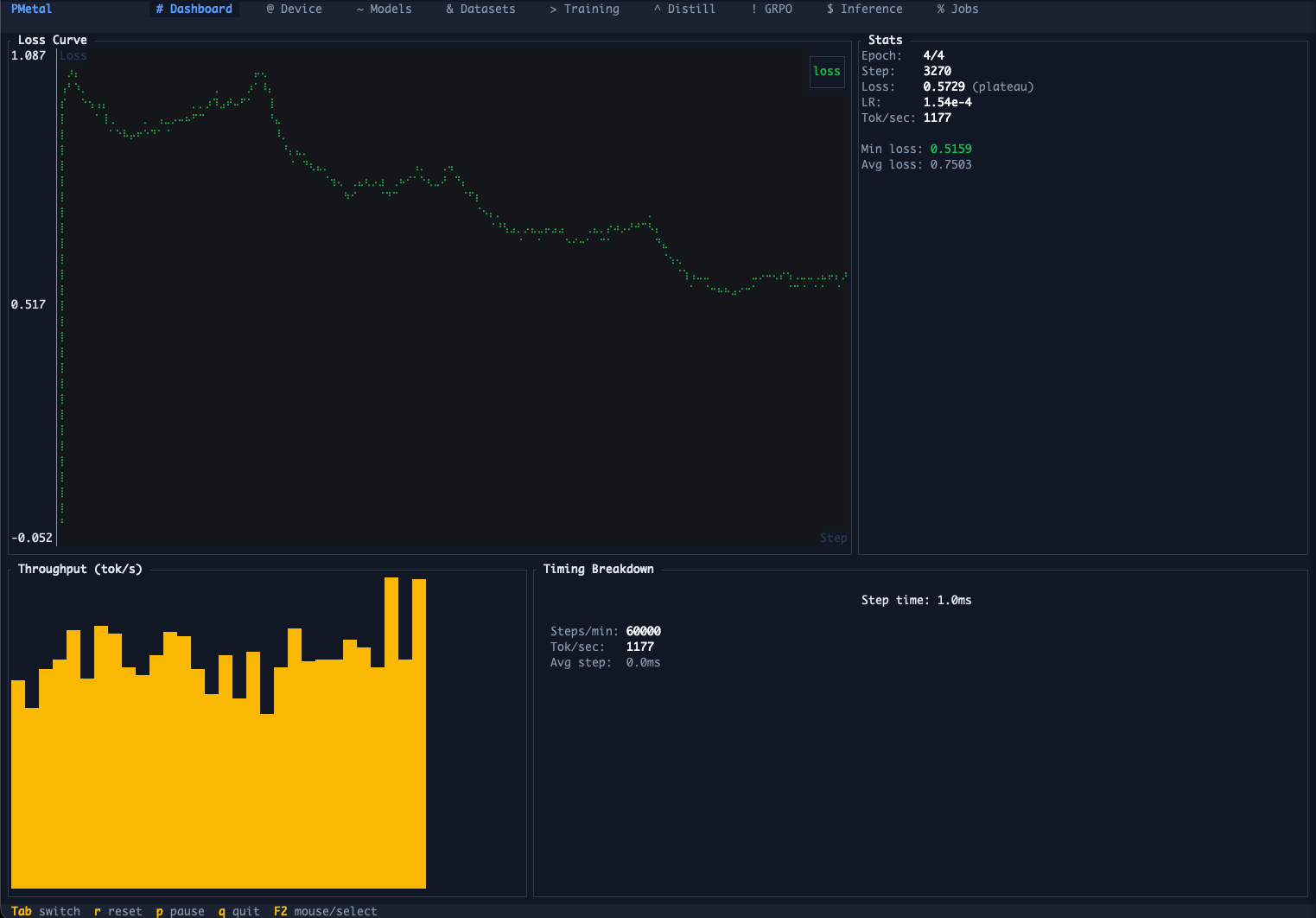
pmetal tui
21 tabs. Every job tab is a form built from the command's job spec; S shows the exact pmetal command and starts it as a supervised child process with a scrollable log, and quitting stops what you started.
| Tab | Description |
|---|---|
| System | GPU and Neural Engine info, Metal features, memory against the device's working-set limit, UltraFusion topology |
| Models | Cached and local models with a fit estimate for this Mac; Hub search (S), download, fuse |
| Datasets | Local datasets (JSONL, Parquet, Arrow, CSV) with format readiness and a preview; convert to pmetal JSONL |
| Tokenize, Pretrain | Build pretraining shards; pretrain from scratch |
| Training, EmbedTrain, Distill, RLKD, GRPO, Preference | The training commands (L changes the learning rate of a running job) |
| Monitor | Live loss, learning rate, throughput and timing of a running or recorded run |
| Inference | Chat with a generation-settings sidebar |
| DFlash, Serve | Speculative decoding; the OpenAI-compatible server |
| Quantize, Merge, Bench, Eval, Modelfile | Model operations, benchmarks, Ollama Modelfiles |
| Jobs | Jobs from this session and finished runs found on disk, with logs |
Ctrl+P jumps to any tab, Tab/Shift+Tab cycle, Alt+1..Alt+9 pick one of the first nine, ? lists the keys of the current tab. See docs/cli/tui.md.
Desktop app
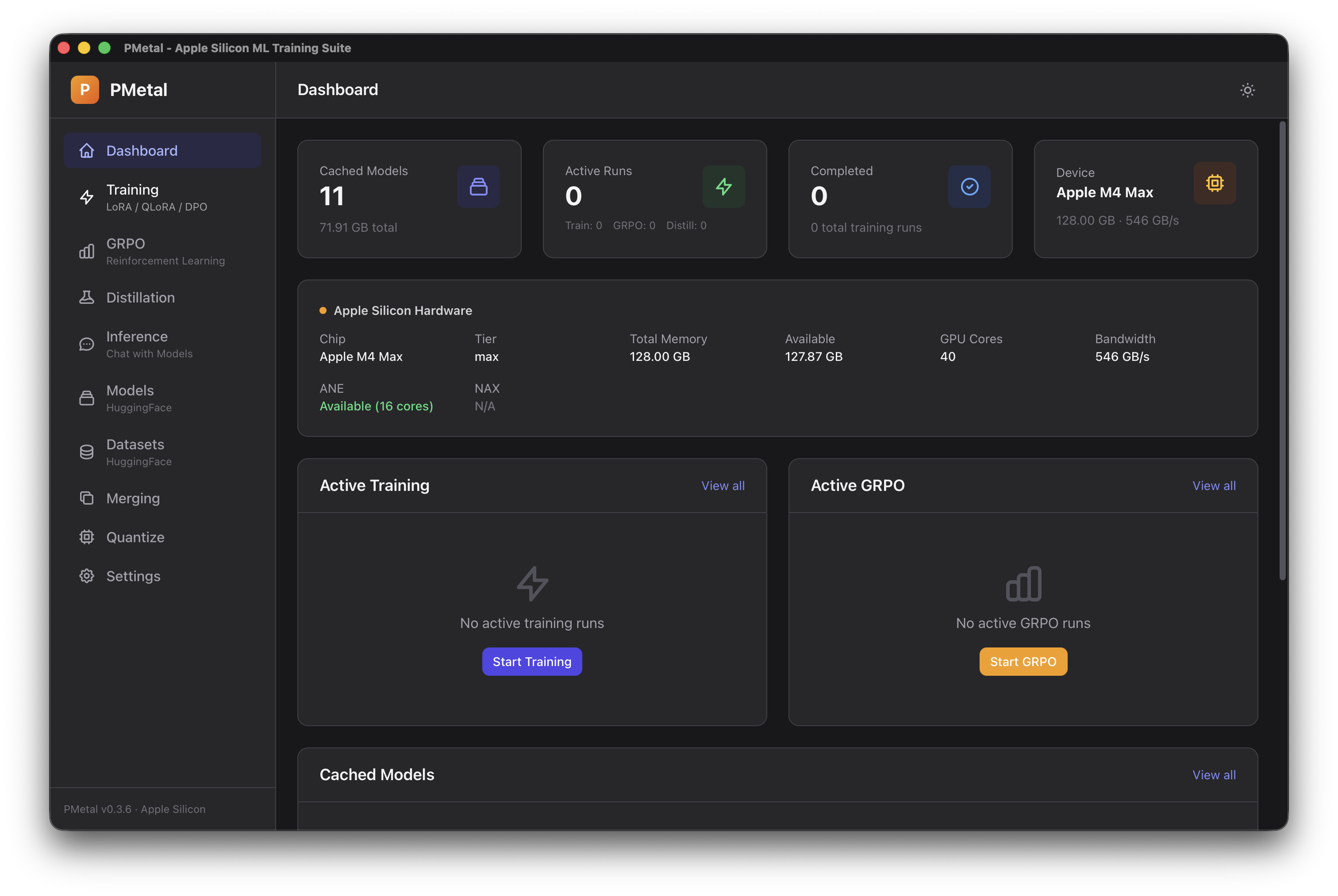
A Tauri + Svelte app. Every pmetal command has a form drawn from its job spec, so the app cannot drift from the command line. Pages: Dashboard, Jobs, Train, Run (chat, server, DFlash), Models and Datasets (local and Hub), Tools (merge, fuse, quantize, Modelfile, pack experts), Measure (perplexity, benchmarks), Advanced and Settings.
Jobs run as pmetal processes under the shared job supervisor (the app bundles the CLI), carry on while you use other pages and are stopped when you quit. A Hugging Face token is kept in the macOS Keychain. Download the app from the Releases page, or run it from source:
cd crates/pmetal-gui && bun install && bun tauri dev
MCP server
pmetal mcp exposes 57 tools over stdio for Claude Desktop, Claude Code and other MCP clients: training, inference, model and dataset operations, device information and job control, with read-only resources and prompts. The tools are generated from the same job specs. See docs/cli/mcp.md.
Python
PyO3 bindings, one abi3 wheel for CPython 3.11 and later (macOS 14+, Apple Silicon). Every pmetal command is a typed spec class (TrainSpec, GrpoSpec, MergeSpec, ...) with the command line's fields, defaults and checks.
import pmetal

# Fine-tune in this process (releases the GIL; Ctrl-C stops after the step and keeps the weights)
spec = pmetal.TrainSpec(model="Qwen/Qwen3-0.6B", dataset="train.jsonl", epochs=3, lora_r=16)
result = pmetal.Trainer(spec, callbacks=[pmetal.LoggingCallback(10)]).train()
print(result.final_loss, result.total_steps, result.weights_path)

# Any other command, as the command line runs it
pmetal.run(pmetal.MergeSpec(model_a="a", model_b="b", output="merged"))

# Inference
model = pmetal.Model.load("Qwen/Qwen3-0.6B")
print(model.generate("The capital of France is", max_tokens=16, temperature=0.0))
print(pmetal.infer("Qwen/Qwen3-0.6B", "What is 2+2?", chat=True, no_thinking=True))
See crates/pmetal-py/README.md and docs/python/.
Rust SDK
pmetal re-exports every sub-crate behind a feature flag, so one dependency gets you the framework. orchestrator::run_training is the one-call entry point the CLI itself uses:
use pmetal::trainer::orchestrator::{TrainingJobConfig, run_training};

let config = TrainingJobConfig {
    model_id: "Qwen/Qwen3-0.6B".to_string(),
    dataset: "train.jsonl".to_string(),
    output_dir: "./output".to_string(),
    ..Default::default()
};

let result = run_training(config, None, Vec::new()).await?;
println!("final loss {:.4} over {} steps", result.final_loss, result.total_steps);
Inference goes through the model dispatcher:
use pmetal::models::generate;
use pmetal::prelude::*;

let model_dir = pmetal::hub::resolve_model_path("Qwen/Qwen3-0.6B", None, None).await?;
let mut model = DynamicModel::load(&model_dir)?;
let tokenizer = Tokenizer::from_model_dir(&model_dir)?;

let input_ids = tokenizer.encode_with_special_tokens("What is 2+2?")?;
let output = generate(
    |input| model.forward(input, None),
    &input_ids,
    GenerationConfig::sampling(256, 0.7),
)?;
println!("{}", tokenizer.decode(&output.token_ids[input_ids.len()..])?);
For step-by-step control use the crates directly (pmetal_trainer::TrainingLoop, pmetal_models::DynamicModel, pmetal_lora::DynamicLoraModel, pmetal_distill::Distiller). Every code block in each crate's README is compiled as a doctest. See crates/pmetal/examples/ and docs/sdk/advanced.md.
Supported models
Language models
Loaded from the Hugging Face Hub or a local directory; the architecture is detected from config.json. All of them work with the CLI, TUI, GUI, server and SDK. A model_type that is not listed is refused by name and never run as a similar family (see Not supported yet).
| Family | Variants | model_type values |
|---|---|---|
| Llama | 2, 3, 3.1, 3.2, 3.3 | llama, llama3 |
| Llama 4 | Scout, Maverick | llama4, llama4_text |
| Llama 3.2 Vision | 11B, 90B (image input) | mllama, mllama_text_model |
| Qwen 2 / 2.5 | dense | qwen2, qwen2_5 |
| Qwen 3 | dense | qwen3 |
| Qwen 3 MoE | e.g. Qwen3-30B-A3B | qwen3_moe |
| Qwen 3.5 / 3.6 / 3.8 | hybrid Gated DeltaNet, dense and MoE (image and video input) | qwen3_next, qwen3_5, qwen3_5_moe, qwen3_6, qwen3_6_moe |
| Qwen 3.8 Flash Next | text tower | qwen4_exp |
| DeepSeek | V2, V3, R1 (V3.2 and V4 are refused by name: the sparse-attention indexer is not implemented) | deepseek_v2, deepseek_v3 |
| Mistral | 7B and the other dense Mistral decoders (Mixtral and the Mistral3 vision wrapper are refused by name) | mistral |
| Gemma | 1, 2, 3 | gemma, gemma2, gemma3 |
| Gemma 4 | dense and MoE | gemma4, gemma4_text |
| DiffusionGemma | dense, MoE | diffusion_gemma, diffusion_gemma_text |
| Phi | Phi-3, Phi-3.5, Phi-4 | phi3, phi4 |
| Cohere | Command R | cohere, cohere2, command_r |
| Granite | 3.x (including MoE), 4.0, 4.0-H | granite, granitemoe, granitemoeshared, granitemoehybrid |
| Nemotron-H, Nemotron 3 | hybrid Mamba-2 and attention (Nemotron 3 Nano and Super, Nemotron-H 4B to 12B) | nemotron_h |
| GPT-OSS | 20B, 120B (MXFP4 checkpoints run packed) | gpt_oss |
| Clef | decision models (pmetal decide, /v1/systemone) | Qwen3.5-family backbones |
Quantized checkpoints load packed: MLX-quantized (affine, mxfp4, nvfp4, mxfp8), NVIDIA ModelOpt NVFP4 and FP8, and gpt-oss MXFP4.
Encoders: BERT, RoBERTa, XLM-RoBERTa, CamemBERT, DistilBERT and ModernBERT (bert, roberta, xlm-roberta, xlm_roberta, camembert, distilbert, modernbert) run for embeddings (/v1/embeddings) and train with pmetal embed-train.
Diffusion: pipelines::FluxPipeline loads a diffusers-layout FLUX.1 directory (1-dev, 1-schnell) from pmetal-models; it has no tokenizer or CLI command yet.
Fine-tuning: LoRA and QLoRA (--quantization nf4|fp4|int8) apply to every architecture the dispatcher loads, with sequence packing, gradient checkpointing and the fused optimizer. The LM head, MoE routers and routed experts stay as loaded; LoRA adapts the routed experts of Qwen3-MoE, DeepSeek and Nemotron-H one adapter per expert. Adapters are written in the PEFT layout. DiffusionGemma trains through train-diffusion.
Speculative decoding (exact: every drafted token is verified, so output quality does not change):
- Gemma 4 MTP assistant checkpoints (
gemma4_assistant) draft for a Gemma 4 target withinfer --draft-model. - Qwen3Next/Qwen3.6 checkpoints with bundled
mtp.*weights (or a predictor fromtrain-mtp) useinfer --mtp; sampling controls carry through, and acceptance metrics are printed. LoRA and packed expert offload are separate modes: fuse the adapter first to combine them. - DFlash drafts (including DFlash 2) run with
pmetal dflashon a Qwen target, or withinfer --ane --draft-modelfor a model on the Neural Engine.train-draftmakes custom drafts.
Training methods
Every method below is a command with the same form in the CLI, TUI, GUI, MCP server and Python (the TUI has tabs for the ones in its list above).
| Method | Command | Library |
|---|---|---|
| SFT, LoRA, QLoRA, DoRA, rsLoRA, LoRA+ | train (--quantization, --dora, --rslora) | orchestrator::run_training() |
| DPO, Robust DPO, IPO, hinge | preference --loss dpo|ipo|hinge | PreferenceTrainer |
| SimPO, ORPO | preference --loss simpo|orpo | PreferenceTrainer |
| KTO | preference --loss kto | KtoTrainer |
| GRPO, DAPO | grpo (--dapo, --loss-type) | GrpoTrainer |
| Dr. GRPO, GSPO | grpo --loss-type dr_grpo|gspo | GrpoConfig::for_dr_grpo, for_gspo |
| Knowledge distillation | distill | Distiller |
| TAID | not wired to a command | TaidDistiller |
| RLKD (GRPO plus distillation) | rlkd | RlkdTrainer |
| Embedding models | embed-train | EmbeddingTrainer |
| Pretraining | pretrain (with --document-mask) | pmetal_trainer |
| Block diffusion (DiffusionGemma) | train-diffusion | DiffusionGemmaTrainer |
| MTP and DFlash draft training | train-mtp, train-draft | pmetal_trainer::mtp_training |
| Neural Engine training | train --ane (experimental) | AneTrainingLoop |
Common to the training commands: optimizers adamw, sgd, lion, adafactor, muon, adamw_schedule_free and adamw_8bit; schedules cosine, linear, constant, cosine_with_restarts, polynomial and wsd; adaptive learning-rate control, best-loss checkpoint rollback, --resume that restores the optimizer, label smoothing, z-loss and NEFTune, --cut-cross-entropy, and live learning-rate steering from the TUI, GUI and MCP server. A training config can also be given as YAML (pmetal init writes a sample; see docs/configuration/config-file.md). Details: docs/training/.
Notable technology
- Own tensor runtime (
pmetal-runtime): arrays, autodiff, compiled graphs, native inference engines and custom Metal kernels, with MLX as the backend. Dense attention, RoPE, SwiGLU, LoRA and GEMM run as runtime ops; custom kernels cover what the runtime has no op for (fused Gated DeltaNet recurrence, fused AdamW, the Neural Engine's weight-gradient GEMM). - TurboQuant KV cache (
infer --kv-turboquant, native Qwen3, Qwen3.5 and Llama 4 engines): rotated, Lloyd-Max-quantized keys and values stored bit-packed, 1 to 8 bits per coordinate, with decode attending straight from the packed cache. At head dimension 128 that is 3.8x smaller than bf16 at 4 bits, 4.9x at 3 bits and 7.1x at 2 bits. Sinks and a recent window stay exact; each KV head's keys are centred and scaled from the first tokens the cache sees. On Qwen3-0.6B text this keeps 4-bit keys and values within 0.3% perplexity of bf16 and 3-bit within 2.3%. - Neural Engine: training kernels compiled once, with weights packed beside activations in IOSurfaces; inference with the whole model on the ANE, several layers per program over a KV cache in IOSurfaces, int8 weights by default (
infer --ane,serve --ane). - Server:
/v1/chat/completions,/v1/completions,/v1/responses,/v1/embeddings,/v1/messages(with/v1/messages/count_tokens) and/v1/models, with streaming, tool calls parsed per model family, JSON-schema andtool_choiceenforced by constrained decoding,logit_bias, logprobs (the prompt's too, withecho, for loglikelihood evaluation),reasoning_content, images and videos (Qwen3.5 family, Llama 3.2 Vision), prefix caching,--continuous-batch, speculative decoding on the GPU (--mtp,--draft-model: the model's own tokens, sooner), Prometheus metrics at/metrics, optional API keys and CORS origins. Seecrates/pmetal-serve/README.md. - Datasets: JSONL, JSON, Parquet, Arrow and CSV, or a directory of shards; messages, ShareGPT, Alpaca, prompt/completion, reasoning and plain-text rows are detected automatically.
pmetal datasetanalyzes, converts, filters, splits and prepares them. - Merging: 18 strategies in the library (14 on the command line: linear, SLERP, TIES, DARE, DELLA, task arithmetic, Breadcrumbs, Model Stock, consensus, Multi-SLERP, nearswap, passthrough and variants), streamed tensor by tensor from memory-mapped checkpoints, with FP8 inputs, layer slices and reproducible masks. See
docs/models/merging.md. - Quantization: GGUF (26 methods including K-quants, IQ4_NL and IQ4_XS, ternary, MXFP4 and NVFP4, with importance matrices measured by
pmetal imatrixor on the fly with--calibration-dataset, and KL-calibrated--kl-calibrate --target-bpw) and MLX-format output. Seedocs/models/quantization.md. - Distillation: online, offline (compressed top-k, int8/int4 or sampled logit caches) and progressive; KL, reverse KL, Jensen-Shannon, skew KL, soft cross-entropy, MSE and cross-vocabulary universal-logit losses; rationale distillation; on-policy generation. See
docs/training/distillation.md.
Multi-Mac cluster
Connect two or more Apple Silicon Macs for data-parallel training. PMetal enumerates every network interface, advertises over mDNS and forms a ring biased toward the fastest fabric: Thunderbolt over Ethernet over Wi-Fi, without configuration. Links between ranks are authenticated and encrypted with a shared cluster secret, so every Mac needs the same one.
# Once, on one Mac; copy ~/.pmetal/cluster_secret (mode 600) to every other Mac
pmetal cluster keygen

# On every Mac
pmetal cluster status        # local interfaces and any peers already announcing
pmetal cluster up            # join the cluster and hold the connection open
pmetal cluster bench --mb 64 --iters 10                 # all-reduce throughput per fabric
pmetal cluster pipeline-bench --tokens 16 --layers 32   # pipeline activation transport

# Distributed training: run the same command on each Mac at the same time
pmetal train --model Qwen/Qwen3-0.6B --dataset train.jsonl --distributed-auto
Wired today: gradient all-reduce for multi-machine training, fabric-aware ring formation with fallback when a cable is unplugged, gradient compression (--compression-strategy none|topk|fp16|random), and a transport-tested pipeline harness. Serving a model that does not fit on one Mac (per-architecture partial-layer execution) is not wired yet.
Hardware support
PMetal detects the Apple Silicon generation, tier, core counts, memory bandwidth and features at startup and tunes itself. Run pmetal info to see what it found.
| Chip family | GPU family | NAX | ANE | Status |
|---|---|---|---|---|
| M1 / Pro / Max / Ultra | Apple7 | - | yes | Supported |
| M2 / Pro / Max / Ultra | Apple8 | - | yes | Supported |
| M3 / Pro / Max / Ultra | Apple9 | - | yes | Supported |
| M4 / Pro / Max | Apple9 | - | yes | Supported |
| M5 and later | Apple10 | yes | yes | Supported |
macOS 14 (Sonoma) or later. NAX (the neural accelerators in M5-generation GPU cores) is used through MLX's NAX kernels on macOS 26.2 or later. An Ultra is treated as two Max dies joined by UltraFusion. Details: docs/hardware-support.md.
Installation
Homebrew (builds the CLI, TUI, server and MCP server from source against the pinned MLX):
brew install epistates/tap/pmetal
Prebuilt binary. Download the pmetal-<version>-aarch64-apple-darwin.tar.gz asset from the Releases page. It holds the pmetal binary and the mlx.metallib it was built with:
tar xzf pmetal-v0.7.1-aarch64-apple-darwin.tar.gz
sudo install -m 755 pmetal-v0.7.1-aarch64-apple-darwin /usr/local/bin/pmetal
pmetal --version
crates.io:
cargo install pmetal --features serve,mcp
serve and mcp are off by default so library users do not inherit axum and rmcp; leave them out if you only want the training CLI and TUI. Building needs the Xcode command line tools, the Metal toolchain (xcodebuild -downloadComponent MetalToolchain) and CMake (brew install cmake). MLX is linked statically, so the installed binary is self-contained.
From source:
git clone https://github.com/epistates/pmetal.git && cd pmetal
cargo build --release --features serve,mcp   # target/release/pmetal
The repository pins its toolchain in rust-toolchain.toml (rustup installs it on first use); the minimum supported Rust version for library users is 1.95.
Desktop app: download the DMG from the Releases page, or cd crates/pmetal-gui && bun install && bun tauri build.
Python: the wheel is built from this repository with maturin (it is not on PyPI yet):
cd crates/pmetal-py && pip install maturin && maturin develop --profile wheel
More detail, including GUI setup and troubleshooting: docs/installation.md.
Workspace
crates/
├── pmetal-runtime      # Tensor runtime: arrays, autodiff, native engines, optimizers, custom Metal kernels
├── pmetal-core         # Configs, traits, error handling, the job specs every surface shares
├── pmetal-core-derive  # Derive macro for the job specs
├── pmetal-metal        # Metal context, ANE runtime and kernels
├── pmetal-cache        # KV caches, prefix reuse, speculative-decoding state
├── pmetal-models       # Model architectures, dispatcher, speculative decoders
├── pmetal-lora         # LoRA/QLoRA as a property of Linear
├── pmetal-trainer      # Training loops (SFT, preference, GRPO, MTP, ...)
├── pmetal-data         # Datasets, chat templates, tokenization, image processing
├── pmetal-hub          # Hugging Face Hub client and model fit estimation
├── pmetal-distill      # Knowledge distillation (losses, offline caches, TAID)
├── pmetal-merge        # Model merging and LoRA fusing
├── pmetal-gguf         # GGUF reader, writer and quantization
├── pmetal-mhc          # Manifold-Constrained Hyper-Connections
├── pmetal-distributed  # Ring all-reduce, mDNS discovery, authenticated transport
├── pmetal-vocoder      # BigVGAN neural vocoder
├── pmetal-serve        # OpenAI- and Anthropic-compatible server
├── pmetal-supervisor   # Runs pmetal commands as supervised child processes
├── pmetal-mcp          # MCP server (57 tools)
├── pmetal-py           # Python bindings (maturin / PyO3)
├── pmetal              # Umbrella crate: the CLI, the TUI and re-exports of the rest
└── pmetal-gui          # Desktop app (Tauri + Svelte), its own workspace
Cargo features of the umbrella crate (defaults: cli, dashboard, trainer, lora, merge, vocoder, ane, distributed) are listed in docs/configuration/feature-flags.md.
Documentation
- Getting started and installation
- CLI reference: one page per command
- Training, models, Python and Rust SDK
- Configuration file and feature flags
- Hardware, contributing, security policy and the changelog
Development
just test         # workspace tests, single-threaded for Metal
just preflight    # everything CI runs
just kani-verify  # cargo-kani proofs for ring all-reduce and topology
License
Licensed under either of MIT or Apache-2.0, at your option. Third-party attributions are in THIRD_PARTY_NOTICES.
Acknowledgments
- MLX, Apple's array framework, which
pmetal-runtimeuses as its backend - Tauri, the desktop application framework
- The papers and reference implementations the individual features follow are cited where they are implemented; kernel techniques are attributed in THIRD_PARTY_NOTICES
Compatibility
- Runs on
- Metal
What shows it
- Metal: pmetal feature metal, pmetal-bridge feature metal, pmetal-metal dependency objc2-metal, pmetal-models dependency objc2-metal, pmetal-runtime feature metal
- Native code
- Required
- Binds native code: pmetal_bridge, pmetal_runtime, mach-sys, pmetal-mlx-sys
- Build uses a native toolchain: cc, cmake
- Python bindings
- Has Python bindings
- pmetal-py needs Python
- License
- Apache-2.0 OR MIT
Compare with similar projects
Order: strongest tier first, then most downloads, then name, with unmeasured values last. A library counts downloads over 30 days. An app counts binary downloads per release. An app with none counts its crate downloads over 30 days. ML Rust runs this catalogue, so its closest project always gets a row.
| Project | Downloads | Dependents | Stars | Latest release | Runs on (GPU) | Native code | License |
|---|---|---|---|---|---|---|---|
|
High-performance LLM fine-tuning framework for Apple Silicon Python bindings |
13 downloads over 30 days | 0 | 332 | 0.7.0 | Metal | Binds native code: pmetal_bridge, pmetal_runtime, mach-sys, pmetal-mlx-sys. Build uses a native toolchain: cc, cmake | Apache-2.0 OR MIT |
|
openvino-rs Listed
High-level bindings for OpenVINO. |
218,765 downloads over 30 days | 6 | 143 | 0.11.1 | GPU support unknown | Binds native code: openvino-genai-sys, openvino-sys, openvino_c_api, openvino_genai_c_api | Apache-2.0 |
|
orp Listed
Lightweight framework for building ONNX runtime pipelines with ort |
41,463 downloads over 30 days | 6 | 14 | 1.0.0 | CUDA, ROCm | Binds native code: ort-sys | Apache-2.0 |
|
llama-gguf Listed
A high-performance Rust implementation of llama.cpp - LLM inference engine with full GGUF support |
1,787 downloads over 30 days | 3 | 21 | 0.14.0 | CUDA, Metal, Vulkan | Binds native code: hailort-sys (feature hailo), libsqlite3-sys (feature rag-sqlite) | Apache-2.0 OR MIT |
|
Inference server for LLMs, speech and embeddings: OpenAI-compatible routes with streaming, plus speech synthesis (TTS) and transcription (ASR). Serves Llama, Mistral, Qwen, Mamba2, MLA+MoE and hybrid models from SafeTensors, AWQ, GPTQ and GGUF. |
8 binary downloads per release | Not applicable | 7 | 0.7.1 | CUDA, WebGPU | Binds native code: ring (feature distributed) | Apache-2.0 |
|
A high-performance ML model serving framework, offers dynamic batching and CPU/GPU pipelines to fully exploit your compute machine |
1 downloads over 30 days | Not applicable | 903 | 0.9.0 | GPU support unknown | No native code found | Apache-2.0 |
|
baseRT New
Safe Rust bindings for the BaseRT LLM inference engine (Apple Silicon) |
49 downloads over 30 days | 2 | 247 | 0.4.6 | GPU support unknown | Binds native code: baseRT, baseRT-sys | Apache-2.0 |
All projects in Run and serve modelsAll projects in Train models
Why ListedNo archive, New or Featured rule places it, so it is Listed.
What it lacks for Featured
- It has 0 active dependents and 0 new dependents in 365 days. Featured needs 11 active dependents or 9 new dependents in 365 days. The repository route reads 332 stars, 27 forks and 3 contributors. It needs 4,539 stars, 434 forks and 79 contributors together.
What else the check found
- The last activity is on 2 Nov 2026, 7 days ago. The rules expect an update within 365 days. Dormancy rule
Exact rules: Listed, Featured library. The check on applied thresholds version 9.
Every rule outcome, as the check records it
expected-interval: version 0.7.0 base 140, raised to the 365-day floor: E = 365 daysdormancy: last activity 2026-11-02, 7 days ago, E = 365: activefeatured: not featured: active_users 0 < 11 and new_adopters 0 < 9 and repository route stars 332 (needs 4539), forks 27 (needs 434), contributors 3 (needs 79)listed: listed: no archive, new or featured rule applies
Crates24 crates
- pmetal Primary
- pmetal-bridge
- pmetal-cache
- pmetal-cli
- pmetal-core
- pmetal-core-derive
- pmetal-data
- pmetal-distill
- pmetal-distributed
- pmetal-gguf
- pmetal-hub
- pmetal-lora
- pmetal-mcp
- pmetal-merge
- pmetal-metal
- pmetal-mhc
- pmetal-mlx
- pmetal-models
- pmetal-py
- pmetal-runtime
- pmetal-serve
- pmetal-supervisor
- pmetal-trainer
- pmetal-vocoder
Measurements and sources
Each signal row shows the raw value, its source and the fetch date. The Sources list gathers every distinct source on this page. Movement needs more history.
Sources6 sources
- Description: the crates.io description
- crates.io database dump, fetched
- RustSec advisory database, fetched
- GitHub repository, fetched
- crates.io package, fetched
- GitHub contributors, fetched
Adoption0 active dependents, 0 new dependents in 365 days1 not measured
| Signal | Value | Source | Fetched | Counts |
|---|---|---|---|---|
| Active dependents | 0 | crates.io database dump | Yes | |
| New dependents (365 days) | 0 | crates.io database dump | Yes | |
| Peak active dependents | 0 | crates.io database dump | Yes | |
| Active dependents as a share of the peak | 1 | crates.io database dump | Yes | |
| Binary downloads per release | Not measured | Yes |
MaintenanceLatest human commit: 7 days ago3 not measured
| Signal | Value | Source | Fetched | Counts |
|---|---|---|---|---|
| Latest human commit | 2026-11-02 | GitHub repository | Yes | |
| Latest release | 2026-10-28 | crates.io database dump | Yes | |
| First release | 2026-02-26 | crates.io database dump | Yes | |
| Latest version | 0.7.0 | crates.io database dump | Yes | |
| Days the oldest outside issue waits for a reply | 237 | GitHub repository | Yes | |
| Maintainer replies over 365 days | 0 | GitHub repository | Yes | |
| Repository archived | false | GitHub repository | Yes | |
| Repository gone | false | GitHub repository | Yes | |
| Release commit or manifest in the repo | true | crates.io package | Yes | |
| Published docs | true | crates.io database dump | Yes | |
| Latest release fails cargo check | Not measured | Yes | ||
| Build check date | Not measured | Yes | ||
| Build check toolchain | Not measured | Yes |
SecurityUnpatched vulnerabilities: none
| Signal | Value | Source | Fetched | Counts |
|---|---|---|---|---|
| Unpatched vulnerabilities past the grace window | none | RustSec advisory database | Yes | |
| RustSec unmaintained advisory | none | RustSec advisory database | Yes | |
| Deprecation notice | none | crates.io database dump | Yes | |
| Deprecated requirement | none | crates.io database dump | Yes |
Distribution15 releases, 13 downloads over 30 days5 not measured
| Signal | Value | Source | Fetched | Counts |
|---|---|---|---|---|
| Releases | 15 | crates.io database dump | Yes | |
| Downloads over 30 days | 13 | crates.io database dump | Yes | |
| Binary downloads over the last 3 releases | Not measured | Yes | ||
| Homebrew installs on request over 365 days | Not measured | Yes | ||
| Repology repository families | Not measured | Yes | ||
| Docker pull growth over 90 days | Not measured | Yes | ||
| Docker pulls at the growth baseline | Not measured | Yes | ||
| Every version a prerelease | false | crates.io database dump | Yes | |
| Every version 0.0.x | false | crates.io database dump | Yes | |
| Every version yanked | false | crates.io database dump | Yes | |
| Crate deleted from crates.io | false | crates.io database dump | Yes |
Repository332 stars, 27 forks, 3 contributors, 1,971 commits. Stars alone never qualify a project.
| Signal | Value | Source | Fetched | Counts |
|---|---|---|---|---|
| GitHub stars | 332 | GitHub repository | Yes — one part of the repository route | |
| GitHub forks | 27 | GitHub repository | Yes — one part of the repository route | |
| Contributors with a GitHub account | 3 | GitHub contributors | Yes — one part of the repository route | |
| Commits on the default branch | 1971 | GitHub repository | No | |
| Repository's main crate left out of the entry | none | crates.io database dump | Yes |
Facts that never count
| Signal | Value | Source | Fetched | Counts |
|---|---|---|---|---|
| License | Apache-2.0 OR MIT | crates.io database dump | No | |
| Runs on, from listed crates and their direct dependencies | Metal | crates.io database dump | No | |
| What shows each backend | Metal: pmetal feature metal, pmetal-bridge feature metal, pmetal-metal dependency objc2-metal, pmetal-models dependency objc2-metal, pmetal-runtime feature metal | crates.io database dump | No | |
| Native code, from listed crates and their dependencies | Binds native code: pmetal_bridge, pmetal_runtime, mach-sys, pmetal-mlx-sys. Build uses a native toolchain: cc, cmake | crates.io database dump | No | |
| Python bindings, from direct dependencies of listed crates | Has Python bindings: pmetal-py needs Python | crates.io database dump | No | |
| Crates that depend on a listed crate directly | 0 | crates.io database dump | No |
Corrections and review history
No correction applies to this entry.
Judgments
A judgment enters only through an approved issue and a merged pull request.
No judgment applies to this entry.