plano
App Listed
Plano is an AI-native proxy server and data plane for agentic apps. Smart LLM routing, observability, agent orchestration, and guardrails so you stay focused on your agents core logic.
- Downloads
- 211
- Dependents
- Not applicable
- Stars
- 7,111
- Forks
- 495
- Contributors
- 42
- Commits
- 757
- Latest release
About

The AI-native proxy server and data plane for agentic apps.
Plano pulls out the rote plumbing work and decouples you from brittle framework abstractions, centralizing what shouldn’t be bespoke in every codebase - like agent routing and orchestration, rich agentic signals and traces for continuous improvement, guardrail filters for safety and moderation, and smart LLM routing APIs for model agility. Use any language or AI framework, and deliver agents faster to production.
Quickstart Guide • Build Agentic Apps with Plano • Documentation • Contact
Star ⭐️ the repo if you found Plano useful — new releases and updates land here first.
Overview
Building agentic demos is easy. Shipping agentic applications safely, reliably, and repeatably to production is hard. After the thrill of a quick hack, you end up building the “hidden middleware” to reach production: routing logic to reach the right agent, guardrail hooks for safety and moderation, evaluation and observability glue for continuous learning, and model/provider quirks scattered across frameworks and application code.
Plano solves this by moving core delivery concerns into a unified, out-of-process dataplane.
Read the full README
- 🚦 Orchestration: Low-latency orchestration between agents; add new agents without modifying app code.
- 🔗 Model Agility: Route by model name, alias (semantic names) or automatically via preferences.
- 🕵 Agentic Signals™: Zero-code capture of Signals plus OTEL traces/metrics across every agent.
- 🛡️ Moderation & Memory Hooks: Build jailbreak protection, add moderation policies and memory consistently via Filter Chains.
Plano pulls rote plumbing out of your framework so you can stay focused on what matters most: the core product logic of your agentic applications. Plano is backed by industry-leading LLM research and built on Envoy by its core contributors, who built critical infrastructure at scale for modern worklaods.
High-Level Network Sequence Diagram:

Jump to our docs to learn how you can use Plano to improve the speed, safety and obervability of your agentic applications.
[!IMPORTANT] Plano and the Plano family of LLMs (like Plano-Orchestrator) are hosted free of charge in the US-central region to give you a great first-run developer experience of Plano. To scale and run in production, you can either run these LLMs locally or contact us on Discord for API keys.
Build Agentic Apps with Plano
Plano handles orchestration, model management, and observability as modular building blocks - letting you configure only what you need (edge proxying for agentic orchestration and guardrails, or LLM routing from your services, or both together) to fit cleanly into existing architectures. Below is a simple multi-agent travel agent built with Plano that showcases all three core capabilities
📁 Full working code: See
demos/agent_orchestration/travel_agents/for complete weather and flight agents you can run locally.
1. Define Your Agents in YAML
# config.yaml
version: v0.3.0

# What you declare: Agent URLs and natural language descriptions
# What you don't write: Intent classifiers, routing logic, model fallbacks, provider adapters, or tracing instrumentation

agents:
  - id: weather_agent
    url: http://localhost:10510
  - id: flight_agent
    url: http://localhost:10520

model_providers:
  - model: openai/gpt-4o
    access_key: $OPENAI_API_KEY
    default: true
  - model: anthropic/claude-3-5-sonnet
    access_key: $ANTHROPIC_API_KEY

listeners:
  - type: agent
    name: travel_assistant
    port: 8001
    router: plano_orchestrator_v1  # Powered by our 4B-parameter routing model. You can change this to different models
    agents:
      - id: weather_agent
        description: |
          Gets real-time weather and forecasts for any city worldwide.
          Handles: "What's the weather in Paris?", "Will it rain in Tokyo?"

      - id: flight_agent
        description: |
          Searches flights between airports with live status and schedules.
          Handles: "Flights from NYC to LA", "Show me flights to Seattle"

tracing:
  random_sampling: 100  # Auto-capture traces for evaluation
2. Write Simple Agent Code
Your agents are just HTTP servers that implement the OpenAI-compatible chat completions endpoint. Use any language or framework:
# weather_agent.py
from fastapi import FastAPI, Request
from fastapi.responses import StreamingResponse
from openai import AsyncOpenAI

app = FastAPI()

# Point to Plano's LLM gateway - it handles model routing for you
llm = AsyncOpenAI(base_url="http://localhost:12001/v1", api_key="EMPTY")

@app.post("/v1/chat/completions")
async def chat(request: Request):
    body = await request.json()
    messages = body.get("messages", [])
    days = 7

    # Your agent logic: fetch data, call APIs, run tools
    # See demos/agent_orchestration/travel_agents/ for the full implementation
    weather_data = await get_weather_data(request, messages, days)

    # Stream the response back through Plano
    async def generate():
        stream = await llm.chat.completions.create(
            model="openai/gpt-4o",
            messages=[{"role": "system", "content": f"Weather: {weather_data}"}, *messages],
            stream=True
        )
        async for chunk in stream:
            yield f"data: {chunk.model_dump_json()}\n\n"

    return StreamingResponse(generate(), media_type="text/event-stream")
3. Start Plano & Query Your Agents
Prerequisites: Follow the prerequisites guide to install Plano and set up your environment.
# Start Plano
planoai up config.yaml
...

# Query - Plano intelligently routes to both agents in a single conversation
curl http://localhost:8001/v1/chat/completions \
  -H "Content-Type: application/json" \
  -d '{
    "model": "gpt-4o",
    "messages": [
      {"role": "user", "content": "I want to travel from NYC to Paris next week. What is the weather like there, and can you find me some flights?"}
    ]
  }'
# → Plano routes to weather_agent for Paris weather ✓
# → Then routes to flight_agent for NYC → Paris flights ✓
# → Returns a complete travel plan with both weather info and flight options
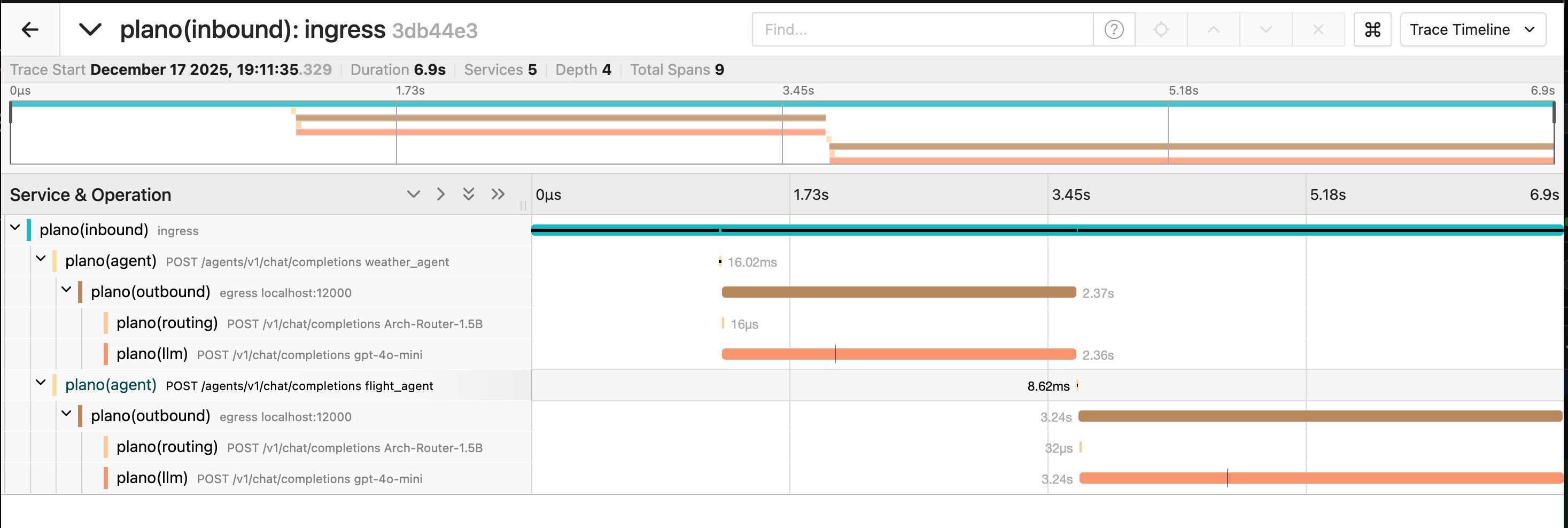
4. Get Observability and Model Agility for Free
Every request is traced end-to-end with OpenTelemetry - no instrumentation code needed.
What You Didn't Have to Build
| Infrastructure Concern | Without Plano | With Plano |
|---|---|---|
| Agent Orchestration | Write intent classifier + routing logic | Declare agent descriptions in YAML |
| Model Management | Handle each provider's API quirks | Unified LLM APIs with state management |
| Rich Tracing | Instrument every service with OTEL | Automatic end-to-end traces and logs |
| Learning Signals | Build pipeline to capture/export spans | Zero-code agentic signals |
| Adding Agents | Update routing code, test, redeploy | Add to config, restart |
Why it's efficient: Plano uses purpose-built, lightweight LLMs (like our 4B-parameter orchestrator) instead of heavyweight frameworks or GPT-4 for routing - giving you production-grade routing at a fraction of the cost and latency.
Contact
To get in touch with us, please join our discord server. We actively monitor that and offer support there.
Getting Started
Ready to try Plano? Check out our comprehensive documentation:
- Quickstart Guide - Get up and running in minutes
- LLM Routing - Route by model name, alias, or intelligent preferences
- Agent Orchestration - Build multi-agent workflows
- Filter Chains - Add guardrails, moderation, and memory hooks
- Observability - Traces, metrics, and logs
Contribution
We would love feedback on our Roadmap and we welcome contributions to Plano! Whether you're fixing bugs, adding new features, improving documentation, or creating tutorials, your help is much appreciated. Please visit our Contribution Guide for more details
Star ⭐️ the repo if you found Plano useful — new releases and updates land here first.
Compatibility
- License
- Apache-2.0
- Crate facts
- Not measured
- Runs on, Native code and Python bindings read crates on crates.io. This entry lists no crate.
Compare with similar projects
Order: strongest tier first, then most downloads, then name, with unmeasured values last. A library counts downloads over 30 days. An app counts binary downloads per release. An app with none counts its crate downloads over 30 days. ML Rust runs this catalogue, so its closest project always gets a row.
| Project | Downloads | Dependents | Stars | Latest release | Runs on (GPU) | Native code | License |
|---|---|---|---|---|---|---|---|
|
Plano is an AI-native proxy server and data plane for agentic apps. Smart LLM routing, observability, agent orchestration, and guardrails so you stay focused on your agents core logic. |
211 binary downloads per release | Not applicable | 7,111 | Not measured | Not measured | Apache-2.0 | |
|
All-in-one LLM CLI tool featuring Shell Assistant, Chat-REPL, RAG, AI Tools & Agents, with access to OpenAI, Claude, Gemini, Ollama, Groq, and more. |
28,422 binary downloads per release | Not applicable | 10,556 | 0.30.0 | GPU support unknown | No native code found | Apache-2.0 OR MIT |
|
Terminal UI to chat with large language models (LLM) using different model backends, and integrations with your favourite editors! |
5,642 binary downloads per release | Not applicable | 772 | 0.13.0 | GPU support unknown | No native code found | MIT |
|
rstructor Listed
Get structured, validated data out of LLMs as native Rust structs and enums. Derive a type and rstructor generates the JSON Schema, prompts the model, parses the reply, and retries on validation errors — across OpenAI, Anthropic Claude, Google Gemini, and xAI Grok. |
1,269 downloads over 30 days | 3 | 34 | 0.6.0 | GPU support unknown | No native code found | MIT |
|
llm_providers Listed
A unified source of truth for LLM providers, models, pricing, and capabilities. |
604 downloads over 30 days | 4 | 2 | 0.14.4 | GPU support unknown | No native code found | MIT |
|
Inference server for LLMs, speech and embeddings: OpenAI-compatible routes with streaming, plus speech synthesis (TTS) and transcription (ASR). Serves Llama, Mistral, Qwen, Mamba2, MLA+MoE and hybrid models from SafeTensors, AWQ, GPTQ and GGUF. |
8 binary downloads per release | Not applicable | 7 | 0.7.1 | CUDA, WebGPU | Binds native code: ring (feature distributed) | Apache-2.0 |
|
llm-kernel New
Foundation library for Rust AI-native apps — provider catalog, LLM client, MCP server, search, telemetry, and safety |
791 downloads over 30 days | 8 | 3 | 0.33.1 | GPU support unknown | Binds native code: libsqlite3-sys (feature store), mach-sys (feature embedding-mlx), mlx-sys (feature embedding-mlx), openssl-sys (feature graph-pg-tls), ort-sys (feature embedding-fastembed-coreml) | Apache-2.0 |
Why ListedNo archive, New or Featured rule places it, so it is Listed.
What it lacks for Featured
- The check holds no value for Homebrew installs on request over 365 days, Docker pull growth over 90 days. A gate that lacks its signal does not pass.
What else the check found
- The last activity is on 24 Oct 2026, 16 days ago. The rules expect an update within 365 days. Dormancy rule
Not measured: First release, Homebrew installs on request over 365 days, Docker pull growth over 90 days.
Exact rules: Listed, Featured app. The check on applied thresholds version 9.
Every rule outcome, as the check records it
expected-interval: app: E = 365 daysdormancy: last activity 2026-10-24, 16 days ago, E = 365: activefeatured: not featured: unknown homebrew_on_request_365d, docker_pull_growth_90dlisted: listed: no archive, new or featured rule applies
Measurements and sources
Each signal row shows the raw value, its source and the fetch date. The Sources list gathers every distinct source on this page. Movement needs more history.
Sources5 sources
- Description: the GitHub repository description
- GitHub releases, fetched
- GitHub repository, fetched
- Repology project, fetched
- GitHub contributors, fetched
Adoption211 binary downloads per release4 not measured
| Signal | Value | Source | Fetched | Counts |
|---|---|---|---|---|
| Active dependents | Not measured | Yes | ||
| New dependents (365 days) | Not measured | Yes | ||
| Peak active dependents | Not measured | Yes | ||
| Active dependents as a share of the peak | Not measured | Yes | ||
| Binary downloads per release | 211 | GitHub releases | Yes |
MaintenanceLatest human commit: 16 days ago7 not measured
| Signal | Value | Source | Fetched | Counts |
|---|---|---|---|---|
| Latest human commit | 2026-10-24 | GitHub repository | Yes | |
| Latest release | 2026-10-24 | GitHub releases | Yes | |
| First release | Not measured | Yes | ||
| Latest version | Not measured | Yes | ||
| Days the oldest outside issue waits for a reply | 273 | GitHub repository | Yes | |
| Maintainer replies over 365 days | 13 | GitHub repository | Yes | |
| Repository archived | false | GitHub repository | Yes | |
| Repository gone | false | GitHub repository | Yes | |
| Release commit or manifest in the repo | Not measured | Yes | ||
| Published docs | Not measured | Yes | ||
| Latest release fails cargo check | Not measured | Yes | ||
| Build check date | Not measured | Yes | ||
| Build check toolchain | Not measured | Yes |
SecurityNot measured
| Signal | Value | Source | Fetched | Counts |
|---|---|---|---|---|
| Unpatched vulnerabilities past the grace window | Not measured | Yes | ||
| RustSec unmaintained advisory | Not measured | Yes | ||
| Deprecation notice | Not measured | Yes | ||
| Deprecated requirement | Not measured | Yes |
Distribution633 binary downloads over the last 3 releases9 not measured
| Signal | Value | Source | Fetched | Counts |
|---|---|---|---|---|
| Releases | Not measured | Yes | ||
| Downloads over 30 days | Not measured | Yes | ||
| Binary downloads over the last 3 releases | 633 | GitHub releases | Yes | |
| Homebrew installs on request over 365 days | Not measured | Yes | ||
| Repology repository families | 1 | Repology project | Yes | |
| Docker pull growth over 90 days | Not measured | Yes | ||
| Docker pulls at the growth baseline | Not measured | Yes | ||
| Every version a prerelease | Not measured | Yes | ||
| Every version 0.0.x | Not measured | Yes | ||
| Every version yanked | Not measured | Yes | ||
| Crate deleted from crates.io | Not measured | Yes |
Repository7,111 stars, 495 forks, 42 contributors, 757 commits. Stars alone never qualify a project.1 not measured
| Signal | Value | Source | Fetched | Counts |
|---|---|---|---|---|
| GitHub stars | 7111 | GitHub repository | Yes — one part of the repository route | |
| GitHub forks | 495 | GitHub repository | Yes — one part of the repository route | |
| Contributors with a GitHub account | 42 | GitHub contributors | Yes — one part of the repository route | |
| Commits on the default branch | 757 | GitHub repository | No | |
| Repository's main crate left out of the entry | Not measured | Yes |
Facts that never count
| Signal | Value | Source | Fetched | Counts |
|---|---|---|---|---|
| License | Apache-2.0 | GitHub repository | No | |
| Runs on, from listed crates and their direct dependencies | Not measured | No | ||
| What shows each backend | Not measured | No | ||
| Native code, from listed crates and their dependencies | Not measured | No | ||
| Python bindings, from direct dependencies of listed crates | Not measured | No | ||
| Crates that depend on a listed crate directly | Not measured | No |
Corrections and review history
No correction applies to this entry.
Judgments
A judgment enters only through an approved issue and a merged pull request.
No judgment applies to this entry.