peroxide
Library Listed
Rust comprehensive scientific computation library contains linear algebra, numerical analysis, statistics and machine learning tools with familiar syntax
- Downloads
- 56,548
- Dependents
- 9
- Stars
- 732
- Forks
- 43
- Contributors
- 23
- Commits
- 1,957
- Latest release
- 0.43.1 ·
About
Rust numeric library contains linear algebra, numerical analysis, statistics and machine learning tools with R, MATLAB, Python like macros.
Quickstart
cargo add peroxide # default profile is pure Rust, no system libraries needed
#[macro_use]
extern crate peroxide;
use peroxide::fuga::*;

fn main() {
    // R / MATLAB-style matrix literals
    let a = ml_matrix("1 2; 3 4");
    let b = c!(5, 6);

    // matrix-vector product (BLAS-dispatched when an `O3-*` feature is on)
    let c = &a * &b;

    a.print(); // pretty-formatted matrix
    c.print(); // [17, 39]
    a.det().print(); // -2
    a.inv().print();
}
For accelerated linear algebra, plotting, or DataFrame I/O, enable the matching feature flag (see Install and Available features).
Table of Contents
- Peroxide
- Table of Contents
- Why Peroxide?
- 1. Customize features
- 2. Easy to optimize
- 3. Friendly syntax
- 4. Can choose two different coding styles.
- 5. Batteries included
- 6. Compatible with Mathematics
- 7. Written in Rust
- Pre-requisite
- Install
- Most common combinations
- Available features
- Examples
- Release notes
- Contributing
- License
- Cite Peroxide
Why Peroxide?
1. Customize features
Peroxide provides various features.
Read the full README
default- Pure Rust (No dependencies of architecture - Perfect cross compilation)O3-openblas/O3-openblas-system/O3-accelerate/O3-mkl/O3-netlib- BLAS & LAPACK accelerated linear algebra; pick one backend flag (see Pre-requisite)plot- With matplotlib of python, we can draw any plots.complex- With complex numbers (vector, matrix and integral)parallel- With some parallel functionsnc- To handle netcdf file format with DataFramecsv- To handle csv file format with Matrix or DataFrameparquet- To handle parquet file format with DataFrameserde- serialization with Serde.rkyv- serialization with rkyv.
If you want to do high performance computation and more linear algebra, then choose one of the O3-* backend features.
If you don't want to depend C/C++ or Fortran libraries, then choose default feature.
If you want to draw plot with some great templates, then choose plot feature.
You can choose any features simultaneously.
2. Easy to optimize
Peroxide uses a 1D data structure to represent matrices, making it straightforward to integrate with BLAS (Basic Linear Algebra Subprograms). This means that Peroxide can guarantee excellent performance for linear algebraic computations by leveraging the optimized routines provided by BLAS.
3. Friendly syntax
For users familiar with numerical computing libraries like NumPy, MATLAB, or R, Rust's syntax might seem unfamiliar at first. This can make it more challenging to learn and use Rust libraries that heavily rely on Rust's unique features and syntax.
However, Peroxide aims to bridge this gap by providing a syntax that resembles the style of popular numerical computing environments. With Peroxide, you can perform complex computations using a syntax similar to that of R, NumPy, or MATLAB, making it easier for users from these backgrounds to adapt to Rust and take advantage of its performance benefits.
For example,
#[macro_use]
extern crate peroxide;
use peroxide::prelude::*;

fn main() {
    // MATLAB like matrix constructor
    let a = ml_matrix("1 2;3 4");

    // R like matrix constructor (default)
    let b = matrix(c!(1,2,3,4), 2, 2, Row);

    // Or use zeros
    let mut z = zeros(2, 2);
    z[(0,0)] = 1.0;
    z[(0,1)] = 2.0;
    z[(1,0)] = 3.0;
    z[(1,1)] = 4.0;

    // Simple but effective operations
    let c = a * b; // Matrix multiplication (BLAS integrated)

    // Easy to pretty print
    c.print();
    //       c[0] c[1]
    // r[0]     1    3
    // r[1]     2    4

    // Easy to do linear algebra
    c.det().print();
    c.inv().print();

    // and etc.
}
4. Can choose two different coding styles.
In peroxide, there are two different options.
prelude: To simple use.fuga: To choose numerical algorithms explicitly.
For examples, let's see norm.
In prelude, use norm is simple: a.norm(). But it only uses L2 norm for Vec<f64>. (For Matrix, Frobenius norm.)
#[macro_use]
extern crate peroxide;
use peroxide::prelude::*;

fn main() {
    let a = c!(1, 2, 3);
    let l2 = a.norm();      // L2 is default vector norm

    assert_eq!(l2, 14f64.sqrt());
}
In fuga, use various norms. But you should write a little bit longer than prelude.
#[macro_use]
extern crate peroxide;
use peroxide::fuga::*;

fn main() {
    let a = c!(1, 2, 3);
    let l1 = a.norm(Norm::L1);
    let l2 = a.norm(Norm::L2);
    let l_inf = a.norm(Norm::LInf);
    assert_eq!(l1, 6f64);
    assert_eq!(l2, 14f64.sqrt());
    assert_eq!(l_inf, 3f64);
}
5. Batteries included
Peroxide can do many things.
- Linear Algebra: effective
Matrixstructure, LU / QR / SVD / Cholesky decompositions (O3feature for the last three), determinant, inverse, block partitioning, reduced row echelon form, eigenvalue & eigenvector - Functional Programming: easier functional programming with
Vec<f64>; matrix maps (fmap,col_map,row_map) - Automatic Differentiation: const-generic
Jet<N>for arbitrary-order forward AD (Dual,HyperDualaliases),#[ad_function]proc macro, exact Jacobian viajacobian(),Realtrait overf64andJet<N> - Numerical Analysis
- Interpolation & splines: Lagrange interpolation, Cubic / Cubic Hermite (Akima, quadratic slope estimation) / B-Spline
- Non-linear regression: Gradient Descent, Levenberg-Marquardt
- ODE (trait-based since
v0.36.0): explicit (Ralston 3rd & 4th, Runge-Kutta 4th & 5th), embedded (Bogacki-Shampine 3(2), Runge-Kutta-Fehlberg 5(4) & 8(7), Dormand-Prince 5(4), Tsitouras 5(4)), implicit (Gauss-Legendre 4th) - Numerical integration: Newton-Cotes, Gauss-Legendre (up to 30th order), adaptive Gauss-Kronrod (G7K15 through G30K61, absolute & relative tolerance variants)
- Root finding (trait-based since
v0.37.0): Bisection, False Position, Secant, Newton, Broyden
- Statistics: probability distributions (Bernoulli, Uniform, Binomial, Normal, Gamma, Beta, Student's-t, LogNormal, Weighted Uniform), RNG algorithms (Acceptance-Rejection, Marsaglia Polar, Ziggurat, Piecewise Rejection Sampling), ordered statistics (median, R-compatible quantile), confusion matrix & metrics
- Special functions: wrapper of the pure-Rust
puruspecrate - Utils: R / MATLAB / NumPy / Julia style macros & functions
- Plotting: matplotlib-based
Plot2Dviapyo3(plotfeature) - DataFrame: mixed-type columns; CSV / NetCDF / Parquet I/O (
csv/nc/parquetfeatures); shape & info, row / column operations, series & frame statistics (describe,mean, ...)
6. Compatible with Mathematics
After 0.23.0, peroxide is compatible with mathematical structures.
Matrix, Vec<f64>, f64 are considered as inner product vector spaces.
And Matrix, Vec<f64> are linear operators - Vec<f64> to Vec<f64> and Vec<f64> to f64.
For future, peroxide will include more & more mathematical concepts. (But still practical.)
7. Written in Rust
Rust provides a strong type system, ownership concepts, borrowing rules, and other features that enable developers to write safe and efficient code. It also offers modern programming techniques like trait-based abstraction and convenient error handling. Peroxide is developed to take full advantage of these strengths of Rust.
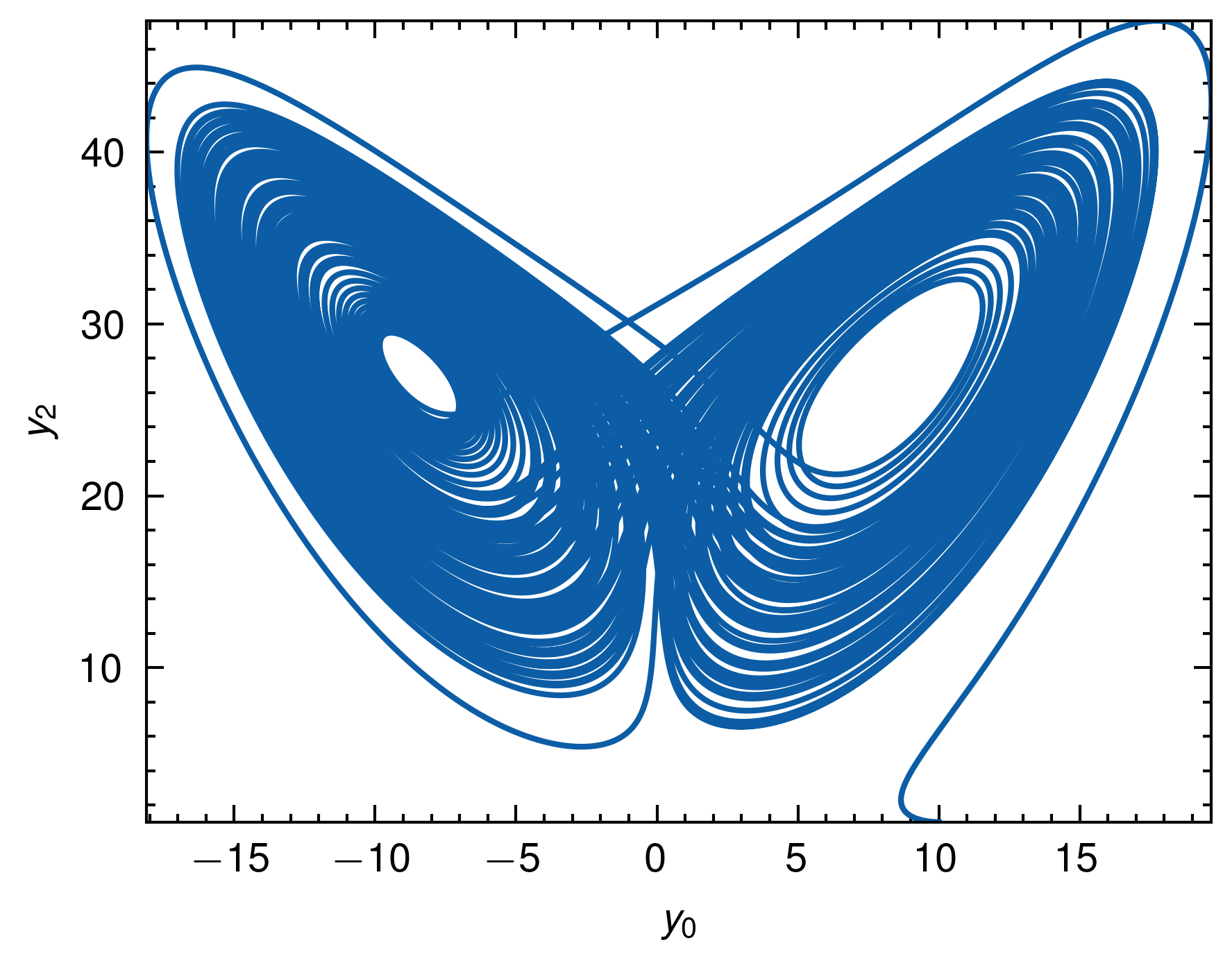
The example code demonstrates how Peroxide can be used to simulate the Lorenz attractor and visualize the results. It showcases some of the powerful features provided by Rust, such as the ? operator for streamlined error handling and the ODEProblem trait for abstracting ODE problems.
use peroxide::fuga::*;

fn main() -> Result<(), Box<dyn Error>> {
    let initial_conditions = vec![10f64, 1f64, 1f64];
    let rkf45 = RKF45::new(1e-4, 0.9, 1e-6, 1e-2, 100);
    let basic_ode_solver = BasicODESolver::new(rkf45);
    let (_, y_vec) = basic_ode_solver.solve(
        &Lorenz,
        (0f64, 100f64),
        1e-2,
        &initial_conditions,
    )?; // Error handling with `?` - can check constraint violation and etc.
    let y_mat = py_matrix(y_vec);
    let y0 = y_mat.col(0);
    let y2 = y_mat.col(2);

    // Simple but effective plotting
    let mut plt = Plot2D::new();
    plt
        .set_domain(y0)
        .insert_image(y2)
        .set_xlabel(r"$y_0$")
        .set_ylabel(r"$y_2$")
        .set_style(PlotStyle::Nature)
        .tight_layout()
        .set_dpi(600)
        .set_path("example_data/lorenz_rkf45.png")
        .savefig()?;

    Ok(())
}

struct Lorenz;

impl ODEProblem for Lorenz {
    fn rhs(&self, t: f64, y: &[f64], dy: &mut [f64]) -> anyhow::Result<()> {
        dy[0] = 10f64 * (y[1] - y[0]);
        dy[1] = 28f64 * y[0] - y[1] - y[0] * y[2];
        dy[2] = -8f64 / 3f64 * y[2] + y[0] * y[1];
        Ok(())
    }
}
Running the code produces the following visualization of the Lorenz attractor:
Peroxide strives to leverage the benefits of the Rust language while providing a user-friendly interface for numerical computing and scientific simulations.
Pre-requisite
Most features are pure Rust and require no system setup. The three groups below depend on external libraries or runtimes; install the relevant prerequisites before enabling the corresponding feature flag.
O3: BLAS + LAPACK
O3 enables hardware-accelerated linear algebra (LU, QR, SVD, Cholesky, GEMV/GEMM dispatch) through the blas and lapack FFI crates.
Those crates only provide function signatures, so the link backend that supplies the actual dgemv_ / dpotrf_ / ... symbols must be selected separately.
The simplest path is to enable one of the convenience flags below; each pulls in blas-src and lapack-src with the matching backend.
| Convenience flag | Backend | Build-time requirements |
|---|---|---|
O3-openblas | OpenBLAS, compiled from source | C + Fortran toolchain, make, network access |
O3-openblas-system | System-installed OpenBLAS | pkg-config + the OpenBLAS system package |
O3-accelerate | Apple Accelerate | macOS only (no extra system install) |
O3-mkl | Intel MKL | Intel's redistributable (fetched automatically) |
O3-netlib | Netlib reference, compiled from source | cmake + Fortran toolchain (lowest performance) |
O3-openblas does not use a system-installed OpenBLAS: the openblas-src crate downloads the OpenBLAS source tarball during the cargo build and compiles it, so it needs gcc, gfortran, make, and network access, but no BLAS system package.
The download happens over HTTPS through openblas-src's default rustls TLS backend; if you depend on openblas-src directly with default-features = false (as some older guides suggest), you must re-enable one of its rustls / native-tls features yourself or the build will fail.
O3-openblas-system skips the source build and links the OpenBLAS already installed on the host, discovered via pkg-config:
| Platform | Install |
|---|---|
| Debian / Ubuntu | sudo apt install libopenblas-dev |
| Fedora / RHEL | sudo dnf install openblas-devel |
| Arch Linux | sudo pacman -S openblas |
| macOS (Homebrew) | brew install openblas |
If you need a backend not in the list above (for example BLIS or R's BLAS), enable the bare O3 flag and add blas-src / lapack-src to your downstream binary's Cargo.toml with the appropriate features yourself.
Note:
O3-accelerateonly builds on Apple targets. Enabling it on Linux or Windows fails while compilingaccelerate-srcwitherror: library kind `framework` is only supported on Apple targets; pickO3-openblas,O3-mkl, orO3-netlibinstead. For the same reason, excludeO3-accelerate(andO3-mkl/O3-netlibunless their toolchains are installed) when running tools likecargo hack --each-featureon Linux.
plot / pyo3: Python 3 + matplotlib
plot enables the high-level Plot2D API, which renders figures by delegating to matplotlib through pyo3.
Python 3 with development headers is required at build time, and matplotlib is required at runtime.
| Step | Command |
|---|---|
| Install Python 3 + dev headers (Debian) | sudo apt install python3 python3-dev |
| Install Python 3 + dev headers (Fedora) | sudo dnf install python3 python3-devel |
| Install matplotlib | pip install matplotlib |
| (Optional) Publication-quality styles | pip install scienceplots |
If you use a virtual environment, activate it before building so that pyo3 resolves to the intended interpreter (e.g. source .venv/bin/activate).
The plain pyo3 flag enables the Python interop layer without pulling in the Plot2D API.
nc / netcdf: HDF5 + netCDF-C
nc (alias netcdf) enables NetCDF I/O for DataFrame via the netcdf crate, which links against the system HDF5 and netCDF-C libraries.
| Platform | Install |
|---|---|
| Debian / Ubuntu | sudo apt install libnetcdf-dev libhdf5-dev |
| Fedora / RHEL | sudo dnf install netcdf-devel hdf5-devel |
| Arch Linux | sudo pacman -S netcdf hdf5 |
| macOS (Homebrew) | brew install netcdf hdf5 |
Note: Peroxide currently pins
netcdf = "0.7", which transitively useshdf5-sys 0.8.x. Thathdf5-sysonly recognizes the HDF5 1.x version string and rejects HDF5 2.x withInvalid H5_VERSION. If your distribution ships HDF5 2.x (e.g. recent rolling-release Linux), install an HDF5 1.14.x package alongside (Debian/Ubuntu LTS releases still default to 1.10/1.14) or wait for the planned bump tonetcdf 0.12. Thencbuild will succeed against any HDF5 1.x.
Install
Peroxide builds on stable Rust 1.91 or later. The default profile is pure Rust; system libraries are only needed for the features listed in the Pre-requisite section.
cargo add peroxide                              # default (pure Rust)
cargo add peroxide --features "<FEATURES>"      # opt-in features
Most common combinations
| Goal | Command |
|---|---|
| Linear algebra on Linux / Windows | cargo add peroxide --features O3-openblas |
| Linear algebra with system OpenBLAS | cargo add peroxide --features O3-openblas-system |
| Linear algebra on macOS | cargo add peroxide --features O3-accelerate |
| Plotting via Python / matplotlib | cargo add peroxide --features plot |
| DataFrame + Parquet I/O | cargo add peroxide --features parquet |
| Full Linux scientific stack | cargo add peroxide --features "O3-openblas plot nc csv parquet serde" |
| Full macOS scientific stack | cargo add peroxide --features "O3-accelerate plot nc csv parquet serde" |
Available features
Most users only need the composite flags in the first table. The remaining single-crate flags exist so advanced users can pull in just one optional dependency without enabling the rest.
Composite flags (recommended)
| Flag | Requires | Purpose |
|---|---|---|
O3-openblas | OpenBLAS (from source) | BLAS / LAPACK accelerated linear algebra (Linux / Windows) |
O3-openblas-system | OpenBLAS (system) | Same, linking the system-installed OpenBLAS via pkg-config |
O3-accelerate | Apple Accelerate | Same, using the Accelerate framework on macOS |
O3-mkl | Intel MKL | Same, using Intel MKL |
O3-netlib | Netlib | Same, using the reference Netlib BLAS |
plot | Python 3 + matplotlib | High-level Plot2D API |
nc | HDF5 + netCDF-C | NetCDF I/O for DataFrame |
parquet | (pure Rust) | Parquet I/O for DataFrame (pulls in arrow, indexmap) |
complex | (pure Rust) | Complex vectors / matrices + cgemm matmul |
parallel | (pure Rust) | Parallel iterators on vectors / matrices |
csv | (pure Rust) | CSV I/O for DataFrame |
json | (pure Rust) | JSON I/O for DataFrame |
serde | (pure Rust) | serde (de)serialization |
rkyv | (pure Rust) | rkyv zero-copy (de)serialization |
rand | (pure Rust) | Random sampling stack: distributions, RNG wrappers, rand() constructors. On by default; disable with default-features = false to get the deterministic core (ODE, integration, splines, linear algebra) for sandboxed targets like wasm32 |
Advanced: single-crate flags
These flags enable one optional dependency in isolation. Use them only if you want to depend on the underlying crate without the surrounding Peroxide API.
| Flag | Underlying crate | Notes |
|---|---|---|
O3 | blas, lapack | Bare BLAS / LAPACK FFI; bring your own blas-src / lapack-src |
blas | blas | Raw BLAS bindings only |
lapack | lapack | Raw LAPACK bindings only |
pyo3 | pyo3 | Python 3 interop without the Plot2D API |
netcdf | netcdf | Alias for nc |
num-complex | num-complex | Raw complex-number dependency only |
rayon | rayon | Raw rayon dependency only |
arrow | arrow | Raw arrow dependency only |
indexmap | indexmap | Raw indexmap dependency only |
Examples
Runnable programs covering every component live in examples/, with longer worked notebooks in the companion Peroxide_Gallery repository.
API reference and feature-specific guidance are published on docs.rs/peroxide.
Release notes
See RELEASES.md.
Contributing
See CONTRIBUTING.md.
License
Peroxide is licensed under dual licenses: Apache License 2.0 and MIT License.
Cite Peroxide
Hey there! If you're using Peroxide in your research or project, you're not required to cite us. But if you do, we'd be really grateful! 😊
Peroxide is described in a paper published in the Journal of Open Source Software:
@article{Kim2026,
  author    = {Kim, Tae-Geun and Comitini, Giorgio and Grage, Jonas and Joens, Benjamin and Schreiber, Marc and Sen, Soumya and Senthamarai, Russell R P and S\"{o}rng\r{a}rd, Johanna},
  title     = {Peroxide: A Batteries-Included Numerical Computing Library for {R}ust},
  journal   = {Journal of Open Source Software},
  publisher = {The Open Journal},
  volume    = {11},
  number    = {124},
  pages     = {10366},
  year      = {2026},
  doi       = {10.21105/joss.10366},
  url       = {https://doi.org/10.21105/joss.10366}
}
To cite one specific release rather than the paper, use the Zenodo archive:
That badge resolves to the newest deposit, and each release page carries citation information in BibTeX, RIS, and APA.
So, if you want to acknowledge the work we've put into Peroxide, citing us would be a great way to do it! Thanks for considering it, we appreciate your support! 👍
Compatibility
- Runs on
- GPU support unknown
What shows it
- no dependency or feature matches a backend row
- Native code
- Optional
- Binds native code: openblas-src (feature O3-openblas-system), blas-sys (feature O3), hdf5-metno-sys (feature nc), lapack-sys (feature O3), libz-sys (feature nc) and 1 more
- Python bindings
- Has Python bindings
- peroxide needs Python only with feature plot
- License
- Apache-2.0 OR MIT
Compare with similar projects
Order: strongest tier first, then most downloads, then name, with unmeasured values last. A library counts downloads over 30 days. An app counts binary downloads per release. An app with none counts its crate downloads over 30 days. ML Rust runs this catalogue, so its closest project always gets a row.
| Project | Downloads | Dependents | Stars | Latest release | Runs on (GPU) | Native code | License |
|---|---|---|---|---|---|---|---|
|
Rust comprehensive scientific computation library contains linear algebra, numerical analysis, statistics and machine learning tools with familiar syntax Python bindings |
56,548 downloads over 30 days | 9 | 732 | 0.43.1 | GPU support unknown | Binds native code: openblas-src (feature O3-openblas-system), blas-sys (feature O3), hdf5-metno-sys (feature nc), lapack-sys (feature O3), libz-sys (feature nc) and 1 more | Apache-2.0 OR MIT |
|
nalgebra Featured
General-purpose linear algebra library with transformations and statically-sized or dynamically-sized matrices. |
6,251,820 downloads over 30 days | 2,119 | 4,810 | 0.35.0 | GPU support unknown | Binds native code: blas-sys, lapack-sys, defmt (feature defmt) | Apache-2.0 |
|
basin Listed
Numerical optimization in pure Rust, with pluggable linear-algebra backends and WASM support. |
22,519 downloads over 30 days | 9 | 128 | 3.2.0 | GPU support unknown | Binds native code: blas-sys (feature nalgebra_latest-lapack), lapack-sys (feature nalgebra_latest-lapack) | Apache-2.0 OR MIT |
|
rstats Listed
Statistics, Information Measures, Data Analysis, Linear Algebra, Clifford Algebra, Machine Learning, Geometric Median, Matrix Decompositions, Mahalanobis Distance, Hulls, Multithreading.. |
2,664 downloads over 30 days | 6 | 57 | 2.1.15 | GPU support unknown | No native code found | Apache-2.0 |
|
numr Listed
The base for numerical code in Rust, in the role NumPy has in Python: n-dimensional tensors, linear algebra, FFT, statistics and autograd on CPU, CUDA and WebGPU. The backends use native kernels, with no cuBLAS, MKL or other vendor math library. |
1,673 downloads over 30 days | 7 | 59 | 0.15.2 | CUDA, WebGPU | Binds native code: ring (feature distributed) | Apache-2.0 |
|
russell Listed
Scientific laboratory for linear algebra and numerical mathematics |
1,282 downloads over 30 days | 5 | 207 | 5.0.0 | GPU support unknown | Build uses a native toolchain: cc, pkg-config | MIT |
Why ListedNo archive, New or Featured rule places it, so it is Listed.
What it lacks for Featured
- It has 2 active dependents and 0 new dependents in 365 days. Featured needs 11 active dependents or 9 new dependents in 365 days. The repository route reads 732 stars, 43 forks and 23 contributors. It needs 4,539 stars, 434 forks and 79 contributors together.
What else the check found
- The last activity is on 10 Aug 2026, 91 days ago. The rules expect an update within 600 days. Dormancy rule
- The latest release requires the deprecated dependency json. RUSTSEC-2022-0081 Rot signals rule
Exact rules: Listed, Featured library. The check on applied thresholds version 9.
Every rule outcome, as the check records it
expected-interval: version 0.43.1 base 300, doubled for 56548 downloads per month: E = 600 daysdormancy: last activity 2026-08-10, 91 days ago, E = 600: activerot: deprecated requirement `json (RUSTSEC-2022-0081, https://rustsec.org/advisories/RUSTSEC-2022-0081.html)`featured: not featured: active_users 2 < 11 and new_adopters 0 < 9 and repository route stars 732 (needs 4539), forks 43 (needs 434), contributors 23 (needs 79)listed: listed: no archive, new or featured rule applies
Measurements and sources
Each signal row shows the raw value, its source and the fetch date. The Sources list gathers every distinct source on this page. Movement needs more history.
Sources6 sources
- Description: the crates.io description
- crates.io database dump, fetched
- RustSec advisory database, fetched
- GitHub repository, fetched
- crates.io package, fetched
- GitHub contributors, fetched
Adoption2 active dependents, 0 new dependents in 365 days1 not measured
| Signal | Value | Source | Fetched | Counts |
|---|---|---|---|---|
| Active dependents | 2 | crates.io database dump | Yes | |
| New dependents (365 days) | 0 | crates.io database dump | Yes | |
| Peak active dependents | 4.5 | crates.io database dump | Yes | |
| Active dependents as a share of the peak | 0.9625 | crates.io database dump | Yes | |
| Binary downloads per release | Not measured | Yes |
MaintenanceLatest human commit: 3 months ago3 not measured
| Signal | Value | Source | Fetched | Counts |
|---|---|---|---|---|
| Latest human commit | 2026-08-10 | GitHub repository | Yes | |
| Latest release | 2026-08-02 | crates.io database dump | Yes | |
| First release | 2018-09-22 | crates.io database dump | Yes | |
| Latest version | 0.43.1 | crates.io database dump | Yes | |
| Days the oldest outside issue waits for a reply | 825 | GitHub repository | Yes | |
| Maintainer replies over 365 days | 37 | GitHub repository | Yes | |
| Repository archived | false | GitHub repository | Yes | |
| Repository gone | false | GitHub repository | Yes | |
| Release commit or manifest in the repo | true | crates.io package | Yes | |
| Published docs | true | crates.io database dump | Yes | |
| Latest release fails cargo check | Not measured | Yes | ||
| Build check date | Not measured | Yes | ||
| Build check toolchain | Not measured | Yes |
SecurityUnpatched vulnerabilities: none
| Signal | Value | Source | Fetched | Counts |
|---|---|---|---|---|
| Unpatched vulnerabilities past the grace window | none | RustSec advisory database | Yes | |
| RustSec unmaintained advisory | none | RustSec advisory database | Yes | |
| Deprecation notice | none | crates.io database dump | Yes | |
| Deprecated requirement | json (RUSTSEC-2022-0081, https://rustsec.org/advisories/RUSTSEC-2022-0081.html) | crates.io database dump | Yes |
Distribution241 releases, 56,548 downloads over 30 days5 not measured
| Signal | Value | Source | Fetched | Counts |
|---|---|---|---|---|
| Releases | 241 | crates.io database dump | Yes | |
| Downloads over 30 days | 56548 | crates.io database dump | Yes | |
| Binary downloads over the last 3 releases | Not measured | Yes | ||
| Homebrew installs on request over 365 days | Not measured | Yes | ||
| Repology repository families | Not measured | Yes | ||
| Docker pull growth over 90 days | Not measured | Yes | ||
| Docker pulls at the growth baseline | Not measured | Yes | ||
| Every version a prerelease | false | crates.io database dump | Yes | |
| Every version 0.0.x | false | crates.io database dump | Yes | |
| Every version yanked | false | crates.io database dump | Yes | |
| Crate deleted from crates.io | false | crates.io database dump | Yes |
Repository732 stars, 43 forks, 23 contributors, 1,957 commits. Stars alone never qualify a project.
| Signal | Value | Source | Fetched | Counts |
|---|---|---|---|---|
| GitHub stars | 732 | GitHub repository | Yes — one part of the repository route | |
| GitHub forks | 43 | GitHub repository | Yes — one part of the repository route | |
| Contributors with a GitHub account | 23 | GitHub contributors | Yes — one part of the repository route | |
| Commits on the default branch | 1957 | GitHub repository | No | |
| Repository's main crate left out of the entry | none | crates.io database dump | Yes |
Facts that never count
| Signal | Value | Source | Fetched | Counts |
|---|---|---|---|---|
| License | Apache-2.0 OR MIT | crates.io database dump | No | |
| Runs on, from listed crates and their direct dependencies | GPU support unknown | crates.io database dump | No | |
| What shows each backend | no dependency or feature matches a backend row | crates.io database dump | No | |
| Native code, from listed crates and their dependencies | Binds native code: openblas-src (feature O3-openblas-system), blas-sys (feature O3), hdf5-metno-sys (feature nc), lapack-sys (feature O3), libz-sys (feature nc) and 1 more | crates.io database dump | No | |
| Python bindings, from direct dependencies of listed crates | Has Python bindings: peroxide needs Python only with feature plot | crates.io database dump | No | |
| Crates that depend on a listed crate directly | 9 | crates.io database dump | No |
Corrections and review history
No correction applies to this entry.
Judgments
A judgment enters only through an approved issue and a merged pull request.
No judgment applies to this entry.