model2vec-rs
Library Featured
Official Rust Implementation of Model2Vec
- Downloads
- 194,422
- Dependents
- 48
- Stars
- 234
- Forks
- 29
- Contributors
- 11
- Commits
- 64
- Latest release
- 0.4.0 ·
About

Fast State-of-the-Art Static Embeddings in Rust
Quickstart • Features • Models • Performance • Relation to Python Model2Vec
model2vec-rs is a Rust crate providing an efficient implementation for inference with Model2Vec static embedding models. Model2Vec is a technique for creating compact and fast static embedding models from sentence transformers, achieving significant reductions in model size and inference speed. This Rust crate is optimized for performance, making it suitable for applications requiring fast embedding generation.
Quickstart
You can utilize model2vec-rs in two ways:
- As a library in your Rust projects
- As a standalone Command-Line Interface (CLI) tool for quick terminal-based inferencing
1. Using model2vec-rs as a Library
Integrate model2vec-rs into your Rust application to generate embeddings within your code.
a. Add model2vec-rs as a dependency:
cargo add model2vec-rs
b. Load a model and generate embeddings:
Read the full README
use anyhow::Result;
use model2vec_rs::model::StaticModel;

fn main() -> Result<()> {
    // Load a model from the Hugging Face Hub or a local path.
    // Arguments: (repo_or_path, hf_token, normalize_embeddings, subfolder_in_repo)
    let model = StaticModel::from_pretrained(
        "minishlab/potion-base-8M", // Model ID from Hugging Face or local path to model directory
        None,                       // Optional: Hugging Face API token for private models
        None,                       // Optional: bool to override model's default normalization. `None` uses model's config.
        None                        // Optional: subfolder if model files are not at the root of the repo/path
    )?;

    let sentences = vec![
        "Hello world".to_string(),
        "Rust is awesome".to_string(),
    ];

    // Generate embeddings using default parameters
    // (Default max_length: Some(512), all sentences in one batch)
    let embeddings = model.encode(&sentences);
    // `embeddings` is a Vec<Vec<f32>>
    println!("Generated {} embeddings.", embeddings.len());

    // To generate embeddings with custom arguments:
    let custom_embeddings = model.encode_with_args(
        &sentences,
        Some(256), // Optional: custom max token length for truncation
        512,       // Custom batch size for processing
    );
    println!("Generated {} custom embeddings.", custom_embeddings.len());

    // `encode_flat` returns one row-major `Vec<f32>` of
    // `sentences.len() * model.dim()` values. Use it when you want contiguous
    // output or only read the rows; prefer `encode` if you need an owned
    // `Vec<f32>` per sentence.
    let flat = model.encode_flat(&sentences);
    for row in flat.chunks_exact(model.dim()) {
        println!("First value: {}", row[0]);
    }

    Ok(())
}
Alternative: Loading from in-memory bytes (wasm / embedded use cases):
When filesystem access is unavailable, use from_bytes instead of from_pretrained:
use model2vec_rs::model::StaticModel;

let model = StaticModel::from_bytes(
    include_bytes!("path/to/tokenizer.json").as_ref(),
    include_bytes!("path/to/model.safetensors").as_ref(),
    include_bytes!("path/to/config.json").as_ref(),
    None, // normalize: None reads the value from config.json
)?;

let embeddings = model.encode(&["Hello world".to_string()]);
Quantizing an f32 model to int8:
use model2vec_rs::model::StaticModel;

let model = StaticModel::from_pretrained("minishlab/potion-base-8M", None, None, None)?.quantize_int8();
quantize_int8 stores the embeddings as int8 with one scale per row, using a quarter of the memory and encoding faster. Outputs stay very close to the f32 model (cosine similarity above 0.9998 on the potion models).
See the feature flags section for wasm and local-only build configurations.
2. Using the model2vec-rs CLI
a. Install the CLI tool:
This command compiles the crate in release mode (for speed) and installs the model2vec-rs executable to Cargo's binary directory ~/.cargo/bin/.
cargo install model2vec-rs --features cli
Ensure ~/.cargo/bin/ is in your system's PATH to run model2vec-rs from any directory.
The CLI is opt-in; default library builds do not include Clap.
From a checkout, use cargo run --release --features cli -- ....
b. Generate embeddings via CLI:
The compiled binary installed via cargo install is significantly faster (often >10x) than running via cargo run -- ... without release mode.
Encode a single sentence:
model2vec-rs encode-single "Hello world" "minishlab/potion-base-8M"Embeddings will be printed to the console in JSON format. This command should take less than 0.1s to execute.
Encode multiple lines from a file and save to an output file:
echo -e "This is the first sentence.\nThis is another sentence." > my_texts.txt
model2vec-rs encode my_texts.txt "minishlab/potion-base-8M" --output embeddings_output.json
Features
- Fast Inference: Optimized Rust implementation for fast embedding generation.
- Hugging Face Hub Integration: Load pre-trained Model2Vec models directly from the Hugging Face Hub using model IDs, or use models from local paths.
- Model Formats: Supports models with f32, f16, and i8 weight types stored in
safetensorsfiles. Int8 models (model2vec'squantize_to="int8") stay int8 in memory, and f32 models can be quantized to int8 at load time withquantize_int8. - Flexible Loading: Load models from the Hub (
from_pretrained), raw bytes (from_bytes), or owned/borrowed data (from_owned,from_borrowed, andfrom_owned_i8,from_borrowed_i8for int8 embeddings) for embedded and WASM use cases. - Batch Processing: Encodes multiple sentences in batches.
- Configurable Encoding: Allows customization of maximum sequence length and batch size during encoding.
Feature flags
The crate exposes a few feature combinations for different runtimes:
default: native build withonigtokenization and optional Hugging Face Hub downloadscli: build the command-line executable with Clap (not enabled by default)fancy-regex: alternative tokenizer backend for native buildslocal-only: disable remote model downloads and restrict loading to local paths orfrom_bytes(...)wasm: minimal WebAssembly-oriented feature set for in-memory loading viafrom_bytes(...)
Typical invocations:
# native local-only build
cargo build --no-default-features --features onig,local-only

# wasm (requires getrandom backend config)
RUSTFLAGS='--cfg getrandom_backend="wasm_js"' \
cargo check --no-default-features --features wasm --target wasm32-unknown-unknown
What is Model2Vec?
Model2Vec is a technique to distill large sentence transformer models into highly efficient static embedding models. This process significantly reduces model size and computational requirements for inference. For a detailed understanding of how Model2Vec works, including the distillation process and model training, please refer to the main Model2Vec Python repository and its documentation.
This model2vec-rs crate provides a Rust-based engine specifically for inference using these Model2Vec models.
Models
A variety of pre-trained Model2Vec models are available on the HuggingFace Hub (MinishLab collection). These can be loaded by model2vec-rs using their Hugging Face model ID or by providing a local path to the model files.
| Model | Language | Sentence Transformer | Params | Task |
|---|---|---|---|---|
| potion-base-32M | English | bge-base-en-v1.5 | 32.3M | General |
| potion-multilingual-128M | Multilingual | bge-m3 | 128M | General |
| potion-retrieval-32M | English | bge-base-en-v1.5 | 32.3M | Retrieval |
| potion-base-8M | English | bge-base-en-v1.5 | 7.5M | General |
| potion-code-16M-v2 | Code | CodeRankEmbed | 16.2M | Code |
Performance
We compared model2vec-rs with the Python version of Model2Vec by encoding the same 666,808 texts with potion-base-8M in both.
| Implementation | Single thread | All cores | Model load |
|---|---|---|---|
| Rust | 575K texts/second | 2.60M texts/second | 24 ms |
| Python | 38K texts/second | 110K texts/second | 436 ms |
| Speedup | 15.2× | 23.6× | 18.2× |
On a single thread, the Rust version is roughly 15× faster than the Python version, and about 24× faster when using all cores. With int8 models the speedup is larger:
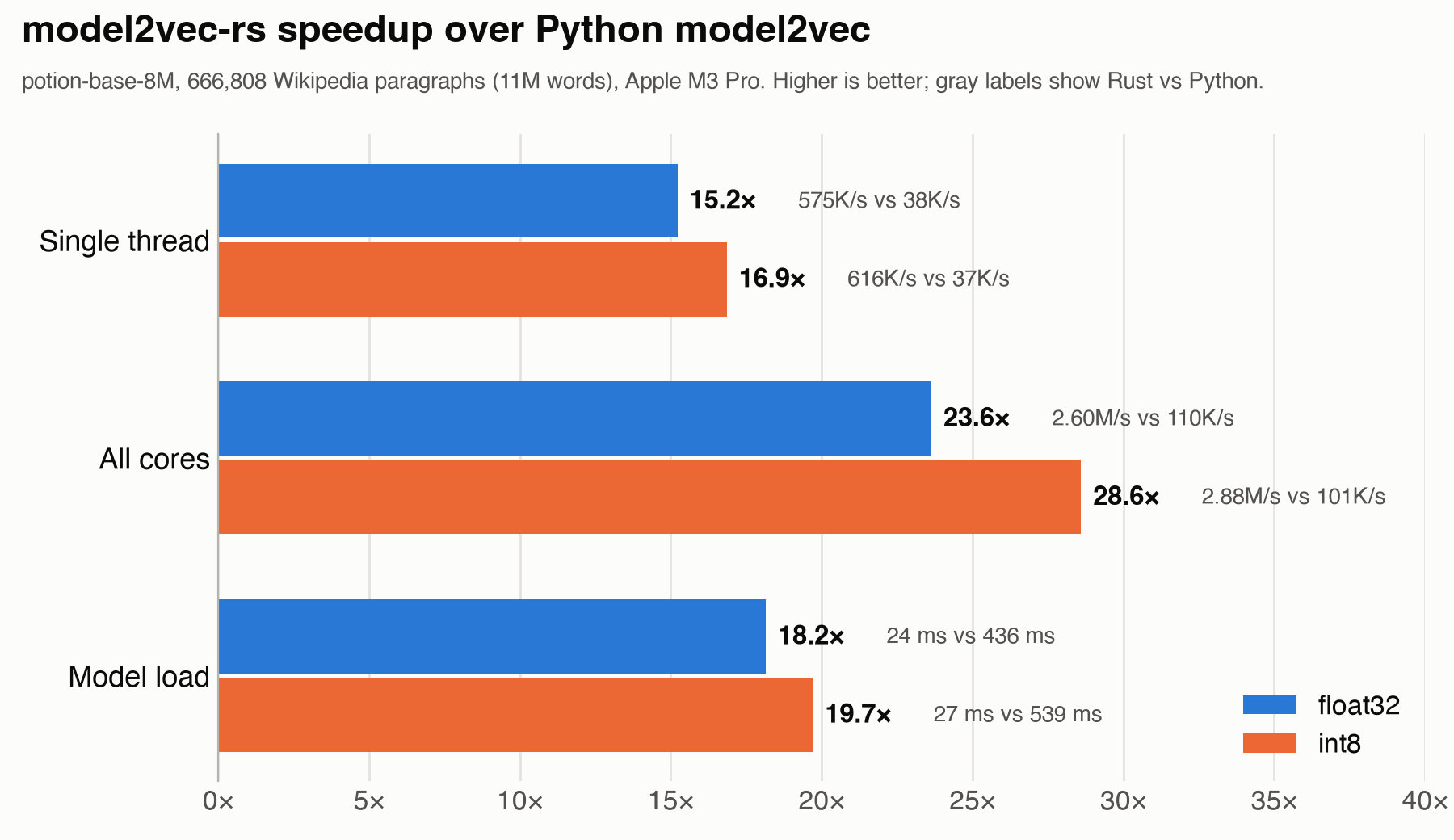
To reproduce these numbers, run this from the repository root (it needs Rust and uv):
uv run scripts/python_compare.py --no-python-multiprocessing
The script downloads the corpus, builds benches/python_compare.rs, runs both implementations and prints the table above. For the int8 bars of the chart, add --quantize int8, then pass both results to scripts/speedup_chart.py. See scripts/python_compare.py for the options.
Benchmark details:
- Corpus: 28,721 random articles from English Wikipedia: shard
20231101.en/train-00017-of-00041.parquetofwikimedia/wikipedia, shuffled with seed 0 and taken until they reach 11M words, joined by blank lines (70.0 MB, SHA-256b6535c025aca457f71ef010b7c4d06f54f564981cb6db5683437ccc8e1ae9710). - Texts: each of the 666,808 non-empty lines (paragraphs and section headings, 16.5 words and 104 bytes on average) is one text. Every timed pass encodes all of them in a single
encodecall with the defaultmax_lengthof 512. - Hardware: Apple M3 Pro (12 cores), 18 GB RAM.
- Software:
model2vec-rs0.4.0 (release build, Rust 1.99.1); Python 3.14.3 withmodel2vec0.10.0,tokenizers0.23.3 andnumpy2.5.4. - Single thread:
RAYON_NUM_THREADS=1andTOKENIZERS_PARALLELISM=falsefor both; Python withuse_multiprocessing=False. - All cores: Rust with Rayon parallelism; Python with tokenizer parallelism and
use_multiprocessing=False. Python's defaultuse_multiprocessing=Truespreads the texts over a process pool, which makes it slower. - Method: 5 alternating rounds of Rust and Python processes, 5 timed passes each after one warm-up pass; throughput is the median over the 25 passes.
- Model load: median time over all 10 process launches per side to load the model from the local Hugging Face cache; for Python this includes importing
model2vec. - Output: for float32, the Rust and Python embeddings differ by at most 3.0e-7 per value (minimum cosine similarity 0.9999998).
- int8: the model is quantized at load time on both sides, with
quantize_int8in Rust andquantize_to="int8"in Python. Rust keeps one scale per row and Python one scale for the whole table, so the int8 embeddings differ between the two (minimum cosine similarity 0.27); these bars compare speed only.
Relation to Python model2vec
model2vec-rs(This Crate): High-performance Rust engine for up to 28x faster Model2Vec inference.model2vec(Python-based): Handles model distillation, training, fine-tuning, and slower Python-based inference.
License
MIT
Citing Model2Vec
If you use Model2Vec in your research, please cite the following:
@software{minishlab2024model2vec,
  author       = {Stephan Tulkens and {van Dongen}, Thomas},
  title        = {Model2Vec: Fast State-of-the-Art Static Embeddings},
  year         = {2024},
  publisher    = {Zenodo},
  doi          = {10.5281/zenodo.17270888},
  url          = {https://github.com/MinishLab/model2vec},
  license      = {MIT}
}
Compatibility
- Runs on
- GPU support unknown
What shows it
- no dependency or feature matches a backend row
- Native code
- None found
- No native code found
- Python bindings
- No Python binding crate found
- License
- MIT
Compare with similar projects
Order: strongest tier first, then most downloads, then name, with unmeasured values last. A library counts downloads over 30 days. An app counts binary downloads per release. An app with none counts its crate downloads over 30 days. ML Rust runs this catalogue, so its closest project always gets a row.
| Project | Downloads | Dependents | Stars | Latest release | Runs on (GPU) | Native code | License |
|---|---|---|---|---|---|---|---|
|
Official Rust Implementation of Model2Vec |
194,422 downloads over 30 days | 48 | 234 | 0.4.0 | GPU support unknown | No native code found | MIT |
|
fastembed-rs Featured
Library for generating vector embeddings, reranking locally. |
1,147,765 downloads over 30 days | 331 | 1,051 | 7.6.1 | CUDA, WebGPU, Metal | Binds native code: accelerate-src (feature accelerate), intel-mkl-src (feature mkl), ort-sys (feature directml) | Apache-2.0 |
|
fasttext-rs Listed
fastText pure Rust implementation |
102,405 downloads over 30 days | 4 | 71 | 0.8.1 | GPU support unknown | Binds native code: cfasttext-sys, cfasttext_static. Build uses a native toolchain: cc | MIT |
|
splintr Listed
Tokenizer for Rust and Python: pure Rust by default, with 18 bundled vocabularies and four backends covering BPE, SentencePiece and WordPiece. Its output matches Hugging Face tokenizers id for id on 14 model families, including GPT-2, Qwen, Whisper, T5 and BERT. Python bindings |
8,204 downloads over 30 days | 7 | 63 | 0.22.2 | GPU support unknown | Binds native code: pcre2-sys (feature pcre2) | MIT |
|
Rust interface to word2vec. |
59 downloads over 30 days | 1 | 32 | 0.3.3 | GPU support unknown | No native code found | MIT |
|
rust-sbert Listed
Rust implementation of Sentence Bert (SBert) |
10 downloads over 30 days | 0 | 127 | 0.4.1 | CUDA | Binds native code: torch-sys | Apache-2.0 |
|
pure rust implemention of word2vec |
Not measured | Not applicable | 87 | Not measured | Not measured | Not measured | None stated |
Why FeaturedIt passes every Featured gate.
What it meets
- It has 42 active dependents and 39 new dependents in 365 days. Featured needs 11 active dependents or 9 new dependents in 365 days.
- Active dependents are at 100% of their peak. Featured needs at least 50%.
- Docs are present. The release commit or a manifest ties the crate to the repository.
- No vulnerability advisory stays unpatched past the grace window. At least one version is neither a prerelease nor 0.0.x.
- The last activity is on 3 Nov 2026, 6 days ago. The rules expect an update within 560 days. Dormancy rule
Exact rules: Featured library. The check on applied thresholds version 9.
Every rule outcome, as the check records it
expected-interval: version 0.4.0 base 140, doubled for 194422 downloads per month, doubled for 42 active users: E = 560 daysdormancy: last activity 2026-11-03, 6 days ago, E = 560: activefeatured: featured: active_users 42, new_adopters 39, former_glory 1
Measurements and sources
Each signal row shows the raw value, its source and the fetch date. The Sources list gathers every distinct source on this page. Movement needs more history.
Sources6 sources
- Description: the crates.io description
- crates.io database dump, fetched
- RustSec advisory database, fetched
- GitHub repository, fetched
- crates.io package, fetched
- GitHub contributors, fetched
Adoption42 active dependents, 39 new dependents in 365 days1 not measured
| Signal | Value | Source | Fetched | Counts |
|---|---|---|---|---|
| Active dependents | 42 | crates.io database dump | Yes | |
| New dependents (365 days) | 39 | crates.io database dump | Yes | |
| Peak active dependents | 41.5 | crates.io database dump | Yes | |
| Active dependents as a share of the peak | 1 | crates.io database dump | Yes | |
| Binary downloads per release | Not measured | Yes |
MaintenanceLatest human commit: 6 days ago3 not measured
| Signal | Value | Source | Fetched | Counts |
|---|---|---|---|---|
| Latest human commit | 2026-11-03 | GitHub repository | Yes | |
| Latest release | 2026-10-30 | crates.io database dump | Yes | |
| First release | 2025-05-15 | crates.io database dump | Yes | |
| Latest version | 0.4.0 | crates.io database dump | Yes | |
| Days the oldest outside issue waits for a reply | 0 | GitHub repository | Yes | |
| Maintainer replies over 365 days | 10 | GitHub repository | Yes | |
| Repository archived | false | GitHub repository | Yes | |
| Repository gone | false | GitHub repository | Yes | |
| Release commit or manifest in the repo | true | crates.io package | Yes | |
| Published docs | true | crates.io database dump | Yes | |
| Latest release fails cargo check | Not measured | Yes | ||
| Build check date | Not measured | Yes | ||
| Build check toolchain | Not measured | Yes |
SecurityUnpatched vulnerabilities: none
| Signal | Value | Source | Fetched | Counts |
|---|---|---|---|---|
| Unpatched vulnerabilities past the grace window | none | RustSec advisory database | Yes | |
| RustSec unmaintained advisory | none | RustSec advisory database | Yes | |
| Deprecation notice | none | crates.io database dump | Yes | |
| Deprecated requirement | none | crates.io database dump | Yes |
Distribution9 releases, 194,422 downloads over 30 days5 not measured
| Signal | Value | Source | Fetched | Counts |
|---|---|---|---|---|
| Releases | 9 | crates.io database dump | Yes | |
| Downloads over 30 days | 194422 | crates.io database dump | Yes | |
| Binary downloads over the last 3 releases | Not measured | Yes | ||
| Homebrew installs on request over 365 days | Not measured | Yes | ||
| Repology repository families | Not measured | Yes | ||
| Docker pull growth over 90 days | Not measured | Yes | ||
| Docker pulls at the growth baseline | Not measured | Yes | ||
| Every version a prerelease | false | crates.io database dump | Yes | |
| Every version 0.0.x | false | crates.io database dump | Yes | |
| Every version yanked | false | crates.io database dump | Yes | |
| Crate deleted from crates.io | false | crates.io database dump | Yes |
Repository234 stars, 29 forks, 11 contributors, 64 commits. Stars alone never qualify a project.
| Signal | Value | Source | Fetched | Counts |
|---|---|---|---|---|
| GitHub stars | 234 | GitHub repository | Yes — one part of the repository route | |
| GitHub forks | 29 | GitHub repository | Yes — one part of the repository route | |
| Contributors with a GitHub account | 11 | GitHub contributors | Yes — one part of the repository route | |
| Commits on the default branch | 64 | GitHub repository | No | |
| Repository's main crate left out of the entry | none | crates.io database dump | Yes |
Facts that never count
| Signal | Value | Source | Fetched | Counts |
|---|---|---|---|---|
| License | MIT | GitHub repository | No | |
| Runs on, from listed crates and their direct dependencies | GPU support unknown | crates.io database dump | No | |
| What shows each backend | no dependency or feature matches a backend row | crates.io database dump | No | |
| Native code, from listed crates and their dependencies | No native code found | crates.io database dump | No | |
| Python bindings, from direct dependencies of listed crates | No Python binding crate found | crates.io database dump | No | |
| Crates that depend on a listed crate directly | 48 | crates.io database dump | No |
Corrections and review history
No correction applies to this entry.
Judgments
A judgment enters only through an approved issue and a merged pull request.
No judgment applies to this entry.