lingua-rs
Library Featured
An accurate natural language detection library, suitable for short text and mixed-language text
- Downloads
- 286,625
- Dependents
- 22
- Stars
- 1,152
- Forks
- 65
- Contributors
- 8
- Commits
- 537
- Latest release
- 1.8.0 ·
About

1. What does this library do?
Its task is simple: It tells you which language some text is written in. This is very useful as a preprocessing step for linguistic data in natural language processing applications such as text classification and spell checking. Other use cases, for instance, might include routing e-mails to the right geographically located customer service department, based on the e-mails' languages.
2. Why does this library exist?
Language detection is often done as part of large machine learning frameworks or natural language processing applications. In cases where you don't need the full-fledged functionality of those systems or don't want to learn the ropes of those, a small flexible library comes in handy.
So far, other comprehensive open source libraries in the Rust ecosystem for this task are CLD2, Whatlang and Whichlang. Unfortunately, most of them have two major drawbacks:
- Detection only works with quite lengthy text fragments. For very short text snippets such as Twitter messages, they do not provide adequate results.
- The more languages take part in the decision process, the less accurate are the detection results.
Read the full README
Lingua aims at eliminating these problems. She nearly does not need any configuration and yields pretty accurate results on both long and short text, even on single words and phrases. She draws on both rule-based and statistical Naive Bayes methods but does not use neural networks or any dictionaries of words. She does not need a connection to any external API or service either. Once the library has been downloaded, it can be used completely offline.
3. Which languages are supported?
Compared to other language detection libraries, Lingua's focus is on quality over quantity, that is, getting detection right for a small set of languages first before adding new ones. Currently, the following 75 languages are supported:
- A
- Afrikaans
- Albanian
- Arabic
- Armenian
- Azerbaijani
- B
- Basque
- Belarusian
- Bengali
- Norwegian Bokmal
- Bosnian
- Bulgarian
- C
- Catalan
- Chinese
- Croatian
- Czech
- D
- Danish
- Dutch
- E
- English
- Esperanto
- Estonian
- F
- Finnish
- French
- G
- Ganda
- Georgian
- German
- Greek
- Gujarati
- H
- Hebrew
- Hindi
- Hungarian
- I
- Icelandic
- Indonesian
- Irish
- Italian
- J
- Japanese
- K
- Kazakh
- Korean
- L
- Latin
- Latvian
- Lithuanian
- M
- Macedonian
- Malay
- Maori
- Marathi
- Mongolian
- N
- Norwegian Nynorsk
- P
- Persian
- Polish
- Portuguese
- Punjabi
- R
- Romanian
- Russian
- S
- Serbian
- Shona
- Slovak
- Slovene
- Somali
- Sotho
- Spanish
- Swahili
- Swedish
- T
- Tagalog
- Tamil
- Telugu
- Thai
- Tsonga
- Tswana
- Turkish
- U
- Ukrainian
- Urdu
- V
- Vietnamese
- W
- Welsh
- X
- Xhosa
- Y
- Yoruba
- Z
- Zulu
4. How accurate is it?
Lingua is able to report accuracy statistics for some bundled test data available for each supported language. The test data for each language is split into three parts:
- a list of single words with a minimum length of 5 characters
- a list of word pairs with a minimum length of 10 characters
- a list of complete grammatical sentences of various lengths
Both the language models and the test data have been created from separate documents of the Wortschatz corpora offered by Leipzig University, Germany. Data crawled from various news websites have been used for training, each corpus comprising one million sentences. For testing, corpora made of arbitrarily chosen websites have been used, each comprising ten thousand sentences. From each test corpus, a random unsorted subset of 1000 single words, 1000 word pairs and 1000 sentences has been extracted, respectively.
Given the generated test data, I have compared the detection results of Lingua, CLD2, Whatlang and Whichlang running over the data of Lingua's supported 75 languages. Languages that are not supported by the other libraries are simply ignored for the respective library during the detection process.
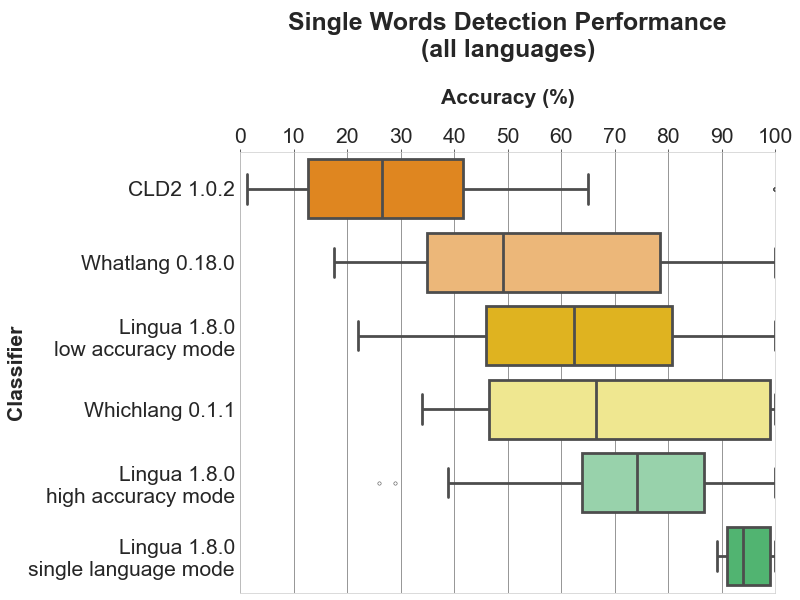
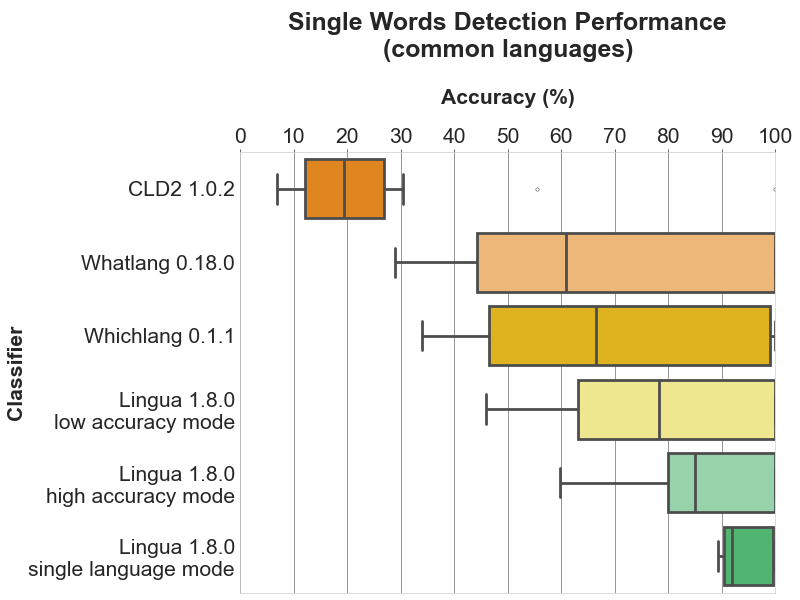
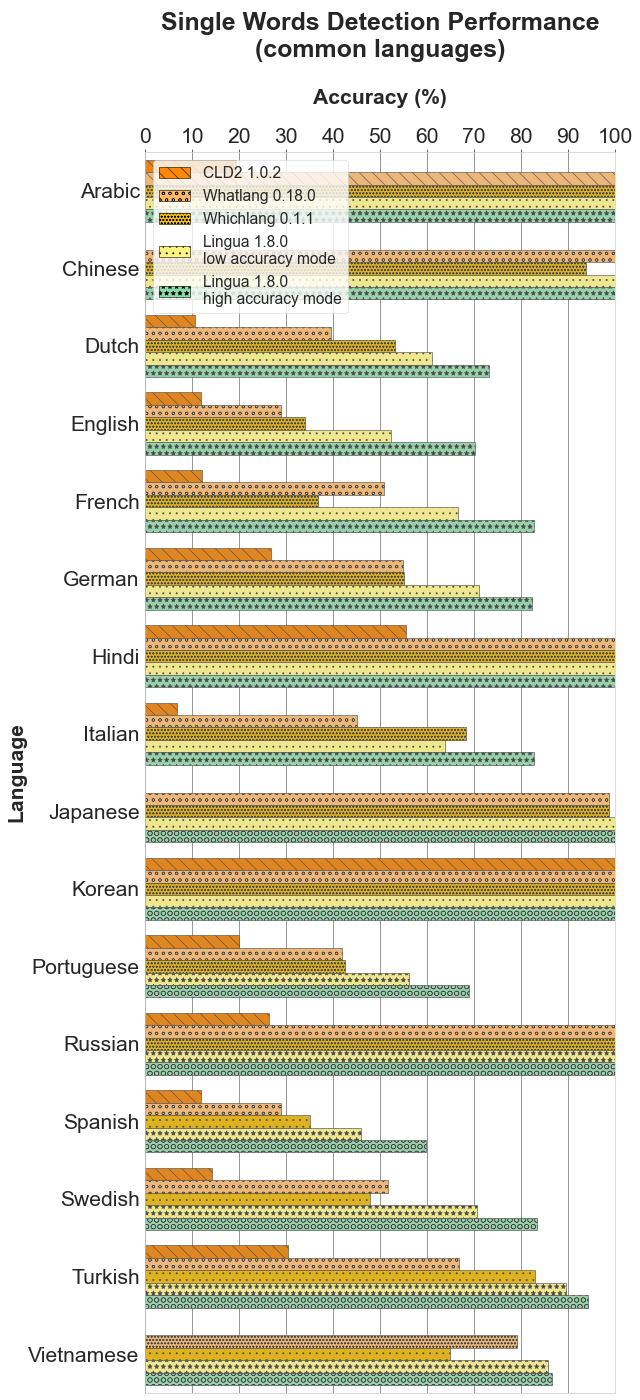
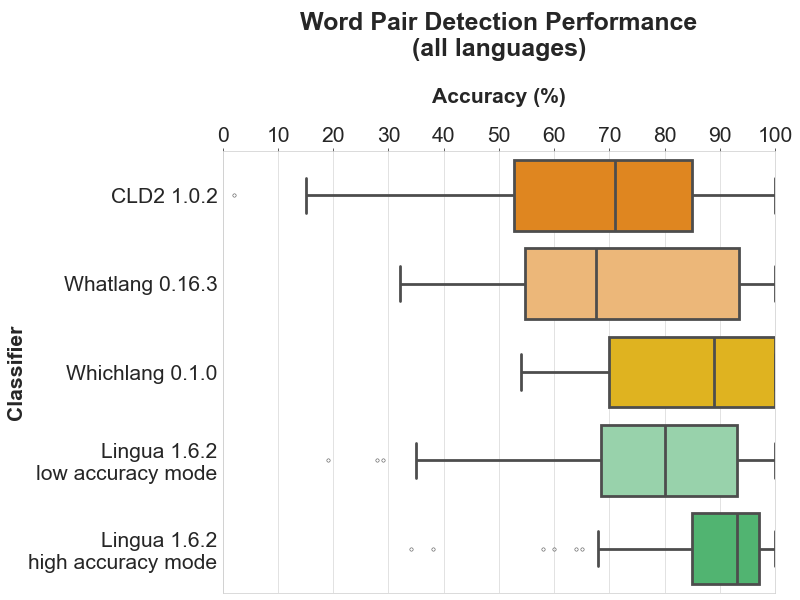
Each of the following sections contains five plots. The bar plots show the detailed accuracy results for each supported language. The box plots illustrate the distributions of the accuracy values for each classifier. The boxes themselves represent the areas which the middle 50 % of data lie within. Within the colored boxes, the horizontal lines mark the median of the distributions.
The first three plots in each section show the results for all supported languages in each classifier, respectively. The last two plots are restricted to the common subset of currently 16 languages that is supported by all compared classifiers. This distinction makes sense because the first box plot creates the impression that Whichlang is the most accurate classifier, but it is not. Whichlang supports only 16 languages whereas Lingua supports 75 languages. For the last box plot, the supported languages in Whatlang and Lingua have been restricted to those 16 languages supported by Whichlang. This provides for a more accurate comparison and shows that overall, Lingua is the most accurate language detection library in this comparison.
4.1 Single word detection
4.1.1 All languages

Bar plot

4.1.2 Common languages
Bar plot
4.2 Word pair detection
4.2.1 All languages

Bar plot

4.2.2 Common languages
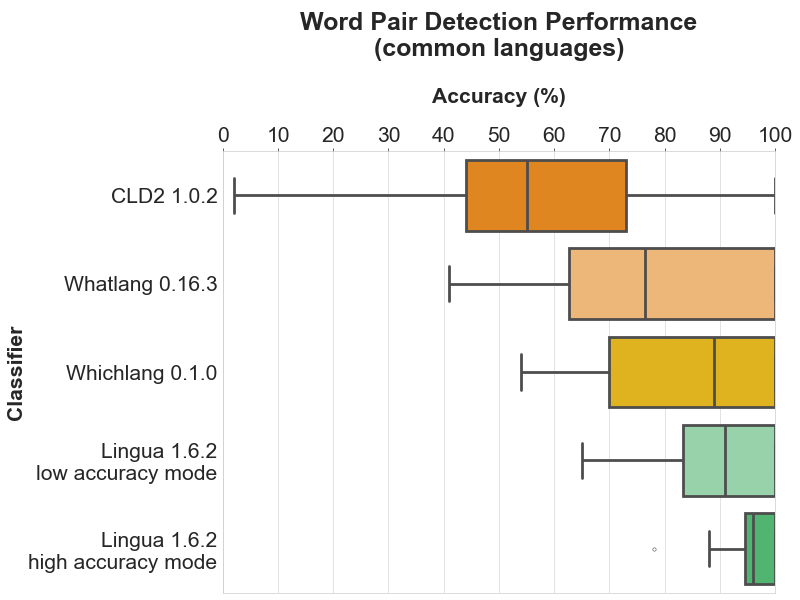
Bar plot
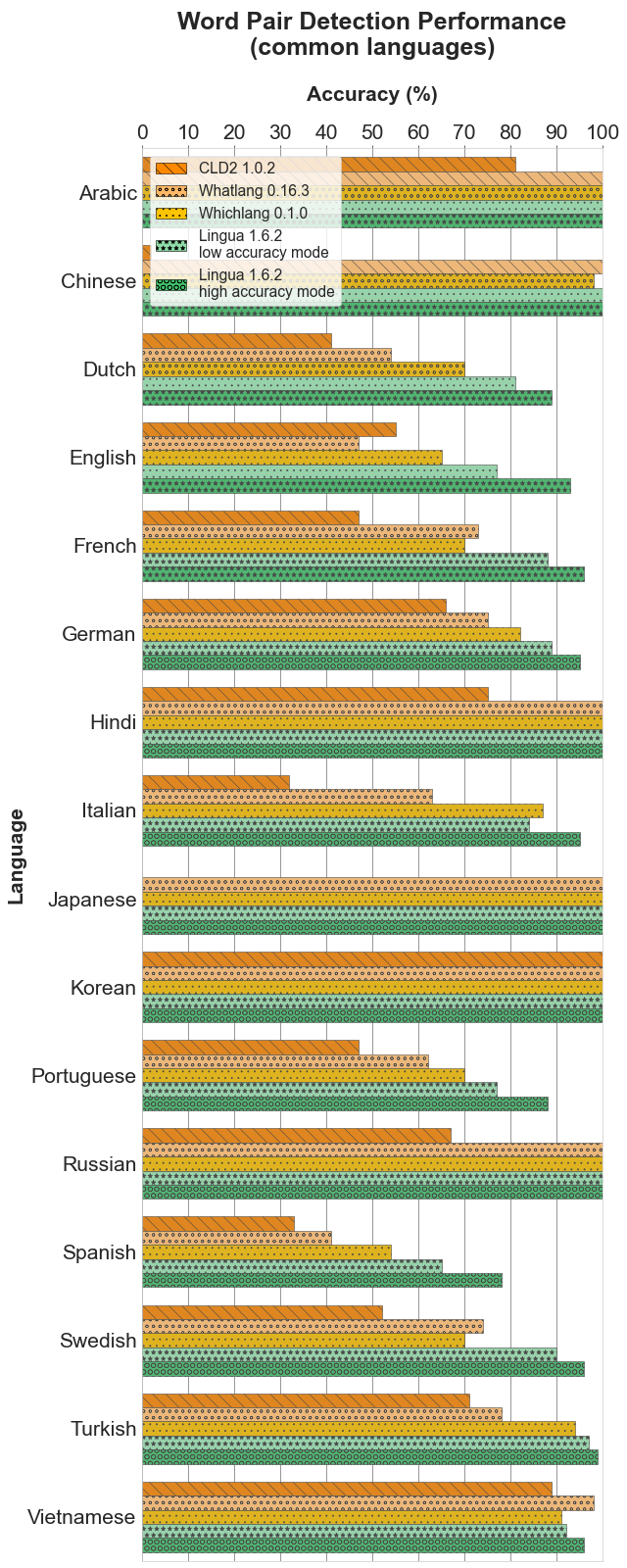
4.3 Sentence detection
4.3.1 All languages
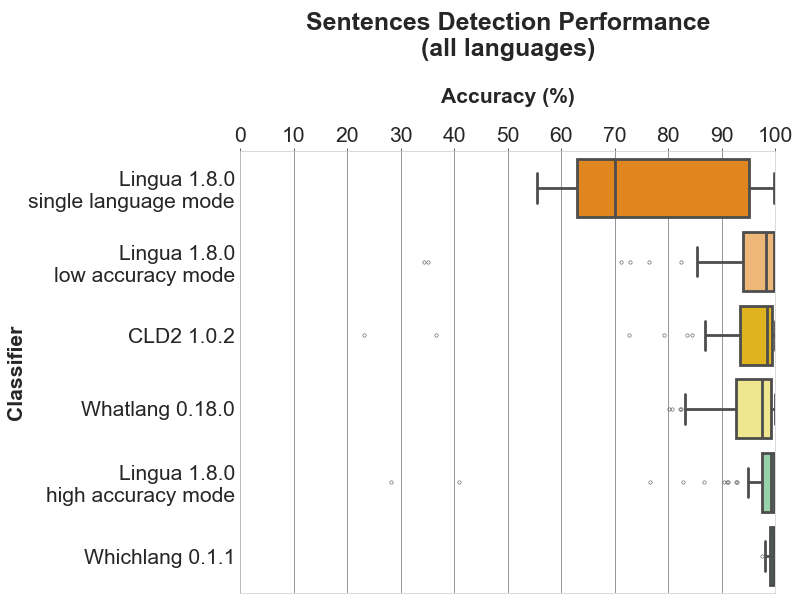

Bar plot

4.3.2 Common languages
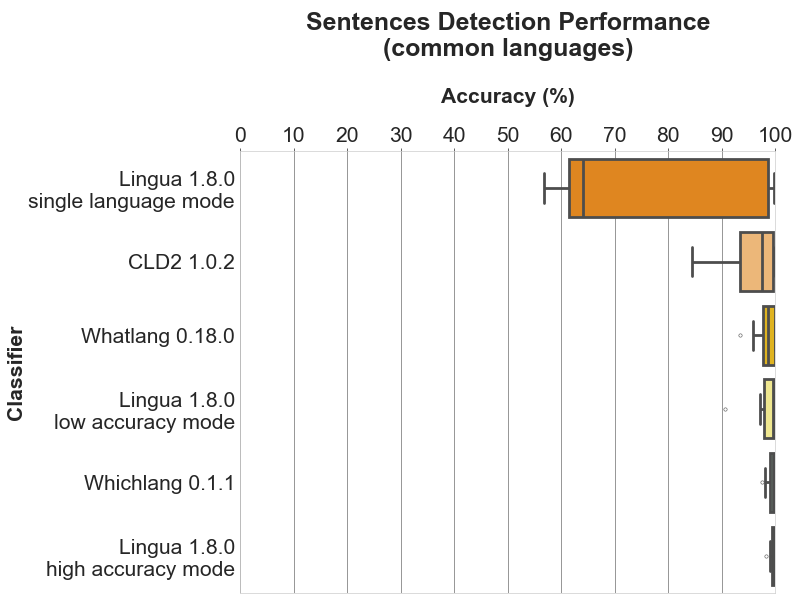
Bar plot
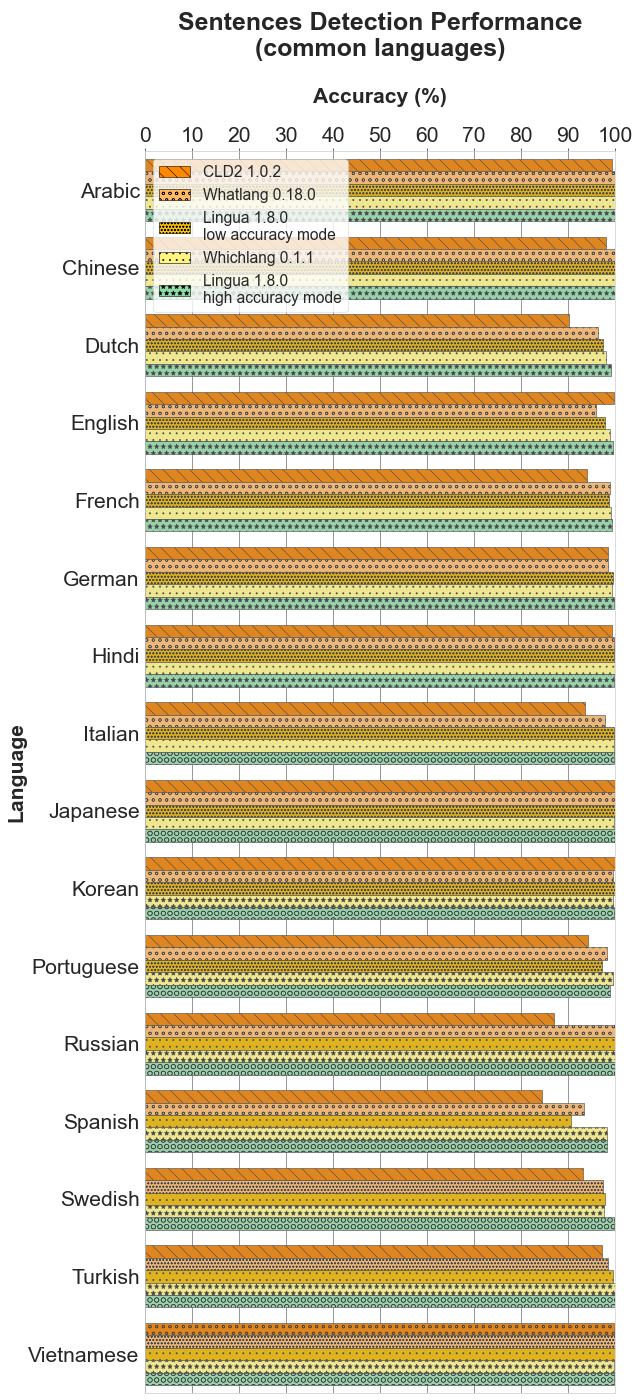
4.4 Average detection
4.4.1 All languages
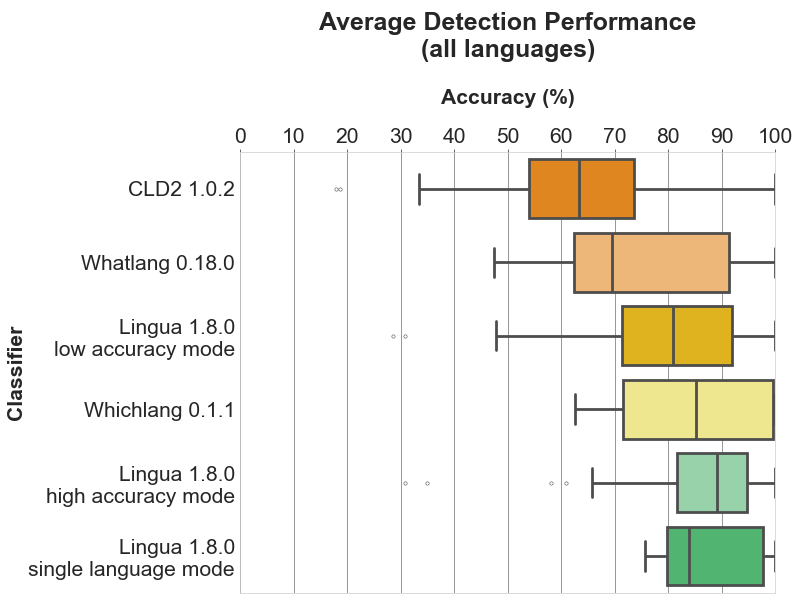

Bar plot

4.4.2 Common languages
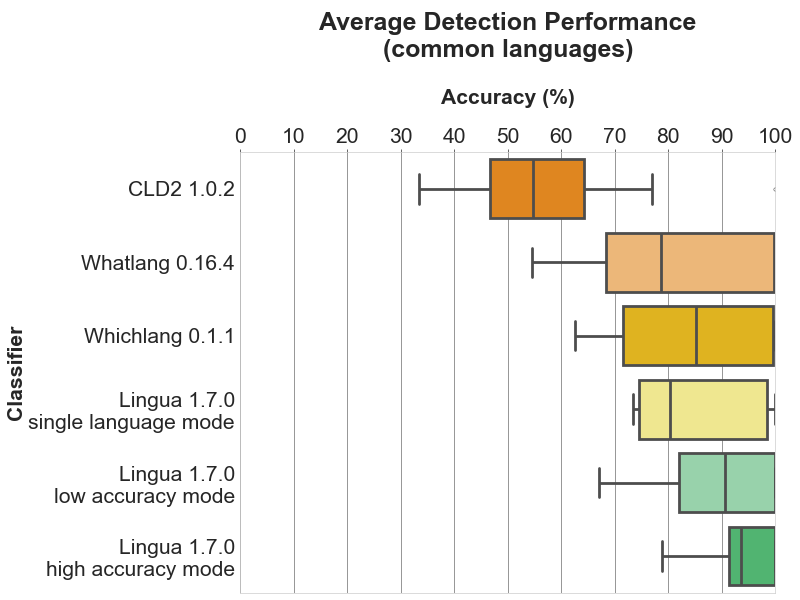
Bar plot
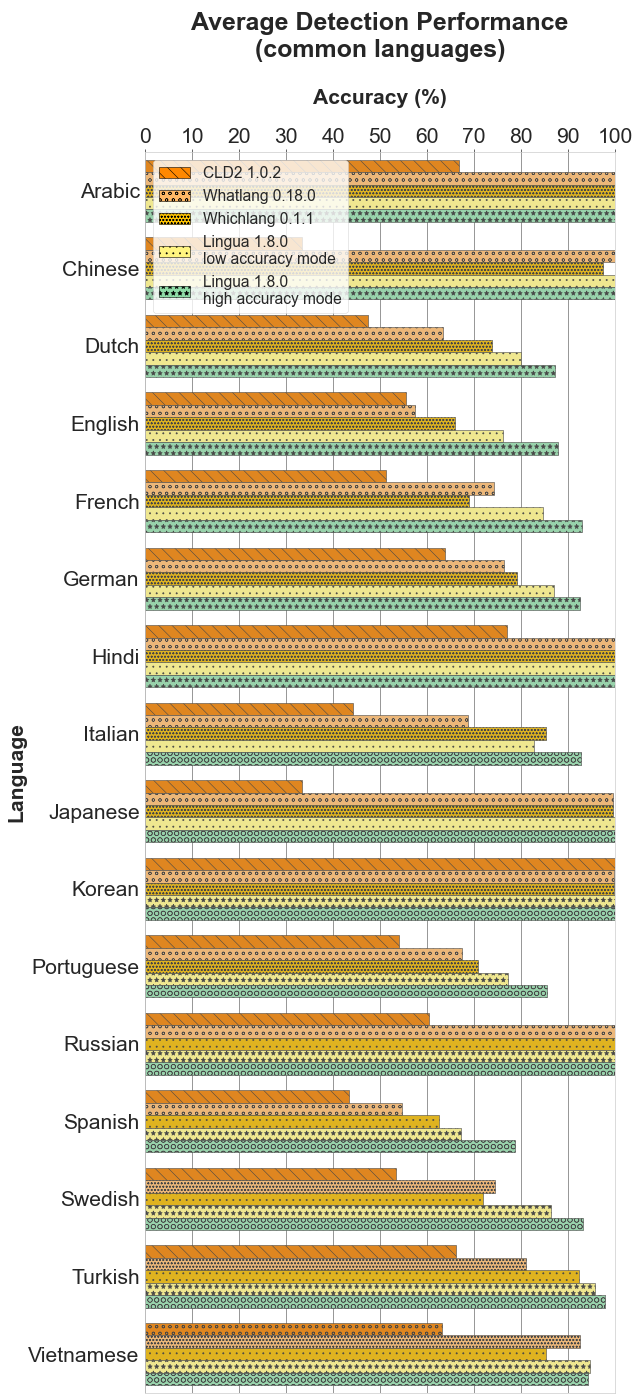
4.5 Mean, median and standard deviation
The tables found here show detailed statistics for each language and classifier including mean, median and standard deviation.
5. How fast is it?
Various benchmarks for all classifiers can be run via:
cargo bench --features benchmark
The benchmarks measure the processing time for classifying 2,000 sentences available in the common 16 languages that are supported by each language detector. The results below have been produced on an iMac 3.6 Ghz 8-Core Intel Core i9 with 40 GB RAM. Whichlang has the shortest processing time, Lingua the longest.
| Detector | Single Thread | Multiple Threads |
|---|---|---|
| Whichlang | 4.47 ms | 651.89 µs |
| CLD 2 | 23.92 ms | 4.81 ms |
| Whatlang (common languages) | 36.24 ms | 4.67 ms |
| Whatlang (all languages) | 89.11 ms | 10.68 ms |
| Lingua (low accuracy mode, common languages) | 492.50 ms | 62.01 ms |
| Lingua (high accuracy mode, common languages) | 640.30 ms | 109.43 ms |
| Lingua (low accuracy mode, all languages) | 2.0448 s | 229.23 ms |
| Lingua (high accuracy mode, all languages) | 3.1243 s | 407.69 ms |
The accuracy reporter script measures the time each language detector needs to classify 3000 input texts for each of the supported 75 languages.
| Detector | Time |
|---|---|
| Whichlang | 0.28 sec |
| CLD 2 | 1.70 sec |
| Whatlang | 7.84 sec |
| Lingua (low accuracy mode, multi-threaded) | 11.81 sec |
| Lingua (high accuracy mode, multi-threaded) | 21.13 sec |
6. Why is it better than other libraries?
Every language detector uses a probabilistic n-gram model trained on the character distribution in some training corpus. Most libraries only use n-grams of size 3 (trigrams) which is satisfactory for detecting the language of longer text fragments consisting of multiple sentences. For short phrases or single words, however, trigrams are not enough. The shorter the input text is, the less n-grams are available. The probabilities estimated from such few n-grams are not reliable. This is why Lingua makes use of n-grams of sizes 1 up to 5 which results in much more accurate prediction of the correct language.
A second important difference is that Lingua does not only use such a statistical model, but also a rule-based engine. This engine first determines the alphabet of the input text and searches for characters which are unique in one or more languages. If exactly one language can be reliably chosen this way, the statistical model is not necessary anymore. In any case, the rule-based engine filters out languages that do not satisfy the conditions of the input text. Only then, in a second step, the probabilistic n-gram model is taken into consideration. This makes sense because loading less language models means less memory consumption and better runtime performance.
In general, it is always a good idea to restrict the set of languages to be considered in the classification process using the respective api methods. If you know beforehand that certain languages are never to occur in an input text, do not let those take part in the classifcation process. The filtering mechanism of the rule-based engine is quite good, however, filtering based on your own knowledge of the input text is always preferable.
Even when taking all language models into account, the library uses only a few dozen megabytes of memory during runtime. This is because the models are stored as finite-state transducers (FSTs). FSTs allow to be searched on disk without actually reading them entirely into memory, making the library suitable for low-resource environments.
7. How to reproduce the accuracy results?
If you want to reproduce the accuracy results above, you can generate the test reports yourself for all classifiers and all languages by executing:
cargo build --release --bin accuracy_reports --features accuracy-reports
./target/release/accuracy_reports
Accuracy reports for only a subset of classifiers and / or languages can be created by passing command line arguments:
./target/release/accuracy_reports --detectors cld2 lingua-high-accuracy --languages bulgarian german
It is important to use the --release flag here because loading the language models in debug mode takes too much time.
For each detector and language, a test report file is then written into
/accuracy-reports,
to be found next to the src directory. As an example, here is the current output of the Lingua German report (high accuracy mode):
##### German #####

>>> Accuracy on average: 89.23%

>> Detection of 1000 single words (average length: 9 chars)
Accuracy: 73.9%
Erroneously classified as Dutch: 2.3%, Danish: 2.1%, English: 2%, Latin: 1.9%, Bokmal: 1.6%, Basque: 1.2%, Esperanto: 1.2%, French: 1.2%, Italian: 1.2%, Swedish: 1%, Afrikaans: 0.8%, Tsonga: 0.7%, Nynorsk: 0.6%, Spanish: 0.6%, Yoruba: 0.6%, Finnish: 0.5%, Sotho: 0.5%, Welsh: 0.5%, Estonian: 0.4%, Irish: 0.4%, Polish: 0.4%, Swahili: 0.4%, Tagalog: 0.4%, Tswana: 0.4%, Bosnian: 0.3%, Icelandic: 0.3%, Romanian: 0.3%, Albanian: 0.2%, Catalan: 0.2%, Croatian: 0.2%, Indonesian: 0.2%, Lithuanian: 0.2%, Maori: 0.2%, Turkish: 0.2%, Xhosa: 0.2%, Zulu: 0.2%, Latvian: 0.1%, Malay: 0.1%, Slovak: 0.1%, Slovene: 0.1%, Somali: 0.1%

>> Detection of 1000 word pairs (average length: 18 chars)
Accuracy: 94.1%
Erroneously classified as Dutch: 0.9%, Latin: 0.8%, English: 0.7%, Swedish: 0.6%, Danish: 0.5%, French: 0.4%, Bokmal: 0.3%, Irish: 0.2%, Tagalog: 0.2%, Afrikaans: 0.1%, Esperanto: 0.1%, Estonian: 0.1%, Finnish: 0.1%, Italian: 0.1%, Maori: 0.1%, Nynorsk: 0.1%, Somali: 0.1%, Swahili: 0.1%, Tsonga: 0.1%, Turkish: 0.1%, Welsh: 0.1%, Zulu: 0.1%

>> Detection of 1000 sentences (average length: 111 chars)
Accuracy: 99.7%
Erroneously classified as Dutch: 0.2%, Latin: 0.1%
8. How to add it to your project?
Add Lingua to your Cargo.toml file like so:
[dependencies]
lingua = "1.8.0"
By default, this will download the language model dependencies for all 75 supported languages,
a total of approximately 300 MB. If your bandwidth or hard drive space is limited, or you simply
do not need all languages, you can specify a subset of the language models to be downloaded as
separate features in your Cargo.toml:
[dependencies]
lingua = { version = "1.8.0", default-features = false, features = ["french", "italian", "spanish"] }
9. How to build?
In order to build the source code yourself, you need the stable Rust toolchain installed on your machine so that cargo, the Rust package manager is available.
git clone https://github.com/pemistahl/lingua-rs.git
cd lingua-rs
cargo build
The source code is accompanied by an extensive unit test suite. To run them, simply say:
cargo test
With the help of PyO3 and Maturin, the library can be compiled to a Python extension module so that it can be used within any Python software as well. It is available in the Python Package Index and can be installed with:
pip install lingua-language-detector
To build the Python extension module yourself, create a virtual environment and install Maturin.
python -m venv .venv
source .venv/bin/activate
pip install maturin
maturin build
10. How to use?
10.1 Basic usage
use lingua::{Language, LanguageDetector, LanguageDetectorBuilder};
use lingua::Language::{English, French, German, Spanish};

let languages = vec![English, French, German, Spanish];
let detector: LanguageDetector = LanguageDetectorBuilder::from_languages(&languages).build();
let detected_language: Option<Language> = detector.detect_language_of("languages are awesome");

assert_eq!(detected_language, Some(English));
The entire library is thread-safe, i.e. you can use a single LanguageDetector instance and
its methods in multiple threads. Multiple instances of LanguageDetector share thread-safe
access to the language models, so every language model is loaded into memory just once, no
matter how many instances of LanguageDetector have been created.
10.2 Minimum relative distance
By default, Lingua returns the most likely language for a given input text. However, there are certain words that are spelled the same in more than one language. The word prologue, for instance, is both a valid English and French word. Lingua would output either English or French which might be wrong in the given context. For cases like that, it is possible to specify a minimum relative distance that the logarithmized and summed up probabilities for each possible language have to satisfy. It can be stated in the following way:
use lingua::LanguageDetectorBuilder;
use lingua::Language::{English, French, German, Spanish};

let detector = LanguageDetectorBuilder::from_languages(&[English, French, German, Spanish])
    .with_minimum_relative_distance(0.9)
    .build();
let detected_language = detector.detect_language_of("languages are awesome");

assert_eq!(detected_language, None);
Be aware that the distance between the language probabilities is dependent on the length of the
input text. The longer the input text, the larger the distance between the languages. So if you
want to classify very short text phrases, do not set the minimum relative distance too high.
Otherwise None will be
returned most of the time as in the example above. This is the return value for cases where
language detection is not reliably possible.
10.3 Confidence values
Knowing about the most likely language is nice but how reliable is the computed likelihood? And how less likely are the other examined languages in comparison to the most likely one? These questions can be answered as well:
use lingua::Language::{English, French, German, Spanish};
use lingua::LanguageDetectorBuilder;

fn main() {
    let languages = vec![English, French, German, Spanish];
    let detector = LanguageDetectorBuilder::from_languages(&languages).build();
    let confidence_values = detector
        .compute_language_confidence_values("languages are awesome")
        .into_iter()
        .map(|(language, confidence)| (language, (confidence * 100.0).round() / 100.0))
        .collect::<Vec<_>>();

    assert_eq!(
        confidence_values,
        vec![
            (English, 0.93),
            (French, 0.04),
            (German, 0.02),
            (Spanish, 0.01)
        ]
    );
}
In the example above, a vector of two-element tuples is returned containing all possible languages sorted by their confidence value in descending order. Each value is a probability between 0.0 and 1.0. The probabilities of all languages will sum to 1.0. If the language is unambiguously identified by the rule engine, the value 1.0 will always be returned for this language. The other languages will receive a value of 0.0.
There is also a method for returning the confidence value for one specific language only:
use lingua::Language::{English, French, German, Spanish};
use lingua::LanguageDetectorBuilder;

fn main() {
    let languages = vec![English, French, German, Spanish];
    let detector = LanguageDetectorBuilder::from_languages(&languages).build();
    let confidence = detector.compute_language_confidence("languages are awesome", French);
    let rounded_confidence = (confidence * 100.0).round() / 100.0;

    assert_eq!(rounded_confidence, 0.04);
}
The value that this method computes is a number between 0.0 and 1.0. If the language is unambiguously identified by the rule engine, the value 1.0 will always be returned. If the given language is not supported by this detector instance, the value 0.0 will always be returned.
10.4 Eager loading versus lazy loading
By default, Lingua uses lazy-loading to load only those language models on demand which are considered relevant by the rule-based filter engine. For web services, for instance, it is rather beneficial to preload all language models into memory to avoid unexpected latency while waiting for the service response. If you want to enable the eager-loading mode, you can do it like this:
LanguageDetectorBuilder::from_all_languages().with_preloaded_language_models().build();
Multiple instances of LanguageDetector share the same language models in memory which are
accessed asynchronously by the instances.
10.5 Low accuracy mode versus high accuracy mode
Lingua's high detection accuracy comes at the cost of being noticeably slower than other language detectors. This requirement might not be feasible for systems running low on resources. If you want to classify mostly long texts or need to save resources, you can enable a low accuracy mode that loads only a small subset of the language models into memory:
LanguageDetectorBuilder::from_all_languages().with_low_accuracy_mode().build();
The downside of this approach is that detection accuracy for short texts consisting of less than 120 characters will drop significantly. However, detection accuracy for texts which are longer than 120 characters will remain mostly unaffected.
An alternative for a faster performance is to reduce the set of languages when building the language detector. In most cases, it is not advisable to build the detector from all supported languages. When you have knowledge about the texts you want to classify you can almost always rule out certain languages as impossible or unlikely to occur.
10.6 Single-language mode
If you build a LanguageDetector from one language only it will operate in single-language mode.
This means the detector will try to find out whether a given text has been written in the given language or not.
If not, then None will be returned, otherwise the given language. In single-language mode, the detector decides based on a set of unique and most common n-grams which
have been collected beforehand for every supported language.
10.7 Detection of multiple languages in mixed-language texts
In contrast to most other language detectors, Lingua is able to detect multiple languages in mixed-language texts. This feature can yield quite reasonable results, but it is still in an experimental state and therefore the detection result is highly dependent on the input text. It works best in high-accuracy mode with multiple long words for each language. The shorter the phrases and their words are, the less accurate are the results. Reducing the set of languages when building the language detector can also improve accuracy for this task if the languages occurring in the text are equal to the languages supported by the respective language detector instance.
use lingua::DetectionResult;
use lingua::Language::{English, French, German};
use lingua::LanguageDetectorBuilder;

fn main() {
    let languages = vec![English, French, German];
    let detector = LanguageDetectorBuilder::from_languages(&languages).build();
    let sentence = "Parlez-vous français? \
        Ich spreche Französisch nur ein bisschen. \
        A little bit is better than nothing.";

    let results: Vec<DetectionResult> = detector.detect_multiple_languages_of(sentence);

    if let [first, second, third] = &results[..] {
        assert_eq!(first.language(), French);
        assert_eq!(
            &sentence[first.start_index()..first.end_index()],
            "Parlez-vous français? "
        );

        assert_eq!(second.language(), German);
        assert_eq!(
            &sentence[second.start_index()..second.end_index()],
            "Ich spreche Französisch nur ein bisschen. "
        );

        assert_eq!(third.language(), English);
        assert_eq!(
            &sentence[third.start_index()..third.end_index()],
            "A little bit is better than nothing."
        );
    }
}
In the example above, a vector of DetectionResult
is returned. Each entry in the vector describes a contiguous single-language text section,
providing start and end indices of the respective substring.
10.8 Single-threaded versus multi-threaded language detection
The LanguageDetector methods explained above all operate in a single thread.
If you want to classify a very large set of texts, you will probably want to
use all available CPU cores efficiently in multiple threads for maximum performance.
Every single-threaded method has a multi-threaded equivalent that accepts a list of texts and returns a list of results.
| Single-threaded | Multi-threaded |
|---|---|
detect_language_of | detect_languages_in_parallel_of |
detect_multiple_languages_of | detect_multiple_languages_in_parallel_of |
compute_language_confidence_values | compute_language_confidence_values_in_parallel |
compute_language_confidence | compute_language_confidence_in_parallel |
10.9 Methods to build the LanguageDetector
There might be classification tasks where you know beforehand that your language data is definitely not written in Latin, for instance (what a surprise :-). The detection accuracy can become better in such cases if you exclude certain languages from the decision process or just explicitly include relevant languages:
use lingua::{LanguageDetectorBuilder, Language, IsoCode639_1, IsoCode639_3};

// Include all languages available in the library.
LanguageDetectorBuilder::from_all_languages();

// Include only languages that are not yet extinct (= currently excludes Latin).
LanguageDetectorBuilder::from_all_spoken_languages();

// Include only languages written with Cyrillic script.
LanguageDetectorBuilder::from_all_languages_with_cyrillic_script();

// Exclude only the Spanish language from the decision algorithm.
LanguageDetectorBuilder::from_all_languages_without(&[Language::Spanish]);

// Only decide between English and German.
LanguageDetectorBuilder::from_languages(&[Language::English, Language::German]);

// Select languages by ISO 639-1 code.
LanguageDetectorBuilder::from_iso_codes_639_1(&[IsoCode639_1::EN, IsoCode639_1::DE]);

// Select languages by ISO 639-3 code.
LanguageDetectorBuilder::from_iso_codes_639_3(&[IsoCode639_3::ENG, IsoCode639_3::DEU]);
11. WebAssembly support
This library can be compiled to WebAssembly (WASM) which allows to use Lingua in any JavaScript-based project, be it in the browser or in the back end running on Node.js.
The easiest way to compile is to use wasm-pack. After the installation,
you can, for instance, build the library with the web target so that it can be directly used in the browser:
wasm-pack build --target web
By default, all 75 supported languages are included in the compiled wasm file which has a size of 288 MB, approximately.
If you only need a subset of certain languages, you can tell wasm-pack which ones to include:
wasm-pack build --target web -- --no-default-features --features "french,italian,spanish"
This creates a directory named pkg on the top-level of this repository, containing the compiled wasm files
and JavaScript and TypeScript bindings. In an HTML file, you can then call Lingua like the following, for instance:
<script type="module">
    import init, { LanguageDetectorBuilder } from './pkg/lingua.js';

    init().then(_ => {
        const detector = LanguageDetectorBuilder.fromAllLanguages().build();
        console.log(detector.computeLanguageConfidenceValues("languages are awesome"));
    });
</script>
There are also some integration tests available for Node.js and all major browsers. To run them, simply say:
wasm-pack test --node --headless --chrome --firefox --safari
The output of wasm-pack will be hosted in a separate repository which
allows to add further JavaScript-related configuration, tests and documentation. Lingua will then be added to the
npm registry as well, allowing for an easy download and installation within every JavaScript
or TypeScript project.
12. What's next for version 1.9.0?
Take a look at the planned issues.
13. Contributions
- Josh Rotenberg has written a wrapper for using Lingua with the Elixir programming language.
Compatibility
- Runs on
- GPU support unknown
What shows it
- no dependency or feature matches a backend row
- Native code
- Optional
- Binds native code: cld2-sys (feature accuracy-reports)
- Python bindings
- Has Python bindings
- lingua needs Python only with feature python
- License
- Apache-2.0
Compare with similar projects
Order: strongest tier first, then most downloads, then name, with unmeasured values last. A library counts downloads over 30 days. An app counts binary downloads per release. An app with none counts its crate downloads over 30 days. ML Rust runs this catalogue, so its closest project always gets a row.
| Project | Downloads | Dependents | Stars | Latest release | Runs on (GPU) | Native code | License |
|---|---|---|---|---|---|---|---|
|
An accurate natural language detection library, suitable for short text and mixed-language text Python bindings |
286,625 downloads over 30 days | 22 | 1,152 | 1.8.0 | GPU support unknown | Binds native code: cld2-sys (feature accuracy-reports) | Apache-2.0 |
|
whatlang-rs Featured
Fast and lightweight language identification library for Rust. |
882,019 downloads over 30 days | 74 | 1,087 | 0.18.0 | GPU support unknown | No native code found | MIT |
|
sentencex Listed
Sentence segmentation library with wide language support optimized for speed and utility. |
114,914 downloads over 30 days | 1 | 145 | 0.1.34 | GPU support unknown | No native code found | MIT |
|
whichlang Listed
A blazingly fast and lightweight language detection library for Rust. |
52,880 downloads over 30 days | 11 | 464 | 0.1.1 | GPU support unknown | No native code found | MIT |
|
A fast, low-resource Natural Language Processing and Error Correction library. |
8,412 downloads over 30 days | 6 | 679 | 0.6.4 | GPU support unknown | Binds native code: onig_sys (feature regex-onig) | Apache-2.0 OR MIT |
|
splintr Listed
Tokenizer for Rust and Python: pure Rust by default, with 18 bundled vocabularies and four backends covering BPE, SentencePiece and WordPiece. Its output matches Hugging Face tokenizers id for id on 14 model families, including GPT-2, Qwen, Whisper, T5 and BERT. Python bindings |
8,204 downloads over 30 days | 7 | 63 | 0.22.2 | GPU support unknown | Binds native code: pcre2-sys (feature pcre2) | MIT |
|
A fast and lightweight Rust library for splitting text into semantically meaningful chunks. |
864 downloads over 30 days | 3 | 4 | 0.1.1 | GPU support unknown | Binds native code: torch-sys (feature rust-bert) | MIT |
Why FeaturedIt passes every Featured gate.
What it meets
- It has 14 active dependents and 10 new dependents in 365 days. Featured needs 11 active dependents or 9 new dependents in 365 days.
- Active dependents are at 100% of their peak. Featured needs at least 50%.
- Docs are present. The release commit or a manifest ties the crate to the repository.
- No vulnerability advisory stays unpatched past the grace window. At least one version is neither a prerelease nor 0.0.x.
- The last activity is on 5 Nov 2026, 4 days ago. The rules expect an update within 800 days. Dormancy rule
Exact rules: Featured library. The check on applied thresholds version 9.
Every rule outcome, as the check records it
expected-interval: version 1.8.0 base 200, doubled for 286625 downloads per month, doubled for 14 active users: E = 800 daysdormancy: last activity 2026-11-05, 4 days ago, E = 800: activefeatured: featured: active_users 14, new_adopters 10, former_glory 1
Crates76 crates
- lingua Primary
- lingua-afrikaans-language-model
- lingua-albanian-language-model
- lingua-arabic-language-model
- lingua-armenian-language-model
- lingua-azerbaijani-language-model
- lingua-basque-language-model
- lingua-belarusian-language-model
- lingua-bengali-language-model
- lingua-bokmal-language-model
- lingua-bosnian-language-model
- lingua-bulgarian-language-model
- lingua-catalan-language-model
- lingua-chinese-language-model
- lingua-croatian-language-model
- lingua-czech-language-model
- lingua-danish-language-model
- lingua-dutch-language-model
- lingua-english-language-model
- lingua-esperanto-language-model
- lingua-estonian-language-model
- lingua-finnish-language-model
- lingua-french-language-model
- lingua-ganda-language-model
- lingua-georgian-language-model
- lingua-german-language-model
- lingua-greek-language-model
- lingua-gujarati-language-model
- lingua-hebrew-language-model
- lingua-hindi-language-model
- lingua-hungarian-language-model
- lingua-icelandic-language-model
- lingua-indonesian-language-model
- lingua-irish-language-model
- lingua-italian-language-model
- lingua-japanese-language-model
- lingua-kazakh-language-model
- lingua-korean-language-model
- lingua-latin-language-model
- lingua-latvian-language-model
- lingua-lithuanian-language-model
- lingua-macedonian-language-model
- lingua-malay-language-model
- lingua-maori-language-model
- lingua-marathi-language-model
- lingua-mongolian-language-model
- lingua-nynorsk-language-model
- lingua-persian-language-model
- lingua-polish-language-model
- lingua-portuguese-language-model
- lingua-punjabi-language-model
- lingua-romanian-language-model
- lingua-russian-language-model
- lingua-serbian-language-model
- lingua-shona-language-model
- lingua-slovak-language-model
- lingua-slovene-language-model
- lingua-somali-language-model
- lingua-sotho-language-model
- lingua-spanish-language-model
- lingua-swahili-language-model
- lingua-swedish-language-model
- lingua-tagalog-language-model
- lingua-tamil-language-model
- lingua-telugu-language-model
- lingua-thai-language-model
- lingua-tsonga-language-model
- lingua-tswana-language-model
- lingua-turkish-language-model
- lingua-ukrainian-language-model
- lingua-urdu-language-model
- lingua-vietnamese-language-model
- lingua-welsh-language-model
- lingua-xhosa-language-model
- lingua-yoruba-language-model
- lingua-zulu-language-model
Measurements and sources
Each signal row shows the raw value, its source and the fetch date. The Sources list gathers every distinct source on this page. Movement needs more history.
Sources6 sources
- Description: the crates.io description
- crates.io database dump, fetched
- RustSec advisory database, fetched
- GitHub repository, fetched
- crates.io package, fetched
- GitHub contributors, fetched
Adoption14 active dependents, 10 new dependents in 365 days1 not measured
| Signal | Value | Source | Fetched | Counts |
|---|---|---|---|---|
| Active dependents | 14 | crates.io database dump | Yes | |
| New dependents (365 days) | 10 | crates.io database dump | Yes | |
| Peak active dependents | 14 | crates.io database dump | Yes | |
| Active dependents as a share of the peak | 1 | crates.io database dump | Yes | |
| Binary downloads per release | Not measured | Yes |
MaintenanceLatest human commit: 4 days ago3 not measured
| Signal | Value | Source | Fetched | Counts |
|---|---|---|---|---|
| Latest human commit | 2026-11-05 | GitHub repository | Yes | |
| Latest release | 2026-03-09 | crates.io database dump | Yes | |
| First release | 2020-11-20 | crates.io database dump | Yes | |
| Latest version | 1.8.0 | crates.io database dump | Yes | |
| Days the oldest outside issue waits for a reply | 991 | GitHub repository | Yes | |
| Maintainer replies over 365 days | 8 | GitHub repository | Yes | |
| Repository archived | false | GitHub repository | Yes | |
| Repository gone | false | GitHub repository | Yes | |
| Release commit or manifest in the repo | true | crates.io package | Yes | |
| Published docs | true | crates.io database dump | Yes | |
| Latest release fails cargo check | Not measured | Yes | ||
| Build check date | Not measured | Yes | ||
| Build check toolchain | Not measured | Yes |
SecurityUnpatched vulnerabilities: none
| Signal | Value | Source | Fetched | Counts |
|---|---|---|---|---|
| Unpatched vulnerabilities past the grace window | none | RustSec advisory database | Yes | |
| RustSec unmaintained advisory | none | RustSec advisory database | Yes | |
| Deprecation notice | none | crates.io database dump | Yes | |
| Deprecated requirement | none | crates.io database dump | Yes |
Distribution19 releases, 286,625 downloads over 30 days5 not measured
| Signal | Value | Source | Fetched | Counts |
|---|---|---|---|---|
| Releases | 19 | crates.io database dump | Yes | |
| Downloads over 30 days | 286625 | crates.io database dump | Yes | |
| Binary downloads over the last 3 releases | Not measured | Yes | ||
| Homebrew installs on request over 365 days | Not measured | Yes | ||
| Repology repository families | Not measured | Yes | ||
| Docker pull growth over 90 days | Not measured | Yes | ||
| Docker pulls at the growth baseline | Not measured | Yes | ||
| Every version a prerelease | false | crates.io database dump | Yes | |
| Every version 0.0.x | false | crates.io database dump | Yes | |
| Every version yanked | false | crates.io database dump | Yes | |
| Crate deleted from crates.io | false | crates.io database dump | Yes |
Repository1,152 stars, 65 forks, 8 contributors, 537 commits. Stars alone never qualify a project.
| Signal | Value | Source | Fetched | Counts |
|---|---|---|---|---|
| GitHub stars | 1152 | GitHub repository | Yes — one part of the repository route | |
| GitHub forks | 65 | GitHub repository | Yes — one part of the repository route | |
| Contributors with a GitHub account | 8 | GitHub contributors | Yes — one part of the repository route | |
| Commits on the default branch | 537 | GitHub repository | No | |
| Repository's main crate left out of the entry | none | crates.io database dump | Yes |
Facts that never count
| Signal | Value | Source | Fetched | Counts |
|---|---|---|---|---|
| License | Apache-2.0 | crates.io database dump | No | |
| Runs on, from listed crates and their direct dependencies | GPU support unknown | crates.io database dump | No | |
| What shows each backend | no dependency or feature matches a backend row | crates.io database dump | No | |
| Native code, from listed crates and their dependencies | Binds native code: cld2-sys (feature accuracy-reports) | crates.io database dump | No | |
| Python bindings, from direct dependencies of listed crates | Has Python bindings: lingua needs Python only with feature python | crates.io database dump | No | |
| Crates that depend on a listed crate directly | 22 | crates.io database dump | No |
Corrections and review history
No correction applies to this entry.
Judgments
A judgment enters only through an approved issue and a merged pull request.
No judgment applies to this entry.