flowcat
Library New
Self-hosted native-Rust real-time voice-agent runtime — one binary, no Python or softswitch: transports, serializers, codec, and a speech-to-speech (Gemini Live) pipeline.
- Downloads
- 46
- Dependents
- 0
- Stars
- 127
- Forks
- 14
- Contributors
- 7
- Commits
- 68
- Latest release
- 0.1.0 ·
About
A native-Rust runtime for real-time voice agents — built to run on your own infrastructure. Flowcat carries a phone or WebRTC call through a composable media pipeline — transport in → VAD / turn-taking → STT · LLM · TTS (or a single speech-to-speech model) → transport out — as one self-contained binary you deploy in your own VPC (or fully air-gapped). No hosted control plane, no phone-home, no Python or FreeSWITCH sidecar to operate. You bring your own provider credentials; a call's audio and data never leave infrastructure you control.
It is a clean-room, native-Rust counterpart to the design of
pipecat: the same FrameProcessor
pipeline model and the same provider breadth, packaged for teams that need to
own the stack — self-hosted, auditable, and dense enough to run serious call
volume per box. No pipecat code is vendored — see NOTICE.
▶ Watch the overview:
Status: pre-1.0, building in the open.
New here? →
QUICKSTART.mdtakes you fromgit cloneto a running pipeline and a real audio round-trip in about five minutes (no credentials), then to a real agent you talk to in your browser — define it in YAML and run one binary (flowcat-server), no Rust required.
Read the full README
Why Flowcat
Most voice-agent platforms are hosted SaaS: your audio, transcripts, and call data flow through someone else's cloud, and you pay per minute. Flowcat is the opposite — a runtime you own and run yourself, for teams that can't or won't put regulated call traffic on a multi-tenant platform and want one auditable artifact instead of a fleet of services.
1. Own your voice stack
Flowcat is a single self-contained binary you deploy in your own VPC — or fully
air-gapped. There is no Flowcat cloud and no phone-home: the runtime reads
only its own FLOWCAT_* config and talks to the providers you configure with
your credentials. Pair it with the local STT/TTS/LLM connectors (Whisper,
Kokoro / Piper / XTTS, Ollama) and a call's audio and transcript never leave your
infrastructure. For data-residency, on-prem, and sovereignty requirements
(healthcare, finance, public sector), that's the deployment model itself — not a
checkbox bolted onto a SaaS.
2. Long-call memory — without the audio tax
Realtime models re-bill the whole conversation every turn — as bulky, expensive audio — so the usual way to keep long calls affordable, sliding-window compression, saves money by discarding the oldest turns (your agent forgets the account number from minute one). Flowcat's ContextRelay converts that accumulated audio context into a compact text transcript and reseeds the session: the model re-attends cheap text (~7× smaller, ~4× cheaper per token) instead of audio, and the whole conversation survives. The live voice path is unchanged — the agent still speaks native audio; the trade-off is that converted turns carry their words, not their prosody. Off by default, provider-agnostic. See the ContextRelay evaluation.
3. pipecat-compatible by design
If you know pipecat, you already know
Flowcat. It deliberately mirrors pipecat's architecture and public API model —
the FrameProcessor graph, the typed Frame taxonomy, the system-frame
priority / interruption model, and the STT/TTS/LLM/realtime service seams. You
bring the same mental model and the same vendor credentials; you get a single
static Rust binary instead of a Python process tree. See
Connectors & providers.
4. One process, room to scale
Because the media loop is Rust — no garbage collector, no GIL — one Flowcat process uses every core and holds a flat p99 from 10 to 2,000 concurrent calls on a single box, where an equivalent Python deployment grows a multi-second tail and needs a worker fleet. Read this as capacity and operational headroom, not as a claim about conversational latency: end-to-end voice latency is dominated by your STT/LLM/TTS providers (hundreds of ms) and Flowcat can't change that. What it guarantees is that the runtime itself never becomes the bottleneck or the source of a stall — so you provision fewer boxes and your tail stays predictable under load. See Benchmark & capacity.
5. Drive it from Python
You don't have to write Rust. Run Flowcat as a service and drive it from Python
at turn granularity: implement your conversation policy as a small HTTP
service (the RemoteBrain adapter, brain-http feature) and expose your Python
functions as tools over MCP. Your code never touches the per-frame path, so the
capacity profile above is preserved. In-process PyO3 bindings are on the
roadmap. See Using Flowcat from Python
and examples/.
Benchmark & capacity
What this measures: how much call volume one box absorbs before the runtime becomes the bottleneck, and how tight the tail stays under load. What it does not measure: end-to-end conversational latency — that's dominated by your STT/LLM/TTS providers (typically hundreds of ms), and Flowcat doesn't change it. Read the sub-millisecond figures below as framework/transport overhead — capacity and reliability headroom — not as the latency a caller hears.
A like-for-like benchmark on a single Azure Standard_FX16mds_v2 box (16 vCPU):
one Flowcat process (12 cores) vs pipecat in its real multiprocess
deployment (12 workers, SO_REUSEPORT, one per core — Python given every
advantage). Identical Rust WebSocket + μ-law load generator, full-duplex echo,
50 frames/s/call, 10 s per data point.
p99 round-trip latency vs concurrent calls
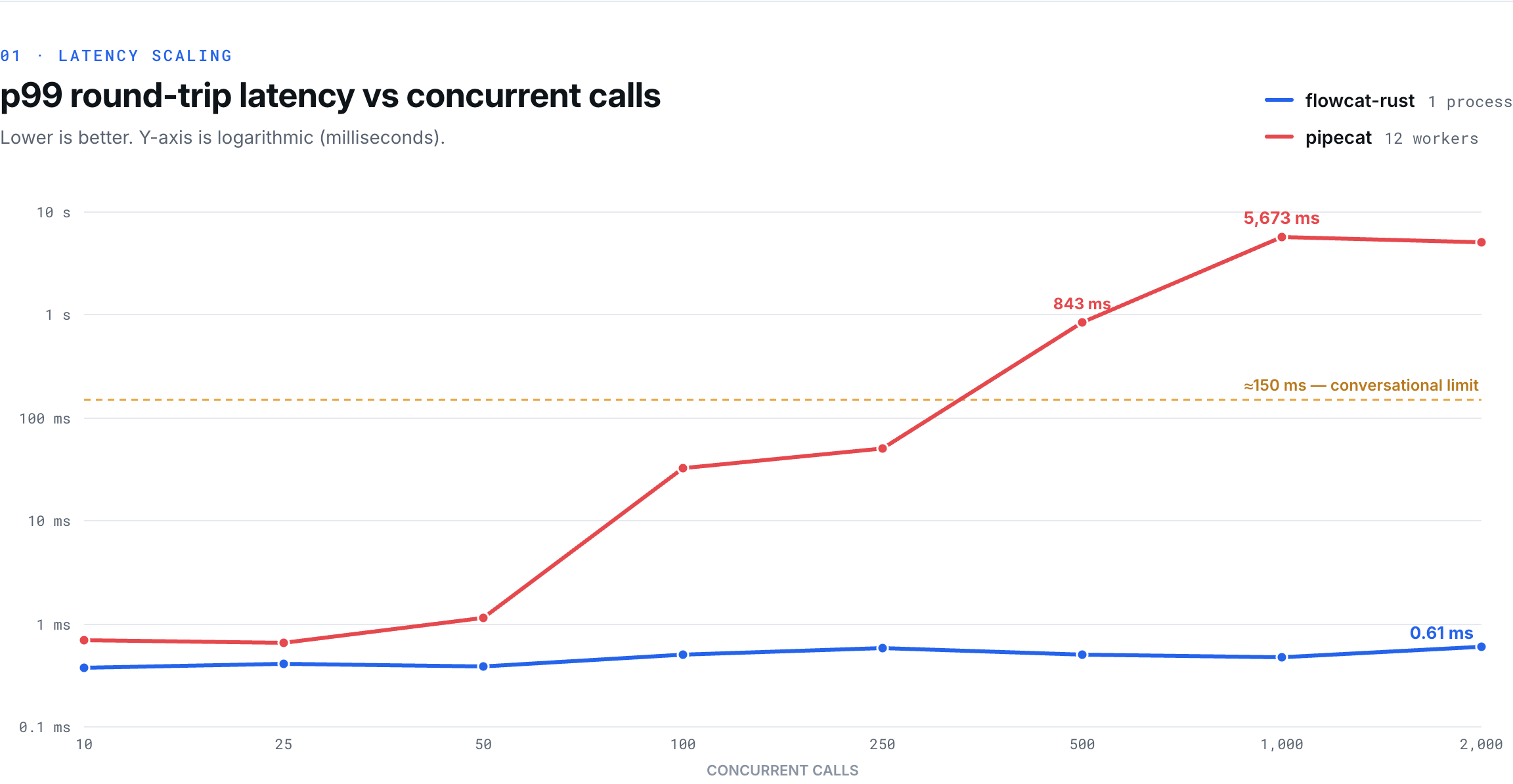
Flowcat's line is flat along the floor; pipecat crosses the ~150 ms conversational limit at a few hundred calls and reaches multi-second tails by 1,000.
| Concurrent calls | Flowcat (1 process) | pipecat (12 workers) |
|---|---|---|
| 250 | 0.59 ms p99 | 51 ms p99 |
| 500 | 0.51 ms p99 | 843 ms p99 |
| 1000 | 0.47 ms p99 | 5,673 ms p99 · 77% throughput |
| 2000 | 0.61 ms p99 | failing · 41% throughput (982 conns refused) |
Other measured metrics
| Metric | Flowcat (Rust) | pipecat (Python) | Ratio |
|---|---|---|---|
| Worst-case p99, 10→2,000 calls | 0.61 ms | 5,673 ms | — |
| Tail at 500 calls (matched load) | 0.51 ms | 843 ms | ~1,650× lower |
| Sustained throughput | 100% to 2,000 calls | collapses past ~250 | — |
| Per-frame routing (framework floor) | ~0.20 µs | ~106 µs | ~525× |
| RAM per idle session | ~19.6 KB | ≤ ~1 MB | ~50× tighter |
| Tasks per session | 7 tokio | 22 asyncio | — |
| Multi-core scaling (1→14 cores) | 8.4× (no GIL) | n/a (1 core/process) | — |
Full percentile distributions (p50 / p90 / p99 / p99.9 / max), the methodology,
and the phase history are in bench/RESULTS.md.
Reproduce it

docker compose -f bench/compose.yml up --build # on a 16-vCPU VM
See bench/README.md for the full harness and SKU notes.
Disclaimer. Numbers above are from the reproducible kit in this repo on the stated hardware; your results will vary with hardware and configuration. pipecat is an independent open-source project; it is used here as an architecture reference and a benchmark baseline. Flowcat is not affiliated with, sponsored by, or endorsed by Daily or the pipecat project. "pipecat" is referenced for identification and comparison only; all marks belong to their respective owners. See
NOTICE.
How to use it
Flowcat is a Cargo workspace of four library crates plus a demo binary. Nothing networked is in the default build — every provider, transport, and exporter is an opt-in Cargo feature.
# Build the whole workspace (default features only → no provider client deps).
cargo build

# Run the full fixture/wire test suite (no network, no credentials).
cargo test

# Build a "fat" binary that pulls in every provider client:
cargo build -p flowcat-services \
  --features stt-all,tts-all,llm-all,realtime-all,obs-all

# The demo binary — two runnable, credential-free demos:
cargo run -p flowcat-cli -- pipeline           # in-process FrameProcessor pipeline
cargo run -p flowcat-cli -- ws-echo --loopback # real WebSocket PCM echo round-trip
Run an agent from a config — no Rust
Don't want to embed Flowcat in a Rust binary? Run flowcat-server: describe
one agent in a YAML/JSON config (a node/edge graph + the realtime or cascaded
provider topology) and serve it over HTTP — no control plane, no database.
cargo build --release -p flowcat-server --features webrtc
GOOGLE_API_KEY=… ./target/release/flowcat-server --config deploy/agent.example.yaml
# open http://localhost:6210/ to talk to it (mic + live transcript), or bridge a
# Plivo number to the server's /telephony/ws/plivo/{run_id}
Providers are selected by name from the config (the flowcat-services
factory) and their keys come from the environment; the agent graph is run by
flowcat-agent. A Dockerfile, compose file, sample config, and env template are
in deploy/. The config schema lives in flowcat-server/src/config.rs.
Embed it in your own service
For full control (custom routing, your own control plane, in-process brain logic), embed the library and implement three seams:
FrameProcessorpipeline — composetransport.input() → vad → stt → llm → tts → transport.output()(or a single realtime S2S model) into aPipeline, drive it with aPipelineTask/PipelineRunner. Each processor runs in its own tokio task behind a bounded channel (natural backpressure).AgentBrain— your conversation decision-making. Flowcat never sees your control-plane, REST contract, or database; the brain is a trait seam. (Don't want to write Rust? The ready-madeRemoteBrainadapter implements this seam against an HTTP service — see Using Flowcat from Python.)SessionSource— how a call is bootstrapped and finalized.
The runtime is provider- and contract-agnostic: it knows nothing about any
downstream control plane. Full processor-author contract:
PROCESSOR-DESIGN.md and
CONTRIBUTING.md.
Feature-flag model
flowcat-core defaults to ["sip", "recorder"] (no HTTP/gRPC/ONNX). Every
provider, transport, and exporter is dep:-gated, so adding the 80th provider
costs the default build nothing. Umbrella features (stt-all, tts-all,
llm-all, realtime-all, obs-all) exist for the CLI and CI. Full enumeration:
FEATURES.md.
The
flowcatCLI ships two demos (the analogue of pipecat'sexamples/), both credential-free and exercised in CI:pipelinedrives a synthetic sine-wave source through a composableFrameProcessorpipeline in-process, andws-echoechoes PCM over the real WebSocket transport (--loopbackfor a self-contained round-trip, or--connect <ws://url>to a live peer). Seeflowcat-cli/src/.
Using Flowcat from Python
Flowcat is a Rust runtime, but you don't have to write Rust to use it. The media loop (SIP/RTP, VAD, STT/LLM/TTS) runs in Rust; your Python runs at turn granularity over a network boundary, so it never sits on the per-audio-frame path that determines tail latency.
- Drive the conversation policy — the
RemoteBrainadapter (flowcat-services, featurebrain-http) implements theAgentBrainseam by POSTing to two JSON endpoints you host. Decide transitions, what to say, and when to end the call — in Python. Reference server + wire contract:examples/python-remote-brain. - Expose Python functions as tools — run an MCP server; Flowcat's
mcpclient lists and calls its tools.examples/python-mcp-tools.
In-process PyO3 bindings — import flowcat, build a pipeline in Python, pass
Python callables as the brain — are on the roadmap; they will keep
Python at turn granularity to preserve the same tail-latency guarantees.
Connectors & providers
Start here: the live-verified path. The Gemini Live + Plivo combination — speech-to-speech over WebSocket-media telephony — is the one path run end-to-end against the real services today. Build on it first, and treat everything below as wire-ready but unproven until you run it yourself.
Beyond that, Flowcat carries a broad provider catalogue, each connector one
dep:-gated Cargo feature so the default build pulls none of their client
dependencies:
| Category | Count | Examples |
|---|---|---|
| STT | 20 | Deepgram, AssemblyAI, Gladia, Cartesia, Azure, ElevenLabs, OpenAI/Whisper (+ Groq/Fal/xAI wrappers), Google/NVIDIA (gRPC), AWS Transcribe (SigV4), local Whisper |
| TTS | 29 | Cartesia, ElevenLabs, Deepgram, Rime, OpenAI (+ Groq/xAI), Azure, Hume, MiniMax, Fish, LMNT, Kokoro/Piper/XTTS (local), Google/NVIDIA (gRPC), AWS Polly (SigV4) |
| LLM | 23 | OpenAI (+ ~18 OpenAI-compatible wrappers: Groq, Together, Fireworks, OpenRouter, DeepSeek, …), Anthropic, Google Gemini, AWS Bedrock (SigV4) |
| Realtime (S2S) | 7 | Gemini Live (in core), OpenAI Realtime (+ Azure/Grok/Inworld), Ultravox, AWS Nova Sonic |
| Transports | 5 | str0m WebRTC (+ Opus), WebSocket, Daily, LiveKit, local mic/speaker |
| Telephony serializers | 9 | Twilio, Telnyx, Plivo, Exotel, Vonage, Genesys, Asterisk, Cloudonix, Vobiz + DTMF (RFC2833 + in-band Goertzel) |
| Observability | 3 | OpenTelemetry, Sentry, Langfuse exporters |
The full feature-flag matrix is in FEATURES.md; how the distinct
(D) clients and thin (W) wrappers relate is in
PROVIDERS.md.
What "supported" means here — read this before you count providers. Every connector is fixture/wire-tested: unit tests pin its message framing (plus SigV4 known-answer tests for the AWS path), so the encode/decode seam is correct. They are not all exercised against the live service in CI — an end-to-end call needs that vendor's credentials. Today the Gemini Live + Plivo/Zadarma path is confirmed live end-to-end; the rest are a short step away but unproven until you run them. Live-verifying a provider against its real service is one of the most useful contributions you can make — see
CONTRIBUTING.md.
How it works
 carrier / WebRTC          FrameProcessor graph (each stage = 1 tokio task)
 ───────────────►  ┌──────────────────────────────────────────────────┐
   SIP / RTP       │  transport.in → vad/turn → stt → llm → tts → out  │
   WebSocket       │                    └──── or realtime S2S ────┘     │
 ◄───────────────  └──────────────────────────────────────────────────┘
                      system frames (Start/Cancel/Interruption/End)
                      jump the queue on a priority channel
- Typed
Frametaxonomy (audio / text / control / system). The hot audio frame is anArc<AudioFrame>, so each hop moves a pointer, not a buffer. - Each processor runs in its own tokio task fed by a bounded mpsc channel, giving natural backpressure on the output media leg. The per-hop channel cost is ~0.029 µs — three orders of magnitude under the audio frame period.
- System frames jump the queue.
Start/Cancel/Interruption/End/Stopride an unbounded priority channel and invoke a processor'sstart()/stop()lifecycle hooks, bypassingprocess_frame. - Native SIP/RTP, in-process — softswitch optional.
flowcat-corespeaks SIP (REGISTER + digest auth, INVITE/ACK/BYE) and hand-rolled RTP/SDP for G.711 telephony directly, so a single binary can terminate calls with no FreeSWITCH/Asterisk at all. That's a deployment choice, not a mandate — if you already run a softswitch, keep it in front and feed audio over the WebSocket media transport. (SIP-DESIGN.md.)
Design details: PROCESSOR-DESIGN.md (frozen API +
latency argument) and DESIGN.md (runtime architecture + trait
seams).
Crate map
flowcat/
├── flowcat-core/        # framework: Frame, FrameProcessor, Pipeline/Task/Runner,
│                        #   Observer/metrics, audio codec/resample/recorder,
│                        #   native SIP/RTP/SDP UA, Gemini Live, all trait seams
├── flowcat-services/    # every STT/TTS/LLM/realtime provider + obs exporters + MCP
│                        #   — one cargo feature each
├── flowcat-transports/  # str0m WebRTC + Opus, WebSocket, Daily, LiveKit, local
├── flowcat-telephony/   # carrier FrameSerializers (Twilio/Telnyx/Plivo/…) + DTMF
├── flowcat-agent/       # declarative graph agent — a config-driven AgentBrain
├── flowcat-server/      # config-driven single-agent server + browser playground
├── flowcat-cli/         # `flowcat` demo binary (DX / examples surface)
├── bench/               # the reproducible pipecat-vs-flowcat benchmark kit + RESULTS.md
├── bench-rs/            # standalone load-gen + framework micro-bench
├── PROCESSOR-DESIGN.md  # the frozen FrameProcessor API + latency argument
├── DESIGN.md            # runtime architecture + the trait seams
├── FEATURES.md          # the full feature-flag matrix
└── CONTRIBUTING.md      # how to add a provider + the processor-author contract
Contributing
Contributions welcome — start with CONTRIBUTING.md. Adding a
provider is usually a small, self-contained PR; the processor-author contract in
PROCESSOR-DESIGN.md §2.1–§2.3 is required reading.
License & attribution
Flowcat is licensed under Apache-2.0 (LICENSE). It is built to
the same architecture and API model as pipecat (BSD-2-Clause, © Daily), used as
a design reference; no pipecat source is vendored. Third-party provider
protocols, service names, and trademarks belong to their respective owners, and
their use requires your own credentials and acceptance of each vendor's terms.
Full attribution: NOTICE.
Compatibility
- Runs on
- GPU support unknown
What shows it
- no dependency or feature matches a backend row
- Native code
- Optional
- Binds native code: audiopus_sys (feature local), ort-sys (feature vad-ort), whisper-rs-sys (feature stt-whisper-local)
- Python bindings
- No Python binding crate found
- License
- Apache-2.0
Compare with similar projects
Order: strongest tier first, then most downloads, then name, with unmeasured values last. A library counts downloads over 30 days. An app counts binary downloads per release. An app with none counts its crate downloads over 30 days. ML Rust runs this catalogue, so its closest project always gets a row.
| Project | Downloads | Dependents | Stars | Latest release | Runs on (GPU) | Native code | License |
|---|---|---|---|---|---|---|---|
|
Self-hosted native-Rust real-time voice-agent runtime — one binary, no Python or softswitch: transports, serializers, codec, and a speech-to-speech (Gemini Live) pipeline. |
46 downloads over 30 days | 0 | 127 | 0.1.0 | GPU support unknown | Binds native code: audiopus_sys (feature local), ort-sys (feature vad-ort), whisper-rs-sys (feature stt-whisper-local) | Apache-2.0 |
|
any-tts Listed
A Rust TTS library with Candle backends and runtime adapters for modern open TTS models Also in Speech and audio. |
3,404 downloads over 30 days | 2 | 23 | 0.2.0 | CUDA, Metal | No native code found | Apache-2.0 OR MIT |
|
moshi Listed
moshi, a real-time voice AI Python bindings Also in Speech and audio. |
1,859 downloads over 30 days | 3 | 11,458 | 0.6.4 | CUDA, Metal | Binds native code: alsa-sys, openssl-sys, opusic-sys, sentencepiece-sys | Apache-2.0 OR MIT |
|
gradbot Listed
Open source framework to vibecode and prototype voice agents with Gradium APIs Also in Build LLM apps and agents. |
31 downloads over 30 days | 3 | 152 | 0.6.4 | GPU support unknown | No native code found | Apache-2.0 OR MIT |
|
qwen3-asr-rs Listed
Pure Rust implementation of Qwen3 ASR (Automatic Speech Recognition) with libtorch and MLX backends Also in Speech and audio. |
21 downloads over 30 days | 0 | 254 | 0.2.0 | CUDA | Binds native code: torch-sys (feature tch-backend). Build uses a native toolchain: cmake | Apache-2.0 |
|
cohere-transcribe-rs Listed
Rust implementation for the CohereLabs/cohere-transcribe-03-2026 speech-to-text model. Includes a CLI and an OpenAI-compatible API server. Also in Speech and audio. |
0 downloads over 30 days | 0 | 101 | 0.1.1 | CUDA | Binds native code: torch-sys (feature tch-backend). Build uses a native toolchain: cmake | Apache-2.0 |
|
voxr New
Audio and speech on boostr: compressed-audio decode, resampling, DSP and grapheme to phoneme, with speech synthesis (Kokoro, VITS), voice cloning (VoxCPM2), transcription with word timings (Whisper), voice activity (Silero) and audio-text scoring (CLAP), on CPU or CUDA. Also in Speech and audio. |
642 downloads over 30 days | 2 | 2 | 0.9.1 | CUDA | No native code found | Apache-2.0 |
All projects in Build LLM apps and agentsAll projects in Speech and audio
Why NewIts first release on 15 Jun 2026 is under 180 days old.
The check tests the Featured gates once the first release passes this age limit.
What else the check found
- The last activity is on 4 Oct 2026, 36 days ago. The rules expect an update within 365 days. Dormancy rule
Exact rules: New. The check on applied thresholds version 9.
Every rule outcome, as the check records it
expected-interval: version 0.1.0 base 80, capped at 1 releases = 50, raised to the 365-day floor: E = 365 daysdormancy: last activity 2026-10-04, 36 days ago, E = 365: activenew: new: first release 2026-06-15 is under 180 days old
Crates5 crates
Measurements and sources
Each signal row shows the raw value, its source and the fetch date. The Sources list gathers every distinct source on this page. Movement needs more history.
Sources6 sources
- Description: the crates.io description
- crates.io database dump, fetched
- RustSec advisory database, fetched
- GitHub repository, fetched
- crates.io package, fetched
- GitHub contributors, fetched
Adoption0 active dependents, 0 new dependents in 365 days1 not measured
| Signal | Value | Source | Fetched | Counts |
|---|---|---|---|---|
| Active dependents | 0 | crates.io database dump | Yes | |
| New dependents (365 days) | 0 | crates.io database dump | Yes | |
| Peak active dependents | 0 | crates.io database dump | Yes | |
| Active dependents as a share of the peak | 1 | crates.io database dump | Yes | |
| Binary downloads per release | Not measured | Yes |
MaintenanceLatest human commit: 36 days ago3 not measured
| Signal | Value | Source | Fetched | Counts |
|---|---|---|---|---|
| Latest human commit | 2026-10-04 | GitHub repository | Yes | |
| Latest release | 2026-06-15 | crates.io database dump | Yes | |
| First release | 2026-06-15 | crates.io database dump | Yes | |
| Latest version | 0.1.0 | crates.io database dump | Yes | |
| Days the oldest outside issue waits for a reply | 147 | GitHub repository | Yes | |
| Maintainer replies over 365 days | 0 | GitHub repository | Yes | |
| Repository archived | false | GitHub repository | Yes | |
| Repository gone | false | GitHub repository | Yes | |
| Release commit or manifest in the repo | true | crates.io package | Yes | |
| Published docs | false | crates.io database dump | Yes | |
| Latest release fails cargo check | Not measured | Yes | ||
| Build check date | Not measured | Yes | ||
| Build check toolchain | Not measured | Yes |
SecurityUnpatched vulnerabilities: none
| Signal | Value | Source | Fetched | Counts |
|---|---|---|---|---|
| Unpatched vulnerabilities past the grace window | none | RustSec advisory database | Yes | |
| RustSec unmaintained advisory | none | RustSec advisory database | Yes | |
| Deprecation notice | none | crates.io database dump | Yes | |
| Deprecated requirement | none | crates.io database dump | Yes |
Distribution1 releases, 46 downloads over 30 days5 not measured
| Signal | Value | Source | Fetched | Counts |
|---|---|---|---|---|
| Releases | 1 | crates.io database dump | Yes | |
| Downloads over 30 days | 46 | crates.io database dump | Yes | |
| Binary downloads over the last 3 releases | Not measured | Yes | ||
| Homebrew installs on request over 365 days | Not measured | Yes | ||
| Repology repository families | Not measured | Yes | ||
| Docker pull growth over 90 days | Not measured | Yes | ||
| Docker pulls at the growth baseline | Not measured | Yes | ||
| Every version a prerelease | false | crates.io database dump | Yes | |
| Every version 0.0.x | false | crates.io database dump | Yes | |
| Every version yanked | false | crates.io database dump | Yes | |
| Crate deleted from crates.io | false | crates.io database dump | Yes |
Repository127 stars, 14 forks, 7 contributors, 68 commits. Stars alone never qualify a project.
| Signal | Value | Source | Fetched | Counts |
|---|---|---|---|---|
| GitHub stars | 127 | GitHub repository | Yes — one part of the repository route | |
| GitHub forks | 14 | GitHub repository | Yes — one part of the repository route | |
| Contributors with a GitHub account | 7 | GitHub contributors | Yes — one part of the repository route | |
| Commits on the default branch | 68 | GitHub repository | No | |
| Repository's main crate left out of the entry | none | crates.io database dump | Yes |
Facts that never count
| Signal | Value | Source | Fetched | Counts |
|---|---|---|---|---|
| License | Apache-2.0 | crates.io database dump | No | |
| Runs on, from listed crates and their direct dependencies | GPU support unknown | crates.io database dump | No | |
| What shows each backend | no dependency or feature matches a backend row | crates.io database dump | No | |
| Native code, from listed crates and their dependencies | Binds native code: audiopus_sys (feature local), ort-sys (feature vad-ort), whisper-rs-sys (feature stt-whisper-local) | crates.io database dump | No | |
| Python bindings, from direct dependencies of listed crates | No Python binding crate found | crates.io database dump | No | |
| Crates that depend on a listed crate directly | 0 | crates.io database dump | No |
Corrections and review history
No correction applies to this entry.
Judgments
A judgment enters only through an approved issue and a merged pull request.
No judgment applies to this entry.