cmf
App Listed
One backbone, many specialists. CMF is a self-describing, memory-mappable single-file format and a dependency-free runtime for quantized LLMs — zero-copy execution on CPU or GPU (Vulkan · Metal · DX12) that overlays task-specialized skills onto one shared model, with no per-model duplication.
- Downloads
- 24
- Dependents
- Not applicable
- Stars
- 52
- Forks
- 7
- Contributors
- 2
- Commits
- 2,286
- Latest release
About
Русский: README.ru.md · 中文: README.zh.md
CMF — Cortiq Model Format
CMF is an auditable model container: one file can hold weights, tokenizer, chat metadata, task masks and skill overlays for inference without a large framework runtime.
CMF against other formats
The table scores the file format and its reference runtime out of 100. Each criterion gets 0–100 and a weight. The weights are ours and printed, so you can recompute the totals for your own needs. Ecosystem size (how many models are already published, how many third-party tools exist) is not a property of the file, so it is not scored.
Read the full README
| criterion | weight | CMF | GGUF | safetensors | ONNX | MLX | EXL3 | PyTorch .pt |
|---|---|---|---|---|---|---|---|---|
| Quantization range: encodings the format itself defines, from 16 bits to below 1 bit | 15 | 100 | 90 | 30 | 50 | 60 | 70 | 25 |
| Mixed codecs in one file: any codec on any tensor, re-quantization in place | 10 | 100 | 90 | 50 | 60 | 70 | 75 | 30 |
| Empty weights take no space: pruned neurons and experts are not stored, every layer keeps its own width | 15 | 100 | 45 | 30 | 60 | 25 | 25 | 30 |
| Flexibility, many tasks on one base: task masks, skills and expert routing inside one file | 15 | 100 | 40 | 35 | 20 | 30 | 20 | 35 |
| Self-contained file: tokenizer, chat template, multi-component pipelines | 10 | 100 | 80 | 30 | 45 | 30 | 25 | 25 |
| Integrity and authenticity: content hashes, verification, signature | 10 | 100 | 30 | 55 | 35 | 50 | 50 | 10 |
| Zero-copy, lazy loading: mmap, the GPU reads the mapped file, experts on demand | 10 | 100 | 90 | 85 | 40 | 80 | 60 | 40 |
| Safe evolution: an old reader refuses what it cannot run | 5 | 100 | 70 | 60 | 85 | 50 | 40 | 40 |
| Standalone runtime: no Python or ML framework, CPU and GPU | 10 | 90 | 100 | 30 | 70 | 50 | 15 | 0 |
| Weighted total | 100 | 99 | 69 | 42 | 49 | 48 | 42 | 26 |
The evidence behind the CMF column:
- 17 weight encodings in one directory.
- Float: f32, f16, bf16.
- 8-bit:
q8_row, andq8_2fwith row and column scales. - 4-bit:
q4_block,q4t,q4tp(predicted scales, 4.17 bits/weight), andmxfp4(re-packs OCP MXFP4 checkpoints without loss). - Variable 3–8 bits:
vbitandvbit_ro. - 2-bit:
q2tp. - Ternary:
q1t. - Binary:
q1,q1g(1.125 bits/weight), andq1s(binary plus outliers). - Below 1 bit/weight: binary low-rank
blr.
- Any encoding on any tensor. Every directory entry carries its own dtype.
--tensor-quant PATTERN=CODECpicks codecs at conversion.cortiq requantchanges them in an existing file without going back to the source checkpoint. - Empty weights take no space. A pruned FFN neuron or MoE expert is neither stored nor computed. Each layer keeps its own width and its own expert count, because the reader takes sizes from tensor shapes, not from one global number (spec §11). Experts and skills the current task does not use are never read from disk.
- Many tasks on one base.
- A task mask costs 1 bit per FFN neuron, attention head, layer and expert.
- Skills are replacement tensors in the same file and take memory only when used.
- A skill can also ship as a separate small file, bound to its base by hash.
- One file, pipelines included. The tokenizer and chat template are stored in the file. Image-editing models (transformer, text encoder, VAE and scheduler), video models and speech models are single files too.
- Integrity. Every tensor and every section has a hash.
cortiq verifychecks the whole chain, and an optional Ed25519 signature comes fromcortiq sign. A damaged file refuses to open instead of producing garbage. - Loading.
- Weights are page-aligned and tensors 64-byte aligned, and the file is memory-mapped.
- On Apple silicon the GPU reads tensors straight from the mapping, with no copy.
- MoE experts are paged in when the router picks them.
- Safe evolution. Every new capability gets a required-feature bit. A reader that does not know a bit refuses the file instead of guessing.
- Runtime. Written in Rust with no Python, it runs on CPU, Metal and
Vulkan/DX12. A separate Python reader (stdlib + numpy) is also provided.
cortiq import-ggufconverts GGUF files directly. CMF scores 90 rather than 100 in the last row because llama.cpp also has CUDA, ROCm and SYCL back ends.
The criteria, and the reasoning behind every other format's score, are in docs/COMPARISON.md.
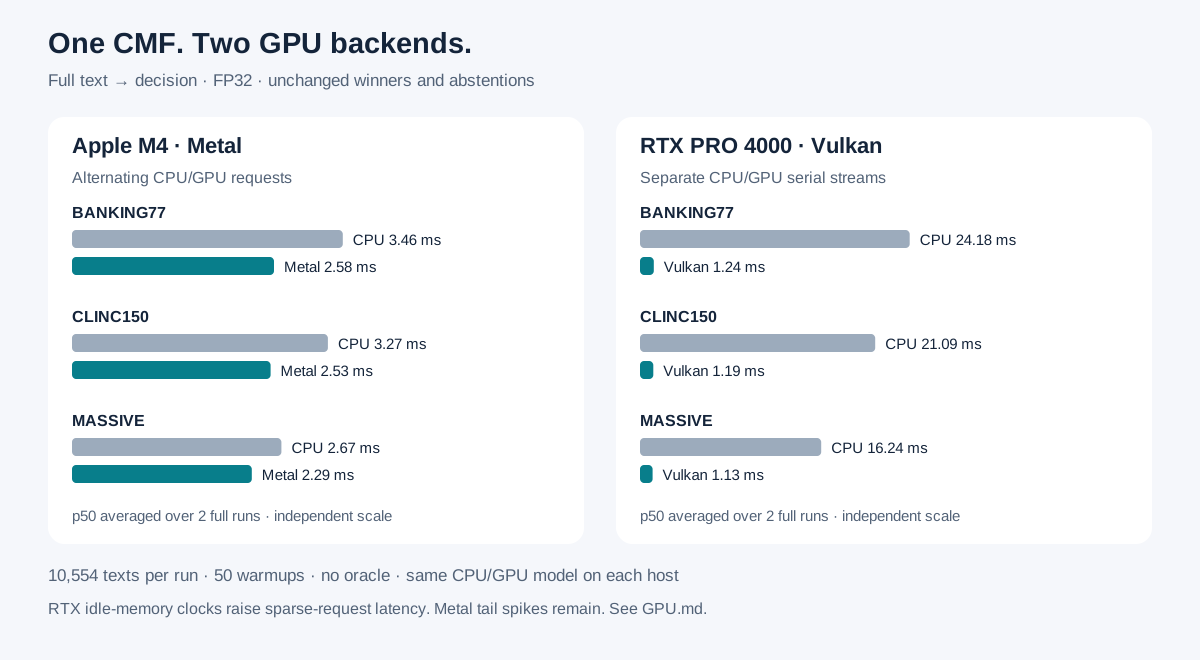
Decisions on Metal and Vulkan
Cortiq 0.8.0: one CMF file with trainable skills, local decisions by
reconstruction error — no token generation. CPU by default; select a GPU with
CORTIQ_DECISION_DEVICE=metal or vulkan. The standard crates.io installation
includes GPU support (Rust 1.88+).
Quick start, custom skills and API · Measurements and limits
Status
CMF v2 is the current on-disk format. Readers validate the envelope, section bounds, tensor metadata and hashes; incompatible changes require a feature bit or version bump. The Rust crate APIs are still pre-1.0 and may change.
The project is usable for local inference and format experiments. Treat model quality and speed numbers as workload-specific measurements, not guarantees; see the focused guides for the test setup behind each claim.
Quick start
Install the CLI and convert a small public checkpoint:
cargo install cortiq-cli --locked
cortiq convert --model Qwen/Qwen3-0.6B --quant q8 --output qwen.cmf
cortiq run qwen.cmf --prompt "What is the capital of France?" --greedy --no-think
Already have GGUF? Import it directly:
cortiq import-gguf model.gguf --output model.cmf
cortiq verify model.cmf
Serve it as an OpenAI-compatible API (chat and completions, streamed or not, a web dashboard on the same
port; --host 127.0.0.1 keeps it local):
cortiq serve model.cmf --port 8080
curl http://localhost:8080/v1/chat/completions -H "Content-Type: application/json" \
  -d '{"model": "cmf", "messages": [{"role": "user", "content": "Hello"}]}'
Ripple-65B Preview, a dense 65B in three files (0.8.60)
Ripple-65B Preview in four bits (34.6 GB), two bits (29.2 GB) and eight bits (64.8 GB), each file with the turbo header: on an NVIDIA A40 (46 GB) the four-bit file decodes at 12 tok/s from 4 000 to 64 000 tokens of prompt at 35 to 37 GB. On an RTX PRO 6000 it decodes at 29.8 tok/s (23.4 before this release), the eight-bit file reads a prompt at 156 tok/s against 43:
cortiq run ripple-65b-q4tp.cmf --prompt-file report.txt --greedy
A DFlash 2 drafter comes beside it (CMF_DFLASH=1), its block one device submission: code 30.2 → 46.6 tok/s
on the RTX PRO 6000, prose about even. See the card.
Qwen3.8-27B Turbo, drafts on a Mac and in a chat (0.8.59)
On a MacBook Air M4 (24 GB, no fan, the base M4's memory bus)
the turbo file decodes at 6.4 tok/s; with drafts it is
10 to 20, and the Neural Engine (CMF_ANE=1) reads a prompt of 3 600 tokens in 28 s against 74. Both switches are
off by default:
CMF_GRAPH_SPEC=1 cortiq run qwen38-27b-turbo.cmf --prompt-file report.txt --greedy --no-think
On Vulkan the depth of the draft chain follows what a round costs on the card: a chat on a 16 GB card runs at 29.8 tok/s against 26.5. See the guide.
Qwen3.8-27B Turbo, a fixed ceiling on the card (0.8.58)
The turbo file keeps device memory in place on long prompts, and a long prompt's rows go to RAM or to a fast SSD as they are read. It fits a 16 GB card at any prompt length. On an RTX 5090, at 64 000 tokens: 15.7 GB against 22.8 GB, first token 177 s against 316 s, decode 92 tok/s against 51, with passwords and codes in the text still exact:
cortiq run qwen38-27b-turbo.cmf --prompt-file report.txt --greedy --no-think --o1-spill /mnt/ssd/cortiq
See the guide.
Nemotron-Labs Dory 1.0 4B, a looped transformer (0.8.57)
Dory runs a block of 40 sub-layers several times over the same weights. The 2.09 GB turbo file picks one pass or two for each token with a resonance router, keeps a long prompt in 0.5 GB of device memory, and keeps passwords and codes exact, chosen by what the layers do with them. An NVIDIA L4 decodes at 61 tok/s on real prompts and at 54 tok/s at 64 000 tokens of context, a MacBook Air M4 at 33 and at 29 at 16 000:
cortiq run dory-turbo.cmf --prompt "Write a Rust function that reverses a list." --no-think
See the guide.
Kandinsky S2V 1.0 Pro-distill, speech to video (0.8.55)
Kandinsky S2V turns a reference frame and a speech track into an avatar video where the whole figure moves. One 24 GB file holds the 21B DiT, the speech and text encoders, CLIP and the VAE. An L40S renders 5 s of 512×512 video in 5.6 minutes at 16.2 GB of VRAM, a MacBook Air M4 in 4.45 hours at 14.6 GB of unified memory:
cortiq s2v --model kandinsky-s2v-pro-q4tp.cmf --image reference.png --audio speech.wav --out avatar.avi
See the guide.
Unlimited-OCR-2 and MiniCPM-OCR-1.0 (0.8.54)
Two OCR models. Unlimited-OCR-2 parses a whole document in one pass: its attention reads at most 512 tokens per step however long the document is. An RTX PRO 4500 decodes at 320 tok/s through 24 pages, a 10-core M4 at 95–112. MiniCPM-OCR-1.0 recognizes a page or a region at 254–267 tok/s, on the M4 at 73–102:
cortiq run unlimited-ocr-2-q8_2f.cmf --image page1.png --image page2.png --prompt "Multi page parsing." --max-tokens 8192
cortiq run minicpm-ocr-1.0-q8_2f.cmf --image page.png --prompt "Text Recognition:" --max-tokens 2048
Embryo-56M, a small model in its own architecture (0.8.53)
Embryo-56M has 56 million parameters, born and trained from scratch on one laptop GPU with no foreign weights: gated delta mixers and two bounded anchors, 10.1 MB of state at any context length, a 91 MB q8_2f file. It answers facts verbatim from records chosen by the reconstruction router, follows up on them, and refuses a factual question it has no record for. Outside the records it is a very small model: grammatical, short, often empty.
| tok/s | decode | after 2000 tokens | prefill |
|---|---|---|---|
| Apple M4 GPU | 650 | 535 | 820 |
| Apple M4 CPU | 470 | 379 | 430 |
| RTX 2000 Ada | 925 | 796 | 1230 |
| EPYC 7443P | 612 | 405 | 233 |
This is the first experimental version of a model built entirely on the technologies of Oleg Kirichenko. Larger models for different tasks and the mechanisms for training models will follow.
How it is assembled and what each gate measures: docs/EMBRYO_CHAT.md.
Clover-35B-A3B-Preview decodes causally (0.8.52)
The block-diffusion model now takes its ordinary causal path by default, with
the release's response penalties: q4tp-v2 runs at 120 tok/s on an RTX 5090
on both prose and code, 53 on a 16 GB budget, 13–18 on a Mac mini M4 (24 GB;
the prompt on Metal at ~170 tok/s, the rows on the CPU). CMF_CLOVER_MODE=denoise
keeps LowConfidence block denoising and CMF_CLOVER_MODE=draft adds the
vendor's self-speculation; the three are compared in docs/CLOVER.md.
SenseNova-Loop, Mage-VL-Cowork and Primal VAE (0.8.51)
SenseNova-Loop-9B-Preview runs a block of 24 decoder layers twice with shared weights and two mHC residual streams inside the loop; Mage-VL-Cowork is Microsoft's 4B computer-use agent over native-resolution screenshots; Primal VAE is Ostris's 1–2-channel 2× image autoencoder:
cortiq run sensenova-loop-9b-q4tp.cmf --image photo.jpg --prompt "Describe this image." --no-think
cortiq run mage-vl-cowork-q8_2f.cmf --image screen.png --prompt "Task: open the Downloads folder."
cortiq vae --model primal_vae_2x2.cmf --mode roundtrip --input photo.png --output recon.png
Greedy text and the vision rows match Transformers float32. Both vision towers run on the GPU (Vulkan and Metal); the loop and mHC run inside the wgpu and Metal token graphs; the VAE encodes or decodes a 1024×1024 image in one GPU submission (0.40 / 0.29 s on an NVIDIA A40).
Liquid AI LFM3 speech, Omni and d1 (0.8.50)
LFM3-Audio-2B transcribes and speaks (19 TTS languages, interleaved voice chat), LFM3-Omni-2B adds pictures and video, and the decision models d1-2B and d1-Omni-2B answer named questions about a state from one forward pass:
cortiq run lfm3-audio-2b-q8_2f.cmf --system "Perform ASR in English." --audio clip.wav --prompt ""
cortiq run lfm3-audio-2b-q8_2f.cmf --system "Perform TTS in American English using a female voice." \
  --prompt "Hello! How are you today?" --speech-out hello.wav
cortiq system-one d1-2b-q8_2f.cmf --state "I was charged twice and my parcel never arrived." \
  --questions '{"refund": {"type": "noul", "instructions": "Is this a refund request?"}}'
Transcripts match Transformers word for word and an f16 file reproduces its speech frames exactly; the codec travels inside the file. d1's whole pass runs in one GPU submission: one question in ~45 ms on an NVIDIA A40 and 79 ms on an Apple M4. On Apple silicon the Metal token graph now takes LFM3's short convolutions: LFM3-1.7B q4tp decodes 84 tok/s on an M4 (was 61).
Liquid AI LFM3 (0.8.49)
LFM3-1.7B, Liquid AI's tri-hybrid model for local agents and tool calling (short convolutions, full and sliding-window attention, 262k context), its pre-trained Base and the vision-language LFM3-VL-2B (images and video):
hf download infosave/LFM3-1.7B-cmf lfm3-1.7b-q8_2f.cmf --local-dir .
cortiq run lfm3-1.7b-q8_2f.cmf --prompt "Write a Python function that merges two sorted lists." --max-tokens 2048
cortiq run lfm3-vl-2b-q8_2f.cmf --image photo.jpg --prompt "Describe this image." --max-tokens 1024
The conversion matches Transformers float32 position for position. On an
NVIDIA A40 the 8-bit file decodes at 166 tok/s and the 4-bit one at 231 tok/s;
a 4096-token prompt reads at ~600 tok/s. The same release passes bos_token to
chat templates, which LFM2/LFM2.5/LFM3 prompts were missing.
Apex-35B-V1.0 and faster Qwen3.5-MoE graphs (0.8.48)
Apex-35B-V1.0, an agentic fine-tune of Qwen3.6-35B-A3B with tool calling and dynamic thinking:
hf download infosave/Apex-35B-V1.0-cmf apex-35b-v1.0-q4tp-v2.cmf --local-dir .
cortiq run apex-35b-v1.0-q4tp-v2.cmf --prompt "Write a Python function that merges two sorted lists." --max-tokens 4096
On an NVIDIA A40 the 4-bit file decodes at 80 tok/s and reads a 4096-token prompt at ~390 tok/s (first token in 10.5 s). The same release speeds up every Qwen3.5/3.6-MoE stack on Vulkan: the prompt of a q4tp MoE is read in 256-row chunks, speculation stays off where the MoE draft block would run on the host, and the token graph builds each layer's expert bank once instead of every token (Apex q4tp-v2: decode 52.9 → 80.3 tok/s, 4096-token prompt 172 → 390 tok/s against 0.8.45).
Spark-X2.6 on a Mac (0.8.43–0.8.44)
Spark-X2.6-4B on a Mac
mini M4 (24 GB): the default q8_2f file prefills a 1000-token prompt at ~205
tok/s and decodes at 16–19 tok/s; the q4tp file decodes at ~30 tok/s. A chat
turn through cortiq serve prefills only what changed since the previous
turn (2.3k-token history: 0.6 s instead of 11 s). Measurements and the
rejected levers: docs/SPARK26_METAL.md.
An Intel Mac with a Radeon Pro runs the same model on its GPU through wgpu:
CMF_GPU=wgpu cortiq run ... (the native Metal path needs unified memory and
falls back to the CPU there). Spark-X2.6-4B q4tp on a Radeon Pro 560X decodes
at ~16 tok/s against ~10 on the Mac's i9 (0.8.44).
Block-diffusion models (0.8.40)
Clover-35B-A3B-Preview writes its answer in 32-token blocks, resolving several tokens a pass by denoising instead of one token a step:
hf download infosave/Clover-35B-A3B-Preview-cmf clover-35b-a3b-preview-q4tp-v2.cmf --local-dir .
cortiq run clover-35b-a3b-preview-q4tp-v2.cmf --prompt "Write a Python function that merges two sorted lists." --no-think
With CMF_CLOVER_MODE=denoise, every denoising pass on Vulkan is one GPU
submission (34 ms for a 32-token block on an RTX 5090: ~26 tok/s on prose,
80–95 on code at the release's threshold) and on Apple silicon the passes run
on Metal (Mac mini M4, 24 GB: 3.2 tok/s on prose, 6.5–9 on code). Converting, the generation controls and the measurements:
docs/CLOVER.md. The same release cuts the VRAM of every
MoE graph on Vulkan: a 35B-A3B q4tp stack takes 18.8 GB instead of 31.8 GB,
and the published Qwen3.6-35B-A3B decodes at 156 tok/s on a 32 GB card.
Task compression in one command (0.8.39)
Turn a general model into a specialist for your prompts:
cortiq compress model.cmf prompts.jsonl model-task.cmf --ratio 0.9
The teacher answers the prompts (the model itself, another .cmf, or any
OpenAI-compatible API: --teacher openrouter:qwen/qwen3.8-27b, openai:MODEL,
api:MODEL --api-base URL); the FFN neurons the task does not use leave the
model (by activation illumination, or by a trained DTG-MA mask with
--select dtgma), their contribution is refit into the kept ones in closed
form, and the model is healed on the answers; held-out answers score it and
gate the output. MoE models drop the experts the task does not route to. The
output keeps the source's codec — quantize it separately. The device stages run
on NVIDIA (Vulkan) and on Apple Silicon (Metal) — since 0.8.42 the fold itself
too: one Qwen3.8-27B layer folds in 12 s on a Mac mini M4 instead of ~11 min
on its CPU, and with --keep-grams several target sizes fold from one
illumination. See the compress guide; the method and its
measurements are in the task-compression article,
and a full run on a large model in
Qwen3.8-27B → 14B, step by step
(the resulting model, its prompts and teacher dataset:
infosave/Qwen3.8-27B-Code-14B-Experimental-cmf).
Prompt-calibrated MTP draft compaction (0.8.38)
For a CMF that already carries a supported dense MTP draft, create a smaller draft calibrated to representative task prompts with one command:
cortiq compact source.cmf prompts.jsonl task-model.cmf
The source is used as the teacher and the command creates or reuses
task-model.tdata, writes an auditable plan, and verifies the runnable output.
It is physical MTP-draft compaction, not general fine-tuning: trunk weights and
greedy output remain verifier-controlled. See the MTP compaction guide
for JSONL input, safety gates, and Metal/Vulkan validation.
Tencent Hy-MT2 (HunYuan)
Version 0.7.0 adds the HunYuan architectures — the dense hunyuan_v1_dense
(Hy-MT2-1.8B / 7B) and the hy_v3 MoE (Hy-MT2-30B-A3B) — including the
family's q/k-norm-after-RoPE attention order and NTK-alpha RoPE base, and an
exact import-gguf path for Tencent's 1.25-bit STQ1_0 checkpoint into q1t.
Ready files: infosave/Hy-MT2-cmf.
0.7.0 also fixes the 0.6.9 crash on any non-Prism file with a 4-bit embedding.
0.7.1 puts the 30B's prompt through the resident graph on discrete cards
(8 → 65 tok/s of ingest) and its experts on the GPU on a 24 GB Mac, whose
Metal buffer cap splits the 15.8 GB file into windows (17.9 → 32 tok/s).
Native Qwen Image Edit
Version 0.6.9 adds the native Qwen-Image-Edit-2509 path and the explicit q2tp_affine Prism profile. The ready default is
one self-contained CMF, while the standalone component files remain available
when users want to stage them independently. Build the bundle from a directory
that contains transformer.cmf, text_encoder.cmf, vae.cmf, and
scheduler_config.json:
cortiq imagine-pack --bundle qwen-image \
  --out qwen-image/qwen-image-edit-2509-q4tp.cmf
The bundle embeds the transformer, Qwen2.5-VL text/vision encoder, tokenizer/processor/configuration, VAE, and scheduler. Run it directly with no companion files:
cortiq imagine qwen-image/qwen-image-edit-2509-q4tp.cmf \
  --image docs/media/fox-512.png \
  --prompt "Add a vivid blue knitted scarf while preserving the fox, pose, and snowy background." \
  --height 1024 --width 1024 --steps 40 --cfg 4 --seed 7 \
  --reference-size 1024 --out fox-scarf.png
The command requires at least one reference image; repeat --image for
additional references. PNG, JPEG, and PPM output are supported. CMF_GPU=0
forces the portable CPU path. The documented profile keeps
--reference-size 1024: this is the square root of the VAE reference area and
is independent of the requested output dimensions. On a capable Vulkan device,
cortiq imagine automatically selects the resident Qwen transformer forward:
hidden state stays on the device across transformer blocks and is read back once
at the end of each forward. CPU and Metal fallback paths remain available, and
the memory-budgeted admission chooses a compatible path when needed. See the
Qwen Image guide for pinned acquisition, standalone staging,
and bundle packing commands.
The standalone layout remains available for explicit component selection:
cortiq imagine qwen-image/transformer.cmf \
  --text-encoder qwen-image/text_encoder.cmf \
  --vae qwen-image/vae.cmf \
  --scheduler qwen-image/scheduler_config.json \
  --image docs/media/fox-512.png \
  --prompt "Turn the scene into a watercolor illustration." \
  --height 1024 --width 1024 --steps 40 --cfg 4 --seed 7 \
  --reference-size 1024 --out watercolor.png
For pinned sources and component packing, see the Qwen Image guide.
The CLI also exposes info, bench, ppl, serve, skill, moe-mask,
moe-defrag, requant, compact, sign, imagine, animate, s2v and
ltx-video. Run cortiq <command> --help for flags and current limitations.
Whisper transcription
Cortiq can convert a 128-bin Hugging Face Whisper checkpoint (including large-v3 and large-v3-turbo) to CMF, then transcribe WAV audio without a Python runtime:
cortiq convert --model openai/whisper-large-v3-turbo --quant q4tp \
  --output whisper-large-v3-turbo-q4tp.cmf
cortiq verify whisper-large-v3-turbo-q4tp.cmf
cortiq transcribe whisper-large-v3-turbo-q4tp.cmf interview.wav --language en
The Whisper q4tp profile keeps attention and the shared decoder token/output
matrix in q8_2f, feed-forward matrices in q4tp, and positional embeddings in
f16. It is a mixed-precision conversion, not a quality/parity guarantee; measure
WER on your languages and audio before deployment. WAV PCM/float is converted to
mono 16 kHz. Metal/wgpu are used when available; CMF_GPU=0 forces CPU. Full
30-second context is the default; CMF_WHISPER_TRIM_ENCODER=1 is experimental
and may affect recognition quality.
Nemotron 3.5 Transcribe (0.8.47)
cortiq-cli 0.8.47 runs NVIDIA Nemotron 3.5 Transcribe
30B-A4B
end to end in Rust: log-mel front end, ASR encoder, Sortformer diarization with
its speaker cache, the Mamba-2/attention/MoE decoder and word timestamps. Ready
files are on Hugging Face:
cortiq transcribe nemotron-3.5-transcribe-30b-a4b-q4tp.cmf meeting.wav
cortiq transcribe nemotron-3.5-transcribe-30b-a4b-q4tp.cmf meeting.wav --timestamps
cortiq transcribe nemotron-3.5-transcribe-30b-a4b-q4tp.cmf a.wav b.wav --stats
--prompt takes the model's instructions (clean transcript, <spk:N> speaker
tags, translation). On a GPU the decoder runs as a resident frame with
speculative decoding by its MTP layer; a card that cannot hold every routed
expert keeps the most used ones and computes the rest on the CPU
(CMF_NEMO_EXPERT_GB sets the budget). cortiq convert --model <checkpoint dir>
packs the NeMo checkpoint (--quant q8_2f | q4tp | q2tp).
Phonon 40M multilingual text-to-speech (0.8.36)
phonon-pack and tts are introduced in cortiq-cli 0.8.36. The currently
published 0.8.35 crate and older releases do not expose either command. Do not
expect a bare cargo install cortiq-cli to provide them until the v0.8.36 tag
and the 0.8.36 crates.io publication exist. After that release is published:
# Default installation includes GPU support and the Phonon bridge.
cargo install cortiq-cli --version 0.8.36 --locked

# Or build the portable CPU-only CLI while retaining Phonon support.
cargo install cortiq-cli --version 0.8.36 --locked \
  --no-default-features --features phonon
Package an upstream checkout only after accepting its terms, or download the ready CMF through the Hugging Face API CLI:
hf download gradium/phonon-40m-multilingual --local-dir phonon-source
cortiq phonon-pack phonon-source --output phonon-40m-multilingual-q8.cmf

hf download infosave/phonon-40m-multilingual-cmf \
  phonon-40m-multilingual-q8.cmf --local-dir .
cortiq verify phonon-40m-multilingual-q8.cmf
cortiq tts phonon-40m-multilingual-q8.cmf "Bonjour, monde." \
  --lang fr --temperature 0.3 --seed 4242424242424242 --out bonjour.wav
The CMF stores the upstream Q8 GGUF, configuration, tokenizer, and default
voice latent byte-for-byte; synthesis uses Gradium's maintained ptts runtime
after Cortiq validates and materializes those entries. This is a bridge, not a
claim of a native Phonon reimplementation. The model accepts only en,
fr, de, es, and pt: it does not support Russian or automatic language
detection, and --voice-file takes a precomputed compatible latent rather than
recorded-audio voice cloning. The upstream payload is CC-BY-NC-4.0. See the
model-card source for provenance and
the public test Space
for the currently deployed demo.
What a CMF file contains
- A fixed 128-byte envelope addressing every section.
- Header JSON with architecture, quantization defaults, chat metadata and provenance.
- A binary tensor directory with dtype, shape, offsets, lengths and
hash64. - A page-aligned weight blob that can be memory-mapped and read in place.
- Optional task masks, skill replacement tensors, tokenizer bytes and sparse indexes.
cortiq verify fails on malformed bounds or a hash mismatch; python/cmf_reader.py
is a small independent reader for inspection. The normative layout is in the
CMF v2 specification.
Quantization
Quantization is selected per tensor, so sensitive tensors can stay at a higher precision while large matrix blocks use a compact codec.
| Codec | Typical use |
|---|---|
f16, f32 | norms, embeddings and exact control tensors |
q8, q8_2f | high-fidelity weights; q8_2f adds input-channel scales |
q4, q4t, q4tp | general dense and MoE weights |
q2tp | existing dtype-16 midrise four-level codec; zero is not an individual code |
q2tp_affine | dtype-16 Prism profile with explicit (c - 1) * s affine operator; requires signed-Hadamard and affine metadata |
vbit, vbit_ro | size-constrained or mixed-bit profiles |
q1, q1t, q1s | trained binary or experimental ternary/PTQ paths |
q1g | trained binary with the native 128-weight scale group (1.125 bpw); a lossless requant --quant q1g of such a q1 file |
See Q1T/PTQ for the experimental low-bit path and the quantization coverage matrix for codec support by execution path.
The q2tp_affine profile is an explicit Prism/Bonsai operator, not a
reinterpretation of ordinary q2tp: its signed Hadamard descriptor and affine
feature metadata are required at load time, and older readers must reject it.
It preserves the public q2tp codec and its existing semantics unchanged.
Runtime capabilities
- CPU inference: portable Rust implementation with memory-mapped weights.
- GPU inference: native Metal on macOS and wgpu backends (Vulkan/DX12)
where the device and build support them. Use
CMF_GPU=1to request GPU. - Long context: optional
--o1attention uses fixed-size state and trades memory growth for a measured quality delta; measure on your model. - Skills: one backbone can carry task masks and replacement-tensor overlays; inactive overlays do not need a second full model copy.
- MoE: task masks and physical defragmentation can reduce the active expert set. Validate perplexity on held-out data before shipping a restriction.
- Speculative decode: supported MTP/draft paths are enabled only where the model metadata and measured acceptance make them useful.
- Serving:
cortiq serveprovides an OpenAI-compatible local HTTP API. - Media:
imagine,animateandltx-videopack model assets and run image, video or audio-capable pipelines when their model guides apply.
Platforms and model families
| Target | Support |
|---|---|
| Linux/macOS/Windows | CPU builds; GPU through the available wgpu backend |
| Apple Silicon | CPU and Metal paths; memory is shared with the system |
| NVIDIA/AMD GPUs | Vulkan or DX12 through wgpu where tested |
| Android/iOS integrations | See the companion mobile project and split guide |
Native conversion covers Qwen, Llama, Mistral, Gemma, Phi, DeepSeek, Kimi
Linear, MiniCPM and several MoE/video families. Model-specific constraints and
published files are indexed in the model guides. For an
unsupported checkpoint, try import-gguf and file a reproducible issue if it
fails.
Focused documentation
- CMF v2 specification — normative file layout.
- Format comparison — criteria and evidence.
- Skills — masks, overlays and routing workflows.
- Task compression — the
cortiq compressguide; the method article and the Qwen3.8-27B → 14B run. - GPU kernel recipes — backend measurements.
- Multi-GPU execution and mobile split.
- FCD restoration and low-bit PTQ.
- MTP FFN compaction — independent calibration and physical shrinking of the MTP draft's FFN.
- Qwen Image Edit — one-file native image editing and standalone component staging.
- Model cards and conversion notes.
- Cortiq Spectra — deterministic CPU streaming colorization for dual-energy X-ray captures, scanner profiles, refusal masks, and measured limits.
Build from source
cargo build --release --workspace
cargo build --release -p cortiq-cli --no-default-features  # CPU-only CLI
cargo test --workspace
The workspace is Apache-2.0. Read LICENSE, PATENTS.md, CONTRIBUTING.md and SECURITY.md before redistributing or reporting a vulnerability. Releases and checksums are listed on the GitHub releases page.
Compatibility
- License
- Apache-2.0
- Crate facts
- Not measured
- Runs on, Native code and Python bindings read crates on crates.io. This entry lists no crate.
Compare with similar projects
Order: strongest tier first, then most downloads, then name, with unmeasured values last. A library counts downloads over 30 days. An app counts binary downloads per release. An app with none counts its crate downloads over 30 days. ML Rust runs this catalogue, so its closest project always gets a row.
| Project | Downloads | Dependents | Stars | Latest release | Runs on (GPU) | Native code | License |
|---|---|---|---|---|---|---|---|
|
One backbone, many specialists. CMF is a self-describing, memory-mappable single-file format and a dependency-free runtime for quantized LLMs — zero-copy execution on CPU or GPU (Vulkan · Metal · DX12) that overlays task-specialized skills onto one shared model, with no per-model duplication. |
24 binary downloads per release | Not applicable | 52 | Not measured | Not measured | Apache-2.0 | |
|
safetensors Featured
Provides functions to read and write safetensors which aim to be safer than their PyTorch counterpart. |
5,486,837 downloads over 30 days | 531 | 3,943 | 0.8.0 | GPU support unknown | No native code found | Apache-2.0 |
|
onnx-extractor Listed
Minimal ONNX model loader for extracting weights, tensors, operations, and graph structure |
3,975 downloads over 30 days | 4 | 6 | 0.5.2 | GPU support unknown | No native code found | MIT |
|
gguf Listed
GGUF file parser |
2,472 downloads over 30 days | 4 | 25 | 0.1.8 | GPU support unknown | No native code found | MIT |
|
onnx-rs Listed
Zero-dependency ONNX model parser in Rust |
453 downloads over 30 days | 5 | 6 | 0.1.3 | GPU support unknown | No native code found | MIT |
|
Model conversion and quantization with no Python: reads SafeTensors, GGUF, TCF and PyTorch state dicts, writes SafeTensors, GGUF and TCF, and quantizes to Q2_K through Q8_0 and IQ4 formats, including Q4_K_M mixes. GPTQ, AWQ, NF4, FP8, EXL2 and ONNX input are not implemented. Python bindings |
23 downloads over 30 days | Not applicable | 0 | 0.2.1 | GPU support unknown | No native code found | Apache-2.0 |
All projects in Datasets and model formatsAll projects in Run and serve models
Why ListedNo archive, New or Featured rule places it, so it is Listed.
What it lacks for Featured
- The check holds no value for Homebrew installs on request over 365 days, Repology repository families, Docker pull growth over 90 days. A gate that lacks its signal does not pass.
What else the check found
- The last activity is on 9 Nov 2026, 0 days ago. The rules expect an update within 365 days. Dormancy rule
Not measured: First release, Homebrew installs on request over 365 days, Repology repository families, Docker pull growth over 90 days.
Exact rules: Listed, Featured app. The check on applied thresholds version 9.
Every rule outcome, as the check records it
expected-interval: app: E = 365 daysdormancy: last activity 2026-11-09, 0 days ago, E = 365: activefeatured: not featured: unknown homebrew_on_request_365d, repology_families, docker_pull_growth_90dlisted: listed: no archive, new or featured rule applies
Measurements and sources
Each signal row shows the raw value, its source and the fetch date. The Sources list gathers every distinct source on this page. Movement needs more history.
Sources4 sources
- Description: the GitHub repository description
- GitHub releases, fetched
- GitHub repository, fetched
- GitHub contributors, fetched
Adoption24 binary downloads per release4 not measured
| Signal | Value | Source | Fetched | Counts |
|---|---|---|---|---|
| Active dependents | Not measured | Yes | ||
| New dependents (365 days) | Not measured | Yes | ||
| Peak active dependents | Not measured | Yes | ||
| Active dependents as a share of the peak | Not measured | Yes | ||
| Binary downloads per release | 24 | GitHub releases | Yes |
MaintenanceLatest human commit: on the check date7 not measured
| Signal | Value | Source | Fetched | Counts |
|---|---|---|---|---|
| Latest human commit | 2026-11-09 | GitHub repository | Yes | |
| Latest release | 2026-11-09 | GitHub releases | Yes | |
| First release | Not measured | Yes | ||
| Latest version | Not measured | Yes | ||
| Days the oldest outside issue waits for a reply | 70 | GitHub repository | Yes | |
| Maintainer replies over 365 days | 19 | GitHub repository | Yes | |
| Repository archived | false | GitHub repository | Yes | |
| Repository gone | false | GitHub repository | Yes | |
| Release commit or manifest in the repo | Not measured | Yes | ||
| Published docs | Not measured | Yes | ||
| Latest release fails cargo check | Not measured | Yes | ||
| Build check date | Not measured | Yes | ||
| Build check toolchain | Not measured | Yes |
SecurityNot measured
| Signal | Value | Source | Fetched | Counts |
|---|---|---|---|---|
| Unpatched vulnerabilities past the grace window | Not measured | Yes | ||
| RustSec unmaintained advisory | Not measured | Yes | ||
| Deprecation notice | Not measured | Yes | ||
| Deprecated requirement | Not measured | Yes |
Distribution72 binary downloads over the last 3 releases10 not measured
| Signal | Value | Source | Fetched | Counts |
|---|---|---|---|---|
| Releases | Not measured | Yes | ||
| Downloads over 30 days | Not measured | Yes | ||
| Binary downloads over the last 3 releases | 72 | GitHub releases | Yes | |
| Homebrew installs on request over 365 days | Not measured | Yes | ||
| Repology repository families | Not measured | Yes | ||
| Docker pull growth over 90 days | Not measured | Yes | ||
| Docker pulls at the growth baseline | Not measured | Yes | ||
| Every version a prerelease | Not measured | Yes | ||
| Every version 0.0.x | Not measured | Yes | ||
| Every version yanked | Not measured | Yes | ||
| Crate deleted from crates.io | Not measured | Yes |
Repository52 stars, 7 forks, 2 contributors, 2,286 commits. Stars alone never qualify a project.1 not measured
| Signal | Value | Source | Fetched | Counts |
|---|---|---|---|---|
| GitHub stars | 52 | GitHub repository | Yes — one part of the repository route | |
| GitHub forks | 7 | GitHub repository | Yes — one part of the repository route | |
| Contributors with a GitHub account | 2 | GitHub contributors | Yes — one part of the repository route | |
| Commits on the default branch | 2286 | GitHub repository | No | |
| Repository's main crate left out of the entry | Not measured | Yes |
Facts that never count
| Signal | Value | Source | Fetched | Counts |
|---|---|---|---|---|
| License | Apache-2.0 | GitHub repository | No | |
| Runs on, from listed crates and their direct dependencies | Not measured | No | ||
| What shows each backend | Not measured | No | ||
| Native code, from listed crates and their dependencies | Not measured | No | ||
| Python bindings, from direct dependencies of listed crates | Not measured | No | ||
| Crates that depend on a listed crate directly | Not measured | No |
Corrections and review history
No correction applies to this entry.
Judgments
A judgment enters only through an approved issue and a merged pull request.
No judgment applies to this entry.