bhtsne
Library Listed
Exact and Barnes-Hut implementations of t-SNE.
- Downloads
- 11,593
- Dependents
- 2
- Stars
- 95
- Forks
- 8
- Contributors
- 4
- Commits
- 107
- Latest release
- 0.7.13 ·
About
Parallel Barnes-Hut and exact implementations of the t-SNE algorithm written in Rust. The tree-accelerated version of the algorithm is described with fine detail in this paper by Laurens van der Maaten. The exact, original, version of the algorithm is described in this other paper by G. Hinton and Laurens van der Maaten. Additional implementations of the algorithm, including this one, are listed at this page.
Installation
Add this line to your Cargo.toml:
[dependencies]
bhtsne = "0.7.12"
Documentation
The API documentation is available here.
Example
The implementation supports custom data types and custom defined metrics. For instance, general vector data can be handled in the following way.
Read the full README
use bhtsne;

const N: usize = 150;         // Number of vectors to embed.
const D: usize = 4;           // The dimensionality of the
                              // original space.
const THETA: f32 = 0.5;       // Parameter used by the Barnes-Hut algorithm.
                              // Small values improve accuracy but increase complexity.

const PERPLEXITY: f32 = 10.0; // Perplexity of the conditional distribution.
const EPOCHS: usize = 2000;   // Number of fitting iterations.

// Loads the data from a csv file skipping the first row,
// treating it as headers and skipping the 5th column,
// treating it as a class label.
// Do note that you can also switch to f64s for higher precision.
let data: Vec<f32> = bhtsne::load_csv("iris.csv", true, Some(&[4]), |float| {
    float.parse().unwrap()
})?;
let samples: Vec<&[f32]> = data.chunks(D).collect();

// Executes the Barnes-Hut approximation of the algorithm and writes the embedding to the
// specified csv file.
bhtsne::tSNE::<f32, &[f32], 2>::new(&samples)
    .perplexity(PERPLEXITY)
    .epochs(EPOCHS)
    .barnes_hut(THETA, |sample_a, sample_b| {
        sample_a
            .iter()
            .zip(sample_b.iter())
            .map(|(a, b)| (a - b).powi(2))
            .sum::<f32>()
            .sqrt()
    })
    .write_csv("iris_embedding.csv")?;
In the example euclidean distance is used, but any other distance metric on data types of choice, such as strings, can be defined and plugged in.
The tree-accelerated barnes_hut and barnes_hut_with_neighbors support an embedding dimensionality D of 2, 3, 4, 5, 6, or 7, the dimensionalities a Z-order code covers with ample precision (32, 21, 16, 25, 21, and 18 bits per axis, respectively). The exact exact path stays general for any D.
The Morton (Z-order) linear tree the Barnes-Hut path walks lives in the sibling barnes-hut-tree crate, which the workspace also publishes standalone. Any other force-approximation problem that needs a Z-order linear tree in a contiguous arena can pull it in directly through its Arena, Morton, and Dim API, without depending on bhtsne.
FIt-SNE
For larger datasets the crate also provides fit_sne and fit_sne_with_neighbors, an FFT-accelerated, interpolation-based fitting path (the FIt-SNE method of Linderman et al., the same algorithm openTSNE defaults to). They build the affinity graph exactly like barnes_hut (same vantage point tree, bandwidth search, symmetrization, and affinity cache) but approximate the repulsive forces in O(n) per epoch on an equispaced grid via a real FFT convolution, with no theta knob. They drop in place of barnes_hut:
bhtsne::tSNE::<f32, &[f32], 2>::new(&samples)
    .perplexity(PERPLEXITY)
    .epochs(EPOCHS)
    .fit_sne(|sample_a, sample_b| {
        sample_a
            .iter()
            .zip(sample_b.iter())
            .map(|(a, b)| (a - b).powi(2))
            .sum::<f32>()
            .sqrt()
    })
    .write_csv("embedding.csv")?;
fit_sne is restricted to an embedding dimensionality D of 1 or 2 (where the interpolation grid stays tractable). Its per-epoch cost is nearly flat in the point count, so it matches the parallel Barnes-Hut path around 50k points and is faster beyond; roughly 1.3x at 70k points and widening.
Parallelism
Being built on rayon, the algorithm uses the same number of threads as the number of CPUs available. Do note that on systems with hyperthreading enabled this equals the number of logical cores and not the physical ones. See rayon's FAQs for additional informations.
MNIST embedding
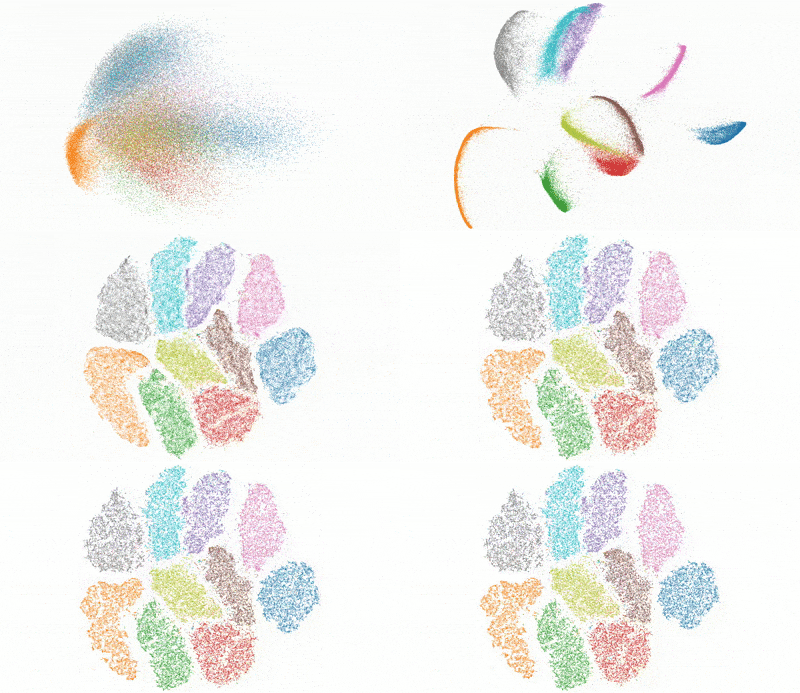
The following embedding has been obtained by preprocessing the MNIST train set using PCA to reduce its dimensionality to 20. It took approximately 20 seconds on a M5 MacBook Pro.
Compatibility
- Runs on
- GPU support unknown
What shows it
- no dependency or feature matches a backend row
- Native code
- None found
- No native code found
- Python bindings
- No Python binding crate found
- License
- MIT
Compare with similar projects
Order: strongest tier first, then most downloads, then name, with unmeasured values last. A library counts downloads over 30 days. An app counts binary downloads per release. An app with none counts its crate downloads over 30 days. ML Rust runs this catalogue, so its closest project always gets a row.
| Project | Downloads | Dependents | Stars | Latest release | Runs on (GPU) | Native code | License |
|---|---|---|---|---|---|---|---|
|
Exact and Barnes-Hut implementations of t-SNE. |
11,593 downloads over 30 days | 2 | 95 | 0.7.13 | GPU support unknown | No native code found | MIT |
|
augurs Listed
A time-series toolkit for forecasting, outlier detection, clustering and more. |
7,507 downloads over 30 days | 8 | 580 | 0.10.3 | GPU support unknown | No native code found | Apache-2.0 OR MIT |
|
radiate Listed
A Rust library for genetic algorithms and artificial evolution. Python bindings |
971 downloads over 30 days | 0 | 257 | 1.3.2 | GPU support unknown | No native code found | MIT |
|
genevo provides building blocks to run simulations of optimization and search problems using genetic algorithms (GA). Execute genetic algorithm (GA) simulations in a customizable and extensible way. |
372 downloads over 30 days | 1 | 185 | 0.7.1 | GPU support unknown | No native code found | Apache-2.0 OR MIT |
|
rust-automl Listed
Automated machine learning for classification and regression |
170 downloads over 30 days | 1 | 39 | 0.3.1 | GPU support unknown | No native code found | Apache-2.0 OR MIT |
|
Fast, parallel, extensible and adaptable genetic algorithm library. |
89 downloads over 30 days | 0 | 183 | 2.2.2 | GPU support unknown | No native code found | MPL-2.0 |
|
treeboost Listed
Gradient-boosted decision trees for tabular data: trains a baseline model in one call, with full control over boosting modes and configs, and Scalar, AVX-512, SVE2, WGPU and CUDA backends. Python bindings |
18 downloads over 30 days | 0 | 9 | 0.1.2 | CUDA, WebGPU | No native code found | Apache-2.0 |
Why ListedNo archive, New or Featured rule places it, so it is Listed.
What it lacks for Featured
- It has 3 active dependents and 0 new dependents in 365 days. Featured needs 11 active dependents or 9 new dependents in 365 days. The repository route reads 95 stars, 8 forks and 4 contributors. It needs 4,539 stars, 434 forks and 79 contributors together.
What else the check found
- The last activity is on 31 Aug 2026, 70 days ago. The rules expect an update within 450 days. Dormancy rule
Exact rules: Listed, Featured library. The check on applied thresholds version 9.
Every rule outcome, as the check records it
expected-interval: version 0.7.13 base 450: E = 450 daysdormancy: last activity 2026-08-31, 70 days ago, E = 450: activefeatured: not featured: active_users 3 < 11 and new_adopters 0 < 9 and repository route stars 95 (needs 4539), forks 8 (needs 434), contributors 4 (needs 79)listed: listed: no archive, new or featured rule applies
Measurements and sources
Each signal row shows the raw value, its source and the fetch date. The Sources list gathers every distinct source on this page. Movement needs more history.
Sources6 sources
- Description: the crates.io description
- crates.io database dump, fetched
- RustSec advisory database, fetched
- GitHub repository, fetched
- crates.io package, fetched
- GitHub contributors, fetched
Adoption3 active dependents, 0 new dependents in 365 days1 not measured
| Signal | Value | Source | Fetched | Counts |
|---|---|---|---|---|
| Active dependents | 3 | crates.io database dump | Yes | |
| New dependents (365 days) | 0 | crates.io database dump | Yes | |
| Peak active dependents | 3 | crates.io database dump | Yes | |
| Active dependents as a share of the peak | 1 | crates.io database dump | Yes | |
| Binary downloads per release | Not measured | Yes |
MaintenanceLatest human commit: 2 months ago3 not measured
| Signal | Value | Source | Fetched | Counts |
|---|---|---|---|---|
| Latest human commit | 2026-08-31 | GitHub repository | Yes | |
| Latest release | 2026-08-31 | crates.io database dump | Yes | |
| First release | 2020-08-21 | crates.io database dump | Yes | |
| Latest version | 0.7.13 | crates.io database dump | Yes | |
| Days the oldest outside issue waits for a reply | 0 | GitHub repository | Yes | |
| Maintainer replies over 365 days | 49 | GitHub repository | Yes | |
| Repository archived | false | GitHub repository | Yes | |
| Repository gone | false | GitHub repository | Yes | |
| Release commit or manifest in the repo | true | crates.io package | Yes | |
| Published docs | true | crates.io database dump | Yes | |
| Latest release fails cargo check | Not measured | Yes | ||
| Build check date | Not measured | Yes | ||
| Build check toolchain | Not measured | Yes |
SecurityUnpatched vulnerabilities: none
| Signal | Value | Source | Fetched | Counts |
|---|---|---|---|---|
| Unpatched vulnerabilities past the grace window | none | RustSec advisory database | Yes | |
| RustSec unmaintained advisory | none | RustSec advisory database | Yes | |
| Deprecation notice | none | crates.io database dump | Yes | |
| Deprecated requirement | none | crates.io database dump | Yes |
Distribution35 releases, 11,593 downloads over 30 days5 not measured
| Signal | Value | Source | Fetched | Counts |
|---|---|---|---|---|
| Releases | 35 | crates.io database dump | Yes | |
| Downloads over 30 days | 11593 | crates.io database dump | Yes | |
| Binary downloads over the last 3 releases | Not measured | Yes | ||
| Homebrew installs on request over 365 days | Not measured | Yes | ||
| Repology repository families | Not measured | Yes | ||
| Docker pull growth over 90 days | Not measured | Yes | ||
| Docker pulls at the growth baseline | Not measured | Yes | ||
| Every version a prerelease | false | crates.io database dump | Yes | |
| Every version 0.0.x | false | crates.io database dump | Yes | |
| Every version yanked | false | crates.io database dump | Yes | |
| Crate deleted from crates.io | false | crates.io database dump | Yes |
Repository95 stars, 8 forks, 4 contributors, 107 commits. Stars alone never qualify a project.
| Signal | Value | Source | Fetched | Counts |
|---|---|---|---|---|
| GitHub stars | 95 | GitHub repository | Yes — one part of the repository route | |
| GitHub forks | 8 | GitHub repository | Yes — one part of the repository route | |
| Contributors with a GitHub account | 4 | GitHub contributors | Yes — one part of the repository route | |
| Commits on the default branch | 107 | GitHub repository | No | |
| Repository's main crate left out of the entry | none | crates.io database dump | Yes |
Facts that never count
| Signal | Value | Source | Fetched | Counts |
|---|---|---|---|---|
| License | MIT | crates.io database dump | No | |
| Runs on, from listed crates and their direct dependencies | GPU support unknown | crates.io database dump | No | |
| What shows each backend | no dependency or feature matches a backend row | crates.io database dump | No | |
| Native code, from listed crates and their dependencies | No native code found | crates.io database dump | No | |
| Python bindings, from direct dependencies of listed crates | No Python binding crate found | crates.io database dump | No | |
| Crates that depend on a listed crate directly | 2 | crates.io database dump | No |
Corrections and review history
No correction applies to this entry.
Judgments
A judgment enters only through an approved issue and a merged pull request.
No judgment applies to this entry.